
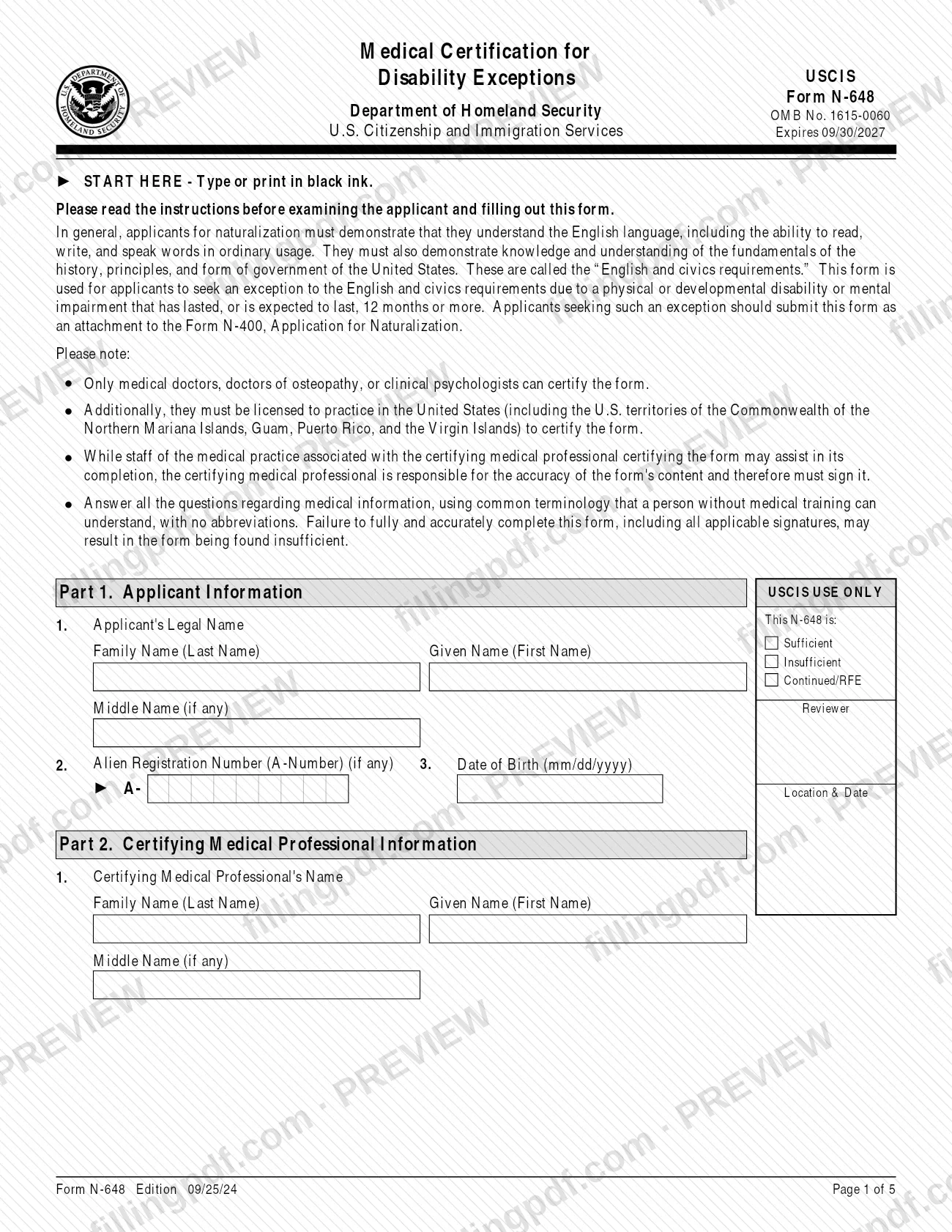
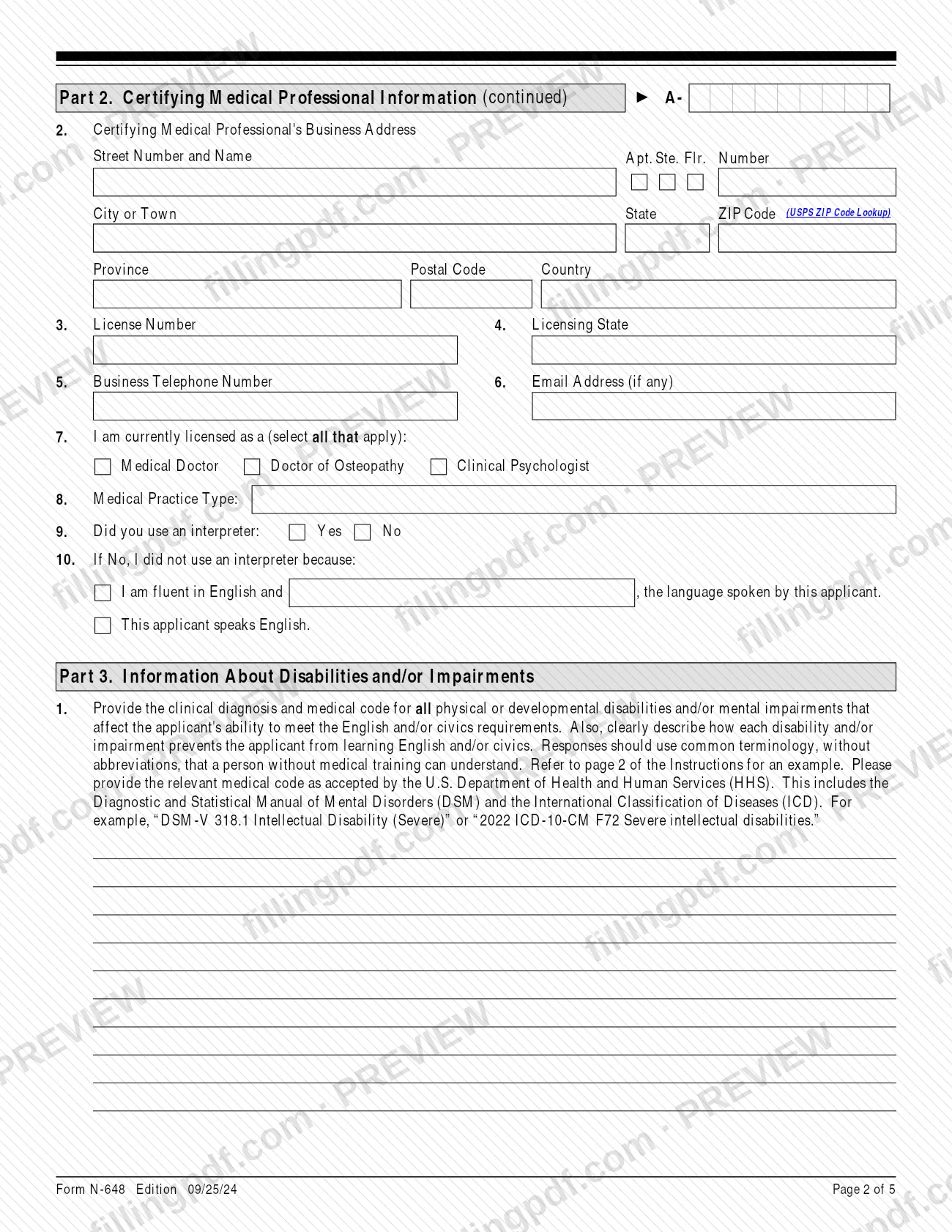
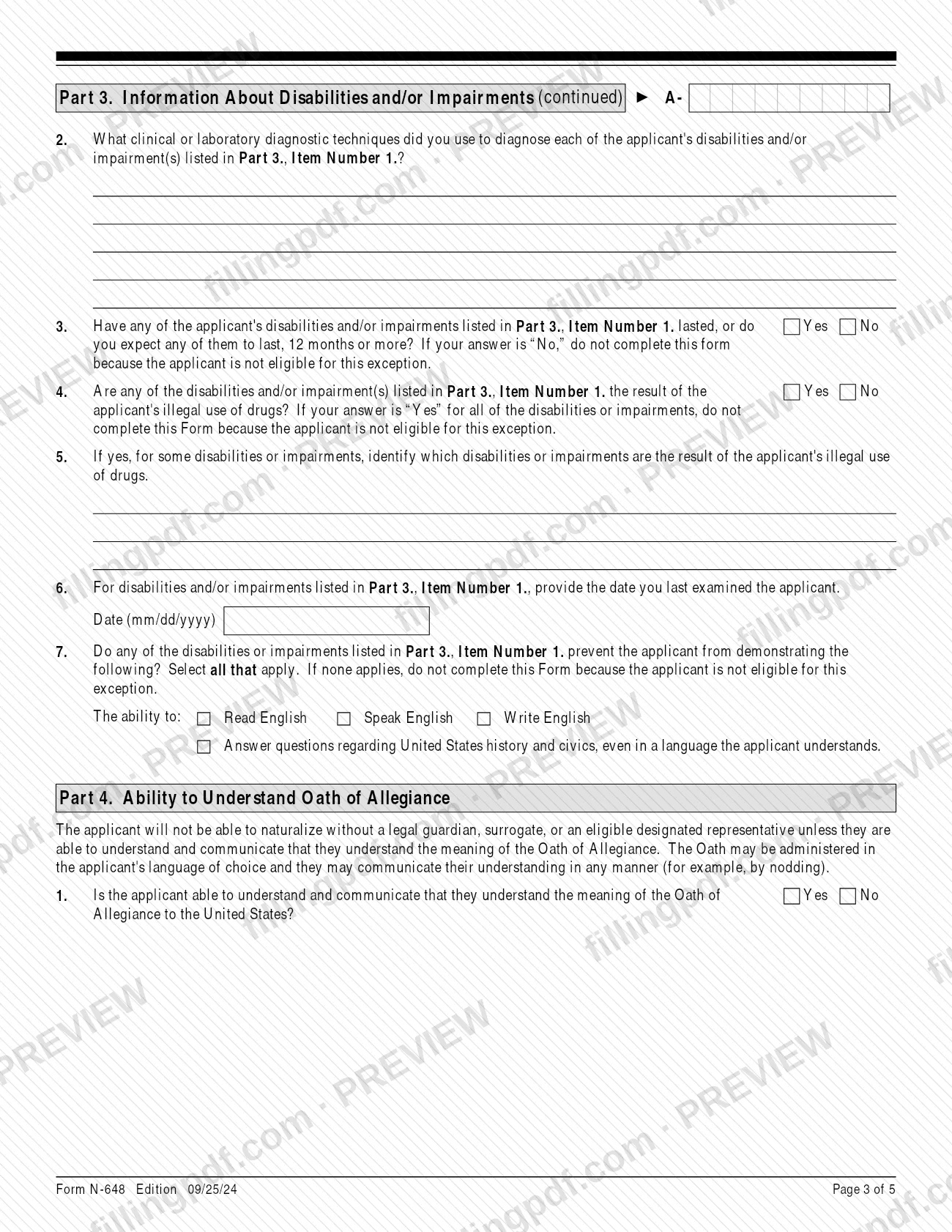
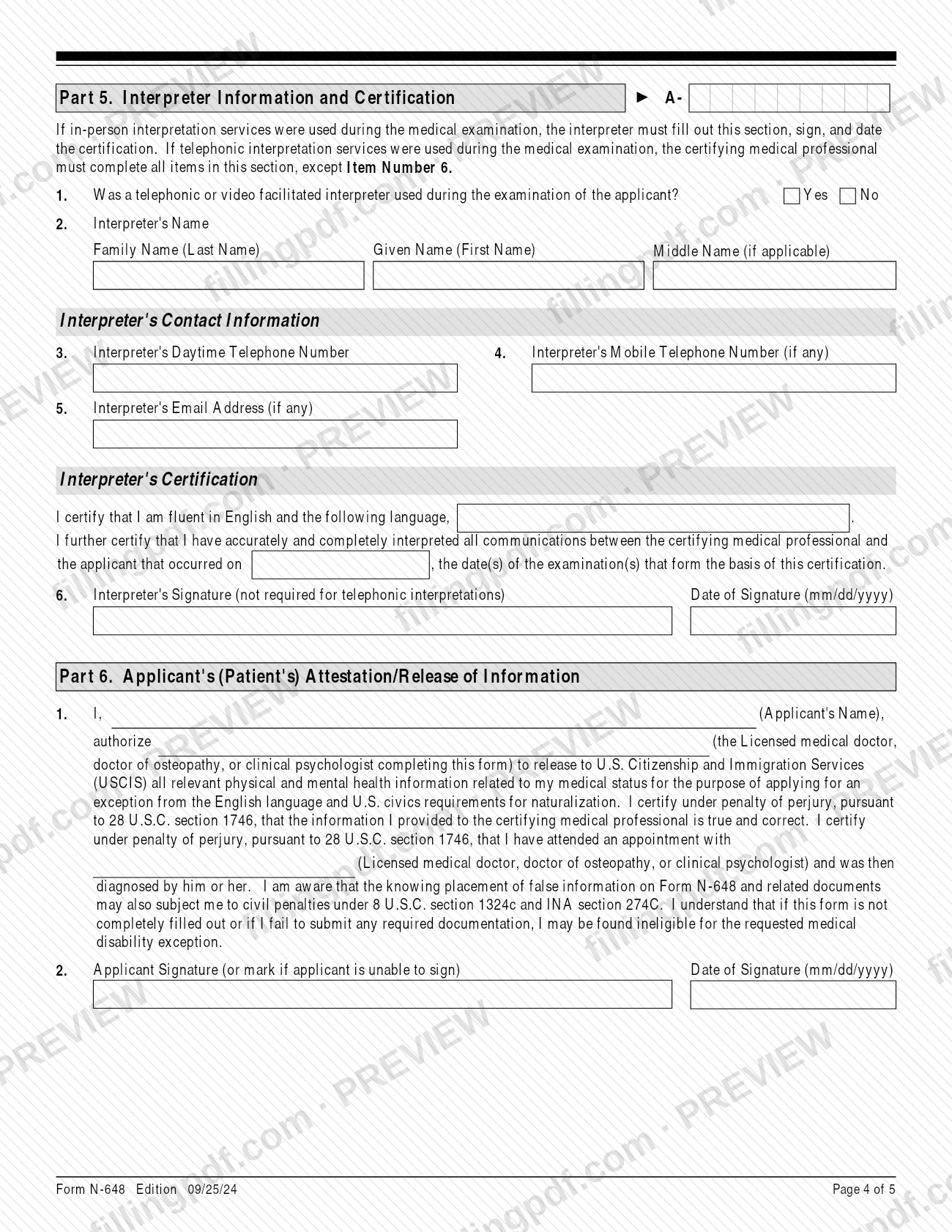
The n648 form, officially Form N-648, Medical Certification for Disability Exceptions, is the U.S. Citizenship and Immigration Services (USCIS) form a licensed medical professional completes to support a naturalization applicant's request for an exception to the English and civics requirements. It is used when a physical or developmental disability or mental impairment that has lasted, or is expected to last, 12 months or more prevents the applicant from meeting them. On this page you can fill out the form online on FillingPDF and download or print the completed PDF; USCIS publishes the original PDF and instructions at uscis.gov/n-648.
Last updated
What is N-648?
Form N-648, Medical Certification for Disability Exceptions, is the USCIS form on which a licensed medical professional certifies that an applicant's physical or developmental disability or mental impairment prevents them from meeting the English and civics requirements for naturalization.
Naturalization applicants generally must show they can read, write and speak ordinary English and know the fundamentals of U.S. history, principles and government. The N-648 supports an exception to those requirements. USCIS says an applicant is eligible if they cannot learn or demonstrate English and/or civics because of a disability or impairment that results from anatomical, physiological or psychological abnormalities, shown by medically acceptable clinical and laboratory diagnostic techniques, and that leaves functioning so impaired the applicant cannot show the required knowledge. The definition may differ from the one used for Social Security, Department of Veterans Affairs or state workers' compensation programs.
The form has seven parts: applicant information, the certifying medical professional, disabilities and impairments, the applicant's ability to understand the Oath of Allegiance, interpreter information, the applicant's attestation and release of information, and the medical professional's certification. It is an attachment to Form N-400, Application for Naturalization, not a stand-alone application. Applicants whose N-648 is found sufficient do not have to meet the English and/or civics requirements if they cannot because of the disability or impairment.
Who needs to file N-648?
Naturalization applicants who cannot meet the English and/or civics requirements because of a physical or developmental disability or mental impairment should submit Form N-648 with Form N-400. The certifying professional must be a medical doctor, doctor of osteopathy or clinical psychologist licensed to practice in the United States, including the Commonwealth of the Northern Mariana Islands, Guam, Puerto Rico and the Virgin Islands, and must have examined the applicant. Staff may help complete the form, but the certifying professional is responsible for its accuracy and must sign it.
Who should not submit it:
- Applicants who can meet the requirements with reasonable accommodations under the Rehabilitation Act of 1973, such as sign language interpreters, extended testing time or off-site examination. USCIS says to request accommodations at uscis.gov/accommodations or at 800-375-5283 (TTY 800-767-1833). If an accommodation is not enough, the applicant must file Form N-648.
- Applicants whose only reasons are illiteracy or advanced age; neither alone is valid.
- Applicants whose disability or impairment has not lasted and is not expected to last 12 months or more, or whose impairments all result from illegal drug use; the form says not to complete it in those cases.
A legal guardian, surrogate or designated representative may sign for an applicant who has been deemed legally incompetent.
When to file N-648
Submit Form N-648 when you file Form N-400, Application for Naturalization. The USCIS form page adds that you may also submit it with a completed N-400 or separately at a later date.
Timing of the medical certification matters: USCIS may not consider a Form N-648 if the certifying medical professional completed it more than 180 days before the N-400 was submitted. Have the examination and certification done close enough to your N-400 filing date to stay inside that window.
The form has no renewal cycle. After you submit it, USCIS checks it for completeness, may ask for more information or evidence, or may ask for originals of copies you sent. USCIS then notifies you of its decision in writing. If your answers do not explain how the disability affects the ability to learn English and civics, USCIS says it will ask for a revised or second Form N-648.
Documents you need
- Form N-400, Application for Naturalization: the N-648 is submitted as an attachment to it, with it or separately at a later date.
- Supporting medical diagnostic reports or records, optional: the certifying professional may attach them, but they cannot replace written answers to each question on the form.
- A full English translation of any foreign-language document you submit, with the translator's signed certification of completeness, accuracy and competence, printed name, signature date and contact information.
- Legible photocopies of any requested documents; USCIS may ask for originals later and returns them once it no longer needs them.
How to fill out N-648
Enter the applicant's information
Part 1: enter the applicant's legal name (Item Number 1.), A-Number if any (Item Number 2.) and date of birth in mm/dd/yyyy format (Item Number 3.). Leave the USCIS USE ONLY box blank.
Identify the certifying professional
Part 2, Items 1. to 6.: enter the certifying medical professional's name, business address, license number, licensing state, business telephone number and email address, if any.
Select license type and practice
Part 2, Item Number 7.: select Medical Doctor, Doctor of Osteopathy or Clinical Psychologist, as applicable. Item Number 8.: enter the medical practice type.
Answer the interpreter questions
Part 2, Item Number 9.: select Yes or No for whether an interpreter was used. If No, Item Number 10.: select whether you are fluent in English and the applicant's language, or the applicant speaks English.
Give diagnoses and how they limit learning
Part 3, Item Number 1.: list the clinical diagnosis and medical code (DSM or ICD) for each disability or impairment, and describe in common terms, without abbreviations, how each prevents learning English and/or civics.
Describe diagnostic methods and duration
Part 3, Item Number 2.: state the clinical or laboratory techniques used for each diagnosis. Item Number 3.: answer whether any has lasted, or is expected to last, 12 months or more; if No, do not complete the form.
Address drug use and last examination
Part 3, Items 4. and 5.: answer whether any impairment results from illegal drug use and, if only some do, identify them. Item Number 6.: enter the date you last examined the applicant (mm/dd/yyyy).
Select what the applicant cannot demonstrate
Part 3, Item Number 7.: select all that apply: read, speak or write English, or answer U.S. history and civics questions even in a language the applicant understands. If none applies, do not complete the form.
Answer the Oath of Allegiance question
Part 4, Item Number 1.: select Yes or No for whether the applicant can understand and communicate understanding of the Oath of Allegiance, which they may do in any manner, for example by nodding.
Complete the interpreter section
Part 5, only if an interpreter was used: answer Item Number 1. and enter the interpreter's name, contact details, language and examination date(s). An in-person interpreter signs and dates Item Number 6.; for telephonic interpretation, the professional completes all items except Item Number 6.
Have the applicant complete Part 6
Part 6: enter the applicant's name and the certifying professional's name in the attestation. The applicant signs and dates Item Number 2.; a legal guardian, surrogate or designated representative may sign for an applicant deemed legally incompetent.
Certify, sign and download the PDF
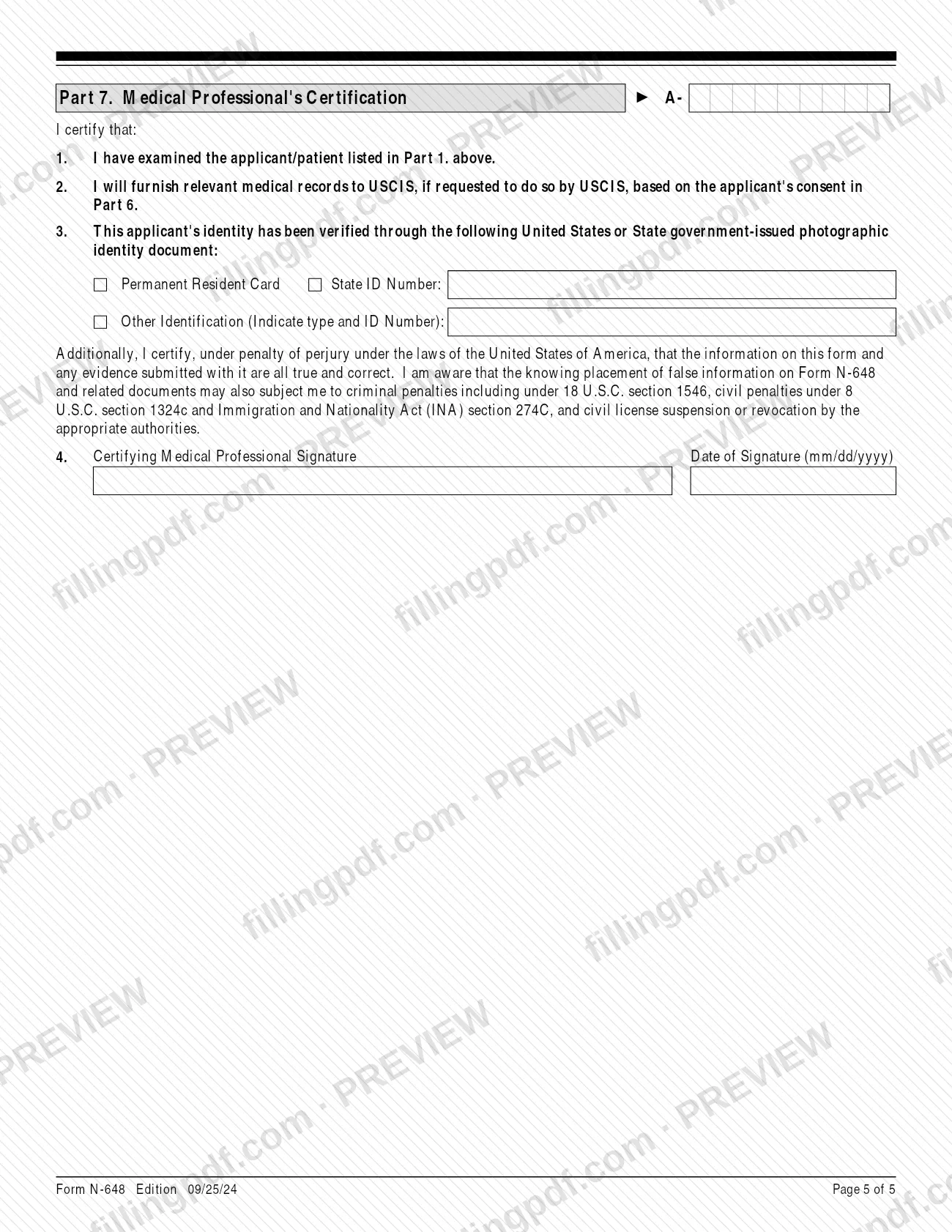
Part 7: the certifying professional checks the photo identity document used (Permanent Resident Card, State ID or other, with its number), then signs and dates Item Number 4. Review every part, then download or print the completed PDF from FillingPDF.
How to submit N-648
The certifying medical professional gives the completed form to the applicant, and the applicant submits it to USCIS with Form N-400, or separately later.
- With Form N-400 by mail: include the N-648 in the N-400 package. The N-648 instructions print no separate mailing address, so follow the filing location given for Form N-400. If you print the form, the edition date and page numbers must be visible at the bottom of every page, and all pages must come from the same edition; USCIS may reject the form if pages are missing or from a different edition.
- With Form N-400 filed electronically: the instructions say the N-648 may be uploaded as additional evidence.
- Separately, after the N-400: the USCIS form page allows this.
Signatures must be handwritten; USCIS does not accept a stamped or typewritten name. A photocopy, fax or scan of the original with the handwritten signature is valid for filing. Send legible photocopies of any attachments; any foreign-language document needs a full English translation with the translator's certification. The USCIS form page says no filing fee applies to Form N-648, although a medical professional may charge for the examination and for completing forms. Do not send the completed form to the Paperwork Reduction Act address printed in the instructions. FillingPDF lets you fill out and download the PDF; submission follows the USCIS channels above.
Common mistakes to avoid
- Leaving any question or item unanswered: USCIS will not accept an incomplete Form N-648 and may find it insufficient.
- Using medical abbreviations or technical terms in Part 3 instead of common terminology a person without medical training can understand.
- Describing the diagnosis in Part 3, Item Number 1., without explaining how each disability or impairment prevents the applicant from learning English and/or civics.
- Attaching medical records instead of answering each question; attachments may not take the place of written responses.
- Submitting the form unsigned, or with a stamped or typewritten name instead of a handwritten signature.
- Having the form certified by someone other than a licensed medical doctor, doctor of osteopathy or clinical psychologist.
- Filing the N-400 more than 180 days after the certifying professional completed the N-648.
- Completing the form when the disability has not lasted and is not expected to last 12 months or more, or when every impairment results from illegal drug use.
- Mailing a printout with pages missing or from different form editions, or with the edition date and page numbers cut off.
Frequently asked questions
What is the n648 form used for?
The n648 form, Form N-648, is the USCIS Medical Certification for Disability Exceptions. A licensed medical professional completes it to support a naturalization applicant's request for an exception to the English and civics requirements because of a physical or developmental disability or mental impairment.
Who can certify Form N-648?
Only a medical doctor, doctor of osteopathy or clinical psychologist licensed to practice in the United States, including the Northern Mariana Islands, Guam, Puerto Rico and the Virgin Islands. The professional must examine the applicant and sign the form. USCIS suggests checking the license with your state medical board.
Is there a filing fee for Form N-648?
The USCIS form page says there is no filing fee for Form N-648. A medical professional may charge for the medical examination and for filling out forms, so ask the professional about those charges directly.
When do I submit Form N-648?
Submit it when you file Form N-400, Application for Naturalization; USCIS also allows submitting it separately at a later date. USCIS may not consider an N-648 completed by the medical professional more than 180 days before you submit the N-400.
Can I fill out Form N-648 online?
You can complete the fillable PDF online on FillingPDF and download or print it. FillingPDF is independent of USCIS and does not file the form; the certifying professional must still sign it, and you submit it through USCIS channels.
Can a doctor complete Form N-648 by telehealth?
USCIS may accept a form certified after a telehealth examination if the professional is licensed and the examination was a synchronous, real-time interaction with the applicant. The USCIS form page adds that this applies where state law permits.
Can I use Form N-648 because I am illiterate or older?
No. USCIS states that illiteracy and advanced age alone are not valid reasons for an exception. The exception requires a physical or developmental disability or mental impairment that prevents learning or demonstrating English and/or civics.
What if the applicant cannot sign Form N-648?
An applicant who cannot sign may use a mark, as Part 6 allows. A legal guardian, surrogate or designated representative may sign for an applicant deemed legally incompetent. USCIS rejects unsigned requests, and stamped or typewritten names are not accepted.
What happens if Form N-648 is incomplete or unclear?
USCIS may find it insufficient. If your answers do not explain how the disability affects the ability to learn English and civics, USCIS says it will ask for a revised or second Form N-648 with the required information.
Ready to fill out N-648?
Fill out N-648 now