
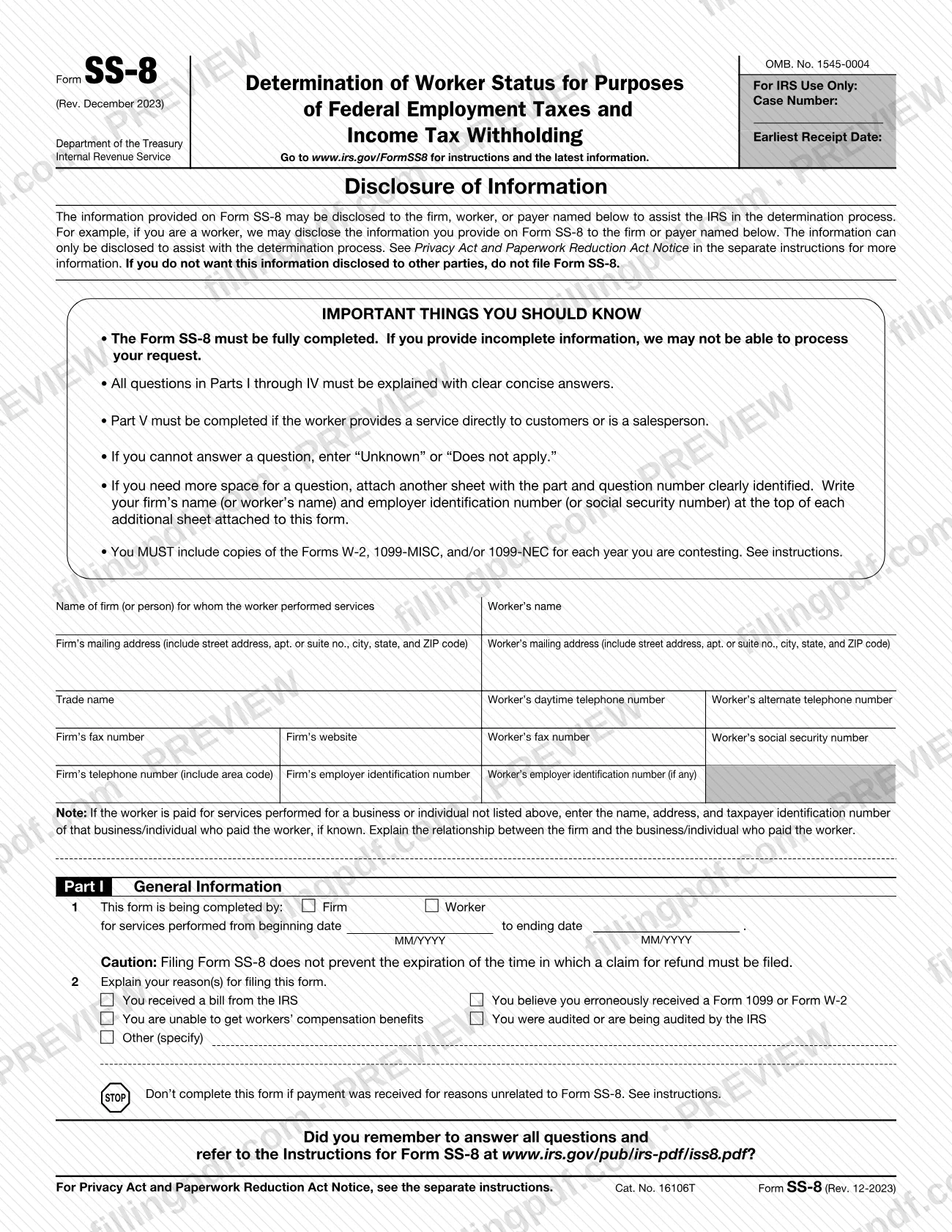
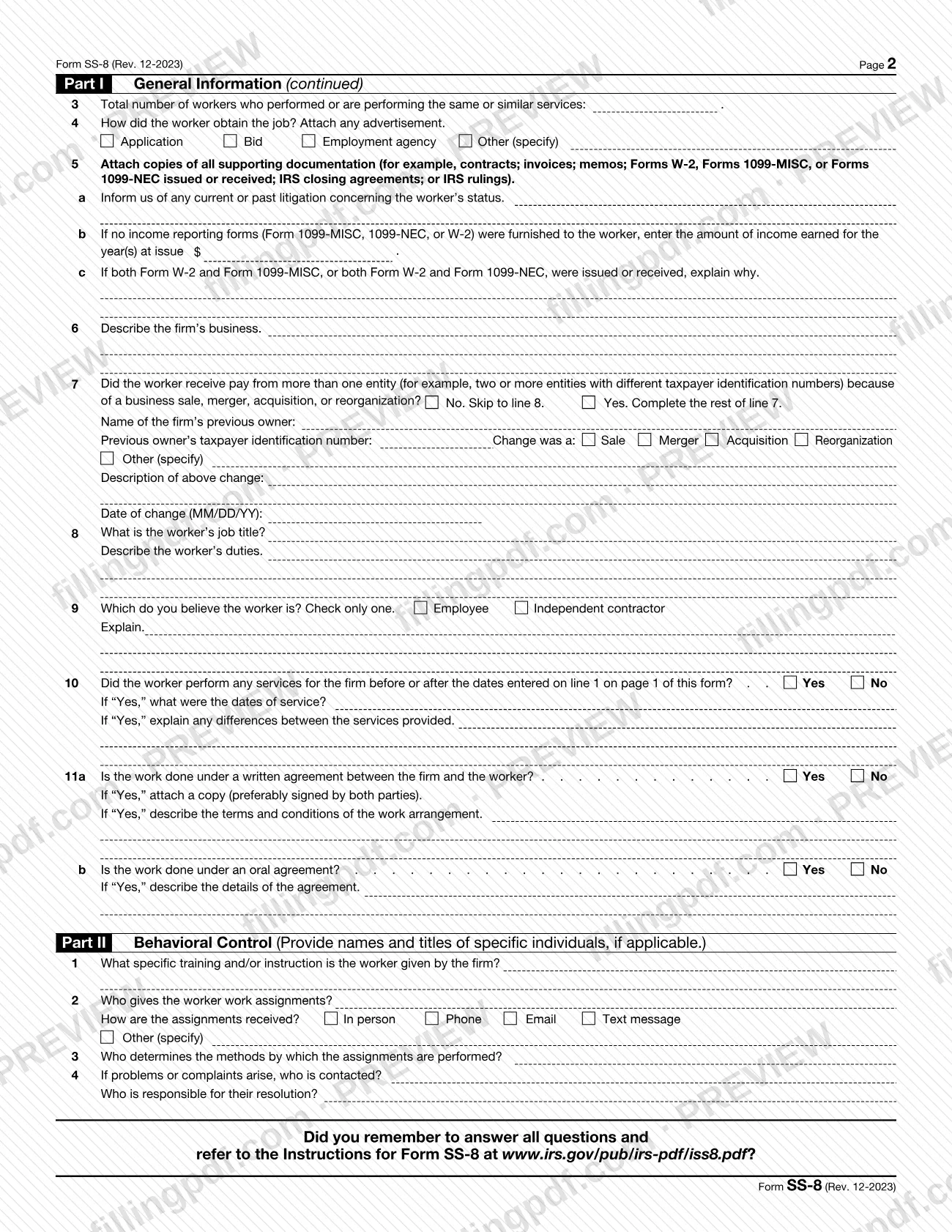
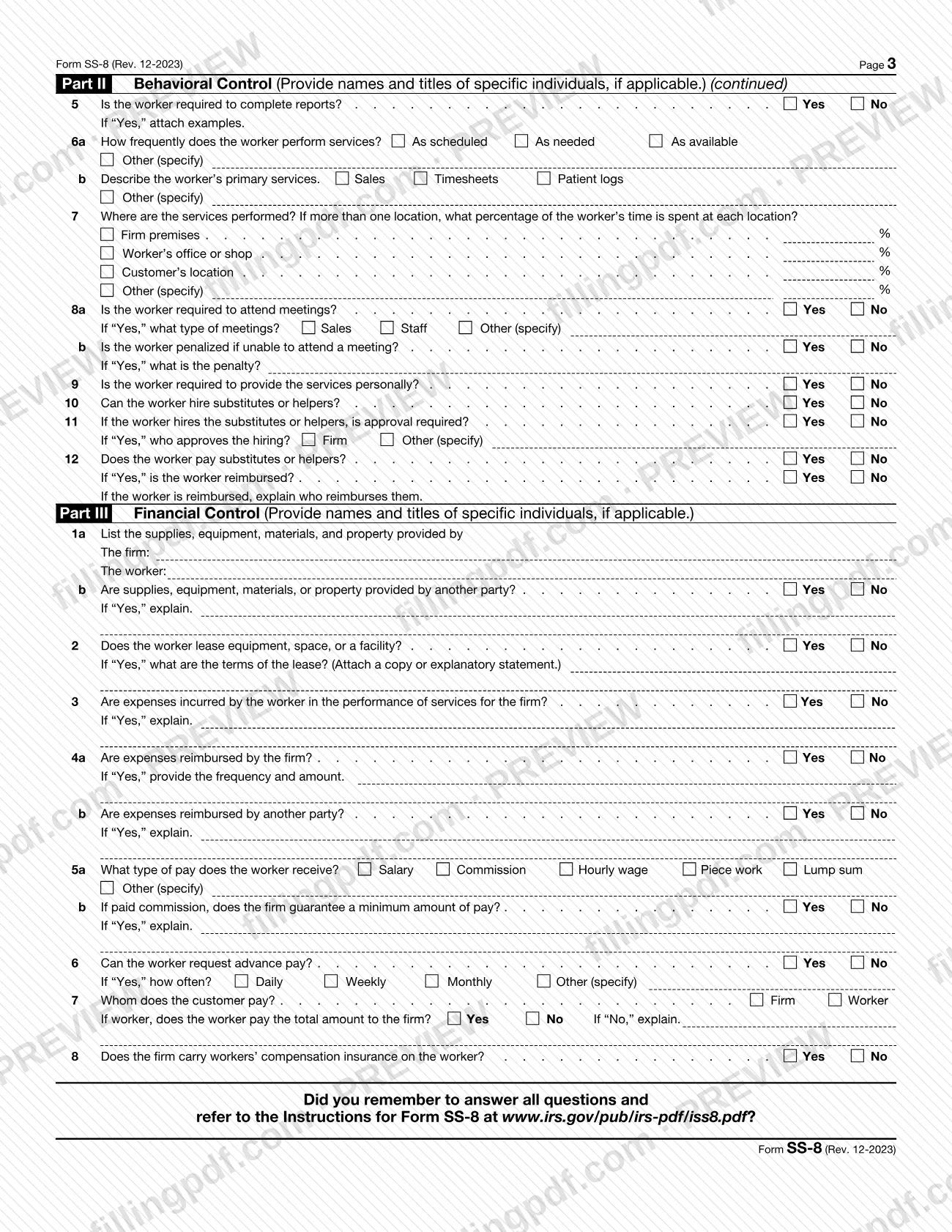
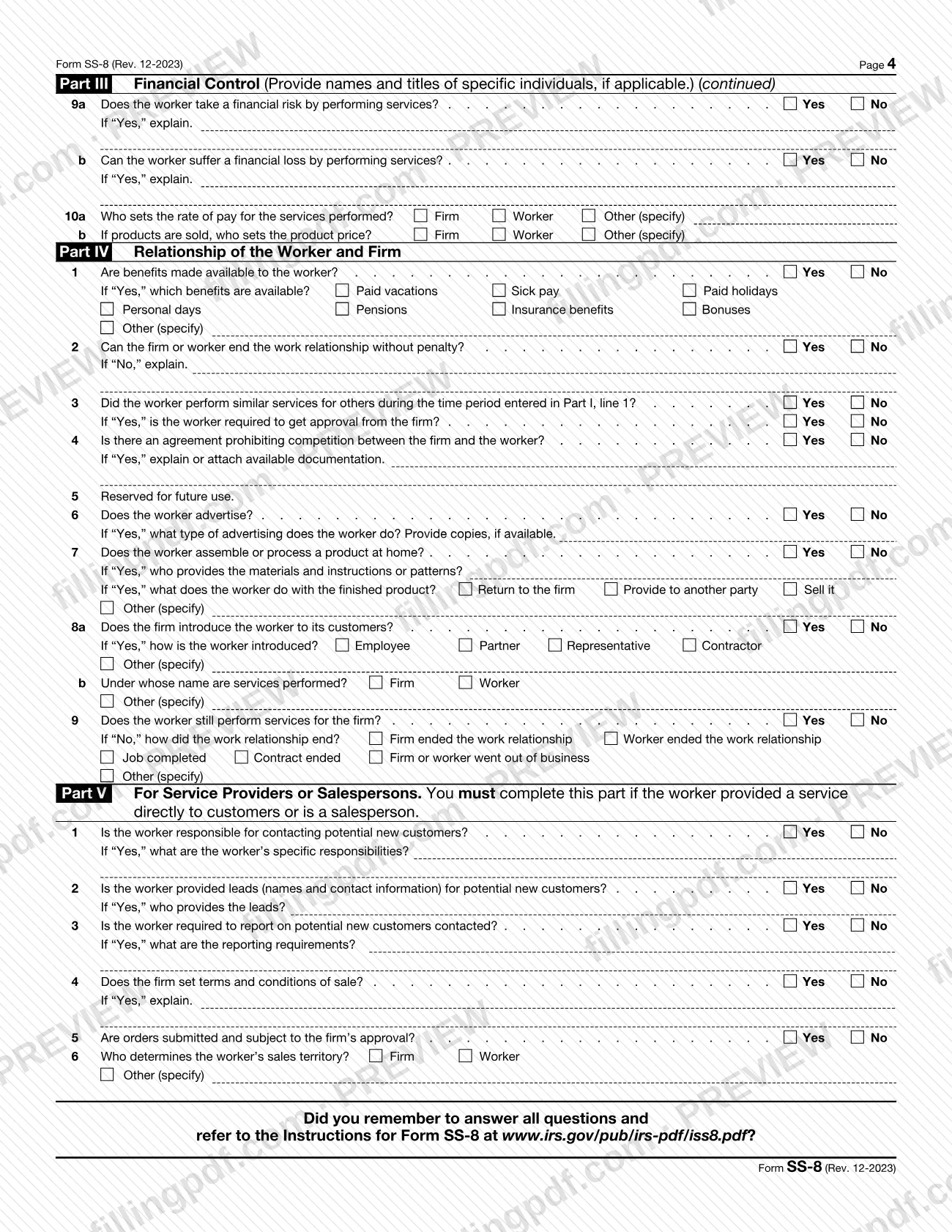
Form SS-8 is the Internal Revenue Service (IRS) request for a determination of worker status: it asks the IRS to decide whether a worker is an employee or an independent contractor for federal employment taxes and income tax withholding. Either the firm or the worker can file it. On FillingPDF you can fill out Form SS-8 online and download or print the completed PDF; the IRS publishes the original form and its instructions at irs.gov, and the request itself is mailed or faxed to the IRS.
Last updated
What is SS-8?
Form SS-8, Determination of Worker Status for Purposes of Federal Employment Taxes and Income Tax Withholding, is the IRS form that firms and workers file to request a determination of a worker's status under the common law rules.
Under those rules, according to the IRS instructions, a worker is generally an employee if the firm has the right to control and direct what will be done and how it will be done. The instructions point to Pub. 15-A, Employer's Supplemental Tax Guide, for how to tell an employee from an independent contractor.
The form has five parts: Part I, General Information; Part II, Behavioral Control; Part III, Financial Control; Part IV, Relationship of the Worker and Firm; and Part V, for service providers or salespersons. A technician at the IRS reviews the facts, applies the law and issues a decision. The IRS generally issues a formal determination to the firm or payer and sends a copy to the worker. In some cases it issues an information letter instead, which is advisory only and not binding on the IRS.
The IRS is clear about limits. Form SS-8 is not a claim for refund of social security and Medicare taxes or federal income tax withholding. It is not an examination (audit) of any return, and it does not consider relief under section 530 of the Revenue Act of 1978. The SS-8 unit does not handle supplemental wage issues.
Who needs to file SS-8?
Firms and workers may file Form SS-8 when they want the IRS to determine the worker's status for federal employment taxes and income tax withholding. Neither is required to request a determination. The form lists reasons for filing, such as receiving a bill from the IRS, believing you erroneously received a Form 1099 or Form W-2, being unable to get workers' compensation benefits, or being audited by the IRS.
- Workers: file a separate form for each firm. If the IRS finds you are an employee, you are responsible for filing an amended return for related corrections.
- Firms: a firm may request a determination for a specific worker or for a class of workers. For a class, complete the form for one worker in the class and attach a list of the names, addresses and SSNs (if available) of all workers potentially affected. For more than one class, file a separate form for each.
- Firms contacted by the IRS: if a worker requested a determination, the IRS sends you a form to complete.
The IRS does not issue a determination letter for proposed transactions, hypothetical situations, current worker classification litigation, business-to-business transactions, or state and local government workers who may be covered by a Section 218 Agreement. Only the Social Security Administration makes Section 218 Agreement determinations. A representative authorized on Form 2848 may act for you, but may not sign the form.
When to file SS-8
Form SS-8 has no fixed due date; file it when you want a status determination, and keep in mind that a determination can only be made for years with open statutes of limitations. If the statute of limitations on the return for a tax year has expired, the IRS will not issue a determination letter for that year.
Filing Form SS-8 does not stop the clock on a refund claim. Generally you must claim a credit or refund within 3 years of filing the original return or within 2 years of paying the tax, whichever is later. If the period for a year at issue has not expired, the IRS instructions say to file Form 1040-X as a protective claim, one for each year.
Do not delay your tax return or any payment while waiting for an answer. The IRS acknowledges receipt of the form, then reviews the case and may ask for more information. The instructions give no processing time.
Documents you need
- Copies of Forms W-2, 1099-MISC and/or 1099-NEC for each year you are contesting; the form says they must be included.
- If you cannot provide those forms: a letter with a breakdown of how much was earned for each year, with copies of checks, paystubs, bank statements and similar records.
- Copies of supporting documentation under Part I, line 5, such as contracts, invoices, memos, IRS closing agreements or IRS rulings, where they exist.
- Any advertisement through which the worker obtained the job (Part I, line 4).
- A copy of the written agreement, preferably signed by both parties, if the work is done under one (Part I, line 11a).
- Examples of reports, if the worker is required to complete reports (Part II, line 5).
- A copy or explanatory statement of the lease terms, if the worker leases equipment, space or a facility (Part III, line 2).
- Documentation for litigation, such as a complaint, first pleading or court docket, if you believe pending litigation does not involve worker classification or has been settled (Part I, line 5a).
- Additional sheets if you need more space, identifying the part and question number and showing the firm's or worker's name and EIN or SSN at the top.
- For a class of workers: a list with names, addresses and SSNs (if available) of all workers potentially affected.
- Form 2848 or Form 8821, if someone represents you; on line 3 enter "Employment Tax," "SS-8" and the related years.
How to fill out SS-8
Enter firm and worker details
On page 1, enter the firm's name, address, trade name, phone, fax, website and EIN, and the worker's name, address, phone numbers, SSN and EIN (if any). If a different business or individual paid the worker, enter its name, address and taxpayer identification number and explain its relationship to the firm.
Complete Part I, lines 1 and 2
On line 1, check whether the Firm or the Worker is completing the form and enter the beginning and ending dates of service in MM/YYYY format. On line 2, check your reason for filing or specify Other.
Answer Part I, lines 3 to 6
Enter the number of workers doing the same or similar services (line 3), how the worker got the job (line 4), and the supporting documents and any litigation or income details (line 5). Describe the firm's business on line 6.
Complete Part I, lines 7 to 9
On line 7, check No to skip to line 8, or give the previous owner details and the date of change (MM/DD/YY). On line 8 give the job title and duties; on line 9 check Employee or Independent contractor, not both, and explain.
Answer Part I, lines 10 and 11
State whether the worker performed services outside the dates on line 1 and any differences. For written or oral agreements (lines 11a and 11b), describe the terms and attach a copy of any written agreement.
Complete Part II, Behavioral Control
Answer lines 1 to 12 on training, who assigns and directs the work, reports, how often services are performed, location percentages, meetings, personal service, and substitutes or helpers. Give names and titles of specific individuals where applicable.
Complete Part III, Financial Control
Answer lines 1 to 10 on supplies and equipment, leases, expenses and reimbursement, type of pay, advances, who the customer pays, workers' compensation insurance, financial risk, and who sets pay rates and prices.
Complete Part IV, Relationship
Answer lines 1 to 9 on benefits, ending the relationship without penalty, work for others, non-compete agreements, advertising, home assembly, how the worker is introduced to customers and whether services continue. Line 5 is reserved; indicate any significant changes over the service term.
Complete Part V when it applies
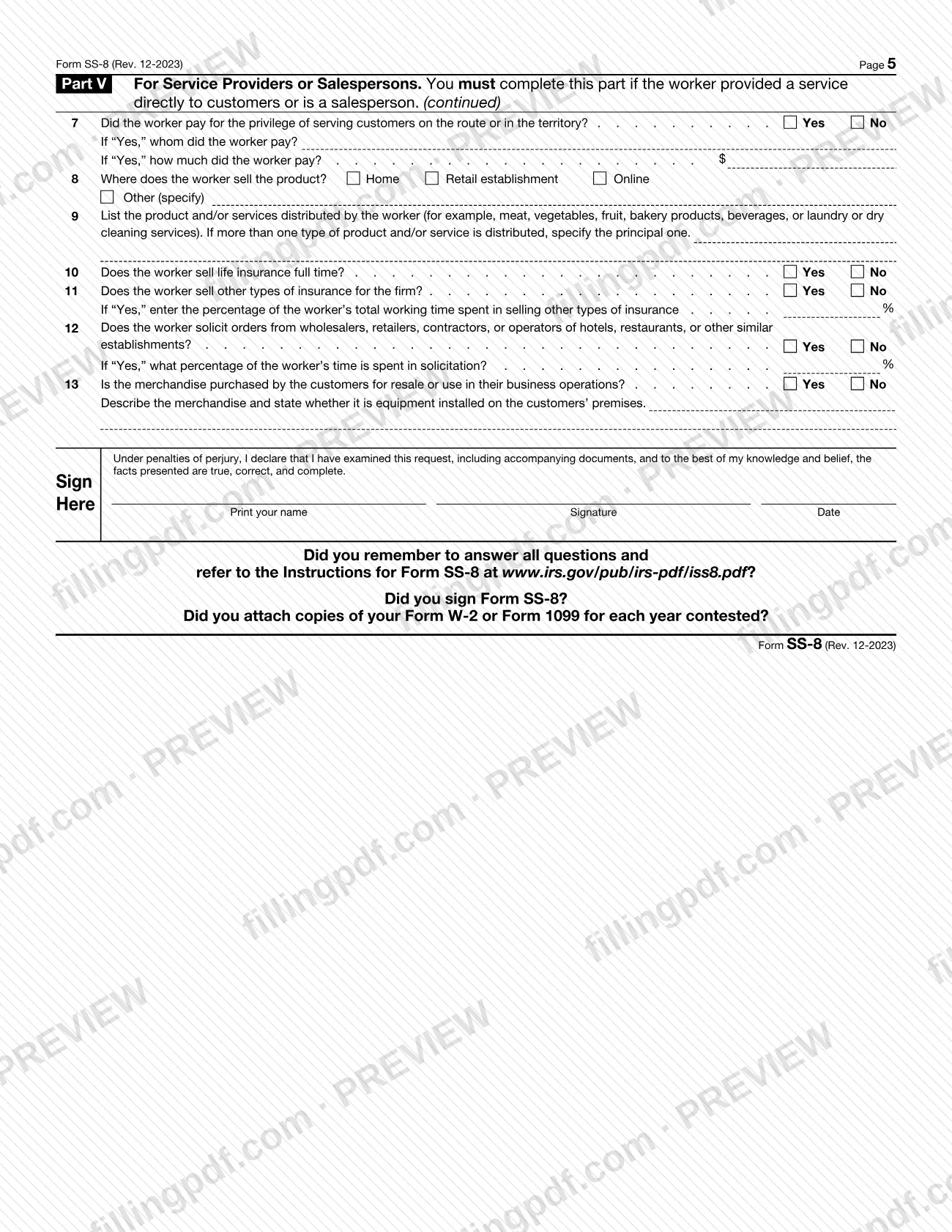
If the worker serves customers directly or is a salesperson, answer lines 1 to 13 on leads, customer contact, sales terms, territory, products and insurance sales. Otherwise it does not apply.
Attach documents and extra sheets
Attach the documents the questions request and copies of Forms W-2 or 1099 for each year contested. For extra space, add a sheet with the part and question number, plus the firm's or worker's name and EIN or SSN at the top.
Review, sign and download the PDF
Print your name, sign and date under the penalties of perjury statement; the taxpayer must sign. Check the checklist at the bottom, then download or print the completed PDF from FillingPDF and mail or fax it as described under How to submit.
How to submit SS-8
You can mail or fax the completed and signed Form SS-8 with its attachments. Do not submit it with your tax return, because that delays processing.
- By mail: Internal Revenue Service, Form SS-8 Determinations, P.O. Box 630, Stop 631, Holtsville, NY 11742-0630.
- By fax: 855-242-4481.
The original request should carry an original handwritten signature or an electronic signature, such as a faxed or digitally signed PDF. A stamped signature or a signature by your power of attorney representative is not accepted. A form that is incomplete or not properly signed and dated by the taxpayer is returned. There is no fee for requesting a determination. To get paper copies of the form, order them at IRS.gov/OrderForms or call 800-TAX-FORM (800-829-3676). FillingPDF lets you fill out and download the PDF; submission follows the channels above.
Common mistakes to avoid
- Leaving questions unanswered in Parts I through IV; the IRS cannot make a determination and incomplete forms are not processed. Enter "Unknown" or "Does not apply" instead.
- Skipping Part V when the worker provided a service directly to customers or is a salesperson, since it must then be completed.
- Not including copies of Forms W-2, 1099-MISC or 1099-NEC for each year contested.
- Signing with a stamped signature, or having a power of attorney representative sign; neither is accepted.
- Having the wrong person sign for an entity; a corporation's officer, or a trustee, general partner or member-manager with personal knowledge of the facts, must sign.
- Submitting Form SS-8 with your tax return instead of mailing or faxing it to the SS-8 unit, which delays processing.
- Filing one form for several firms, or for a class of workers without a list of the affected workers.
- Assuming the filing protects a refund claim; it does not prevent the time for filing a claim from expiring.
- Delaying your tax return or a payment while waiting for the determination.
- Filing when you do not want the information shared; it may be disclosed to the firm, worker or payer named on the form.
Frequently asked questions
What is Form SS-8 used for?
Form SS-8 is used to ask the IRS to decide whether a worker is an employee or an independent contractor under the common law rules, for federal employment taxes and income tax withholding. Either the firm or the worker can file it, and the IRS issues a determination or an information letter.
Who can file Form SS-8?
Both firms and workers can file it. Neither is required to. A firm may ask about one worker or a class of workers; a worker files a separate form for each firm. State or local government workers who may be covered by a Section 218 Agreement must contact the State Social Security Administrator instead.
Where do I mail or fax Form SS-8?
Mail it to Internal Revenue Service, Form SS-8 Determinations, P.O. Box 630, Stop 631, Holtsville, NY 11742-0630, or fax it to 855-242-4481. Do not send it with your tax return, because that delays processing.
Is there a fee to file Form SS-8?
No. The IRS instructions state that there is no fee for requesting a Form SS-8 determination letter.
Does filing Form SS-8 protect my refund claim?
No. Filing does not prevent the time for a refund claim from expiring. If the period for a year at issue has not expired, the instructions say to file Form 1040-X as a protective claim, with "Protective Claim" written at the top of page 1, one for each year.
Can I fill out Form SS-8 online?
Yes. You can fill out the PDF online on FillingPDF and download or print it. FillingPDF is an independent service and does not send the form to the IRS; you mail or fax the signed form yourself.
Can my representative sign Form SS-8 for me?
No. The taxpayer must sign and date the form; neither a stamped signature nor a power of attorney representative's signature is accepted. An authorized representative can act for you using Form 2848, but cannot sign the SS-8.
Can I send an electronic signature on Form SS-8?
Yes. The instructions say the request should include an original handwritten signature or an electronic signature, such as a faxed or digitally signed PDF. A stamped signature is not accepted.
What happens after I file Form SS-8?
The IRS acknowledges receipt and usually sends blank forms to the other parties. A technician reviews the facts, may ask for more information, and issues a determination to the firm or payer with a copy to the worker. The instructions give no processing time.
Ready to fill out SS-8?
Fill out SS-8 now