
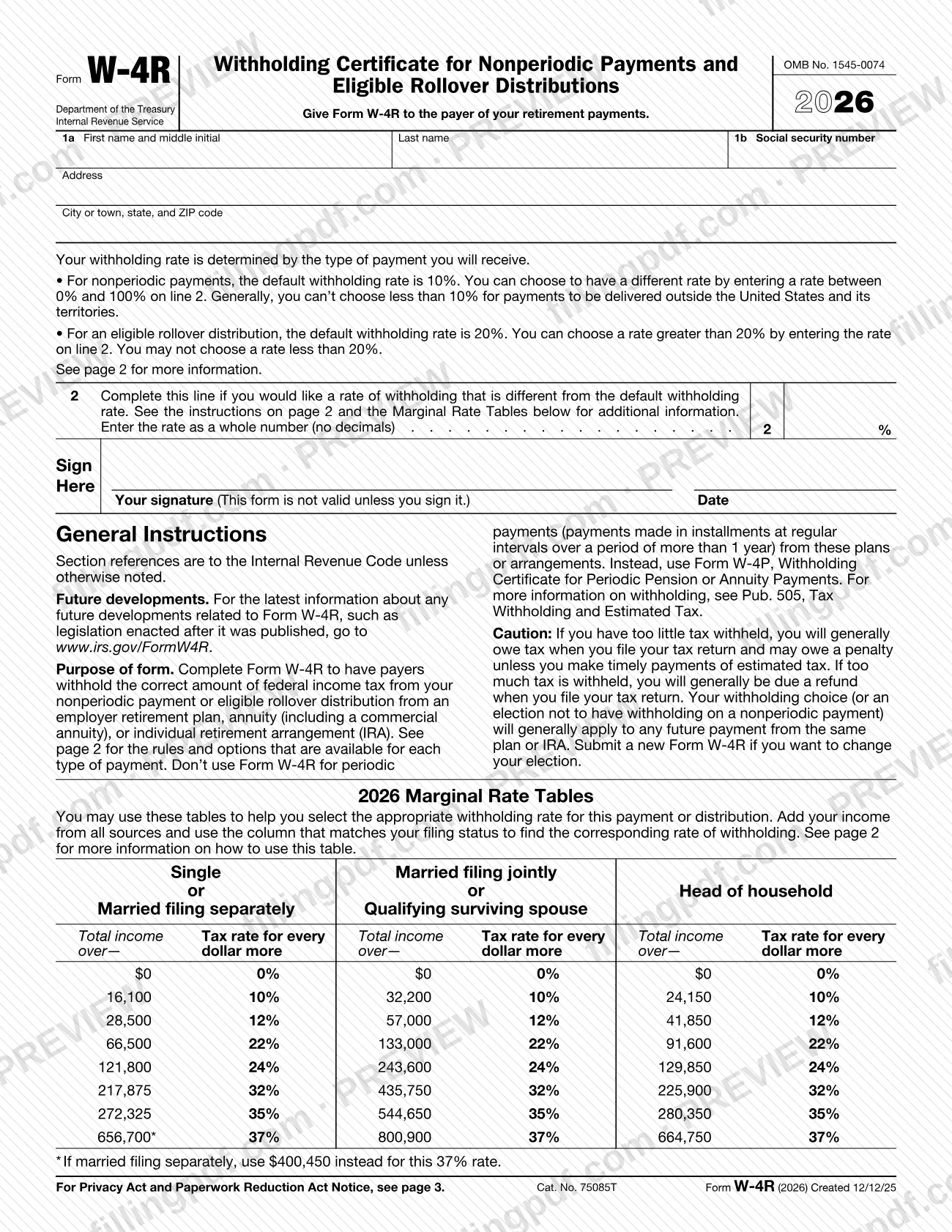

Form W-4R, Withholding Certificate for Nonperiodic Payments and Eligible Rollover Distributions, is the Internal Revenue Service (IRS) form that people search for as w4r. You complete it to tell the payer of your retirement payments how much federal income tax to withhold from a lump-sum style payment or a rollover distribution. It applies to payments from an employer retirement plan, an annuity, or an individual retirement arrangement (IRA). On FillingPDF you can fill out the 2026 form online and download or print the completed PDF; you then give it to your payer, as the form directs.
Last updated
What is W-4R?
Form W-4R, Withholding Certificate for Nonperiodic Payments and Eligible Rollover Distributions, is the Internal Revenue Service (IRS) form you complete so a payer withholds the correct amount of federal income tax from a nonperiodic payment or an eligible rollover distribution from an employer retirement plan, annuity (including a commercial annuity), or individual retirement arrangement (IRA).
The form has one decision: line 2, where you enter a withholding rate as a whole number with no decimals. If you leave line 2 blank, default rates apply. For nonperiodic payments the default is 10%, and you may enter any rate from 0% to 100%, although you generally cannot choose less than 10% for payments delivered outside the United States and its territories. For an eligible rollover distribution the default is 20%; you may enter a higher rate but not a lower one.
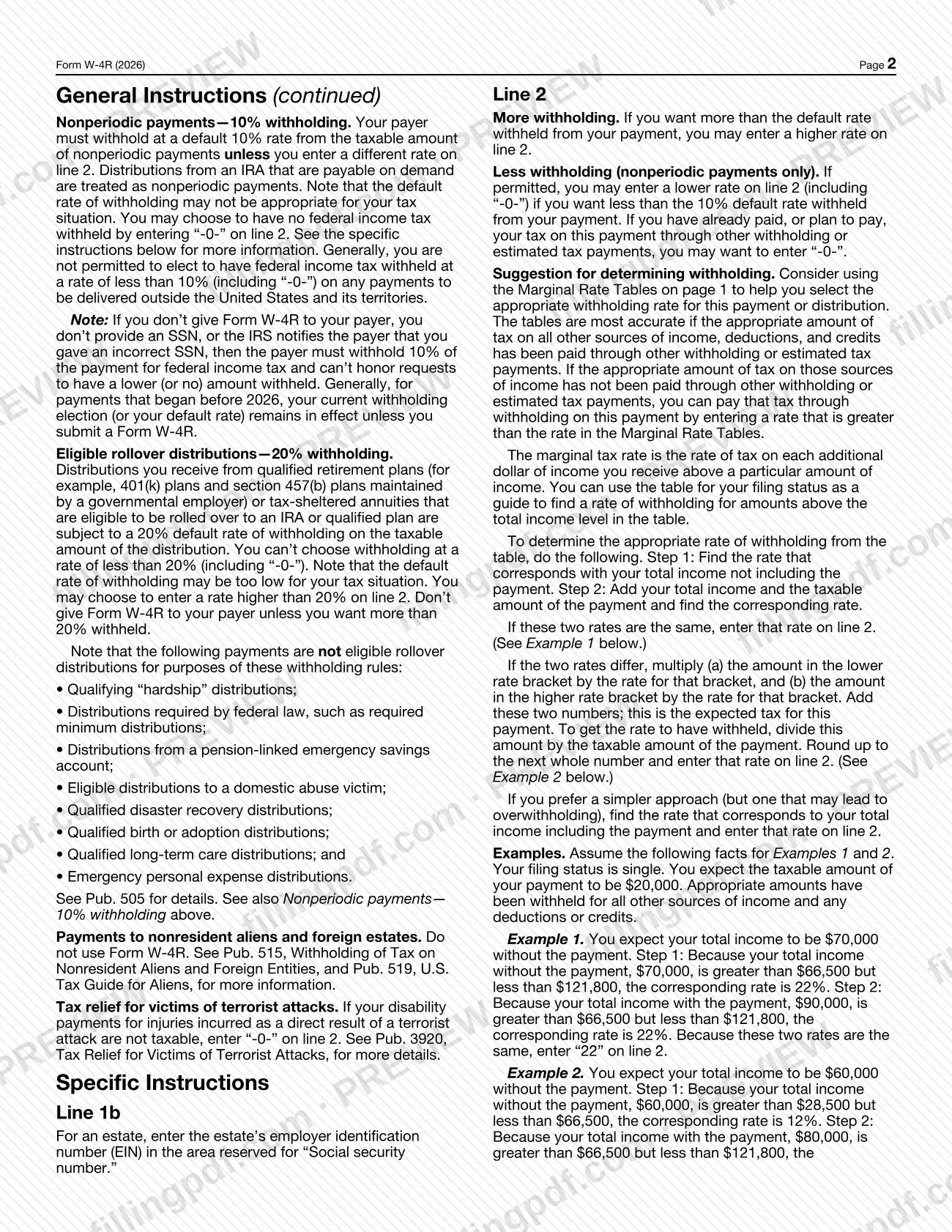
Page 1 also prints Marginal Rate Tables for 2026 by filing status, which you can use to pick a rate, and page 2 walks through two worked examples. Distributions from an IRA that are payable on demand are treated as nonperiodic payments.
Form W-4R is not for periodic payments, meaning payments made in installments at regular intervals over a period of more than 1 year. For those, the IRS instructions point to Form W-4P, Withholding Certificate for Periodic Pension or Annuity Payments. The form is also not for payments to nonresident aliens and foreign estates.
Who needs to file W-4R?
People who receive a nonperiodic payment or an eligible rollover distribution from an employer retirement plan, annuity (including a commercial annuity), or IRA use Form W-4R when they want a withholding rate different from the default.
- Nonperiodic payments: the payer withholds at a default 10% unless you enter another rate on line 2. Give the form to your payer if you want more withheld, or, where permitted, less, including "-0-".
- Eligible rollover distributions: the default is 20%. Give the form to your payer only if you want more than 20% withheld; you cannot choose less.
- Estates: enter the estate's employer identification number (EIN) in the area reserved for the Social security number on line 1b.
Do not use Form W-4R for periodic payments; use Form W-4P instead. Do not use it for payments to nonresident aliens and foreign estates; the instructions refer to Pub. 515 and Pub. 519. Qualifying "hardship" distributions, required minimum distributions and several other payments listed in the instructions (such as qualified disaster recovery distributions and qualified birth or adoption distributions) are not eligible rollover distributions for these rules. Details are in Pub. 505.
If you give no form, the default rate applies.
When to file W-4R
Give Form W-4R to your payer when you want a withholding rate other than the default on a nonperiodic payment or an eligible rollover distribution. The form prints no due date of its own.
Your choice, or an election not to have withholding on a nonperiodic payment, generally applies to any future payment from the same plan or IRA, so you submit a new Form W-4R only when you want to change it. For payments that began before 2026, your current withholding election (or default rate) remains in effect unless you submit a Form W-4R.
If you don't give the form to your payer, don't provide a Social Security number (SSN), or the IRS notifies the payer that the SSN is incorrect, the payer must withhold 10% of a nonperiodic payment and can't honor requests for a lower or no amount.
How to fill out W-4R
Identify your type of payment
Your withholding rate depends on the payment: a nonperiodic payment (default 10%) or an eligible rollover distribution (default 20%). Periodic payments use Form W-4P, not this form.
Decide whether to change the default
If the default rate suits you, you may not need to give the form at all; for a rollover, give it only if you want more than 20% withheld. Complete the form to choose a different rate.
Enter your name on line 1a
Write your first name and middle initial, and your last name.
Enter your SSN or EIN on line 1b
Enter your Social security number. For an estate, enter the estate's employer identification number (EIN) in that same area.
Enter your address
Write your street address, then city or town, state, and ZIP code.
Use the Marginal Rate Tables
Find the rate for your total income without the payment, then for your total income with the taxable amount of the payment, using the column for your filing status. If both rates match, use that rate; if they differ, follow the weighted calculation in the instructions.
Enter your rate on line 2
Enter the rate as a whole number with no decimals. Enter a higher rate for more withholding; for a nonperiodic payment, where permitted, enter a lower rate or "-0-" for less. Leave line 2 blank to keep the default.
Sign and date the form
Sign and date at the bottom of page 1. The form is not valid without your signature.
Review and download the completed PDF
Check the name, SSN or EIN and line 2 rate, then download or print the completed PDF from FillingPDF and give it to your payer as described under How to submit.
How to submit W-4R
Form W-4R goes to the payer of your retirement payments, not to a tax return. The form states: "Give Form W-4R to the payer of your retirement payments."
- To your payer: give the signed form to the plan administrator, annuity provider or IRA custodian that will make the payment. The form is not valid unless you sign it.
- Substitute or telephonic submissions: the IRS agency page for Form W-4R lists guidance titled "Additional Guidance for Substitute and Telephonic Submissions of Forms W-4P and W-4R" (dated 01-SEPT-2022). Ask your payer which of its own channels it accepts.
The form prints no mailing address or fee. Keep a copy for your records; the instructions note that your choice generally applies to future payments from the same plan or IRA. FillingPDF lets you fill out and download the PDF; submission follows the channels above.
Common mistakes to avoid
- Not signing the form: the form says it is not valid unless you sign it.
- Entering a rate below 20% for an eligible rollover distribution, including "-0-"; you may only choose a higher rate.
- Giving Form W-4R to your payer for a rollover when you are fine with the 20% default; the instructions say to give it only if you want more than 20% withheld.
- Entering a decimal on line 2; the rate must be a whole number, and the instructions round the computed rate up to the next whole number.
- Using Form W-4R for periodic payments made at regular intervals over more than 1 year; use Form W-4P instead.
- Using Form W-4R for payments to nonresident aliens or foreign estates; the instructions send you to Pub. 515 and Pub. 519.
- Choosing less than 10% for a nonperiodic payment delivered outside the United States and its territories; this is generally not permitted.
- Leaving out your SSN: the payer must then withhold 10% and can't honor a request for less.
- Entering an estate's EIN anywhere other than the Social security number area on line 1b.
Frequently asked questions
What is Form W-4R used for?
Form W-4R tells the payer of your retirement payments how much federal income tax to withhold from a nonperiodic payment or an eligible rollover distribution. It covers employer retirement plans, annuities (including commercial annuities) and IRAs. You enter your chosen rate on line 2.
What is the w4r form and is it the same as Form W-4R?
Yes. People search for it as w4r, w-4r or w4r form, but the printed name is Form W-4R, Withholding Certificate for Nonperiodic Payments and Eligible Rollover Distributions, issued by the IRS. The version on this page is the 2026 edition.
What is the difference between Form W-4R and Form W-4P?
Form W-4R is for nonperiodic payments and eligible rollover distributions. Form W-4P, Withholding Certificate for Periodic Pension or Annuity Payments, is for periodic payments made in installments at regular intervals over more than 1 year. Don't use W-4R for periodic payments.
What is the default withholding rate on Form W-4R?
The default is 10% for nonperiodic payments and 20% for eligible rollover distributions. You can enter a higher rate on line 2 for either. For nonperiodic payments you may enter a lower rate, including "-0-", if permitted; you cannot go below 20% on a rollover.
Can I choose no withholding on Form W-4R?
Only for a nonperiodic payment, and only where permitted: enter "-0-" on line 2. You can't choose less than 20% (including "-0-") on an eligible rollover distribution, and generally can't choose less than 10% on payments delivered outside the United States and its territories.
Where do I send Form W-4R?
Give it to the payer of your retirement payments, such as the plan administrator, annuity provider or IRA custodian. The form prints no mailing address and is not sent with a tax return. Ask the payer about substitute or telephonic submissions.
What happens if I don't give my payer a Form W-4R?
The payer withholds at the default rate. The instructions also say that if you don't give the form, don't provide an SSN, or the IRS tells the payer your SSN is wrong, the payer must withhold 10% of a nonperiodic payment and can't honor requests for less.
Do I need to submit a new W-4R for every payment?
No. Your withholding choice, or an election not to have withholding on a nonperiodic payment, generally applies to any future payment from the same plan or IRA. Submit a new Form W-4R only if you want to change your election.
Can I fill out Form W-4R online on FillingPDF?
Yes. You can fill out the fillable PDF online on FillingPDF and download or print it. FillingPDF is an independent service and does not send the form to your payer or the IRS; you deliver it to your payer yourself.
Ready to fill out W-4R?
Fill out W-4R now