
Form W-9 is an IRS document used by U.S. persons, including U.S. resident aliens, to furnish their taxpayer identification number (TIN) and make applicable certifications to a person or business that needs it for information reporting. The March 2024 revision contains lines 1–7, Part I for the TIN, and Part II for certification. Specific rules apply to sole proprietors, disregarded entities, partnerships, certain foreign ownership situations, and some types of payments. This FillingPDF page brings together the official form, its instructions, and practical guidance; it is not an IRS website or a filing service.
Last updated
What is W-9?
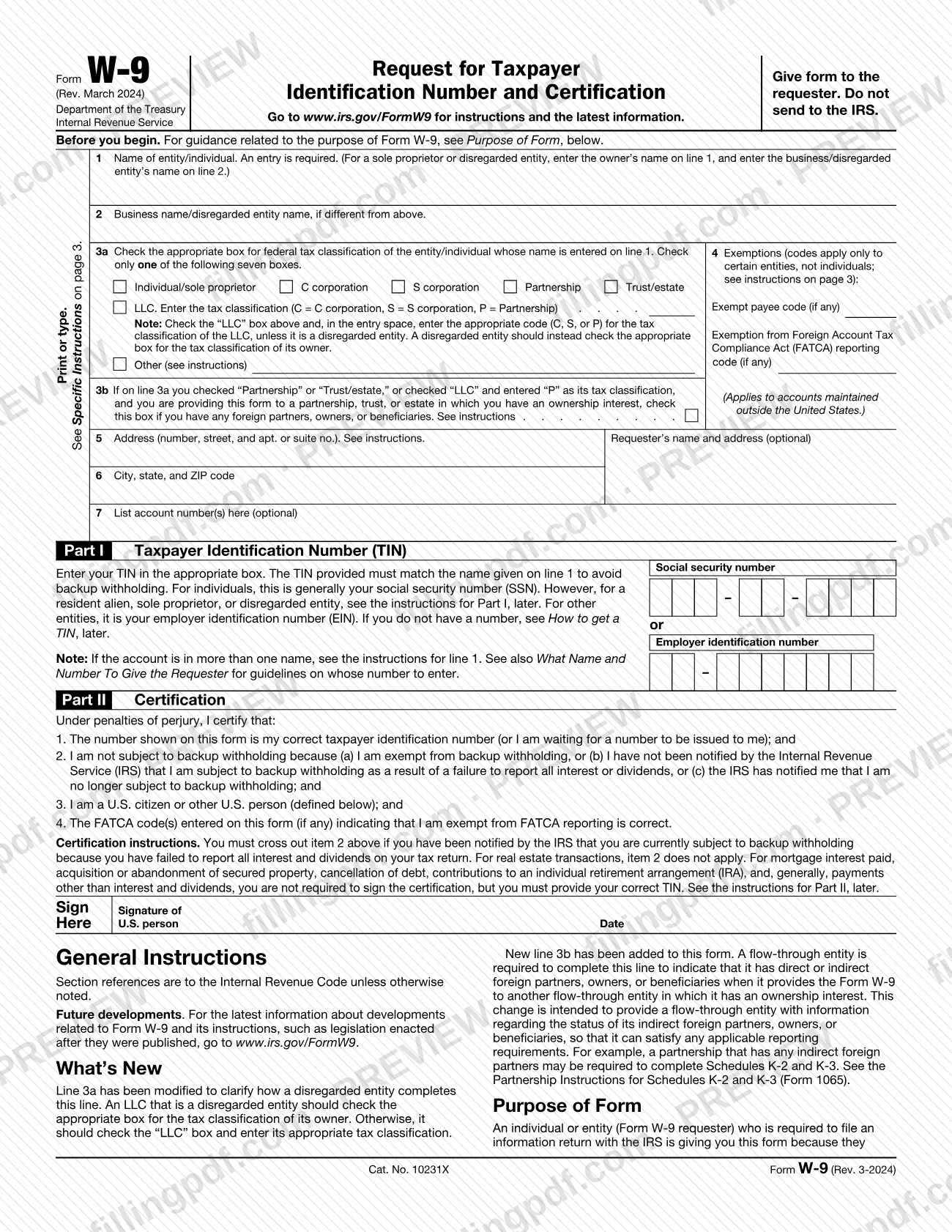
Form W-9, Request for Taxpayer Identification Number and Certification, enables a U.S. person to give the correct TIN (such as an SSN, ITIN, ATIN, or EIN, as applicable) to a requester who may have to report payments or other transactions to the IRS. Reporting examples include nonemployee compensation (Form 1099-NEC), interest (1099-INT), dividends (1099-DIV), certain real estate transactions (1099-S), and certain mortgage interest (1098). Form W-9 itself is not sent to the IRS; the requester uses the information for applicable information returns. The March 2024 version clarified LLC classification on line 3a and added line 3b for foreign partners, owners, or beneficiaries in specific pass-through situations. The form includes certification statements on TIN accuracy, backup withholding, U.S. status, and any applicable FATCA exemption code.
Who needs to file W-9?
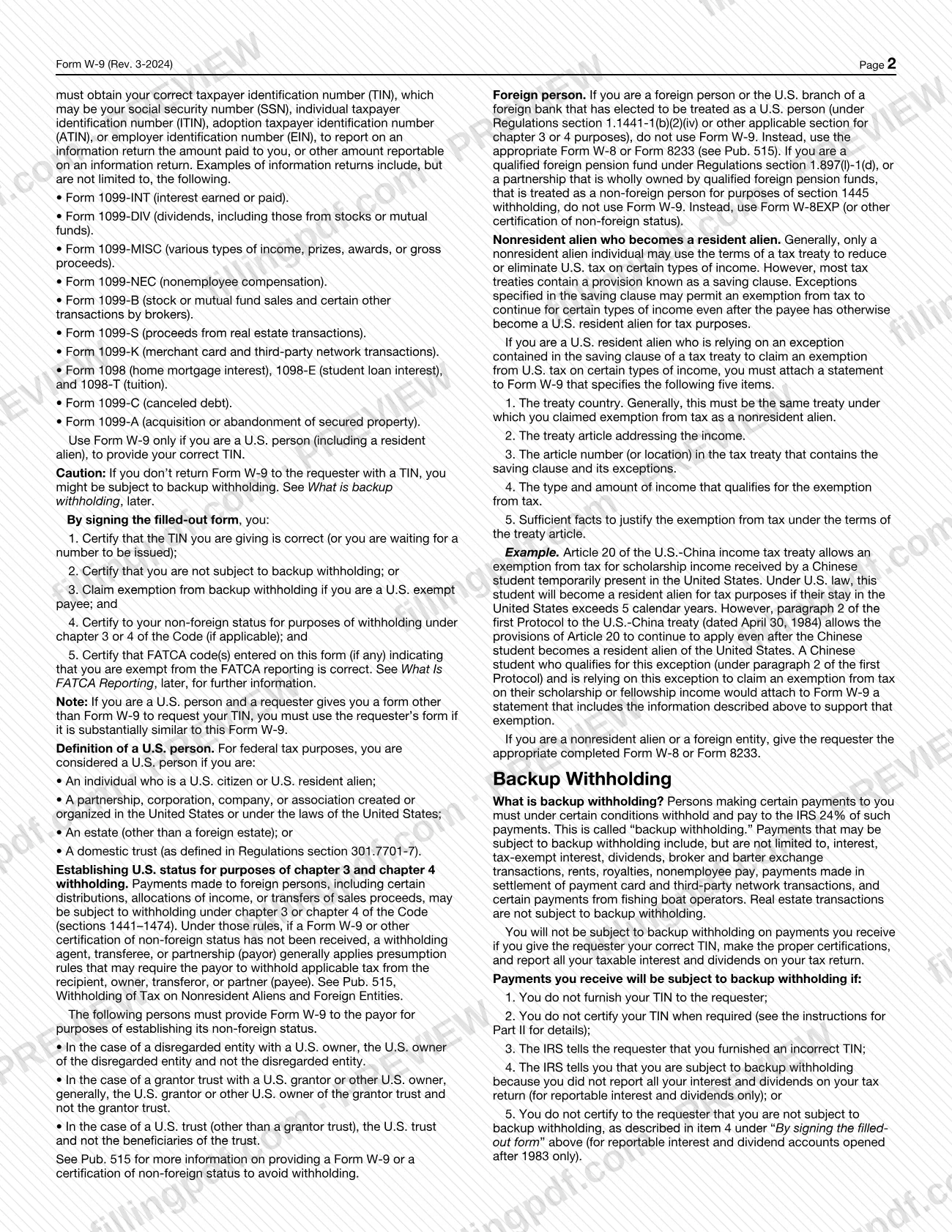
U.S. persons, including citizens, resident aliens, and U.S.-organized entities, may be asked by someone required to file an information return to provide Form W-9. Examples include independent contractors, recipients of reportable interest or dividends, and businesses receiving reportable payments; whether a particular person must provide it depends on the payment and reporting context. A sole proprietor generally provides the individual name on line 1. A disregarded entity generally reports its owner on line 1 and the disregarded entity name on line 2; its tax classification follows the owner. A nonresident alien or foreign entity generally should provide the appropriate Form W-8 or Form 8233 instead, not Form W-9. Special rules apply to certain U.S. resident aliens relying on treaty saving-clause exceptions.
When to file W-9
The IRS Form W-9 instructions do not specify a single annual filing deadline for delivering the form. Give a properly completed W-9 when a requester needs your TIN and certifications for an applicable information-reporting relationship. The IRS directs you to supply a new Form W-9 when the name or TIN changes for the account and updated information in specified circumstances when an exempt-payee status changes. The requester, not the IRS, receives the form. Do not borrow tax-return filing deadlines or business-registration deadlines as a W-9 due date.
Documents you need
- Only when an applicable U.S. resident alien claims a treaty saving-clause exception: attach the statement described in the IRS instructions identifying the treaty country and article, saving-clause provision, type and amount of income, and supporting facts.
How to fill out W-9
Confirm Form W-9 is appropriate
Use Form W-9 if you are a U.S. person (including a resident alien) providing your TIN to a requester. A nonresident alien or foreign entity generally uses the applicable Form W-8 or Form 8233 instead.
Complete line 1: legal name
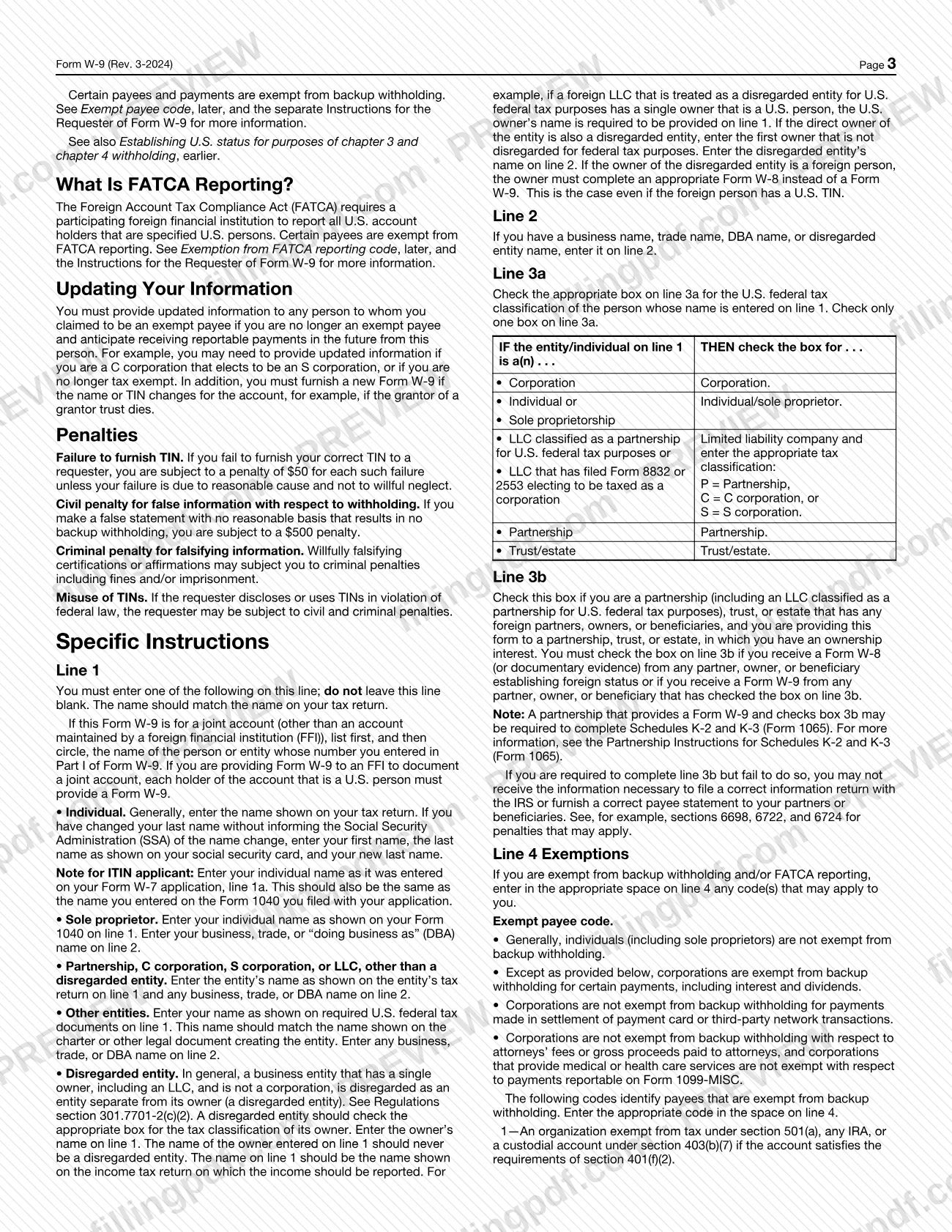
Enter the name that should match the relevant tax return and taxpayer identification number. Sole proprietors and disregarded entities generally enter the individual or owner name, not the disregarded business name.
Complete line 2: business name
If different from line 1, enter the business, trade, DBA, or disregarded entity name. Leave this line blank if there is no different business name to report.
Select line 3a classification
Check only one applicable U.S. federal tax classification for the person or entity on line 1. A disregarded entity checks the tax classification of its owner; an LLC that is not disregarded selects LLC and enters C, S, or P, as applicable.
Review line 3b foreign ownership
Complete line 3b only under its stated conditions: for the relevant partnership, trust, estate, or partnership-classified LLC providing this W-9 to another pass-through entity in which it has an ownership interest, indicate whether foreign partners, owners, or beneficiaries are present.
Check line 4 exemptions
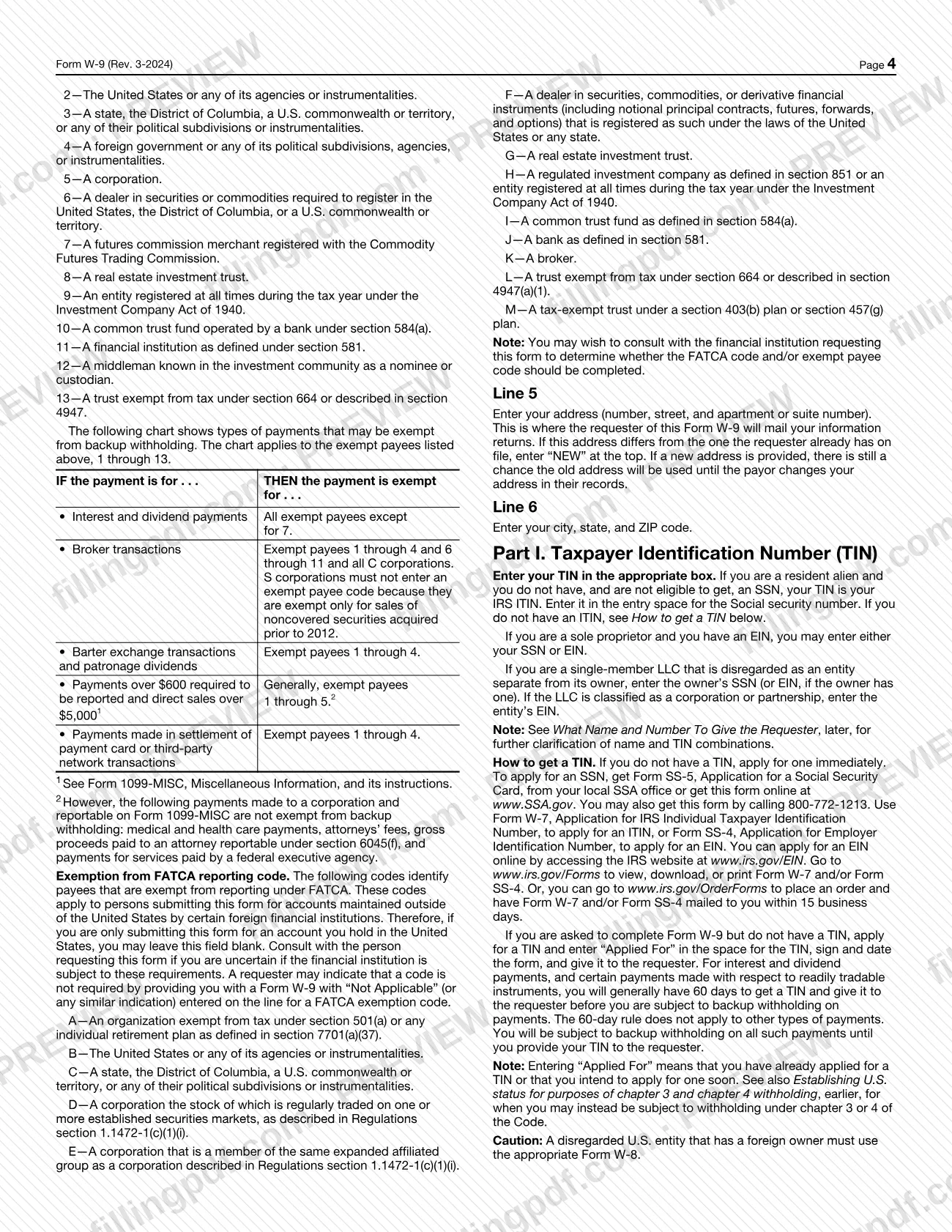
Enter an exempt-payee or FATCA reporting code only if the corresponding IRS instructions apply to you. Exempt-payee codes generally relate to eligible entities rather than individuals; the FATCA code field is for the circumstances described in the form.
Enter lines 5–7 contact details
Provide the address on lines 5 and 6, including city, state, and ZIP code. The requester name and address and account number(s) are optional fields on the official form.
Supply Part I taxpayer ID
Enter the correct TIN in the appropriate box and ensure the number corresponds to the name entered on line 1. Depending on the taxpayer, the relevant identifier may be an SSN, ITIN, ATIN, or EIN; use the IRS instructions for special cases.
Review Part II and sign if required
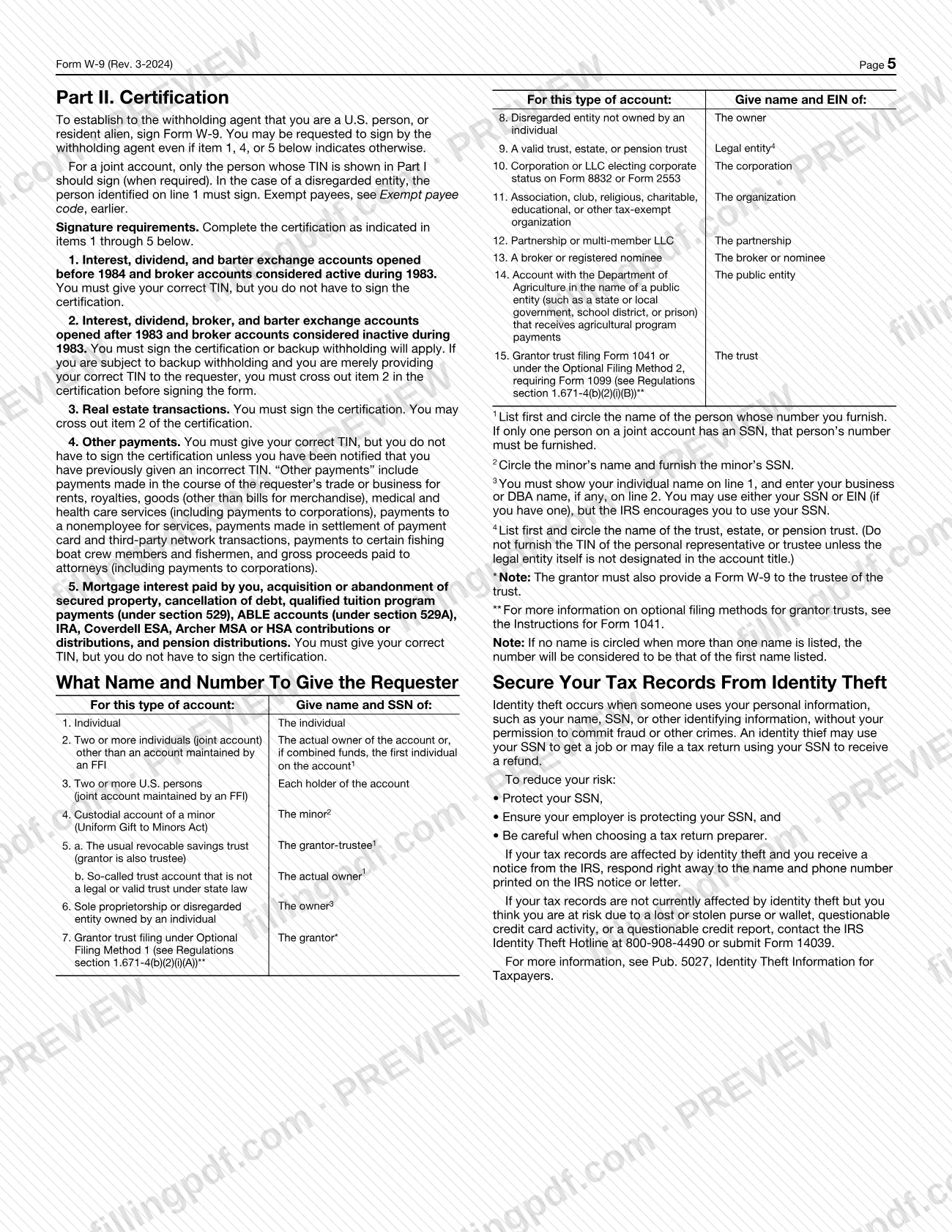
Read each certification, including backup withholding and FATCA statements. If the IRS notified you that you are currently subject to backup withholding for unreported interest or dividends, cross out item 2 as instructed. The IRS explains that signing is not required for certain payment types, although a correct TIN is still needed.
Give the W-9 to the requester
Deliver Form W-9 to the person or business asking for it, not to the IRS. Keep the information current and provide a new form when your account name or TIN changes under the IRS guidance.
How to submit W-9
Provide the completed Form W-9 to the person or organization that requested it, using the submission channel they specify. The IRS PDF explicitly says: give the form to the requester; do not send it to the IRS. Review the certification instructions before signing, because certification is not required for every type of payment, although an accurate TIN is still required. The form itself does not prescribe a universal upload portal or mailing address. FillingPDF provides information and document access; it does not transmit or file your W-9.
Common mistakes to avoid
- Sending Form W-9 to the IRS instead of giving it to the requester.
- Entering a line 1 name that does not match the name associated with the TIN or required tax reporting.
- For a disregarded entity, putting the entity name instead of its owner on line 1 or selecting the entity classification instead of the owner’s classification on line 3a.
- Checking multiple federal tax classification boxes on line 3a instead of the single applicable category.
- Overlooking line 3b when the partnership, trust, estate, or partnership-classified LLC meets the foreign-ownership conditions described in the form.
- Entering an exemption code without checking whether the IRS instructions say that code applies.
- Providing no TIN or an incorrect TIN, which can lead to backup withholding under the circumstances described by the IRS.
- Signing the Part II certification without following the instruction to cross out item 2 when the IRS has notified you that you are currently subject to backup withholding for underreported interest or dividends.
Frequently asked questions
What is IRS Form W-9 used for?
It provides a U.S. person’s correct taxpayer identification number and applicable certifications to someone who may need to report a payment or other transaction to the IRS, such as on certain Forms 1099.
Do I send Form W-9 directly to the IRS?
No. The IRS instructions printed on the form say to give Form W-9 to the requester and not to send it to the IRS.
Can a nonresident alien complete Form W-9?
Generally no. The IRS directs nonresident aliens and foreign entities to the appropriate Form W-8 or Form 8233 instead. A U.S. resident alien is considered a U.S. person for this purpose.
How does a single-member LLC complete lines 1 and 3a?
If it is disregarded for U.S. federal income tax purposes, the owner name belongs on line 1, the business name generally belongs on line 2, and line 3a uses the owner’s tax classification. An LLC taxed as a corporation or partnership follows the rules for that classification.
Who must complete line 3b?
Line 3b concerns a partnership, trust, estate, or LLC classified as a partnership that provides its W-9 to another pass-through entity in which it has an ownership interest; under the form’s conditions, it indicates whether it has foreign partners, owners, or beneficiaries.
What taxpayer identification number belongs in Part I?
The number must correspond to the name on line 1. The appropriate TIN may be an SSN, ITIN, ATIN, or EIN depending on the type of taxpayer and the IRS instructions.
Does every Form W-9 require a signature?
No. The IRS certification instructions say that for certain transactions, including mortgage interest, cancellation of debt, and generally payments other than interest and dividends, certification need not be signed, but a correct TIN must be supplied. Review the rules for your payment type.
What happens if I do not provide a correct TIN?
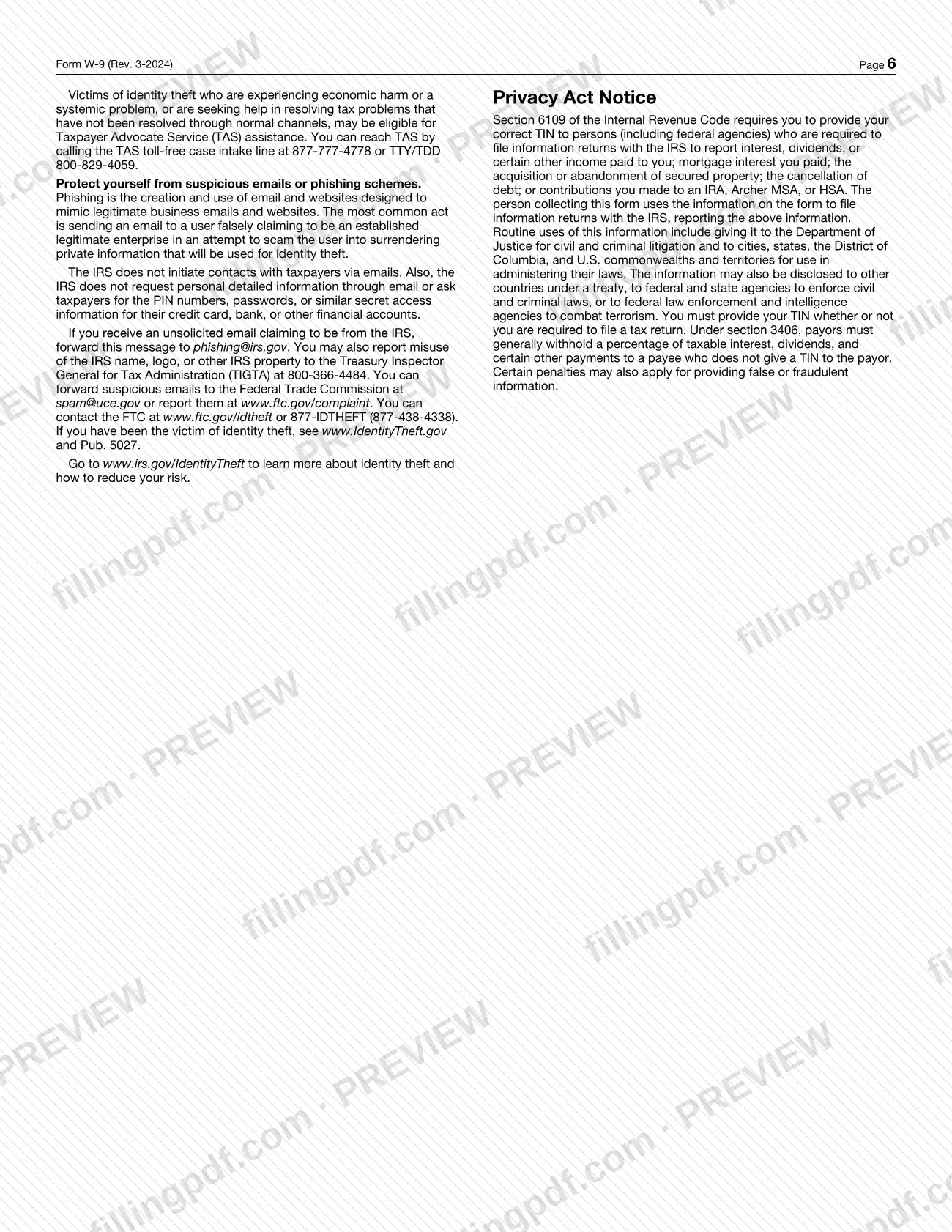
Some reportable payments can become subject to 24% backup withholding in the circumstances described by the IRS, such as a missing or incorrect TIN. Form W-9 itself is not a tax return and has no single annual filing deadline.
Ready to fill out W-9?
Fill out W-9 now