
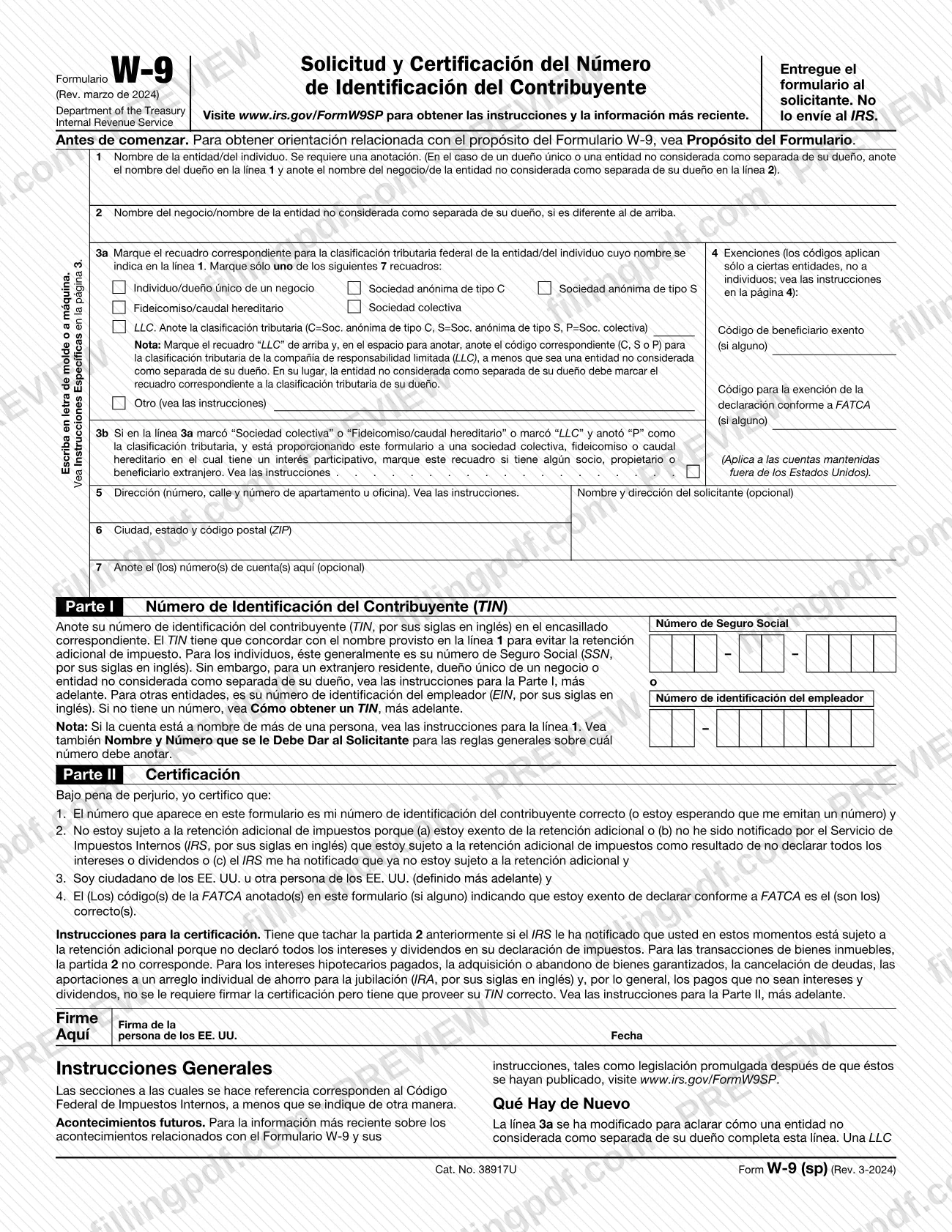
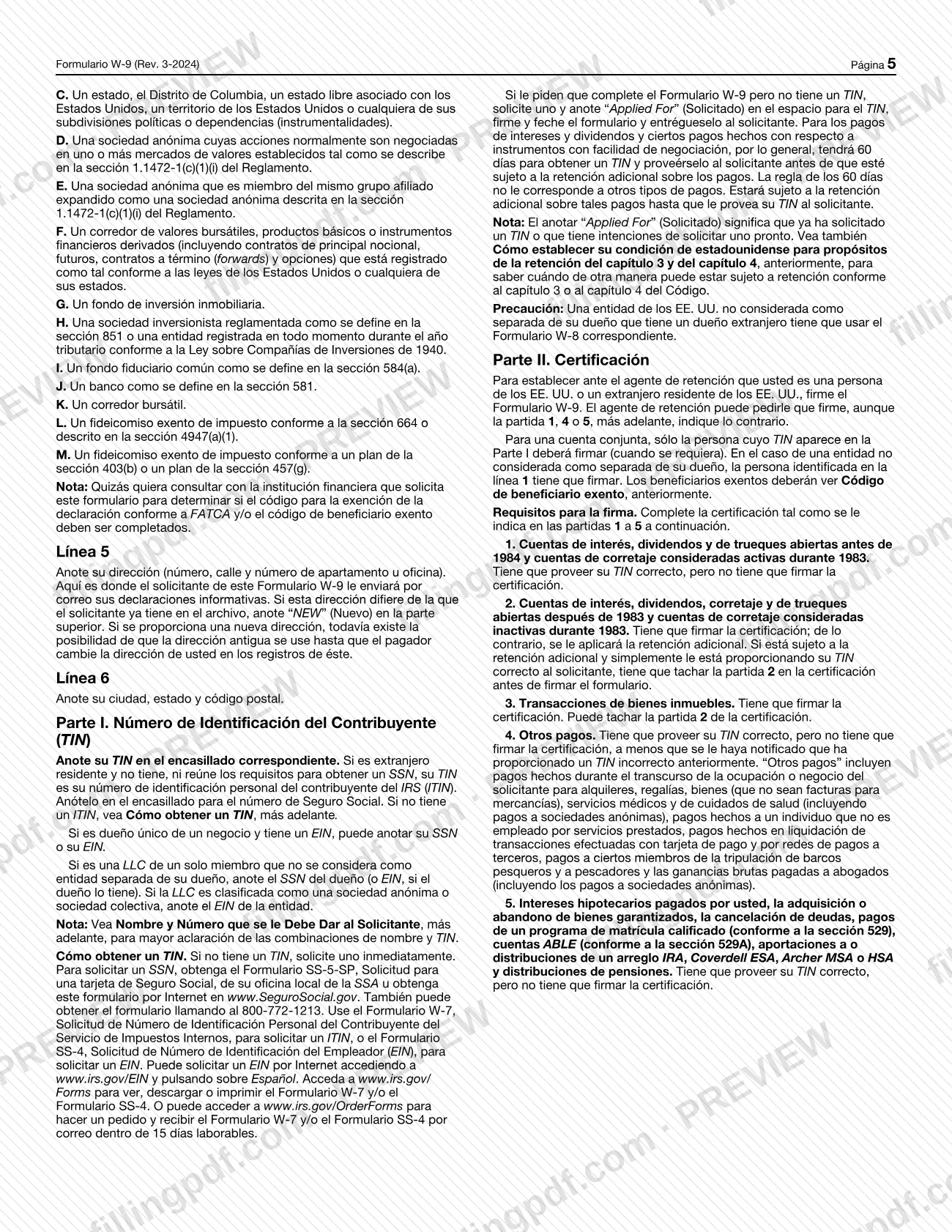
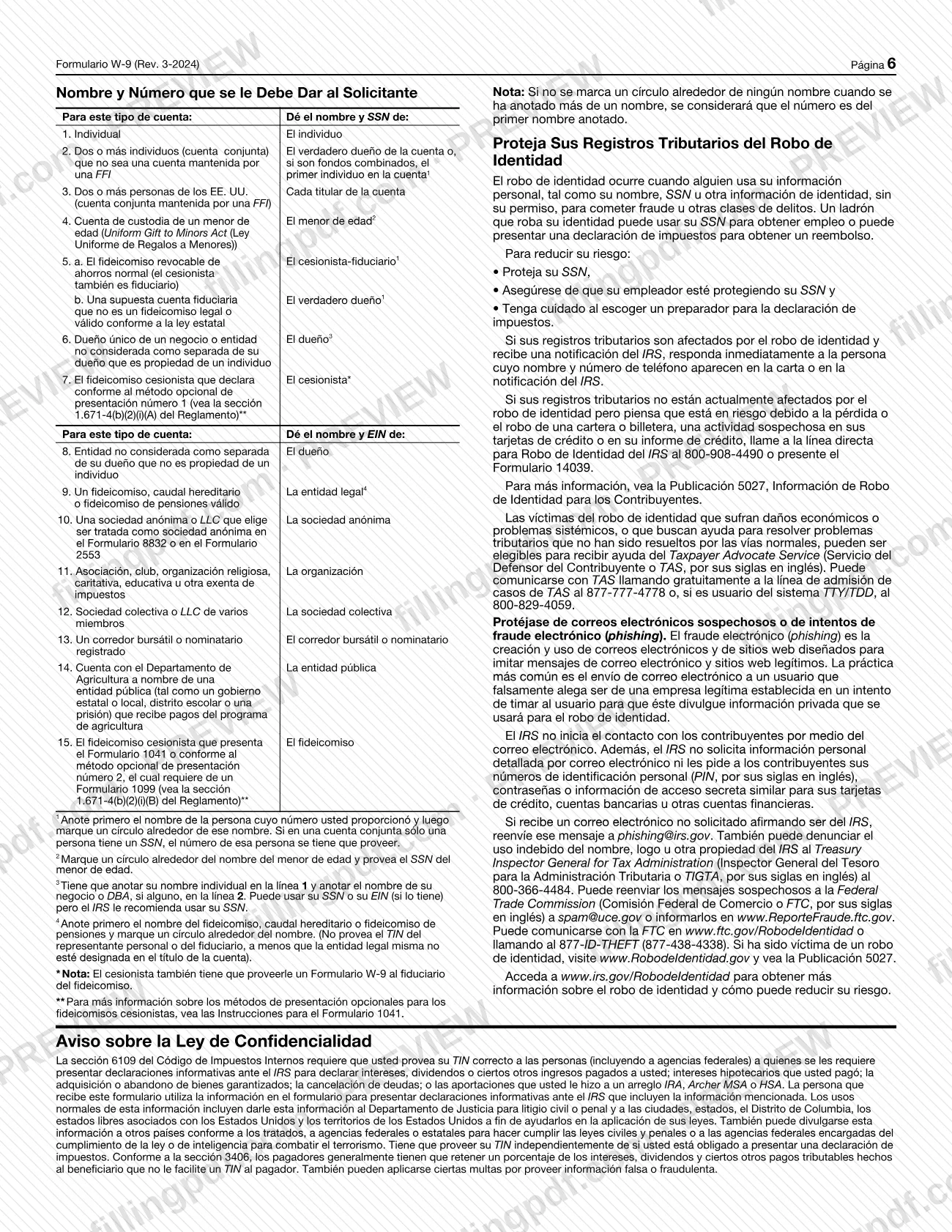
Form W-9 (sp), Request for Taxpayer Identification Number and Certification (Spanish Version), is the Spanish-language edition of the Internal Revenue Service (IRS) form that a payee gives to a requester to provide a correct Taxpayer Identification Number (TIN). The requester is a person or entity that must file an information return with the IRS. On FillingPDF you can fill out Form W-9 (sp) online and download or print the completed PDF. The IRS publishes the original PDF and its instructions at irs.gov, and the form itself says to give it to the requester, not to send it to the IRS.
Last updated
What is W-9 (sp)?
Form W-9 (sp), Request for Taxpayer Identification Number and Certification (Spanish Version), is the Spanish-language IRS form on which a U.S. person gives a requester their correct TIN and makes the certifications in Part II under penalty of perjury.
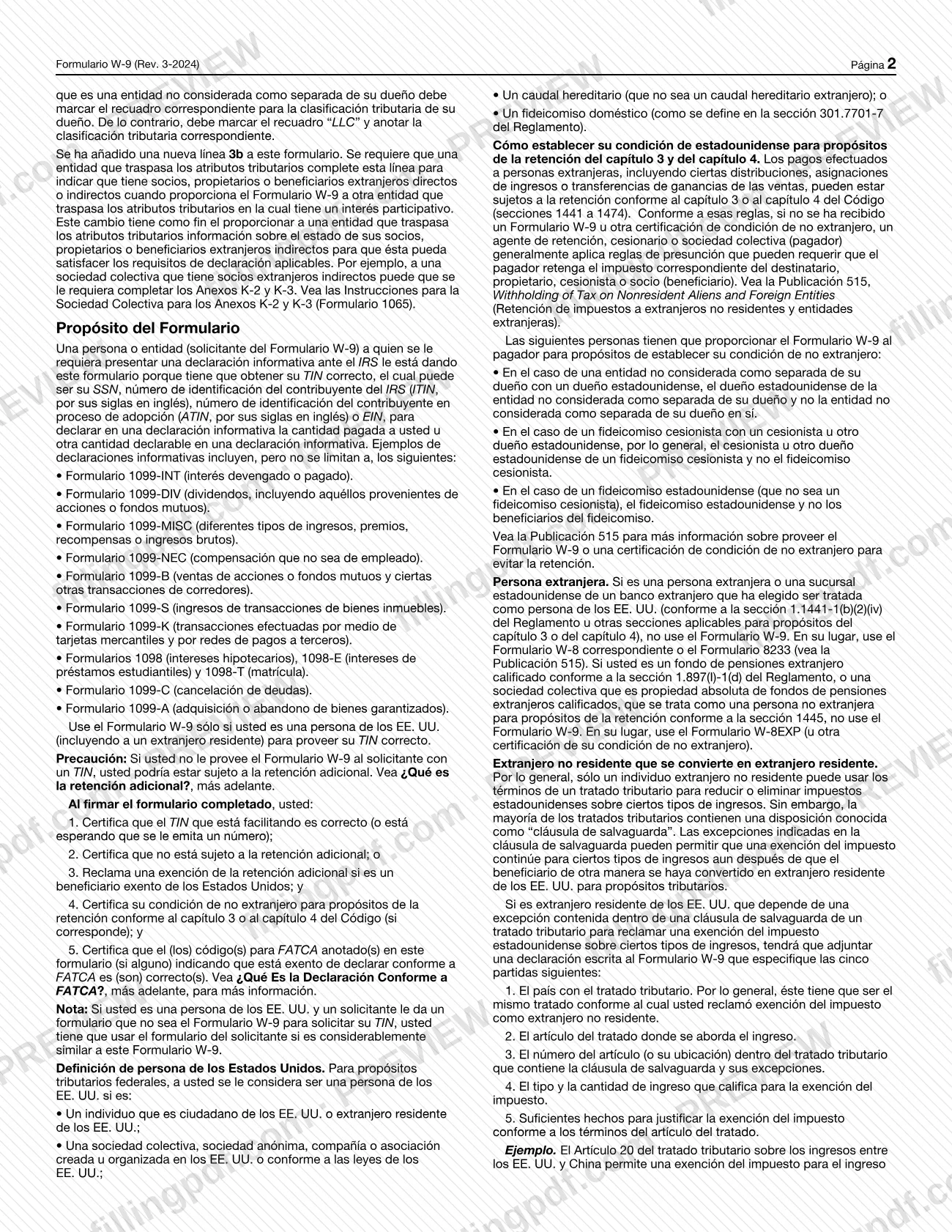
The form is printed in Spanish as Solicitud y Certificación del Número de Identificación del Contribuyente. The TIN can be a Social Security number (SSN), an IRS individual taxpayer identification number (ITIN), an adoption taxpayer identification number (ATIN) or an employer identification number (EIN). The requester uses it to report amounts paid to you on an information return such as Form 1099-INT, 1099-DIV, 1099-MISC, 1099-NEC, 1099-B, 1099-S, 1099-K, 1098, 1098-E, 1098-T, 1099-C or 1099-A.
By signing, you certify that the TIN is correct (or that you are waiting for one), that you are not subject to backup withholding or are exempt from it, that you are a U.S. person, and that any FATCA code you entered is correct. You also use the form to claim an exemption from backup withholding when you are an exempt payee.
This revision, Rev. marzo de 2024 (Rev. 3-2024), changed line 3a to clarify how an entity disregarded as separate from its owner completes it, and added line 3b for pass-through entities with foreign partners, owners or beneficiaries. The IRS's general page about Form W-9 describes the same purpose; this page covers the Spanish edition, and its instructions are the Spanish-language Instrucciones para el Solicitante del Formulario W-9. The form is not for foreign persons, who use a Form W-8 or Form 8233.
Who needs to file W-9 (sp)?
You complete Form W-9 (sp) if you are a U.S. person and a requester, meaning a person or entity that must file an information return with the IRS, asks you for your correct TIN. For federal tax purposes you are a U.S. person if you are:
- an individual who is a U.S. citizen or U.S. resident alien;
- a partnership, corporation, company or association created or organized in the United States or under U.S. law;
- an estate (other than a foreign estate); or
- a domestic trust.
Do not use this form if you are a foreign person, or a U.S. branch of a foreign bank treated as a U.S. person. Give the requester the appropriate Form W-8 or Form 8233 instead. A qualified foreign pension fund, or a partnership wholly owned by such funds, uses Form W-8EXP. A foreign owner of a disregarded entity completes a Form W-8 even if that owner has a U.S. TIN, and a U.S. disregarded entity with a foreign owner also uses the appropriate Form W-8.
Exempt payees may still be asked for a signed form. Individuals, including sole proprietors, are generally not exempt from backup withholding. If a requester gives you a different form that is substantially similar to Form W-9, use theirs. On a joint account, only the person whose TIN appears in Part I signs, when a signature is required.
When to file W-9 (sp)
Complete Form W-9 (sp) when a requester asks you for your TIN, so the requester can report payments to you on an information return. The form sets no filing date with the IRS because you give it to the requester, not to the agency.
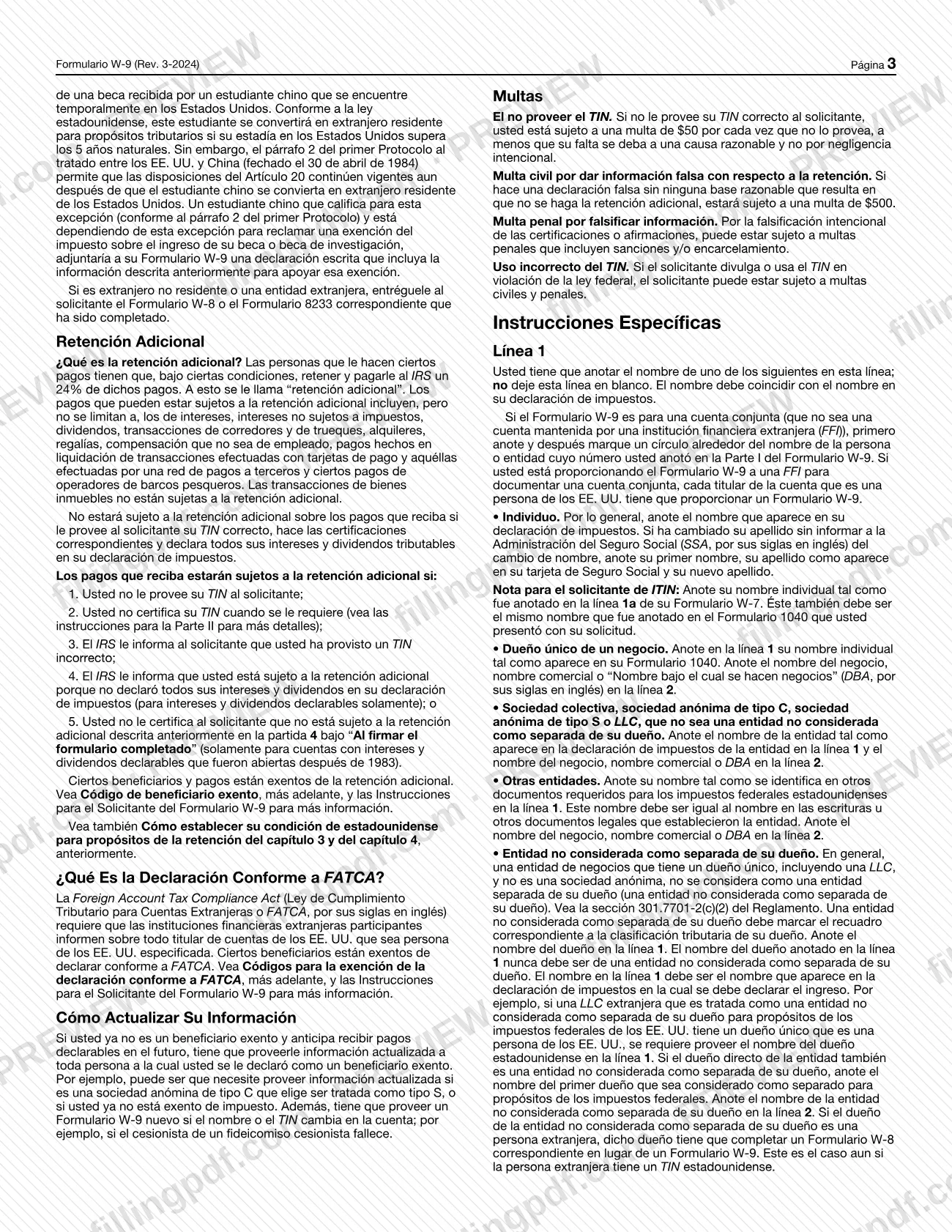
You must also give updated information to everyone you were reported to as an exempt payee if you stop being exempt and expect reportable payments, and you must give a new form if the name or TIN on the account changes, for example when the grantor of a grantor trust dies.
If you have no TIN yet, apply for one immediately and write "Applied For" in Part I. For interest and dividend payments and certain payments on readily tradable instruments, you generally have 60 days to get a TIN and give it to the requester before backup withholding starts. The 60-day rule does not apply to other payments.
Documents you need
- Written statement attached to the form, only if you are a U.S. resident alien relying on a tax treaty saving clause to claim exemption from U.S. tax: it must give the treaty country, the treaty article on the income, the saving clause article number, the type and amount of income, and facts supporting the exemption.
How to fill out W-9 (sp)
Enter the name on line 1
Line 1 is required: enter the name shown on your income tax return and do not leave it blank. For a sole proprietor or disregarded entity, enter the owner's name on line 1 and the business or entity name on line 2.
Enter the business name on line 2
If you have a business name, trade name, DBA name or disregarded entity name different from line 1, enter it on line 2. Otherwise leave line 2 empty.
Select your tax classification on line 3a
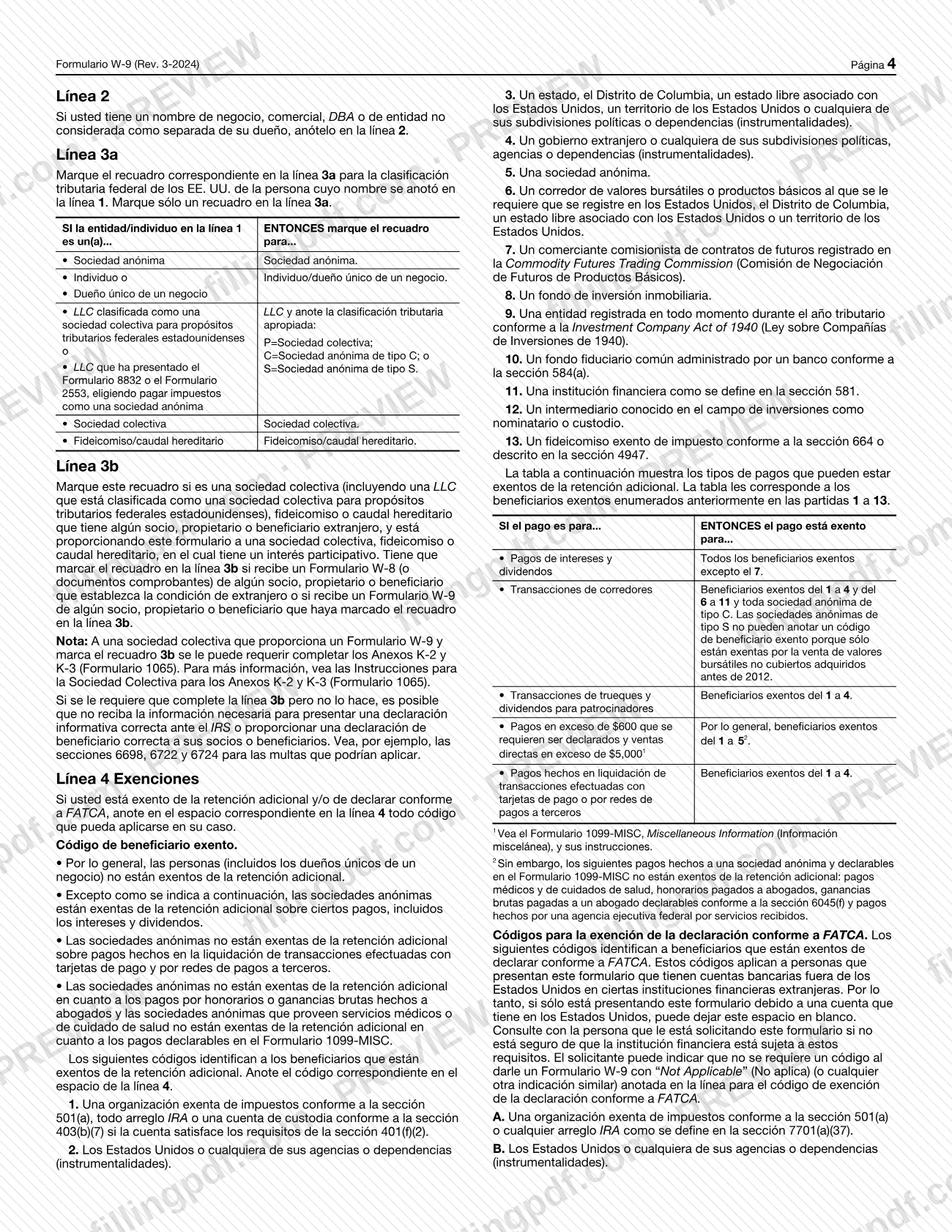
Check only one box: Individuo/dueño único de un negocio (individual/sole proprietor), Sociedad anónima de tipo C (C corporation), Sociedad anónima de tipo S (S corporation), Fideicomiso/caudal hereditario (trust/estate), Sociedad colectiva (partnership), LLC or Otro (other). For an LLC, enter C, S or P; a disregarded LLC checks the box for its owner's classification instead.
Complete line 3b if it applies
Check line 3b only if you checked Partnership or Trust/estate (or LLC with P), you give the form to a partnership, trust or estate in which you have an ownership interest, and you have any foreign partners, owners or beneficiaries.
Enter exemption codes on line 4
If you are exempt from backup withholding, enter the exempt payee code. Enter the FATCA exemption code only if it applies to accounts maintained outside the United States; if your account is only in the United States, you can leave it blank.
Enter your address on lines 5 and 6
Line 5: street address and apartment or suite number, where the requester will mail your information returns; write "NEW" at the top if it changed. Line 6: city, state and ZIP code.
Add account numbers if useful
Line 7 is optional: enter the account number(s) the requester uses for you. The requester's name and address box is optional too.
Enter your TIN in Part I
Enter your SSN or EIN in the matching boxes; an ITIN goes in the Social Security number boxes. A sole proprietor with an EIN may use either number. If you have no TIN, apply for one and write "Applied For".
Read the Part II certification
Read items 1 to 4. Cross out item 2 only if the IRS has notified you that you are currently subject to backup withholding for not reporting all interest and dividends; item 2 does not apply to real estate transactions.
Sign and date the form
Sign under Firma de la persona de los EE. UU. and enter the date when a signature is required for your type of payment. For a disregarded entity, the person named on line 1 signs; for a joint account, the person whose TIN is in Part I signs.
Review and download the completed PDF
Check that the name on line 1 matches your TIN and tax return and that only one box is marked on line 3a. Download or print the completed PDF from FillingPDF and give it to the requester as described under How to submit.
How to submit W-9 (sp)
You give Form W-9 (sp) to the requester who asked for it; the form says "Entregue el formulario al solicitante. No lo envíe al IRS" (give the form to the requester, do not send it to the IRS).
- To the requester: hand, mail or deliver the signed form to the person or entity that requested it. Use the optional box "Nombre y dirección del solicitante" if you want to record who asked for it.
- Electronically or by fax: the IRS instructions for requesters allow a requester to set up a system through which payees can submit Form W-9 electronically, including by fax. Use that system only if the requester offers it.
The address on line 5 is where the requester mails your information returns. If it differs from the address the requester already has, write "NEW" at the top of the form. Keep the copy of the requester's account number on line 7 if you use it.
FillingPDF lets you fill out and download the PDF; submission follows the channels above.
Common mistakes to avoid
- Leaving line 1 blank, or entering a name that does not match the name on your tax return; the TIN must also match the name on line 1 to avoid backup withholding.
- Entering the disregarded entity's name on line 1; the owner's name goes on line 1 and the entity's name goes on line 2.
- Checking more than one box on line 3a; the form allows only one of the 7 boxes.
- Checking the LLC box for a disregarded single-owner LLC instead of the box for its owner's tax classification.
- Not crossing out item 2 of the certification after the IRS has notified you that you are currently subject to backup withholding for underreporting interest or dividends.
- Using Form W-9 (sp) as a foreign person instead of the appropriate Form W-8 or Form 8233.
- Entering an ITIN anywhere other than the Social Security number boxes of Part I.
- Writing "Applied For" and assuming it protects every payment; the 60-day period covers only interest, dividends and certain payments on readily tradable instruments.
- Sending the completed form to the IRS; the form says to give it to the requester.
- Not circling the name whose TIN you entered when more than one name is listed on line 1 for a joint account; the number is then treated as the first name's.
Frequently asked questions
What is Form W-9 (sp) used for?
Form W-9 (sp) is the Spanish-language IRS form you give to a requester to provide your correct TIN and make the Part II certifications. The requester needs it to report payments to you, such as interest, dividends, non-employee compensation or mortgage interest, on an information return.
Is Form W-9 (sp) the same as the W9 form in English?
It serves the same purpose as Form W-9: giving a requester your correct TIN and certifications. The difference is language: Form W-9 (sp) is printed in Spanish (Rev. marzo de 2024) and comes with Spanish instructions, while its official name stays in English.
Do I send Form W-9 (sp) to the IRS?
No. The form states that you give it to the requester and do not send it to the IRS. The requester uses the information to file its own information returns, so deliver the signed form to the person or company that asked for it.
Who should not use Form W-9 (sp)?
Foreign persons should not use it. A nonresident alien or foreign entity gives the requester the appropriate Form W-8 or Form 8233 instead. The form is only for U.S. persons, including resident aliens, who provide their correct TIN.
What do I write if I do not have a TIN yet?
Apply for one right away and write "Applied For" in the TIN space, then sign and date the form. For interest and dividend payments you generally have 60 days to give the requester a TIN before backup withholding starts; other payments are subject to it until you provide the TIN.
How do I fill out Form W-9 (sp) for a single-member LLC?
If the LLC is disregarded as separate from its owner, enter the owner's name on line 1 and the LLC's name on line 2, check the box for the owner's tax classification on line 3a, and use the owner's SSN or EIN in Part I. If it is taxed as a corporation or partnership, check LLC and enter C, S or P.
What happens if I do not give the requester my TIN?
Payments to you may be subject to backup withholding, and you may owe a penalty for each failure to provide your correct TIN unless it is due to reasonable cause and not willful neglect. The form also warns of criminal penalties for willfully falsifying certifications.
Can I fill out Form W-9 (sp) online on FillingPDF?
Yes. You can fill out the fillable PDF online on FillingPDF and download or print it. FillingPDF is an independent service, not the IRS, and does not send the form to anyone; you give the completed form to the requester yourself.
Ready to fill out W-9 (sp)?
Fill out W-9 (sp) now