
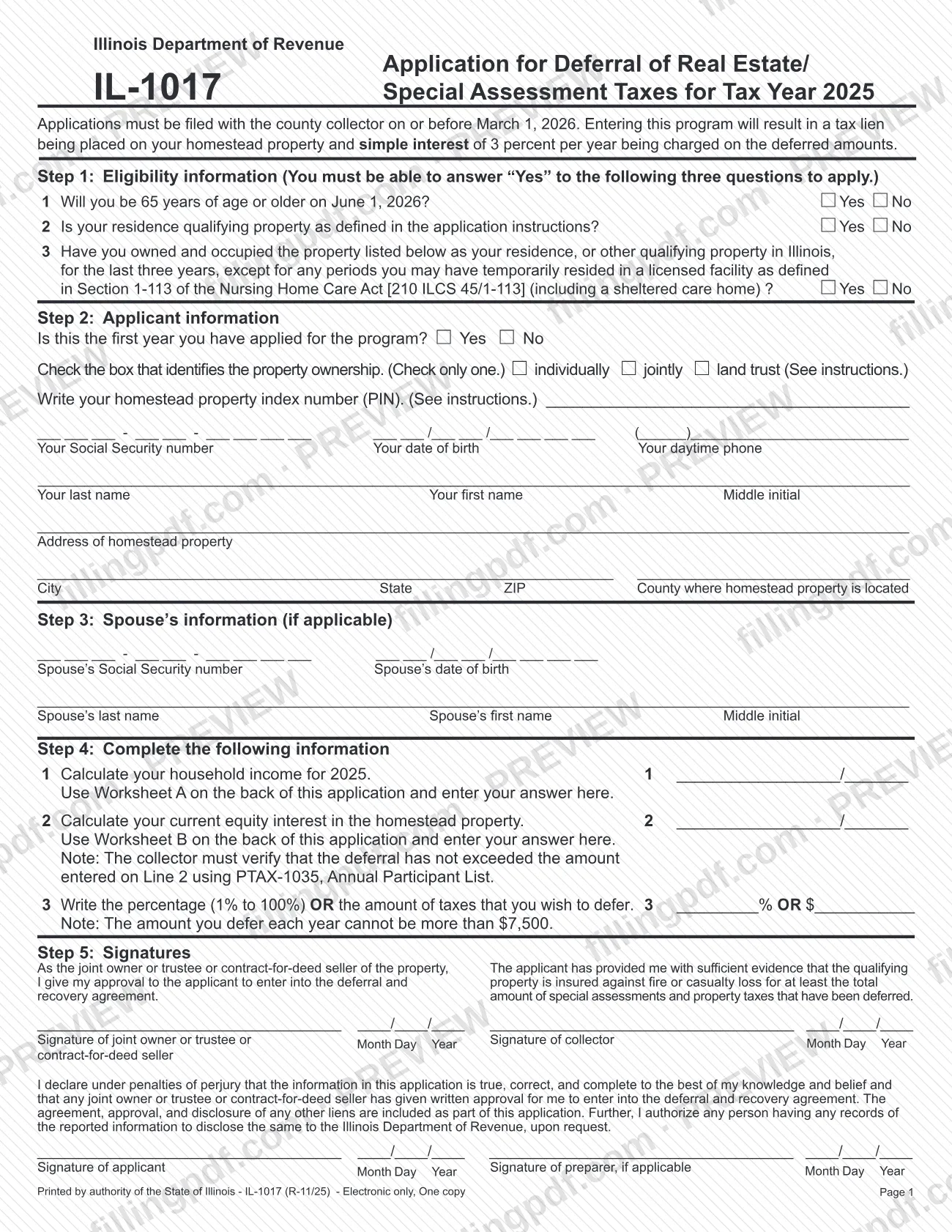
Form IL-1017, Application for Deferral of Real Estate/Special Assessment Taxes for Tax Year 2025, is the Illinois Department of Revenue application for the Senior Citizens Real Estate Tax Deferral program, which lets qualified seniors defer all or part of the property taxes and special assessments on their principal residence. The Cook County Treasurer's Office publishes it with the program information, and it must be filed with the county collector on or before March 1, 2026. On this page you can fill out the form online on FillingPDF and download or print the completed PDF; the official PDF is published on the Cook County Treasurer's website.
Last updated
What is IL-1017?
Form IL-1017, Application for Deferral of Real Estate/Special Assessment Taxes for Tax Year 2025, is the Illinois Department of Revenue application that senior citizens file with the county collector to defer property taxes and special assessments on their principal residence.
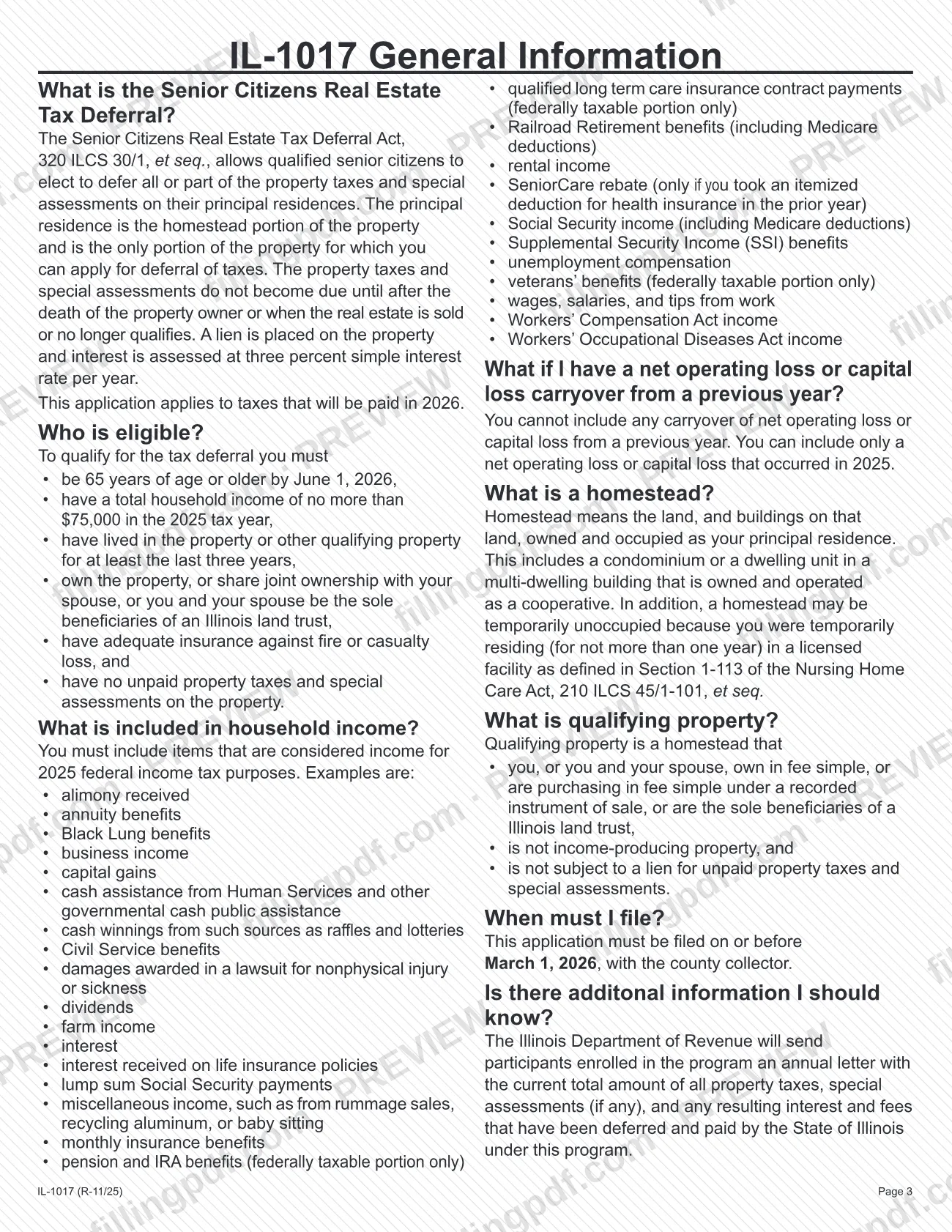
The form belongs to the Senior Citizens Real Estate Tax Deferral program under the Senior Citizens Real Estate Tax Deferral Act, 320 ILCS 30/1, et seq. The taxes and special assessments do not become due until after the death of the property owner, or when the real estate is sold or no longer qualifies. Entering the program places a tax lien on the homestead property, and simple interest is charged on the deferred amounts. Only the homestead portion of the property can be deferred, and this application applies to taxes that will be paid in 2026. The Cook County Treasurer's Office describes the program as working like a loan from the State of Illinois.
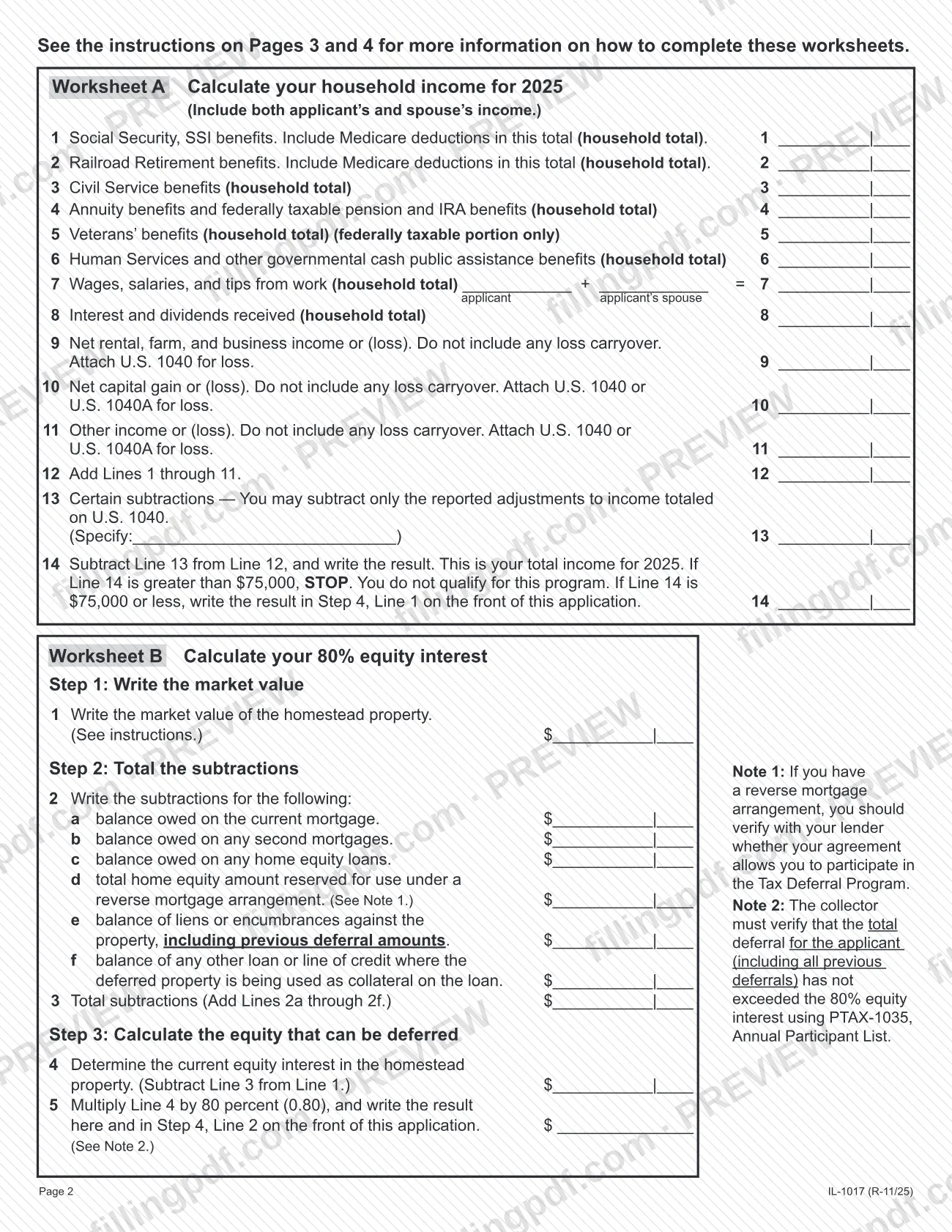
The form has five steps (eligibility, applicant, spouse, the amounts, signatures) and two worksheets. Worksheet A figures your 2025 household income; Worksheet B figures your 80% equity interest in the property. The total deferred, including special assessments and interest, cannot exceed 80 percent of your equity.
Two related documents appear in the instructions. Form IL-1018, Real Estate/Special Assessment Tax Deferral and Recovery Agreement, must be completed when you file this application. PTAX-1035, Annual Participant List, is what the collector uses to verify that deferrals have not exceeded the equity limit.
Who needs to file IL-1017?
Homeowners who want to defer the property taxes and special assessments on their principal residence use Form IL-1017. The instructions list these conditions:
- You are 65 years of age or older by June 1, 2026.
- Your total household income for 2025 is no more than $75,000.
- You have lived in the property, or other qualifying property, for at least the last three years.
- You own the property, share joint ownership with your spouse, or you and your spouse are the sole beneficiaries of an Illinois land trust.
- You have adequate insurance against fire or casualty loss.
- You have no unpaid property taxes or special assessments on the property.
The Cook County Treasurer's page also lists surviving spouses of previously approved applicants who are at least 55 years of age within six months of the taxpayer's death.
Exclusions: income-producing property and property under a lien for unpaid taxes or special assessments are not qualifying property. If Worksheet A line 14 is greater than $75,000, the form says you do not qualify. A joint owner, trustee or contract-for-deed seller must approve by signing. A tax preparer who prepared the application also signs.
When to file IL-1017
File Form IL-1017 with the county collector on or before March 1, 2026. The Cook County Treasurer's page states that, per state law, there are no time extensions. Applications are available at the Cook County Treasurer's Office after January 1 through the March 1 deadline.
You must apply each year you want to participate. This application covers tax year 2025 and the taxes that will be paid in 2026; eligibility is tested against your age on June 1, 2026 and your household income for 2025.
If your property is held in a trust, the Treasurer's page advises starting as early as possible, because the trustee must also sign. Once you are enrolled, the Illinois Department of Revenue sends an annual letter with the total deferred amount, including interest and fees.
Documents you need
- Form IL-1018, Real Estate/Special Assessment Tax Deferral and Recovery Agreement, completed and entered into with the county collector when you file Form IL-1017.
- Evidence of fire or casualty insurance on the homestead for at least the total of the property taxes and special assessments deferred, provided to the county collector.
- Photocopies, not originals, of the documents the application requires.
- An appraisal by a qualified real estate appraiser, if the market value on Worksheet B differs from the recorded assessed value or the home has no separate assessed value yet.
- A copy of U.S. 1040 (or U.S. 1040A for lines 10 and 11) when you report a loss on Worksheet A line 9, 10 or 11.
- A separate sheet naming the creditor and address for each subtraction claimed in Worksheet B, Step 2.
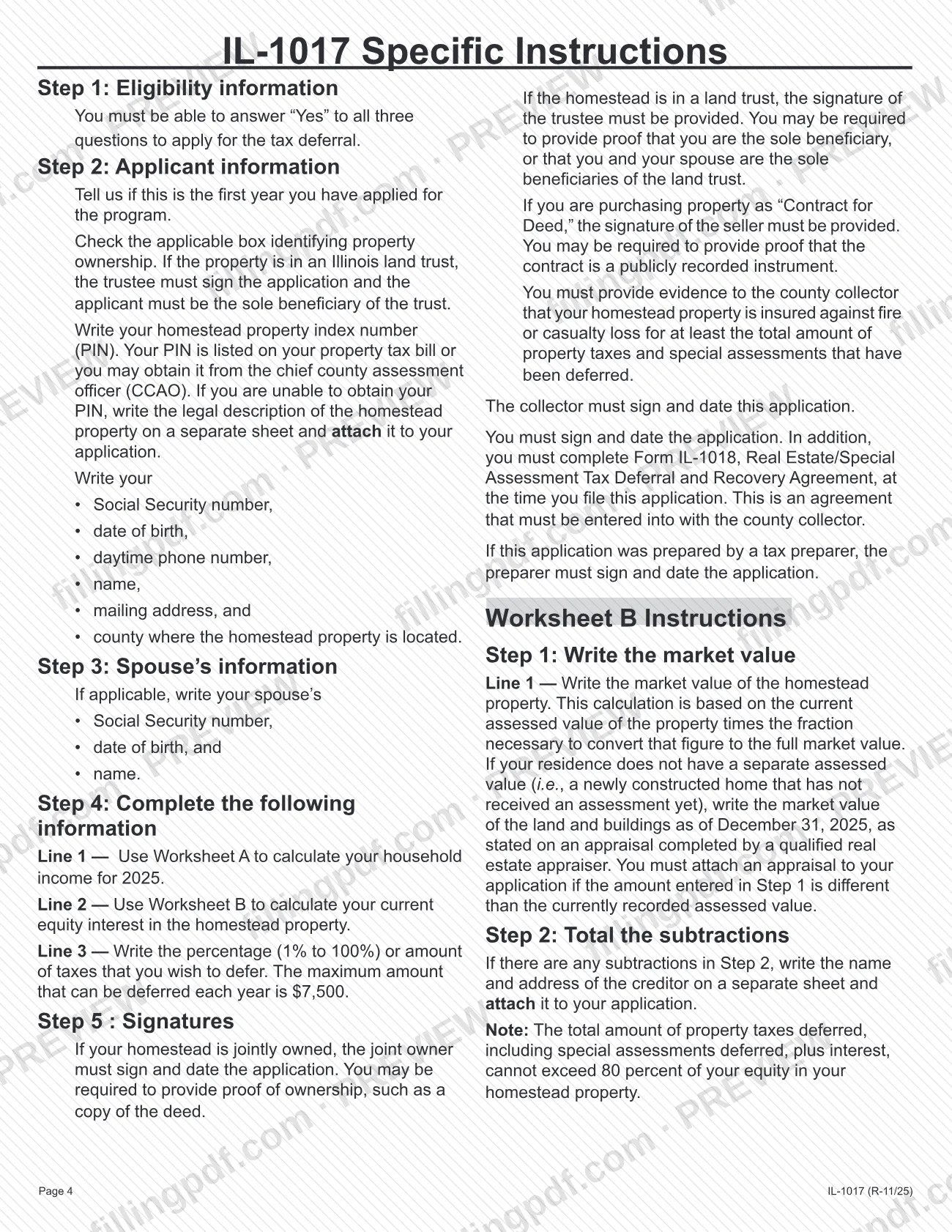
- A separate sheet with the legal description of the homestead, only if you cannot obtain your property index number (PIN).
- Proof of ownership, such as a copy of the deed, if the property is jointly owned and the collector requires it.
- For an Illinois land trust: the Trust Agreement and Deed in Trust, plus proof you (or you and your spouse) are the sole beneficiary if requested.
- For a contract-for-deed purchase: proof that the contract is a publicly recorded instrument, if required.
How to fill out IL-1017
Answer the Step 1 eligibility questions
Check Yes or No for age 65 or older on June 1, 2026, for qualifying property, and for owning and occupying the property for the last three years. You must be able to answer Yes to all three to apply.
Enter applicant information in Step 2
Say whether this is your first year applying and check one ownership box: individually, jointly or land trust. Write the homestead PIN, your Social Security number, date of birth and daytime phone, then your name, the homestead address and its county.
Add spouse information in Step 3
If applicable, enter your spouse's Social Security number, date of birth and name. Leave this step blank if you have no spouse.
Fill in income lines on Worksheet A
Enter on lines 1 to 6 the household totals for Social Security and SSI, Railroad Retirement, Civil Service, annuity, pension and IRA, veterans' and public assistance benefits. On line 7 enter wages for the applicant and the spouse separately, then lines 8 to 11 for interest, dividends, net business, capital gain and other income.
Total your income on Worksheet A
Add lines 1 through 11 on line 12, subtract allowed adjustments on line 13 and specify them, and write the result on line 14. If line 14 is greater than $75,000, stop; otherwise copy it to Step 4, line 1.
Enter the market value on Worksheet B
On Worksheet B Step 1, line 1, write the market value of the homestead based on the assessed value converted to full market value. Use an appraisal as of December 31, 2025 if the home has no separate assessed value.
List the subtractions on Worksheet B
On lines 2a to 2f enter balances for mortgages, second mortgages, home equity loans, reverse mortgage equity, liens including previous deferrals, and other collateral loans. Add them on line 3 and attach a creditor sheet.
Calculate the equity you can defer
On line 4 subtract line 3 from line 1, then multiply by 0.80 on line 5. Copy the line 5 result to Step 4, line 2.
Complete the amounts in Step 4
Line 1 is your Worksheet A income and line 2 your Worksheet B equity. On line 3 write either the percentage (1% to 100%) or the dollar amount of taxes to defer, not more than $7,500 a year.
Collect signatures in Step 5
The joint owner, trustee or contract-for-deed seller signs and dates if one applies. The collector signs and dates, and you sign and date; a tax preparer, if any, signs as well.
Prepare Form IL-1018 and attachments
Complete Form IL-1018 to file with the application and gather the supporting documents and sheets listed in the instructions.
Review and download the completed PDF
Check every line against the instructions and the worksheets' totals. Download or print the completed PDF from FillingPDF and deliver it as described under How to submit.
How to submit IL-1017
Form IL-1017 is filed with the county collector; in Cook County, the Cook County Treasurer's Office takes the applications and distributes the form.
- Where to file: return the completed application to the Cook County Treasurer's Office no later than March 1, 2026. The form itself names the county collector and prints no mailing address or online channel.
- Copies: provide photocopies, not originals, of the required documents.
- Agreement: complete Form IL-1018, Real Estate/Special Assessment Tax Deferral and Recovery Agreement, and file it at the same time.
- Signatures: the collector signs and dates the application, confirming that the applicant provided evidence of fire or casualty insurance. A joint owner, trustee or contract-for-deed seller signs too, when one applies.
- Trusts: the trustee (the bank or trust company) and the homeowner must both sign, and a Trust Agreement and Deed in Trust are submitted.
No fee for filing is stated, but interest is charged on the deferred amounts. The Cook County Treasurer's Office can answer questions about the program. FillingPDF lets you fill out and download the PDF; submission follows the channels above.
Common mistakes to avoid
- Filing after March 1, 2026; the county collector deadline has no time extensions under state law.
- Applying when you must answer "No" to any Step 1 question; all three eligibility questions must be "Yes".
- Including a net operating loss or capital loss carryover on Worksheet A lines 9 to 11; only a loss that occurred in 2025 counts.
- Continuing past Worksheet A line 14 when the total income is greater than $75,000; the form says to stop.
- Filing Form IL-1017 without Form IL-1018, which must be completed when you file the application.
- Missing the signature of the joint owner, trustee or contract-for-deed seller where the property is jointly owned, in trust or bought on contract.
- Entering a market value different from the recorded assessed value without attaching an appraisal.
- Claiming Worksheet B subtractions without attaching a sheet with each creditor's name and address.
- Writing a deferral on Step 4, line 3 of more than $7,500 a year; the form sets that as the maximum.
- Submitting original documents when the Treasurer's page asks for photocopies.
Frequently asked questions
What is Form IL-1017 used for?
Form IL-1017 is the Illinois Department of Revenue application for the Senior Citizens Real Estate Tax Deferral program. It lets qualified seniors defer all or part of the property taxes and special assessments on their principal residence, with a lien placed on the property and simple interest charged.
What is the deadline to file Form IL-1017 for tax year 2025?
March 1, 2026, with the county collector. The Cook County Treasurer's page says that under state law there are no time extensions. Applications are available at the Cook County Treasurer's Office after January 1, and you must apply again each year you want to participate.
Who qualifies for the Illinois senior real estate tax deferral?
You must be 65 or older by June 1, 2026, with 2025 household income of $75,000 or less, and have owned and occupied the property for the last three years. You also need fire or casualty insurance and no unpaid property taxes or special assessments on the property.
Can I fill out Form IL-1017 online?
Yes. You can fill out the PDF online on FillingPDF and download or print it. FillingPDF is an independent service and does not file the application; you deliver it to the county collector through the Cook County Treasurer's Office.
Do I have to file Form IL-1018 with Form IL-1017?
Yes. The instructions say you must complete Form IL-1018, Real Estate/Special Assessment Tax Deferral and Recovery Agreement, at the time you file the application. It is an agreement entered into with the county collector.
Where do I find my PIN for Form IL-1017?
Your PIN is on your property tax bill, or you can get it from the chief county assessment officer (CCAO). If you cannot get it, write the legal description of the homestead on a separate sheet and attach it to the application.
Can I include a loss carryover in my household income?
No. You cannot include a net operating loss or capital loss carried over from a previous year. You can include only a loss that occurred in 2025, and you attach U.S. 1040 or U.S. 1040A to show the loss.
Do I need my mortgage lender's approval to defer taxes?
No. The Cook County Treasurer says lender approval is not required to qualify. You should still tell your lender and confirm participation does not violate your mortgage, and do the same with a reverse mortgage, which may limit your participation.
When do the deferred taxes have to be paid?
The deferred taxes and special assessments do not become due until after the owner's death or when the real estate is sold or no longer qualifies. Interest is charged on the deferred amounts, and the lien stays on the property.
Ready to fill out IL-1017?
Fill out IL-1017 now