

Form ATJ 405.4, Order of Protection, is the statewide order form approved by the Illinois Supreme Court, and every Illinois court must accept it. This Illinois order of protection form lists the people protected, the remedies the court grants against the respondent, the dates the order runs and the court's findings. On this page you can fill out the form online on FillingPDF and download or print the completed PDF; the official PDF is published by the Illinois Courts at ilcourts.info/forms.
Last updated
What is ATJ 405.4?
Form ATJ 405.4, Order of Protection, is the statewide form approved by the Illinois Supreme Court on which an Illinois circuit court records an order of protection: who is protected, what the respondent must do or avoid, and how long the order lasts.
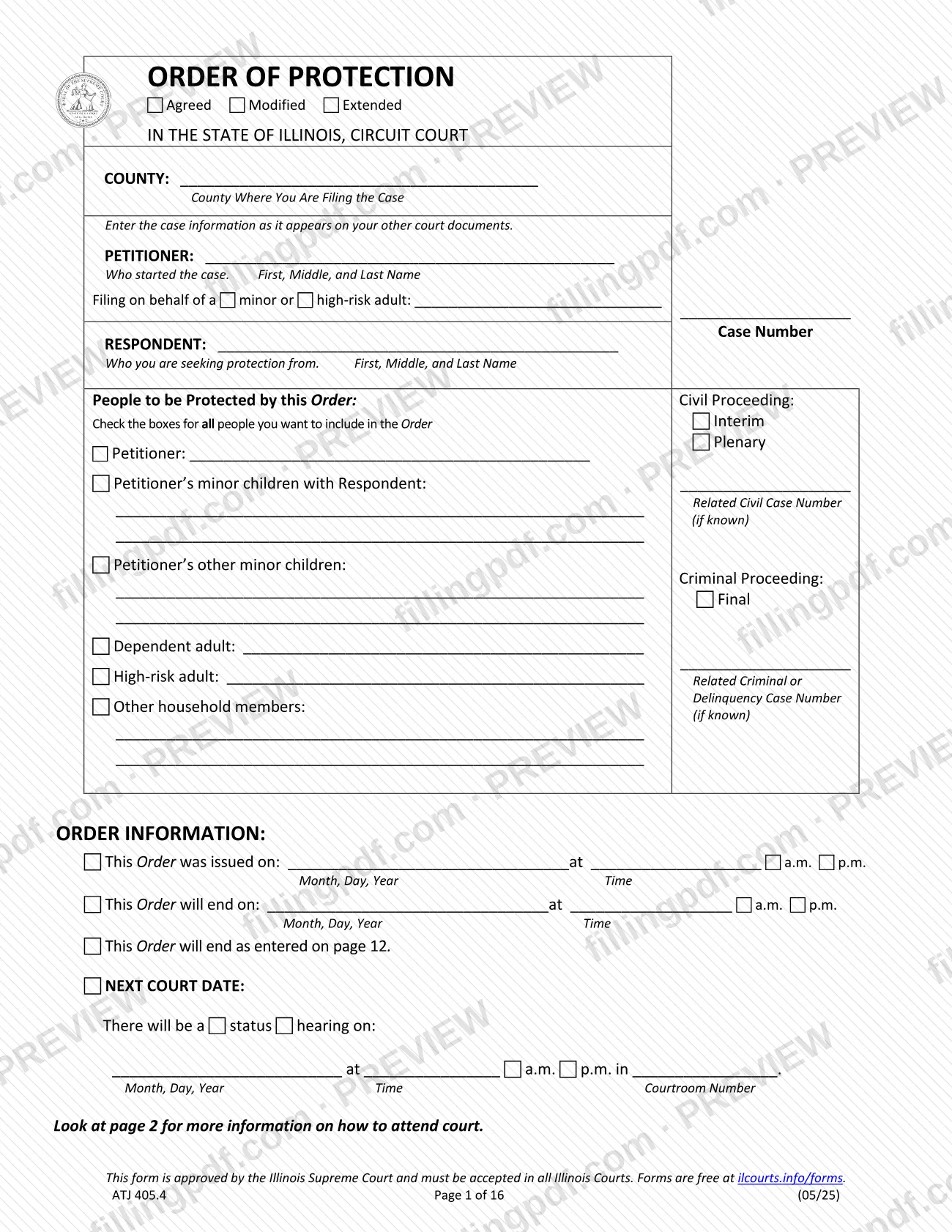
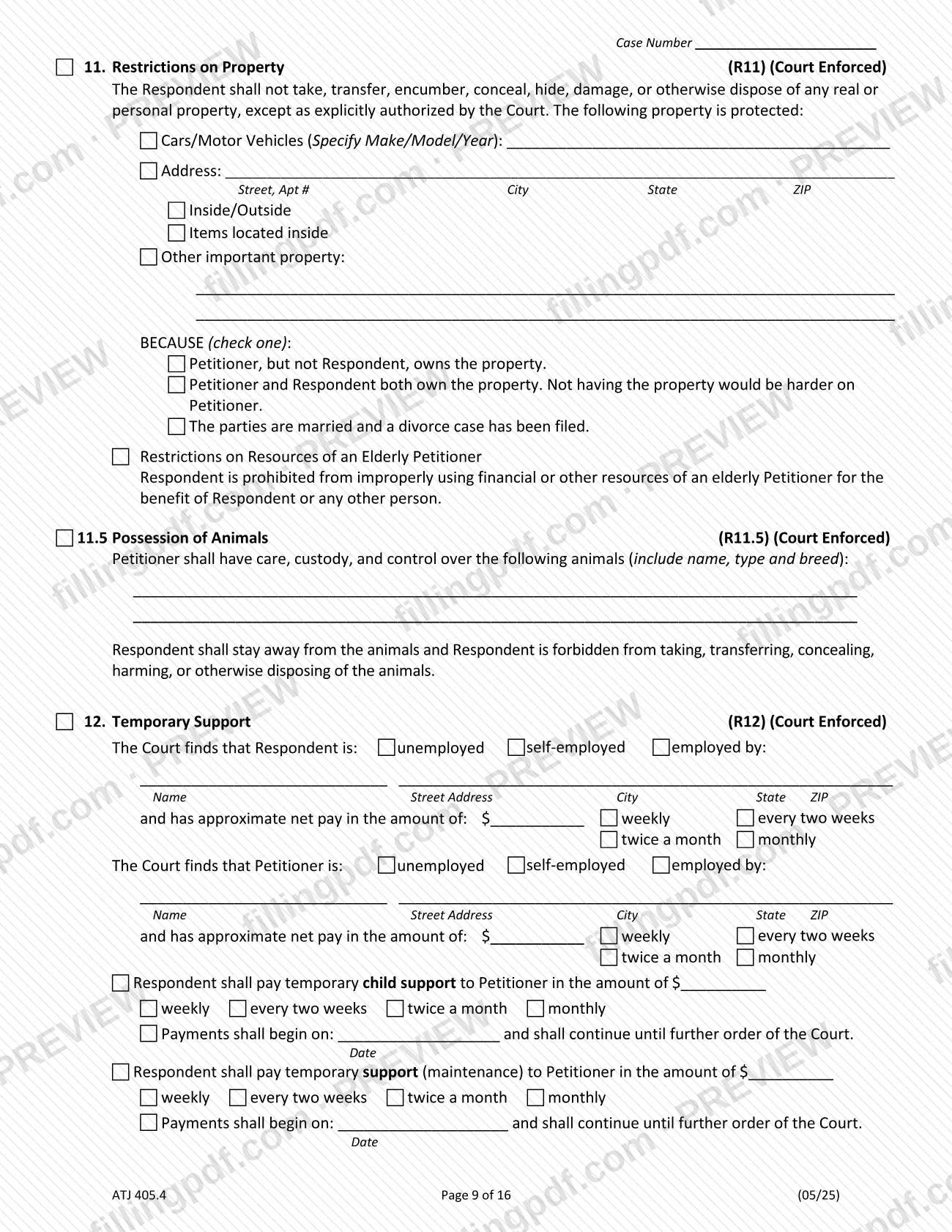
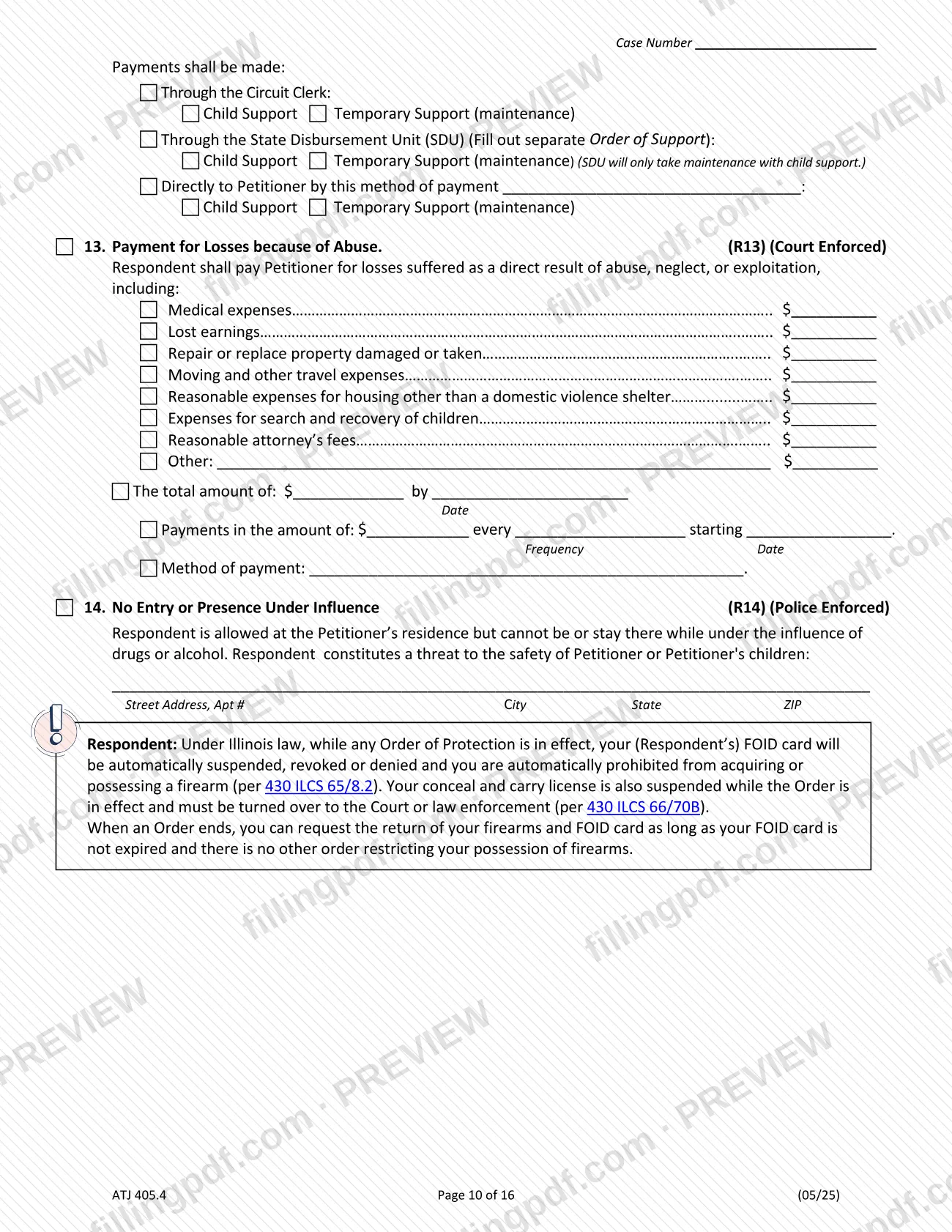
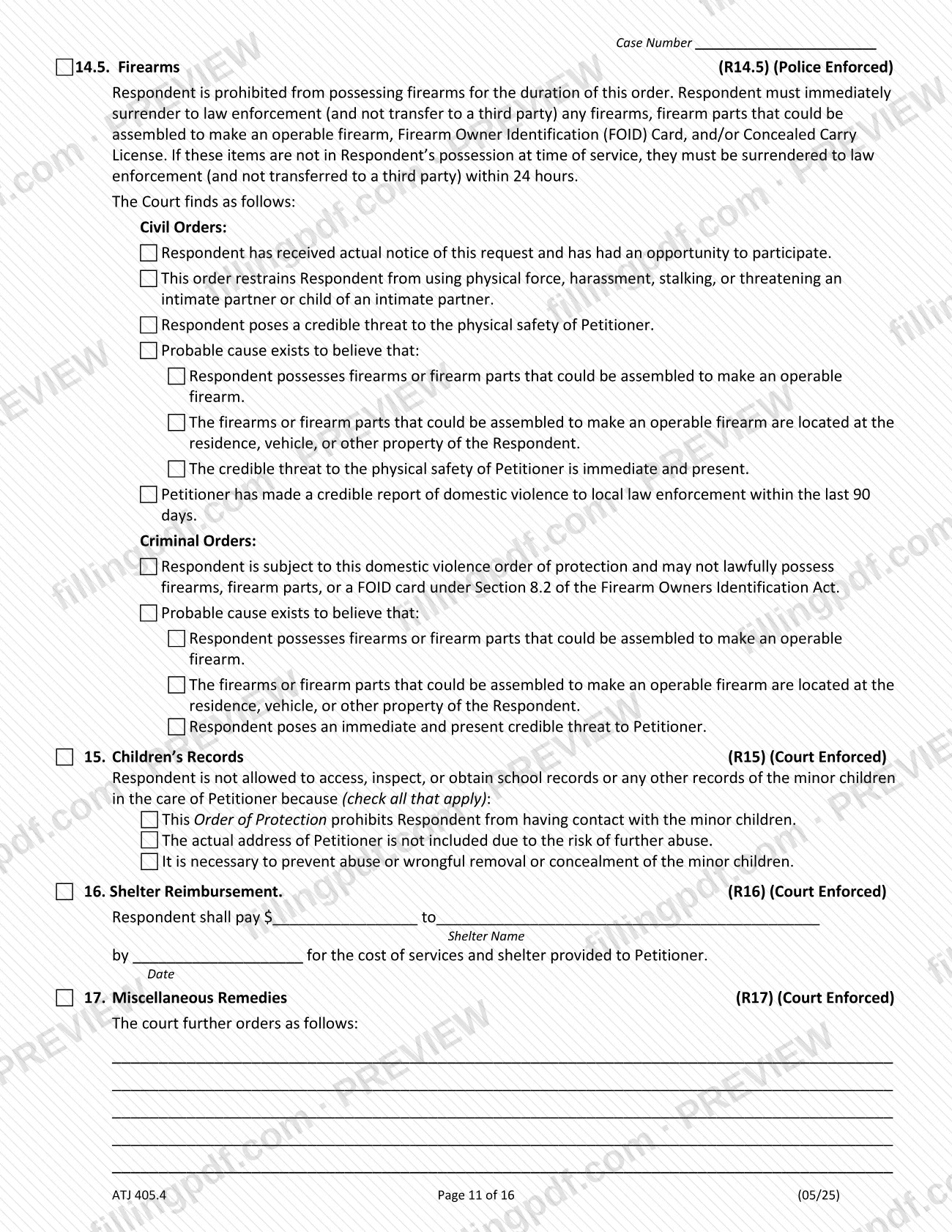
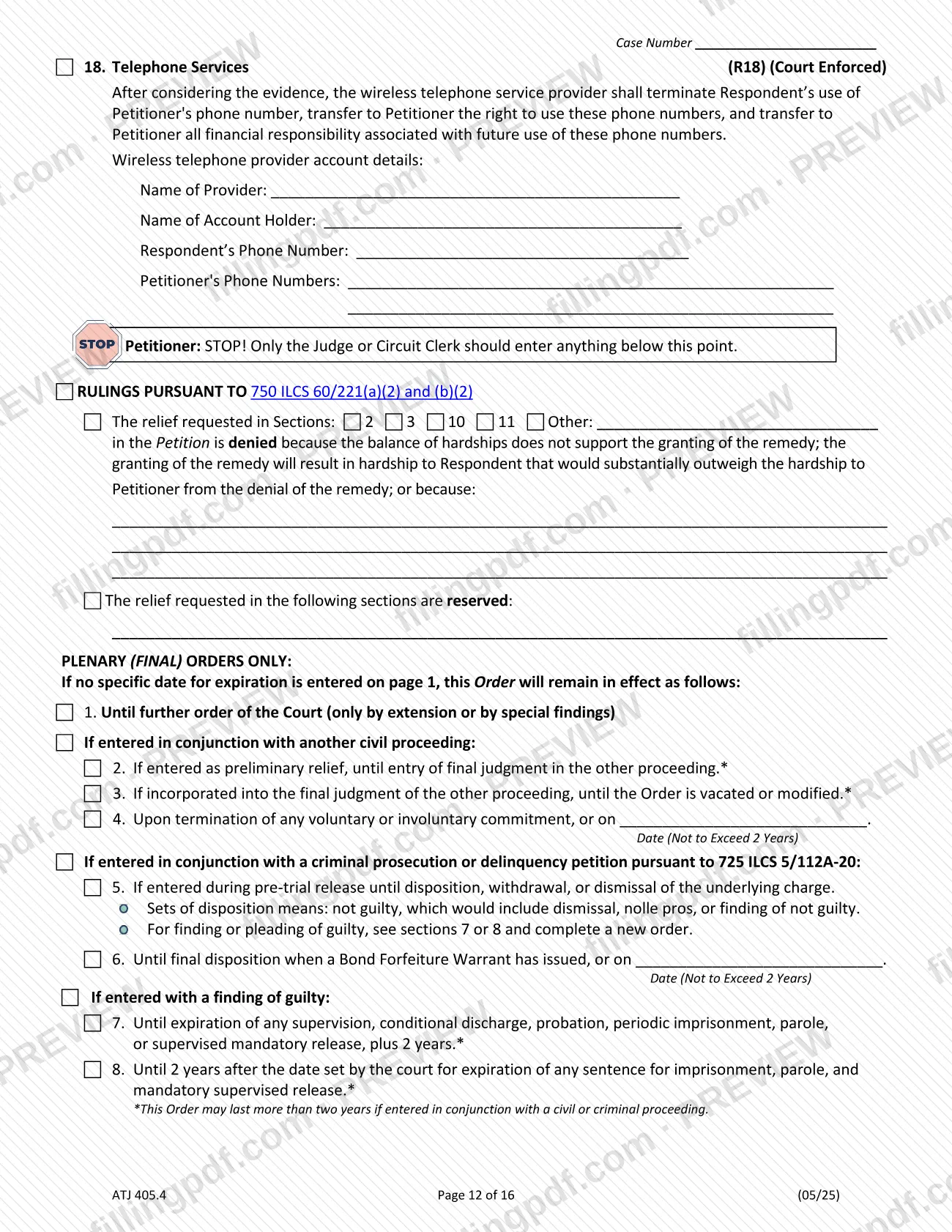
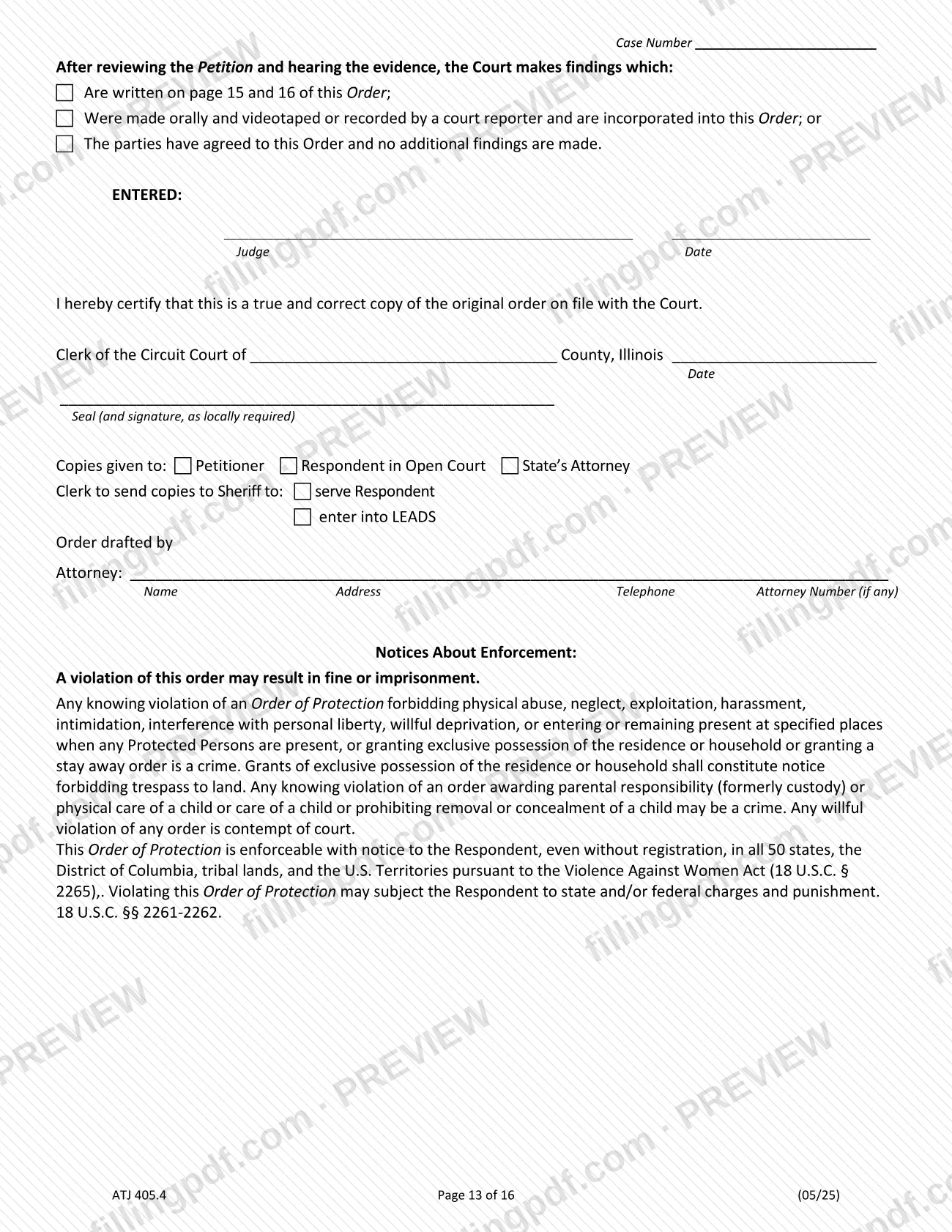
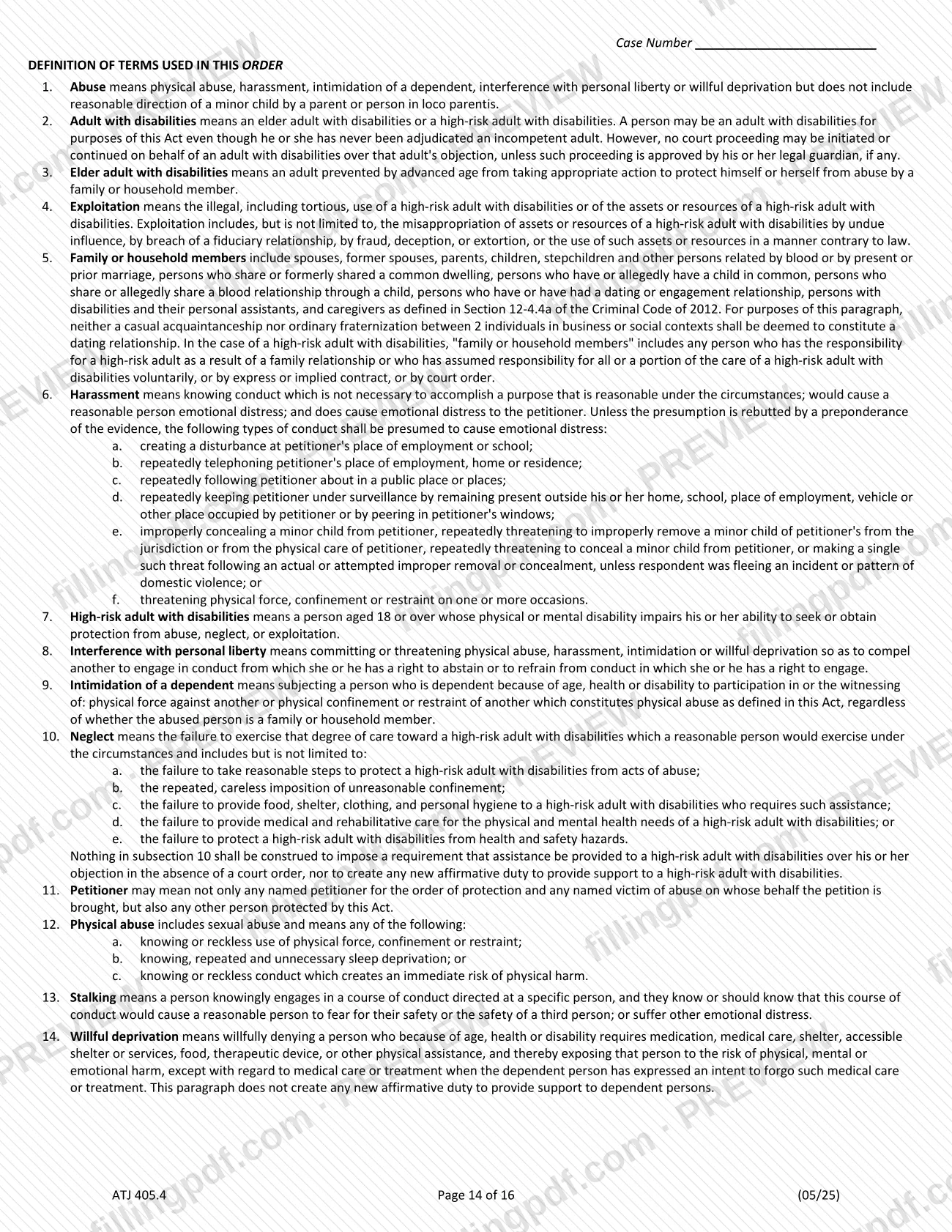
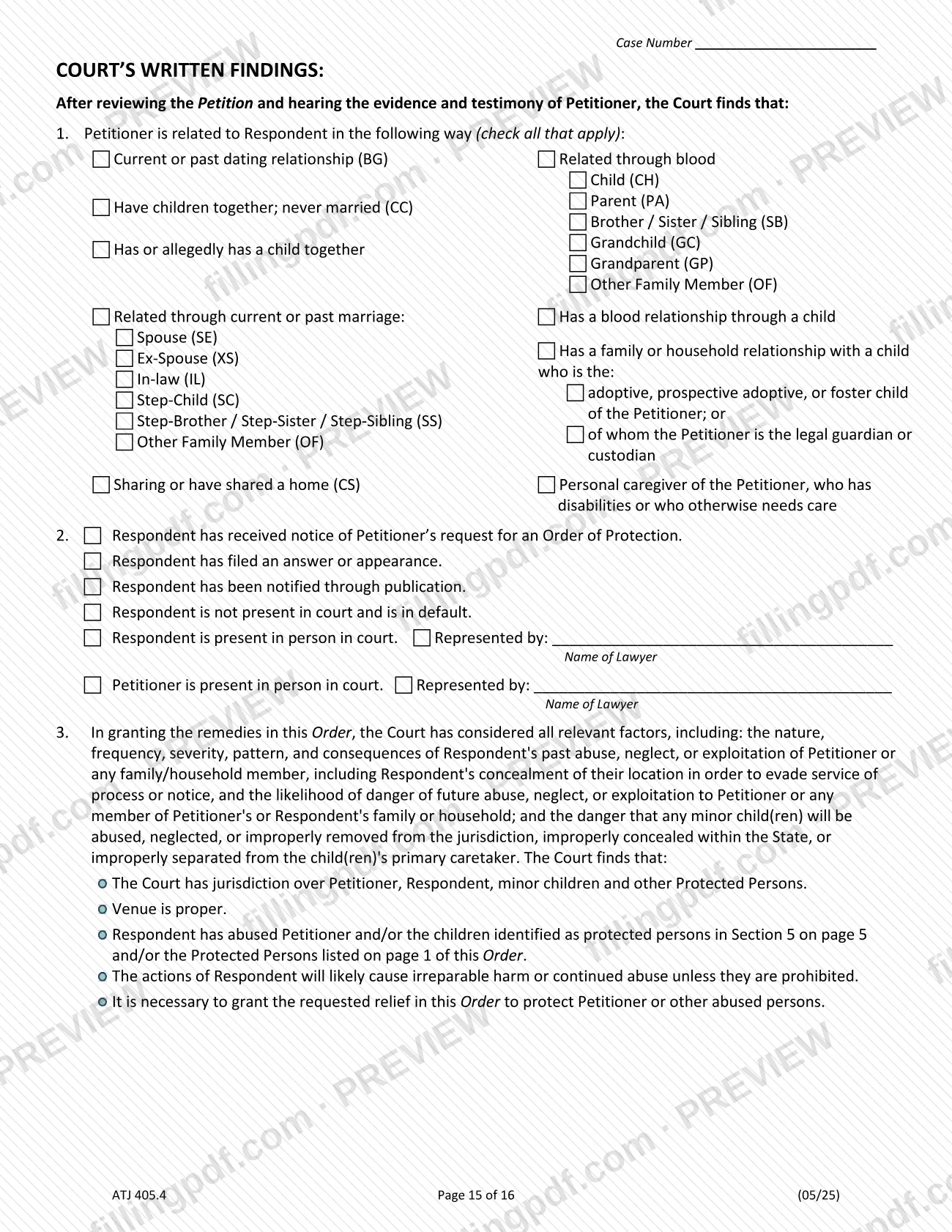
The form is 16 pages. Page 1 names the county, petitioner, respondent, case number and protected people, marks whether the order is Agreed, Modified or Extended, and identifies the proceeding: Interim or Plenary in a civil proceeding, Final in a criminal proceeding. Pages 3 to 12 contain numbered remedies, each labeled as police enforced or court enforced, from No Abuse (R01) through Telephone Services (R18). Pages 12 to 16 hold the court's rulings, the signature block for the judge and Circuit Clerk, notices about enforcement, definitions of terms such as abuse, harassment and stalking, and the court's written findings.
The Illinois Courts list this order separately from the Petition for Order of Protection, the Emergency Order of Protection and other approved forms in the same set. This document is the order itself, not the request for one. The form states that it is enforceable with notice to the respondent in all 50 states, the District of Columbia, tribal lands and the U.S. Territories.
Who needs to file ATJ 405.4?
The petitioner, the person who started the case, completes the information sections of this form. If you are completing it for a minor child, a dependent adult or a high-risk adult, the form says to enter the information as if you were that person, not your own.
Other people who appear on the form:
- Protected people: the petitioner, the petitioner's minor children with the respondent, other minor children, a dependent adult, a high-risk adult and other household members, each checked on page 1.
- Respondent: the person you are seeking protection from. Respondent details are entered only if known.
- Judge and Circuit Clerk: the form says only the judge or Circuit Clerk should enter anything below the line marked "STOP!" on page 12, including rulings, the expiration terms, the judge's signature and the clerk's certification.
Sections 5 to 9 apply only when there are children in common. Section 4 and several other remedies are checked only if the court is asked to grant them. Respondents, including a respondent who is a minor, receive the order; the form has a section for a parent or guardian's duties when the respondent is a minor.
When to file ATJ 405.4
The form is used when a court enters, modifies or extends an order of protection in a case; the boxes at the top mark the order as Agreed, Modified or Extended. No separate due date is printed on it.
Page 1 records the date and time the order was issued, the date and time it ends, and the next court date, including whether it is a status or hearing date and the courtroom. For Plenary (Final) orders with no expiration date entered on page 1, page 12 lists how long the order lasts, such as until further order of the court, until final judgment in a related civil case, or a date not to exceed 2 years. The form notes an order may last more than two years if entered with a civil or criminal proceeding.
Some timing rules are printed in the order itself. Firearms, firearm parts, a FOID card or a Concealed Carry License not in the respondent's possession at service must be surrendered to law enforcement within 24 hours. If Section 5 is used, the Circuit Clerk sends written notice to listed schools, daycare or health care providers within 24 hours of entry.
Documents you need
- Petition for Order of Protection: the order is entered in the case that begins with it; the Illinois Courts list it as a separate approved form.
- Confidential Name & Location of the School or Daycare form: for use when the Section 5 box says the school or daycare name and location are listed there for the petitioner's safety.
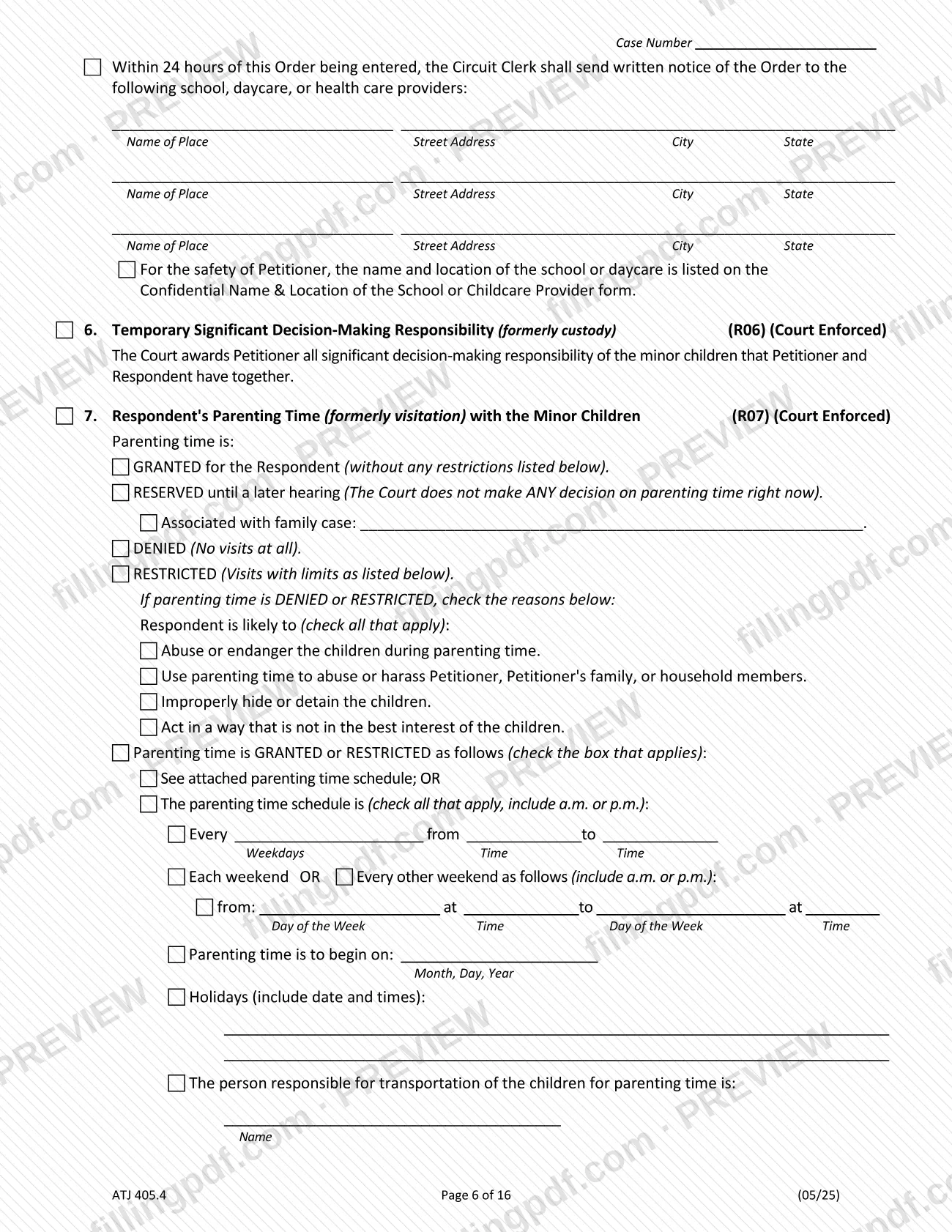
- Affidavit of Parenting Time Supervisor: filed or to be filed by the named supervisor when Section 7 provides that parenting time will be supervised by a named person.
- Attached parenting time schedule: when you check "See attached parenting time schedule" in Section 7 instead of filling out the schedule on the form.
- A separate Order of Support: when Section 12 payments are to go through the State Disbursement Unit (SDU).
- Court findings attached or recorded: the form says findings are written on pages 15 and 16, made orally and recorded, or not made if the parties agree.
How to fill out ATJ 405.4
Enter the court and case information
On page 1, enter the county where you are filing, the petitioner and respondent names (first, middle, last) and the case number as on your other court documents. Check Agreed, Modified or Extended if it applies, and the box for a minor or high-risk adult if you file on that person's behalf.
List the people to be protected
Check each person to include: Petitioner, the petitioner's minor children with Respondent, other minor children, a dependent adult, a high-risk adult or other household members, and write their names. Mark Interim or Plenary for a civil proceeding or Final for a criminal proceeding, with any related case numbers if known.
Complete the order information block
Enter the issue date and time, the end date and time (or check that the order ends as entered on page 12), and the next court date with status or hearing, time and courtroom.
Add how to attend court
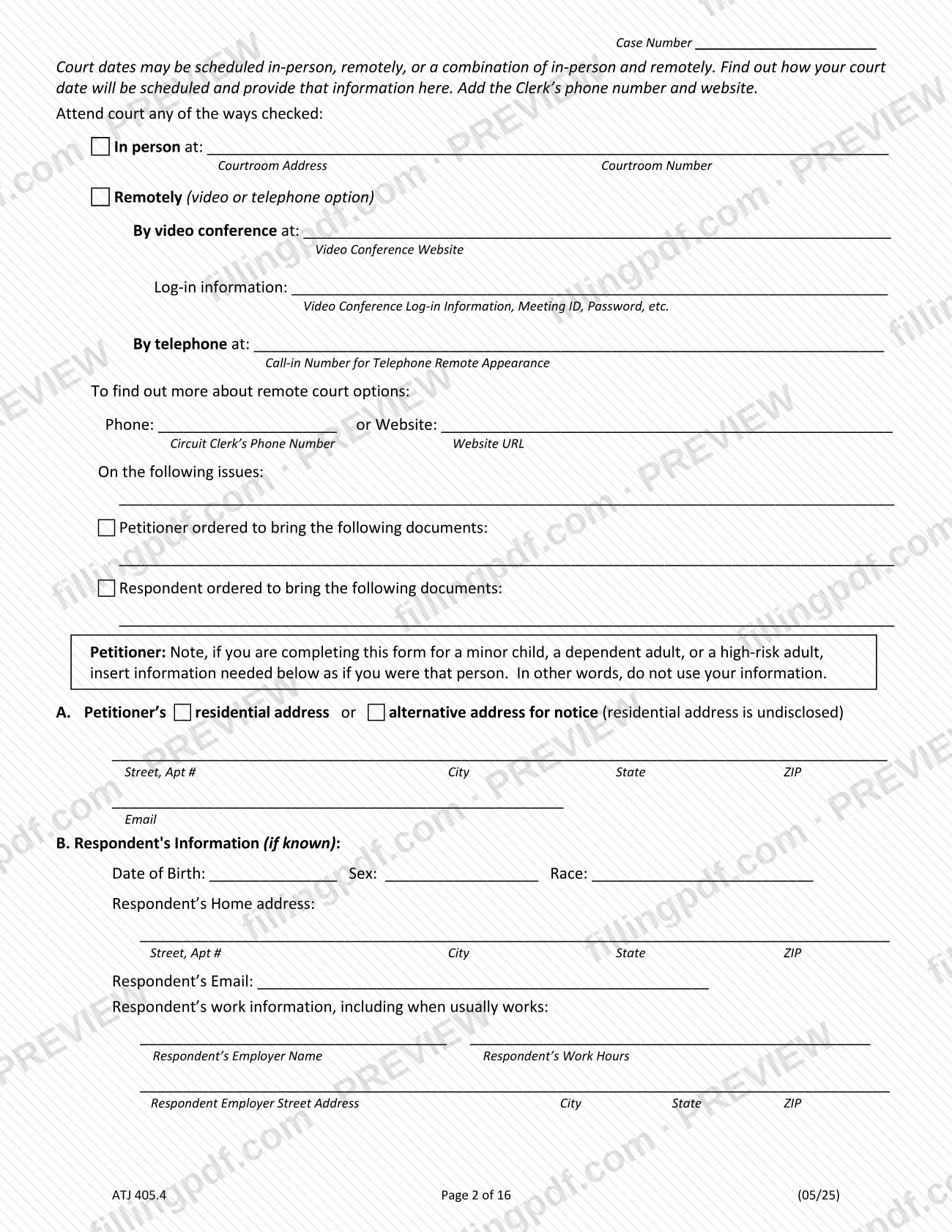
On page 2, check in person, video conference or telephone, and enter the courtroom address, the video website and log-in details or the call-in number. Add the Circuit Clerk's phone number and website, the issues for the date, and any documents either party must bring.
Enter petitioner and respondent details
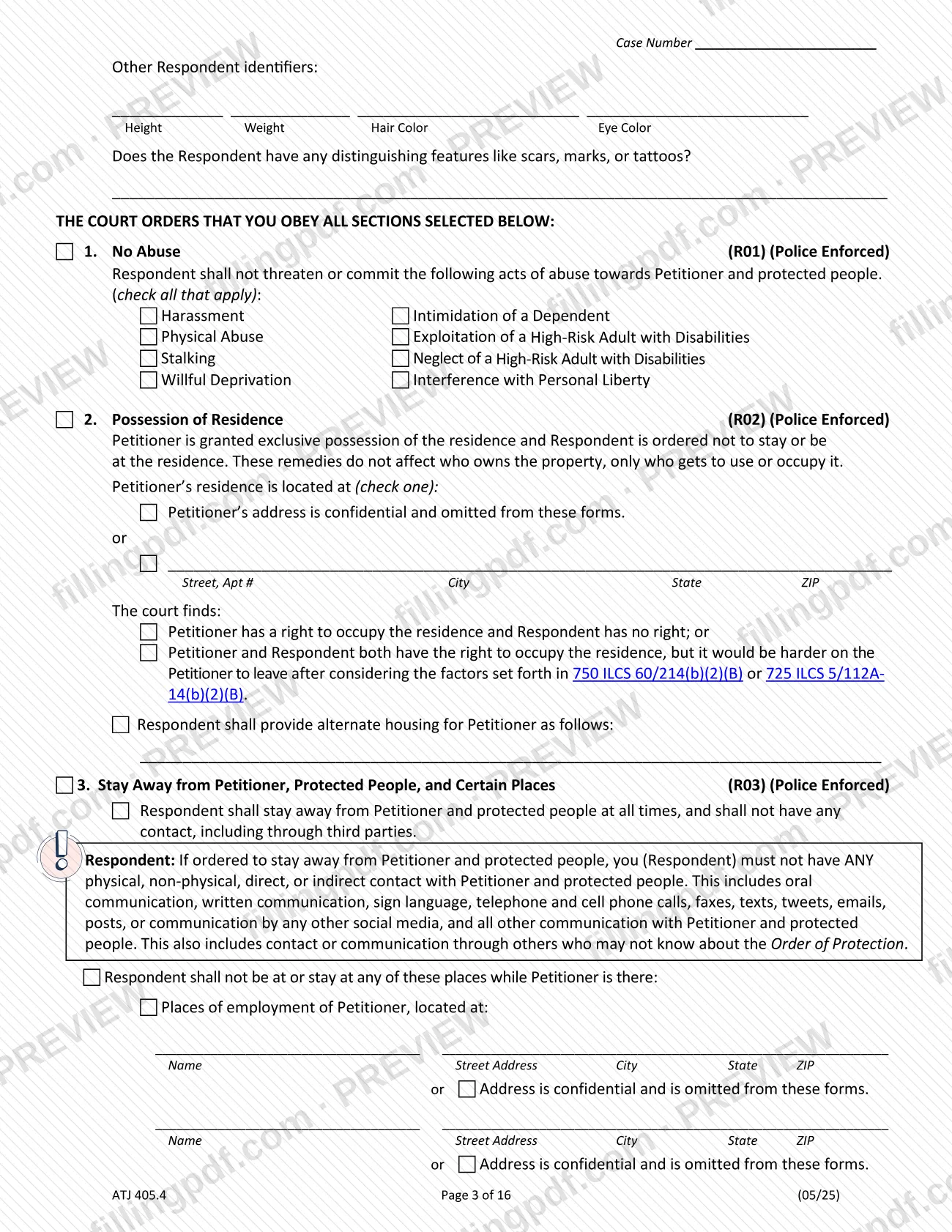
Under A, give the petitioner's residential or alternative address and email. Under B, enter what you know of the respondent: date of birth, sex, race, address, email, employer and work hours, height, weight, hair and eye color, and distinguishing features.
Select the protective remedies
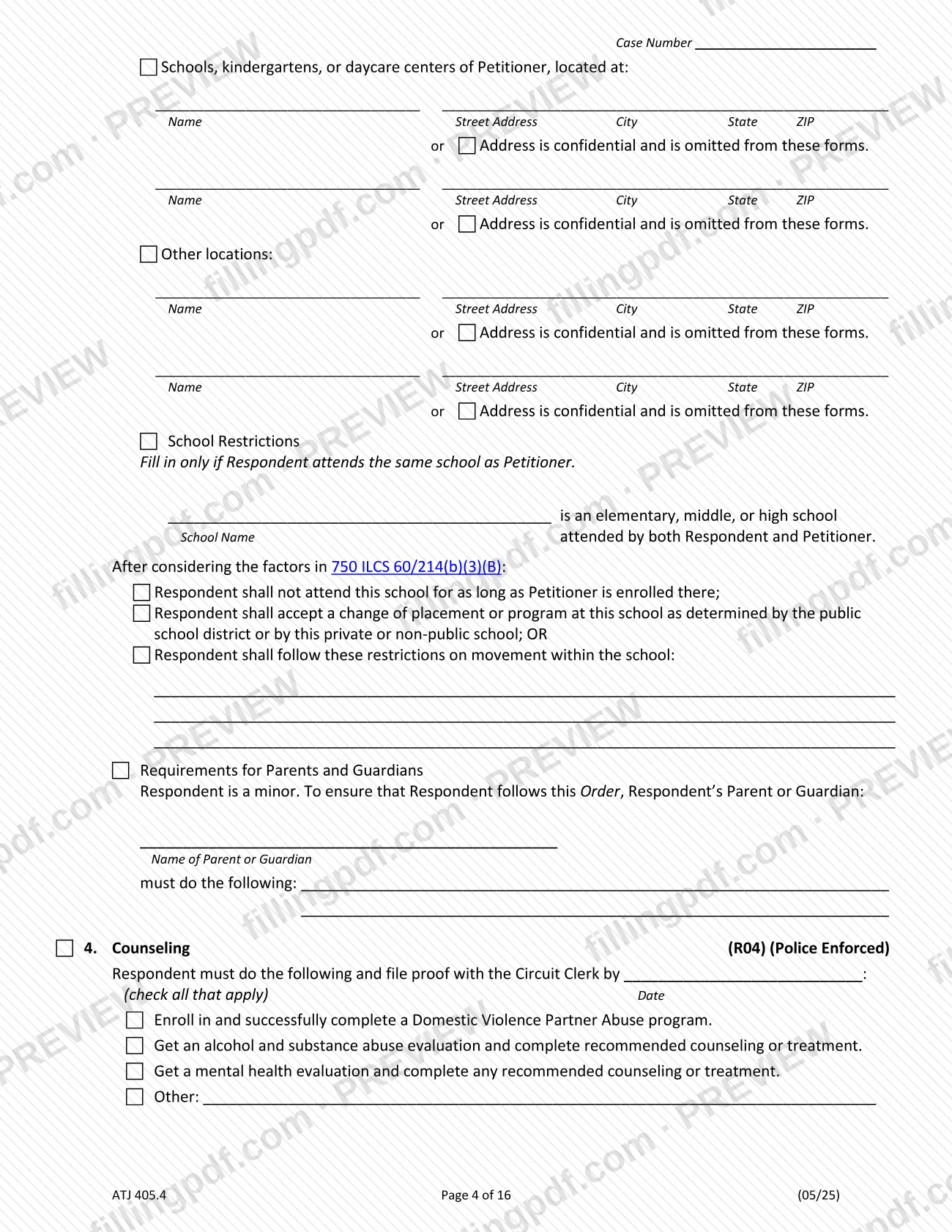
Check the sections you are asking the court to order: 1 No Abuse (R01), 2 Possession of Residence (R02), 3 Stay Away (R03) with any places or school restrictions, and 4 Counseling (R04) with its proof date.
Complete the children's sections
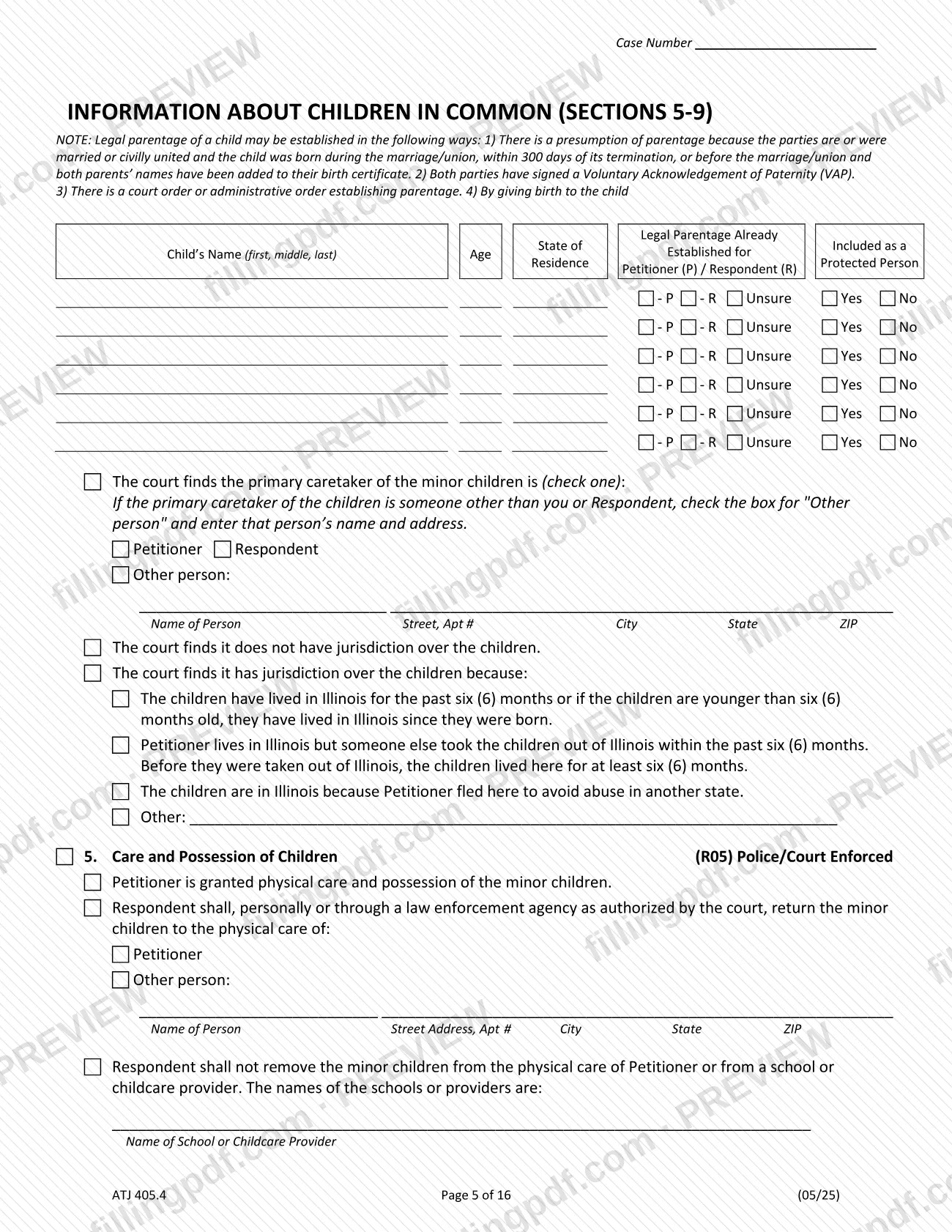
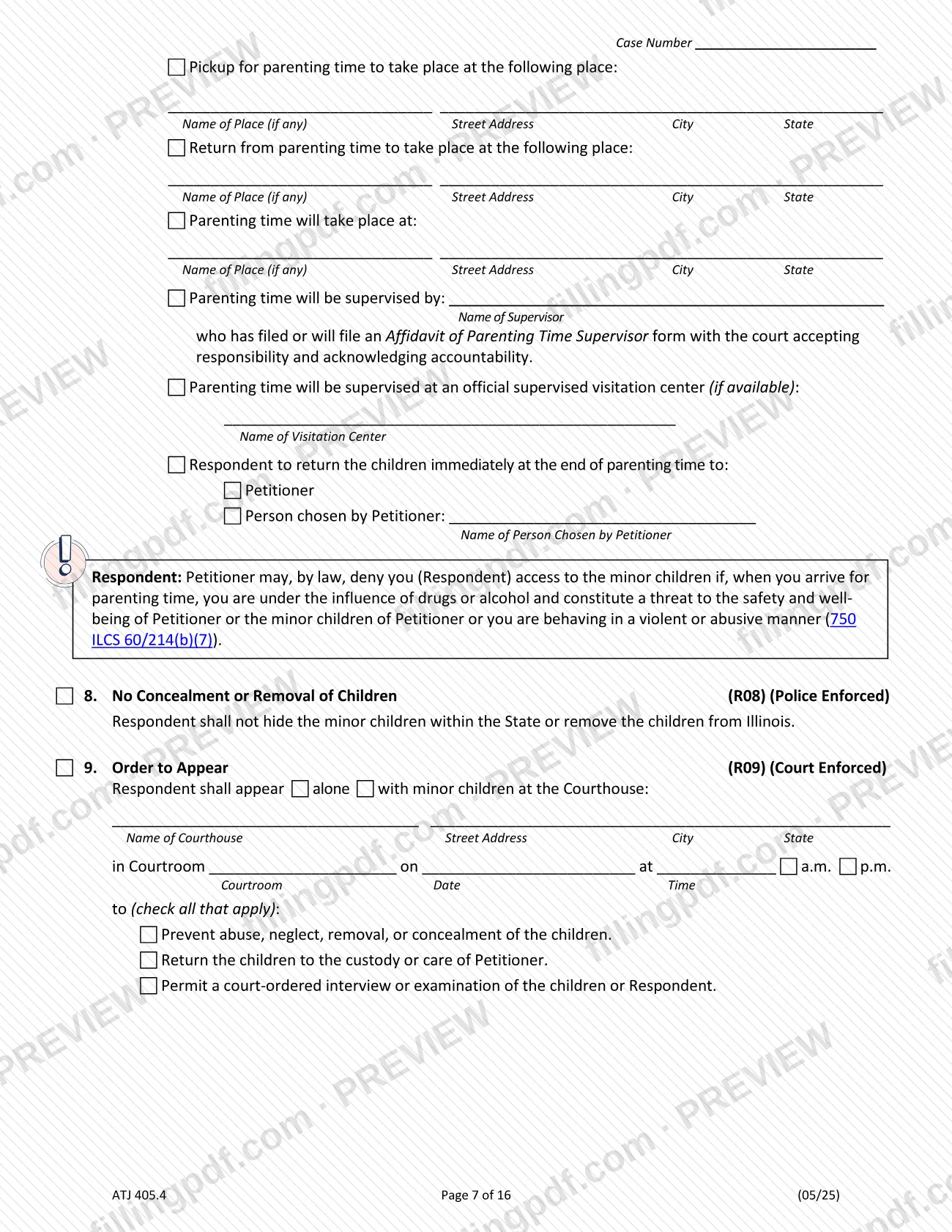
If there are children in common, list each child's name, age, state of residence, legal parentage and whether the child is a protected person. Then complete the primary caretaker and jurisdiction findings and sections 5 to 9, including parenting time terms in Section 7.
Complete the property and animal sections
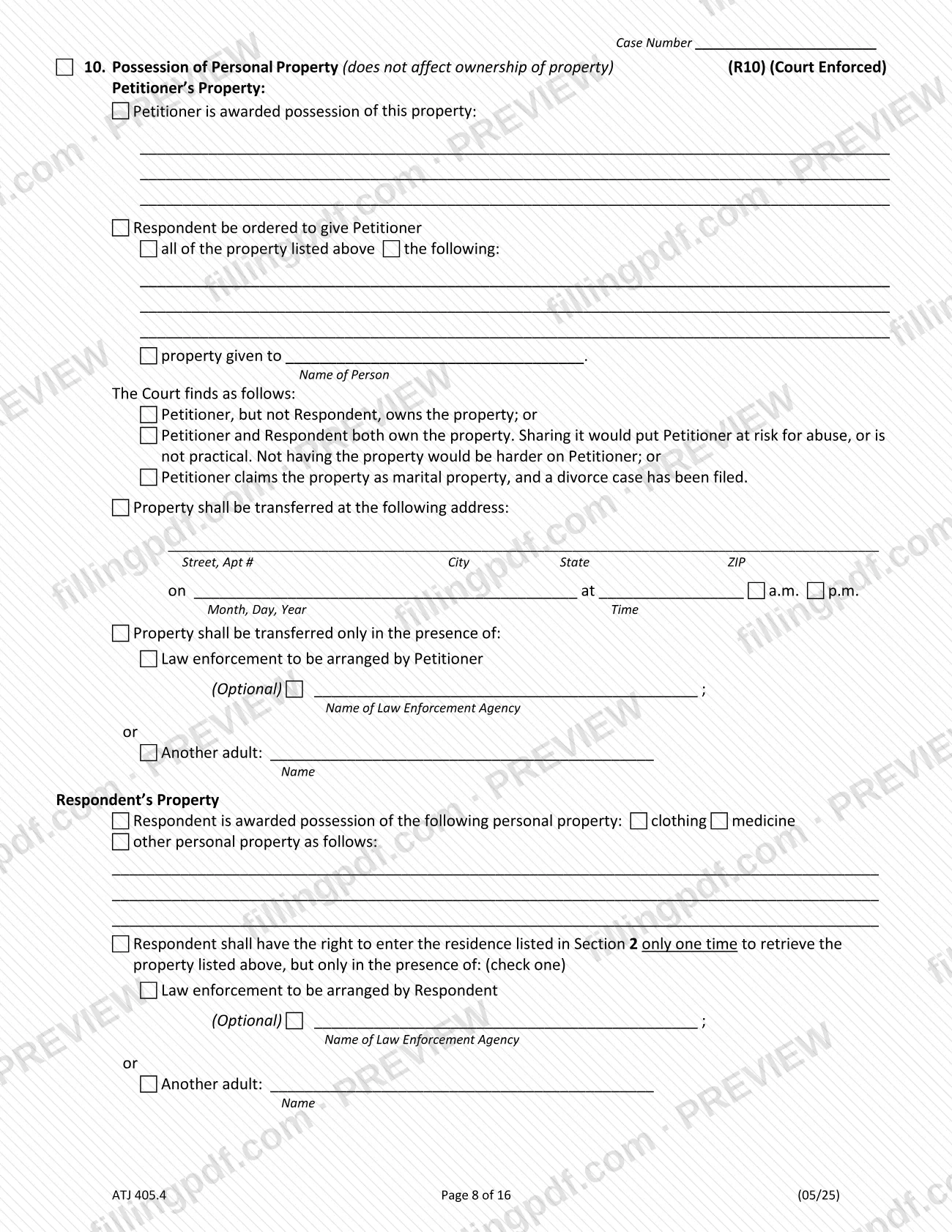
Use Section 10 for personal property, Section 11 for restrictions on cars, a location or other property, and the elderly petitioner box, and Section 11.5 for animals, entering names, types and breeds.
Complete the financial sections
Section 12 asks for employment and net pay details and temporary child support or maintenance with a payment method. Section 13 lists losses the respondent is ordered to pay, and Section 16 covers shelter reimbursement; amounts are filled in only where the court orders them.
Complete the remaining sections
Check Section 14 (No Entry or Presence Under Influence) with an address, Section 14.5 (Firearms) with the findings that apply, Section 15 (Children's Records), Section 17 (Miscellaneous Remedies) and Section 18 (Telephone Services) with provider account details.
Leave the court's portion blank
Do not enter anything below the "STOP!" line on page 12. Rulings, expiration terms, findings, the judge's signature, the clerk's certification and copy distribution belong to the judge or Circuit Clerk.
Review, flatten and download the PDF
Check that names, dates and checked boxes match your other court documents and that each completed section reflects what you are asking for. Download or print the completed PDF from FillingPDF, flatten it if you will e-file, and use the channels under How to submit.
How to submit ATJ 405.4
This form is filed in the Illinois circuit court of the county named at the top, under "County Where You Are Filing the Case." The Illinois Courts page for these forms describes e-filing and the Circuit Clerk as the points of contact.
- E-filing: you must "flatten" the completed PDF so it cannot be changed. In Adobe Acrobat or Reader, choose File, then Print, then Adobe PDF or Print to PDF, and save the result. Without Adobe, use a "Save as PDF" option in your software's print dialog. Open the flattened file to check that it looks filled out before you e-file it.
- Circuit Clerk: page 2 asks for the Circuit Clerk's phone number and website, where you can learn about remote court options. Contact the clerk of your county's circuit court about other ways to file.
- Guided help: Illinois Legal Aid Online offers a free guided interview, the Easy Form, that completes the forms from your answers.
Save each form as a PDF before you begin; the Illinois Courts warn that progress is lost if you fill out a form in a web page. After entry, the form shows copies given to the petitioner, respondent and State's Attorney, and the clerk sends copies to the Sheriff to serve the respondent and enter the order into LEADS. FillingPDF lets you fill out and download the PDF; submission follows the channels above.
Common mistakes to avoid
- Entering your own information when completing the form for a minor child, a dependent adult or a high-risk adult; the form says to enter that person's information instead.
- Writing anything below the line marked "STOP!" on page 12; only the judge or Circuit Clerk should enter rulings, expiration terms or the signature and certification there.
- Entering a confidential residence or workplace address instead of checking the box that the address is confidential and omitted from these forms.
- Checking the State Disbursement Unit payment option without preparing a separate Order of Support, or choosing it for maintenance alone; the SDU takes maintenance only with child support.
- Choosing a supervised parenting time option without the supervisor filing an Affidavit of Parenting Time Supervisor with the court.
- Filling out the PDF inside a web page without first downloading and saving it, which loses your progress.
- E-filing a PDF that has not been flattened, or not opening the flattened file to confirm it looks filled out.
- Checking sections 5 to 9 for children without listing each child's legal parentage status and whether the child is included as a protected person.
Frequently asked questions
What is an Illinois order of protection form?
Form ATJ 405.4, Order of Protection, is the statewide form approved by the Illinois Supreme Court that records an order of protection entered by an Illinois circuit court. It names the protected people, the remedies granted against the respondent and how long the order lasts.
Who fills out Form ATJ 405.4?
The petitioner completes the information sections, and the judge or Circuit Clerk completes everything below the "STOP!" line on page 12. If you are filling it out for a minor, a dependent adult or a high-risk adult, enter that person's information, not yours.
Can I fill out the Illinois Order of Protection form online?
Yes. You can fill out the PDF online on FillingPDF and download or print it. FillingPDF is an independent service and does not file the form with the court; you submit it through the court's channels, such as e-filing or the Circuit Clerk.
Do I need to flatten the PDF before e-filing?
Yes. The Illinois Courts say any form you e-file must be flattened so it cannot be changed. In Adobe Acrobat or Reader, print to Adobe PDF or Print to PDF and save the file, then open it to check it looks filled out.
How long does an order of protection last?
The end date is entered on page 1. If no date is entered on a Plenary (Final) order, page 12 sets how long it lasts, such as until further order of the court, until final judgment in a related case, or a date not to exceed 2 years. It may last longer with a civil or criminal proceeding.
What happens to the respondent's firearms under this order?
The form says the respondent's FOID card is suspended, revoked or denied while any order of protection is in effect, and the respondent cannot possess firearms. Under Section 14.5, items not in the respondent's possession at service must be surrendered to law enforcement within 24 hours.
What is the difference between this and the Emergency Order of Protection?
The Illinois Courts list the Order of Protection (this form), the Emergency Order of Protection and the Petition for Order of Protection as separate approved forms. This form is the order with civil Interim and Plenary and criminal Final options and the court's written findings.
Is an Illinois order of protection enforceable in other states?
Yes. The form states it is enforceable with notice to the respondent, even without registration, in all 50 states, the District of Columbia, tribal lands and the U.S. Territories under the Violence Against Women Act (18 U.S.C. § 2265). A violation may bring state or federal charges.
Ready to fill out ATJ 405.4?
Fill out ATJ 405.4 now