
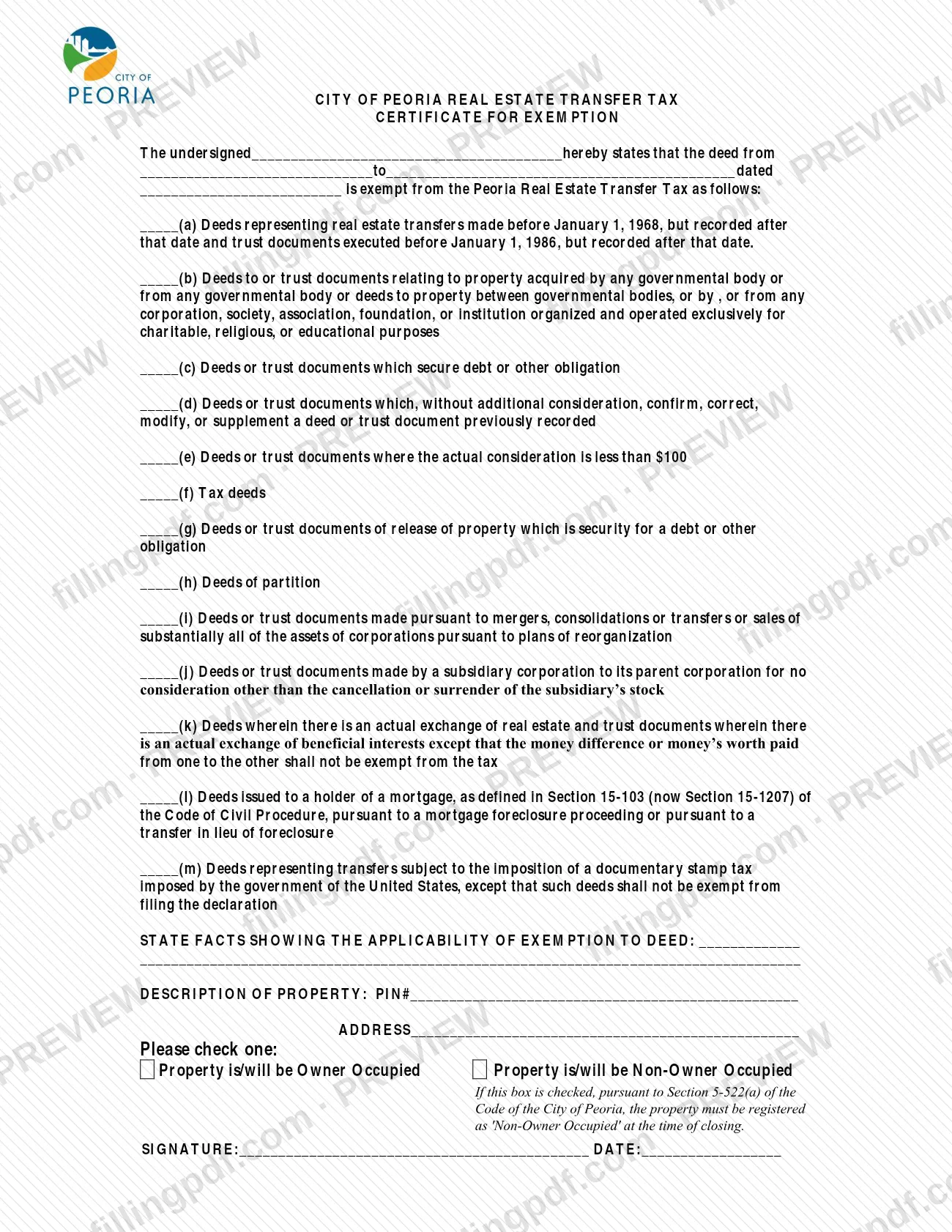
The City of Peoria Real Estate Transfer Certificate of Exemption is the certificate on which the undersigned states that a deed is exempt from the Peoria Real Estate Transfer Tax under one of the categories (a) through (m) printed on the form. It is a transfer-tax exemption statement about one deed, not a bill or return for Peoria County property tax. You can fill out the form online on FillingPDF and download or print the completed PDF; the official PDF is published by Peoria County at its Document Center.
Last updated
What is City of Peoria Real Estate Transfer Certificate of Exemption?
The City of Peoria Real Estate Transfer Certificate of Exemption, printed on the form as "City of Peoria Real Estate Transfer Tax Certificate for Exemption," is the statement in which the undersigned declares that a named deed is exempt from the Peoria Real Estate Transfer Tax and says why.
The certificate identifies the deed by its parties and date ("the deed from ___ to ___ dated ___"). The signer marks the blank in front of one exemption category and adds the facts that show the exemption applies. The categories printed on the form are:
- (a) deeds made before January 1, 1968 but recorded after that date, and trust documents executed before January 1, 1986 but recorded after that date;
- (b) transfers to or from governmental bodies, and transfers to or from charitable, religious or educational organizations;
- (c) deeds or trust documents that secure a debt or other obligation;
- (d) documents that confirm, correct, modify or supplement a recorded deed or trust document without additional consideration;
- (e) deeds or trust documents with actual consideration below the amount printed on the form;
- (f) tax deeds;
- (g) releases of property that is security for a debt or obligation;
- (h) deeds of partition;
- (i) transfers under mergers, consolidations or reorganization plans;
- (j) deeds from a subsidiary to its parent for no consideration other than cancellation or surrender of the subsidiary's stock;
- (k) actual exchanges of real estate or beneficial interests, except that the money difference or money's worth paid is not exempt;
- (l) deeds issued to a mortgage holder under a foreclosure or a transfer in lieu of foreclosure;
- (m) transfers subject to a federal documentary stamp tax, which are still not exempt from filing the declaration.
The form also describes the property by PIN and address and asks whether it is or will be owner occupied or non-owner occupied. It is separate from the Illinois Real Estate Transfer Declaration (PTAX-203), which the county's Recording Forms page lists on its own.
Who needs to file City of Peoria Real Estate Transfer Certificate of Exemption?
The person who signs the certificate, shown on the form as "the undersigned," uses it when a deed or trust document for property in the City of Peoria falls within one of the exemption categories (a) through (m) and the signer wants to state that exemption from the Peoria Real Estate Transfer Tax.
Conditions printed on the form:
- You must mark the one category that fits the deed and state the facts showing it applies.
- You must check whether the property is or will be owner occupied or non-owner occupied.
- If you check the non-owner occupied box, Section 5-522(a) of the Code of the City of Peoria requires the property to be registered as "Non-Owner Occupied" at the time of closing.
- Category (k) exempts an exchange but not the money difference or money's worth paid from one party to the other.
- Category (m) deeds are not excused from filing the declaration.
The form does not say who may sign for the undersigned or whether a representative may do so.
When to file City of Peoria Real Estate Transfer Certificate of Exemption
Complete the certificate when the deed or trust document it describes is prepared for recording and you are claiming an exemption from the Peoria Real Estate Transfer Tax. The form prints no separate due date.
Peoria County's Recording Forms page says that for deeds of land in the City of Peoria, certain documents must also be included with your recording, so timing follows the recording of the deed.
If you check Non-Owner Occupied, the form says the property must be registered as "Non-Owner Occupied" at the time of closing, so that registration cannot wait until after closing.
How to fill out City of Peoria Real Estate Transfer Certificate of Exemption
Enter the name of the undersigned
On the first blank after "The undersigned," write the name of the person making the statement.
Identify the deed
Fill in the grantor on the "from" line, the recipient on the "to" line and the date of the deed on the "dated" line.
Mark one exemption category
Write a mark on the blank in front of the one category, (a) through (m), that matches the deed or trust document. Read the wording of (k) and (m) closely, since each has an exception.
State the facts for the exemption
On the lines under "State facts showing the applicability of exemption to deed," explain why the category you marked applies.
Describe the property
Enter the PIN# and the property address under "Description of Property."
Choose the occupancy box
Check one: Property is/will be Owner Occupied, or Property is/will be Non-Owner Occupied. If you check the second box, the property must be registered as "Non-Owner Occupied" at closing.
Sign and date the certificate
Sign on the SIGNATURE line and write the date on the DATE line.
Review and download the PDF
Check the deed details, the marked category, the PIN and the address, then download or print the completed PDF from FillingPDF and deliver it as described under How to submit.
How to submit City of Peoria Real Estate Transfer Certificate of Exemption
The form prints no mailing address, portal or office. It is delivered through the deed recording process in Peoria County.
- Recording package: Peoria County's Recording Forms page (https://www.peoriacounty.gov/238/Recording-Forms) has a section called City of Peoria Deed Forms. It says that for deeds of land in the City of Peoria, certain documents must also be included with your recording. Check that page for the list, and ask the county whether this certificate belongs in your package.
- Illinois declaration: the same page says Peoria County participates in the State of Illinois MyDec system, which allows electronic submission of the PTAX-203 before a deed is recorded. That applies to the PTAX-203, not to this certificate.
- Registration: if the property is non-owner occupied, register it as "Non-Owner Occupied" at closing, as the form requires.
FillingPDF lets you fill out and download the PDF; submission follows the channels above.
Common mistakes to avoid
- Leaving every blank before (a) through (m) unmarked, so the certificate does not say which exemption you claim.
- Leaving the "State facts showing the applicability of exemption to deed" lines empty instead of explaining why the deed is exempt.
- Treating the money difference in an exchange under (k) as exempt; the form says money or money's worth paid from one party to the other is not exempt.
- Assuming a category (m) deed escapes the declaration; the form says such deeds are not exempt from filing it.
- Checking Non-Owner Occupied without registering the property as "Non-Owner Occupied" at closing, as Section 5-522(a) requires.
- Skipping the owner occupied or non-owner occupied choice, although the form says to check one.
- Omitting the PIN or the property address in the description of property.
- Leaving the signature or date blank.
Frequently asked questions
What is the City of Peoria Real Estate Transfer Certificate of Exemption?
It is a certificate in which the undersigned states that a deed is exempt from the Peoria Real Estate Transfer Tax. The signer marks one category from (a) through (m), states the supporting facts, gives the PIN and address, and signs and dates it.
Is this a Peoria County property tax form?
No. Although Peoria County publishes the PDF, the certificate concerns the Peoria Real Estate Transfer Tax on a deed, not a Peoria County property tax bill or return. It covers one deed and one property, identified by its PIN and address.
Which exemption category should I mark?
Mark the one category from (a) through (m) that matches your deed, such as (f) for tax deeds, (h) for deeds of partition or (l) for deeds issued to a mortgage holder after foreclosure. Then state the facts that support it on the lines provided.
Do I have to register the property if it is non-owner occupied?
Yes. The form says that if you check the Non-Owner Occupied box, Section 5-522(a) of the Code of the City of Peoria requires the property to be registered as "Non-Owner Occupied" at the time of closing.
Does a category (m) exemption mean I skip the declaration?
No. Category (m) covers transfers subject to a U.S. documentary stamp tax, but the form says those deeds are not exempt from filing the declaration. The county's Recording Forms page lists the Illinois PTAX-203 declaration separately.
Where do I submit the certificate?
The form names no address or portal. Peoria County's Recording Forms page says certain documents must be included with the recording of deeds of land in the City of Peoria. Check that page and ask the county whether this certificate belongs in your package.
Can I fill out the certificate online on FillingPDF?
Yes. You can fill out the PDF online on FillingPDF and download or print it. FillingPDF is an independent service: it does not file the certificate or record the deed, so you deliver it through the county's channels.
Ready to fill out City of Peoria Real Estate Transfer Certificate of Exemption?
Fill out City of Peoria Real Estate Transfer Certificate of Exemption now