
The PTAX-300-R Religious Application for Non-homestead Property Tax Exemption is the Illinois Department of Revenue (IDOR) form an organization completes to ask for a religious property tax exemption on a non-homestead property. It also serves as the county board of review's statement of facts, and Peoria County posts the PDF among its forms and documents, so it is one of the Peoria County property tax forms. The applicant completes Steps 1 through 6; the county board of review completes Steps 7 and 8. On FillingPDF you can fill out the form online and download or print the completed PDF, then file it with the county board of review where the property is located.
Last updated
What is PTAX-300-R?
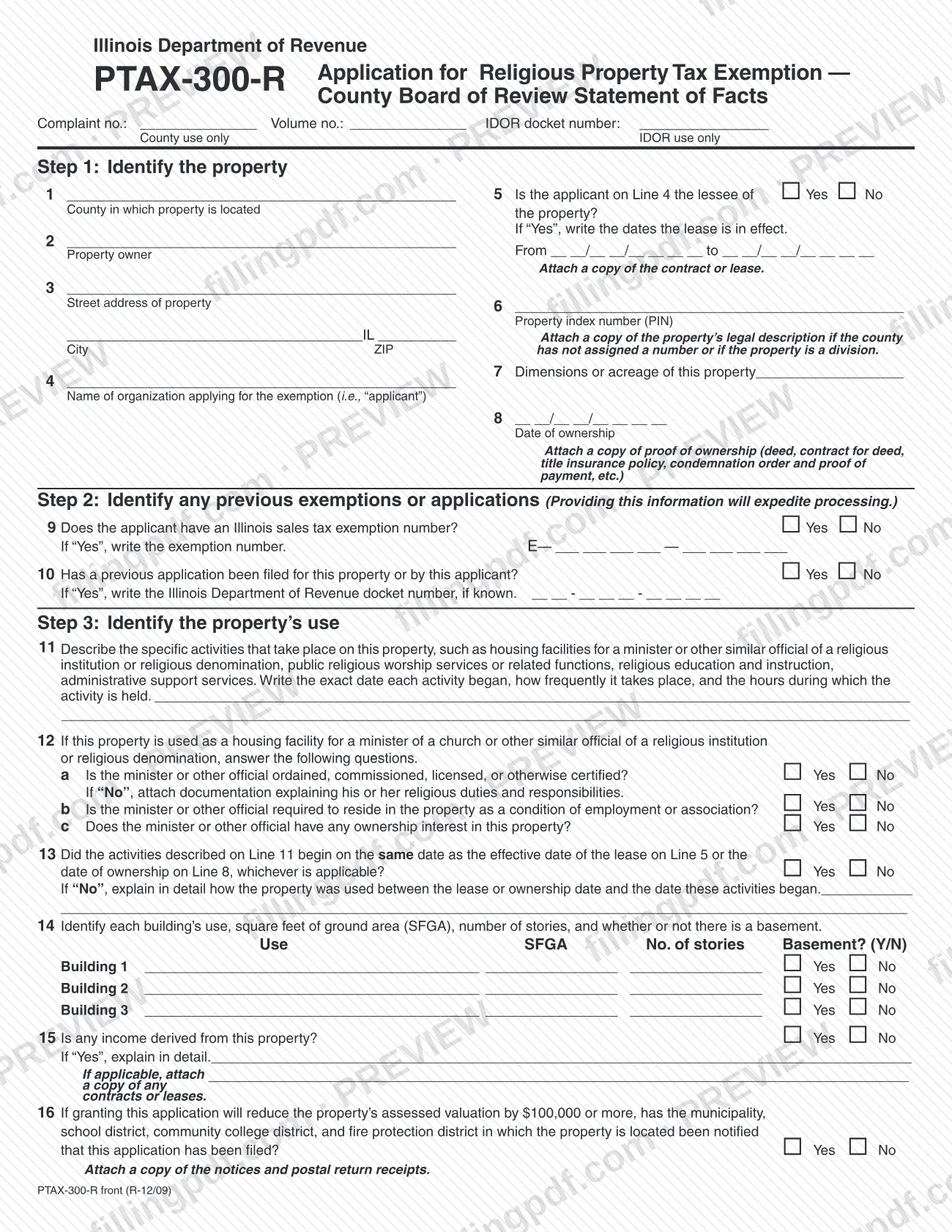
The PTAX-300-R Religious Application for Non-homestead Property Tax Exemption is the Illinois Department of Revenue (IDOR) form on which an organization applies for a religious property tax exemption for a non-homestead property. Its printed title is Application for Religious Property Tax Exemption — County Board of Review Statement of Facts.
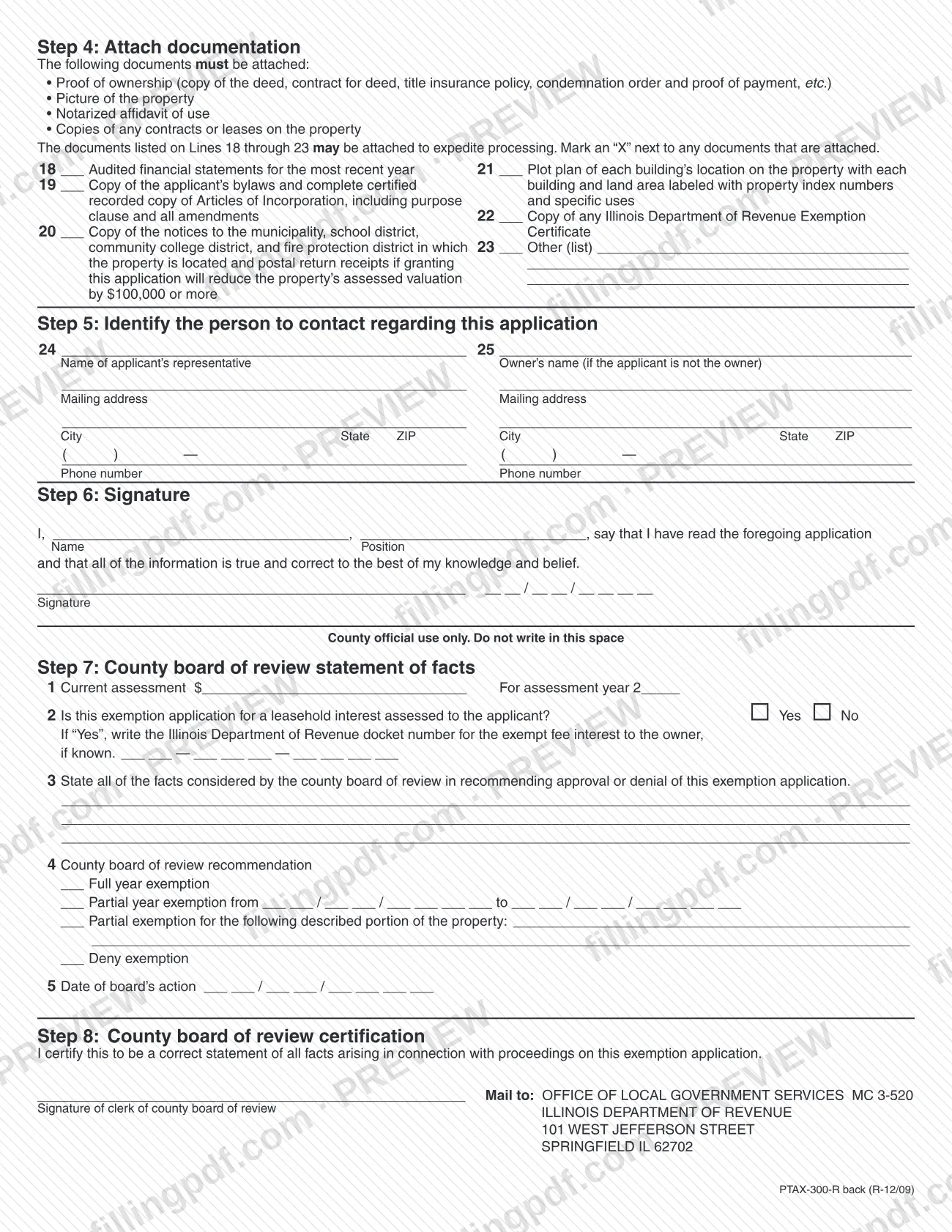
The form has two halves. The applicant completes Steps 1 through 6: identifying the property, listing previous exemptions or applications, describing how the property is used, attaching documentation, naming a contact person and signing. The county board of review completes Steps 7 and 8: the current assessment, the facts it considered, its recommendation (full year exemption, partial year exemption, partial exemption for a described portion, or denial), the date of its action and the clerk's certification.
The application is filed with the county board of review, which recommends whether to grant the exemption and forwards the form and supporting documents to IDOR. The department assigns a docket number, reviews the facts and decides whether the exemption should be granted.
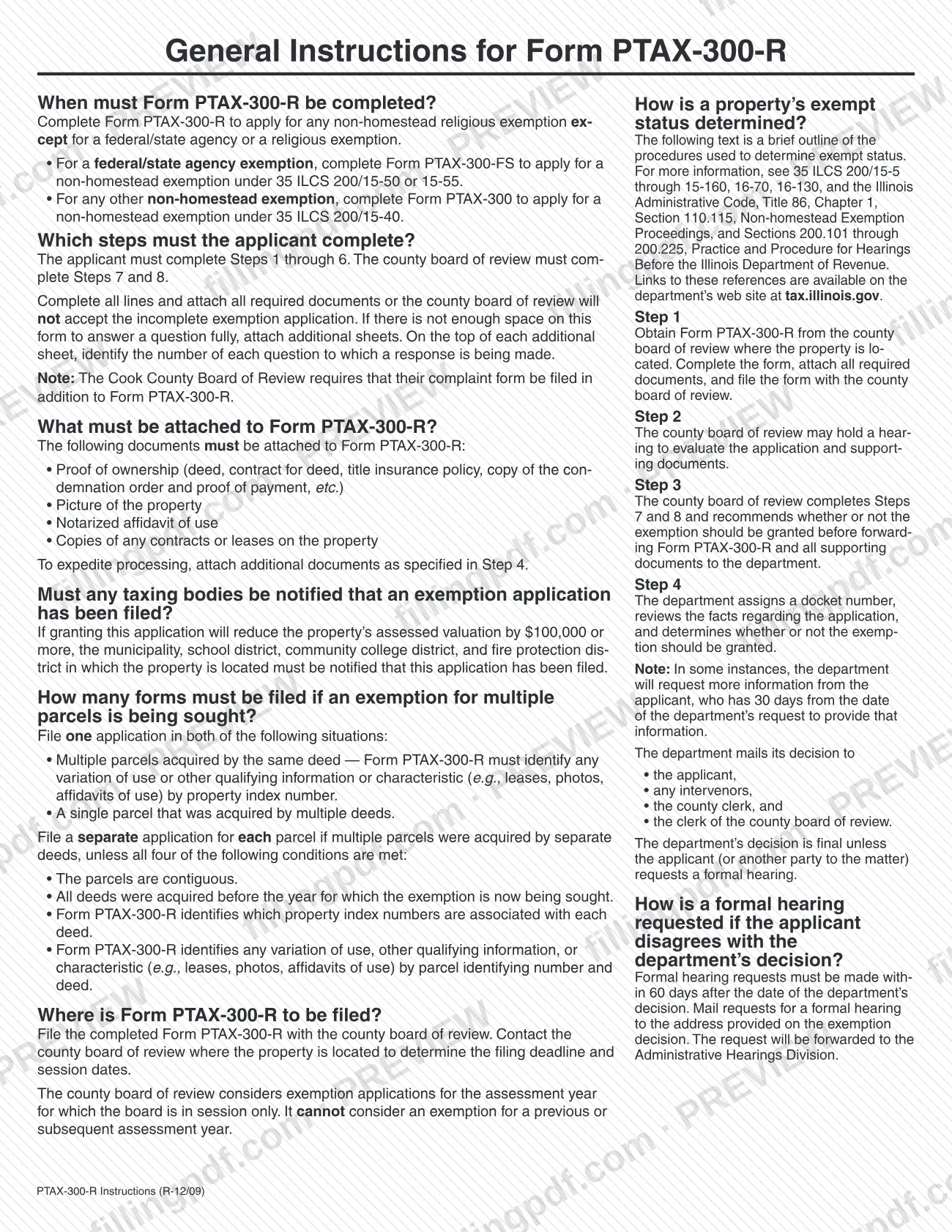
The instructions point to other forms for other cases. A federal or state agency exemption under 35 ILCS 200/15-50 or 15-55 uses Form PTAX-300-FS, and any other non-homestead exemption under 35 ILCS 200/15-40 uses Form PTAX-300. The instructions cite 35 ILCS 200/15-5 through 15-160, 16-70 and 16-130, and Title 86, Chapter 1, Section 110.115 of the Illinois Administrative Code. The revision printed on this form is R-12/09.
Who needs to file PTAX-300-R?
An organization that wants a religious exemption from property tax on a non-homestead property files Form PTAX-300-R. The organization is the "applicant" on Line 4, whether it owns the property or leases it (Line 5).
Conditions the form attaches:
- If the applicant is not the owner, the owner's name, mailing address and phone number go on Line 25.
- The applicant's representative, or whoever the county board of review and IDOR should contact, goes on Line 24.
- The signer writes a name and position and states that the information is true and correct to the best of his or her knowledge and belief.
- If the property houses a minister or similar official of a religious institution, the applicant also answers Line 12.
- Multiple parcels acquired by the same deed, or a single parcel acquired by multiple deeds, take one application. Parcels acquired by separate deeds need a separate application each, unless the parcels are contiguous, all deeds predate the year being sought, and the form identifies the property index numbers and any variation of use by deed.
Do not use this form for a federal or state agency exemption (Form PTAX-300-FS) or for any other non-homestead exemption (Form PTAX-300). The Cook County Board of Review requires its own complaint form in addition to Form PTAX-300-R.
When to file PTAX-300-R
File Form PTAX-300-R with the county board of review in the assessment year for which you seek the exemption. The instructions tell you to contact the board of review where the property is located to learn the filing deadline and session dates.
The board considers applications only for the assessment year in which it is in session. It cannot consider an exemption for a previous or subsequent assessment year.
After filing, timing depends on the later steps. If IDOR requests more information, the applicant has 30 days from the date of the department's request to provide it. The department's decision is final unless the applicant or another party requests a formal hearing within 60 days after the date of the decision. The instructions give no processing time.
Documents you need
- Proof of ownership: a copy of the deed, contract for deed, title insurance policy, or condemnation order and proof of payment. Always required.
- A picture of the property. Always required.
- A notarized affidavit of use. Always required.
- Copies of any contracts or leases on the property. Required if there are any; a lease copy is also attached when the applicant is the lessee on Line 5.
- A copy of the property's legal description, if the county has not assigned a property index number or if the property is a division.
- Copies of the notices to the municipality, school district, community college district and fire protection district, with postal return receipts, if granting the application will reduce assessed valuation by $100,000 or more.
- Documentation explaining the religious duties and responsibilities of a minister or other official, if the answer to Line 12a is "No".
- A copy of the Illinois Department of Revenue Exemption Certificate for the exempt parcel, if the property is a parking area, playground, lawn or other ancillary use to an already exempt parcel.
- Optional, to expedite processing (Lines 18 through 23): audited financial statements for the most recent year, bylaws and certified recorded Articles of Incorporation with all amendments, and a plot plan of each building's location labeled with property index numbers.
How to fill out PTAX-300-R
Identify the county, owner and address
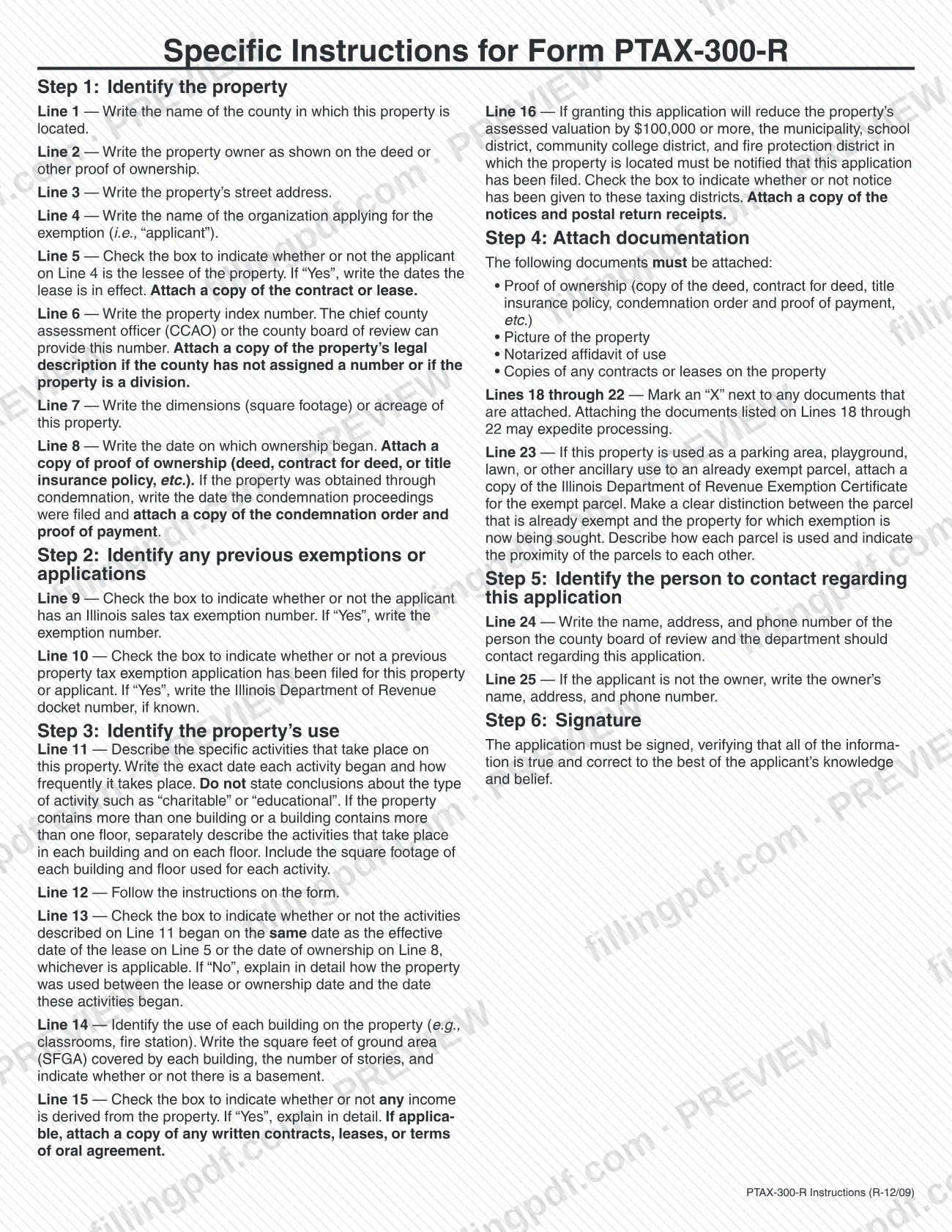
Line 1: the county where the property is located. Line 2: the property owner as shown on the deed or other proof of ownership. Line 3: the property's street address.
Name the applicant and any lease
Line 4: the name of the organization applying for the exemption. Line 5: check Yes or No for whether it is the lessee; if Yes, enter the lease dates and attach the contract or lease.
Enter PIN, size and ownership date
Line 6: the property index number (PIN), which the chief county assessment officer or the county board of review can provide; attach the legal description if no number is assigned or the property is a division. Line 7: dimensions or acreage. Line 8: the date ownership began, with proof of ownership attached.
Report previous exemptions and applications
Line 9: check Yes or No for an Illinois sales tax exemption number and enter it if Yes. Line 10: check Yes or No for a previous application and enter the IDOR docket number if known.
Describe the activities on the property
Line 11: describe the specific activities, the exact date each began, how often it takes place and the hours held. Do not state conclusions; describe each building and floor separately, with square footage.
Answer the minister housing questions
If the property houses a minister or similar official, answer Lines 12a, 12b and 12c. If 12a is No, attach documentation of religious duties. Then answer Line 13 and, if No, explain how the property was used before the activities began.
List buildings and income
Line 14: for each building, enter its use, square feet of ground area (SFGA), number of stories and whether it has a basement. Line 15: check Yes or No for income from the property and explain in detail if Yes, attaching any contracts or leases.
Confirm taxing body notices
Line 16: if granting the application will reduce assessed valuation by $100,000 or more, check whether the municipality, school district, community college district and fire protection district were notified, and attach the notices and postal return receipts.
Mark the attached documents
In Step 4, make sure the required documents are attached. Mark an X next to each document on Lines 18 through 22 that you attach, and list anything else on Line 23.
Add contact and owner details
Line 24: name, mailing address and phone number of the applicant's representative or contact person. Line 25: the owner's name, mailing address and phone number, if the applicant is not the owner.
Sign and date Step 6
Enter your name and position and sign and date the statement that the information is true and correct to the best of your knowledge and belief. Leave Steps 7 and 8 blank.
Review and download the completed PDF
Check that every line is answered and that each attachment is ready, with any extra sheets labeled by question number. Download or print the completed PDF from FillingPDF and file it with the county board of review as described under How to submit.
How to submit PTAX-300-R
File the completed form with the county board of review of the county where the property is located; the instructions name no other filing channel.
- Get the form: the instructions say to obtain Form PTAX-300-R from the county board of review where the property is located. Peoria County also posts the PDF at the link given for this page.
- File with the board: submit the signed form with every required attachment. If a question needs more room, attach additional sheets and write the question number at the top of each sheet. The board will not accept an incomplete application.
- Board hearing: the board may hold a hearing to evaluate the application and supporting documents.
- Forwarding to IDOR: the board completes Steps 7 and 8 and forwards the form and all supporting documents to the department. The form's back prints the mail-to address for that step: Office of Local Government Services MC 3-520, Illinois Department of Revenue, 101 West Jefferson Street, Springfield IL 62702.
- Decision: the department mails its decision to the applicant, any intervenors, the county clerk and the clerk of the county board of review. To request a formal hearing, mail the request to the address on the decision.
FillingPDF lets you fill out and download the PDF; submission follows the channels above.
Common mistakes to avoid
- Filing an incomplete application or leaving out a required attachment; the county board of review will not accept it.
- Omitting the notarized affidavit of use, the picture of the property, proof of ownership, or copies of contracts or leases.
- Stating conclusions such as "charitable" or "educational" on Line 11 instead of the specific activities, with the exact date each began and how often it takes place.
- Describing the property as a whole when it has several buildings or floors; the instructions ask for each building and each floor, with square footage, to be described separately.
- Not notifying the municipality, school district, community college district and fire protection district when the exemption would reduce assessed valuation by $100,000 or more, or not attaching the notices and postal return receipts.
- Combining parcels acquired by separate deeds on one application when the contiguity, deed-date and identification conditions are not all met.
- Writing in Steps 7 and 8, which the county board of review completes.
- Using Form PTAX-300-R for a federal or state agency exemption or another non-homestead exemption, which use Forms PTAX-300-FS and PTAX-300.
- Assuming the board can grant the exemption for a previous or later assessment year; it considers only the year in which it is in session.
- Skipping the Cook County Board of Review complaint form when the property is in Cook County, which requires it in addition to Form PTAX-300-R.
Frequently asked questions
What is Form PTAX-300-R used for?
Form PTAX-300-R is the application for a non-homestead religious property tax exemption in Illinois. The applicant fills in Steps 1 through 6, the county board of review adds its statement of facts and recommendation in Steps 7 and 8, and the Illinois Department of Revenue decides.
Where do I file Form PTAX-300-R?
File it with the county board of review in the county where the property is located. Contact that board to learn the filing deadline and session dates. The board forwards the form and supporting documents to the Illinois Department of Revenue after completing Steps 7 and 8.
What documents must I attach to PTAX-300-R?
Attach proof of ownership, a picture of the property, a notarized affidavit of use, and copies of any contracts or leases. Lines 18 through 23 list extra documents, such as audited financial statements and bylaws, that may expedite processing. Other attachments depend on your answers.
Do I have to notify the school district or other taxing bodies?
Only if granting the application will reduce the property's assessed valuation by $100,000 or more. Then the municipality, school district, community college district and fire protection district must be notified; check the box on Line 16 and attach the notices and postal return receipts.
When is the deadline to file the religious exemption application?
The instructions set no date; ask the county board of review where the property is located for the filing deadline and session dates. The board considers only the assessment year for which it is in session, not earlier or later years.
What happens after I file Form PTAX-300-R?
The board of review may hold a hearing, completes Steps 7 and 8 and forwards everything to the Illinois Department of Revenue, which assigns a docket number and reviews it. If the department asks for more information you have 30 days to respond. Its decision is mailed to the parties.
How do I appeal the department's decision?
Request a formal hearing within 60 days after the date of the department's decision. Mail the request to the address provided on the decision, and it is forwarded to the Administrative Hearings Division. The decision is final unless a party requests a formal hearing.
Can I fill out PTAX-300-R online?
You can fill out the PDF online on FillingPDF and download or print it. FillingPDF is an independent service, is not connected to Peoria County or the Illinois Department of Revenue, and does not file the application; you file it with the county board of review.
Do I need one application for several parcels?
One application covers multiple parcels acquired by the same deed, and a single parcel acquired by multiple deeds. Parcels acquired by separate deeds need separate applications unless they are contiguous, all deeds predate the year sought, and the form identifies index numbers and variations in use by deed.
Ready to fill out PTAX-300-R?
Fill out PTAX-300-R now