
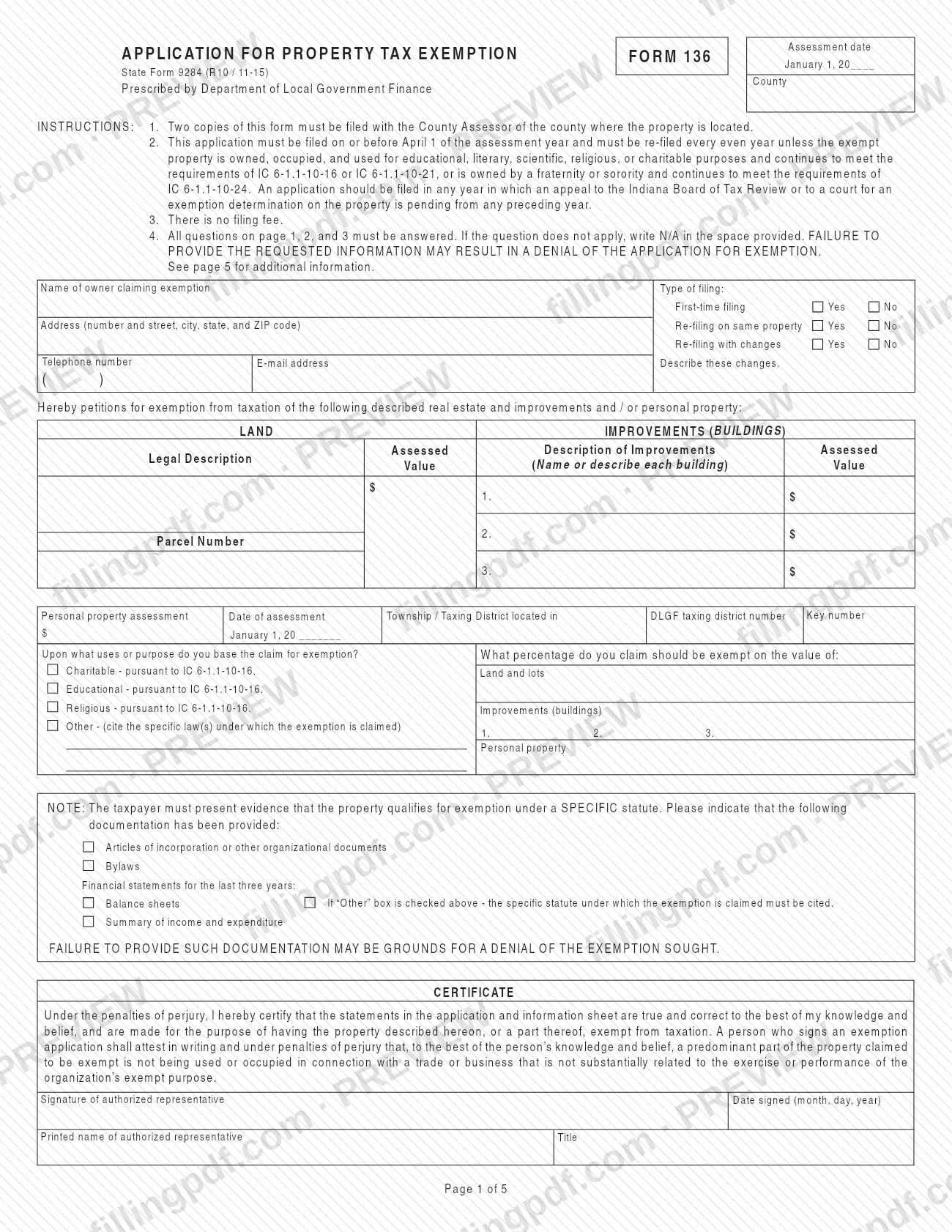
Form 136, Application for Property Tax Exemption (State Form 9284), is the form an owner files with the County Assessor to ask that real estate, improvements or personal property be exempted from property tax. The Indiana Department of Local Government Finance (DLGF) prescribes it, and it is one of the Hendricks County property tax forms listed by the Hendricks County Assessor's Office. On this page you can fill out the form online on FillingPDF and download or print the completed PDF; the original is published on the Hendricks County website.
Last updated
What is 136?
Form 136, Application for Property Tax Exemption (State Form 9284), is the Indiana form that a property owner files in duplicate with the County Assessor to request exemption from property tax on real estate, improvements, or personal property under a specific statute.
The form is prescribed by the Department of Local Government Finance (DLGF). The County Property Tax Assessment Board of Appeals (PTABOA) considers the application and can grant an exemption, in whole or in part, only if it specifically finds that the statutory prerequisites are met. The form explains that an exemption is a privilege that may be waived if the application is not filed on time, and that without an application the PTABOA has no power to grant one.
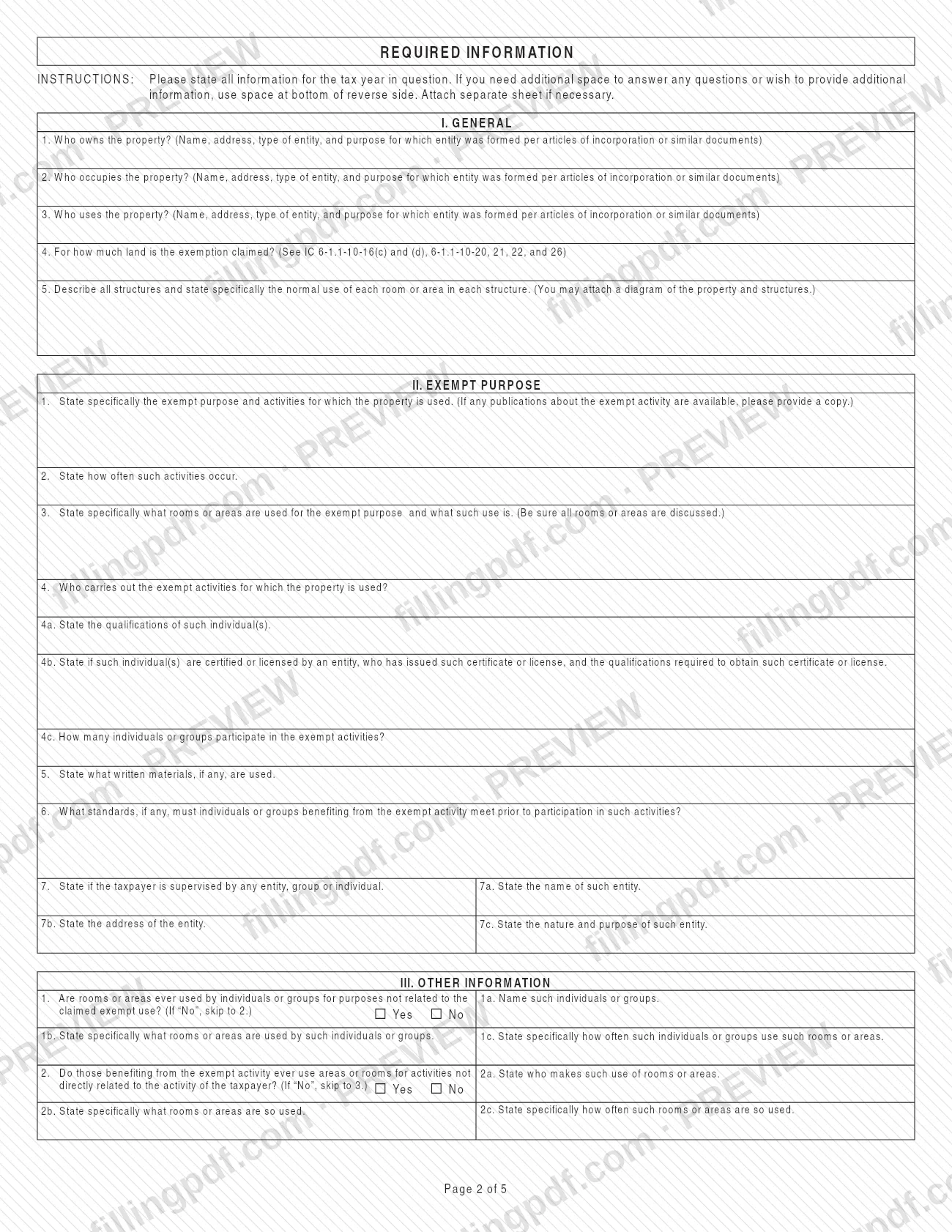
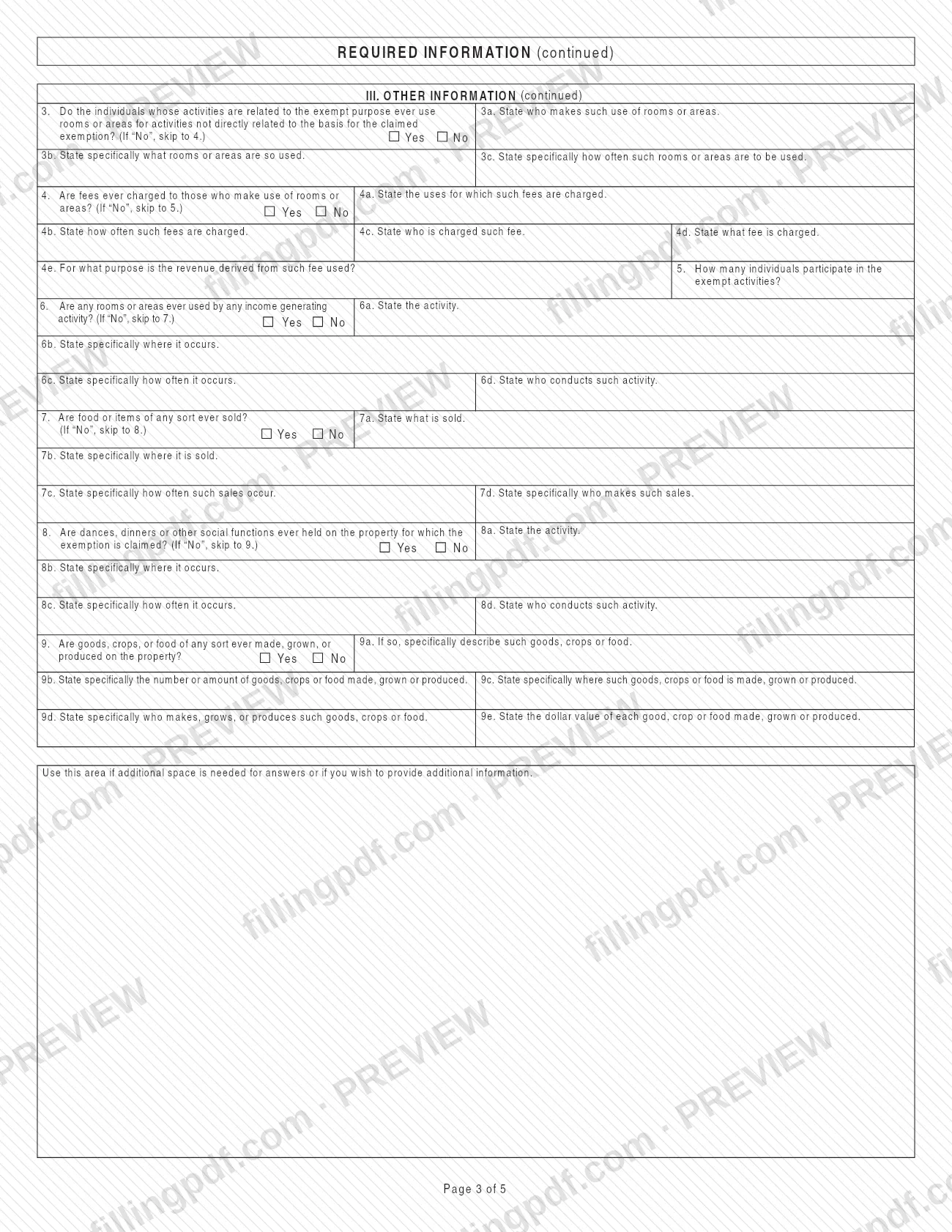
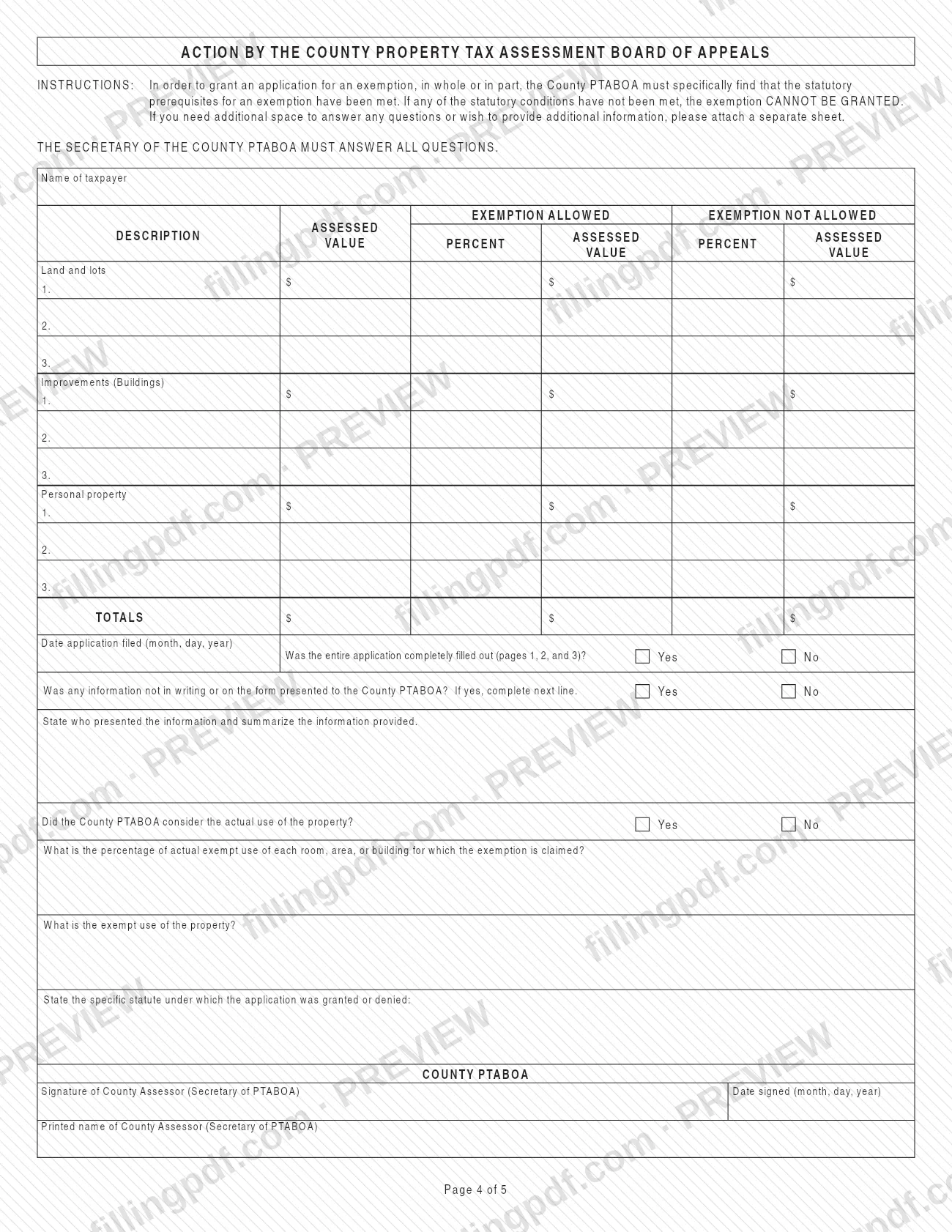
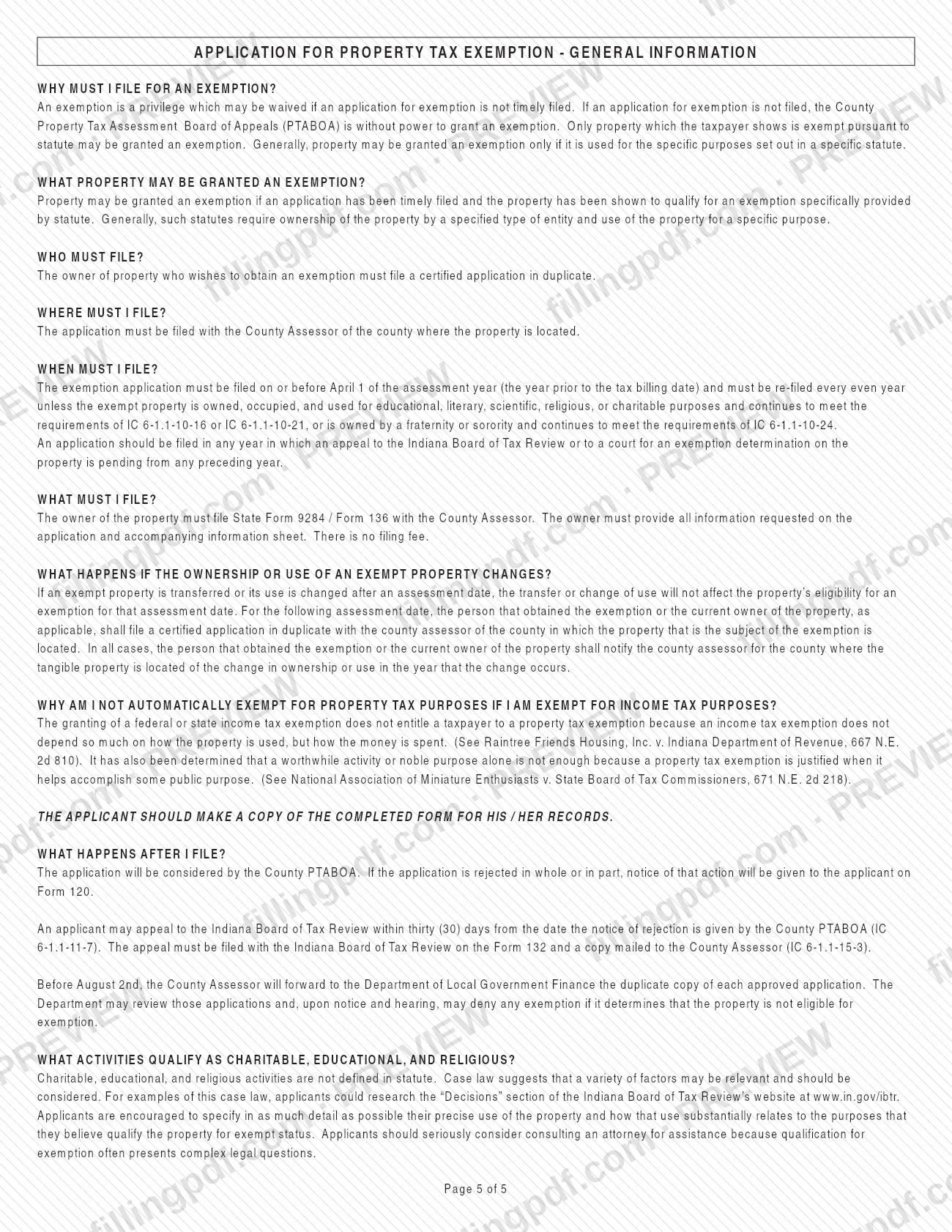
The application has five pages. Page 1 identifies the owner, the property and the legal basis for the claim, and carries the signed certificate. Pages 2 and 3 are the required information sheet: general ownership and use, the exempt purpose, and other uses such as fees, sales, social functions and goods produced. Page 4, Action by the County Property Tax Assessment Board of Appeals, is completed by the County Assessor as secretary of the PTABOA. Page 5 gives general information.
An income tax exemption does not make property exempt from property tax; the form says the two rest on different tests. If the PTABOA rejects the application in whole or in part, it gives notice on Form 120, and an appeal to the Indiana Board of Tax Review is made on Form 132.
Who needs to file 136?
The owner of property who wishes to obtain a property tax exemption must file Form 136 with the County Assessor of the county where the property is located. The form describes the application as a certified application filed in duplicate.
- Owners claiming an exemption by statute. Property may be exempted only if the owner shows that it qualifies under a specific statute. Generally, those statutes require ownership by a specified type of entity and use of the property for a specific purpose. The form lists charitable, educational and religious bases under IC 6-1.1-10-16, and an "Other" box where the specific law must be cited.
- Owners who must re-file. The application must be re-filed every even year, unless the property is owned, occupied and used for educational, literary, scientific, religious or charitable purposes and continues to meet IC 6-1.1-10-16 or IC 6-1.1-10-21, or is owned by a fraternity or sorority and continues to meet IC 6-1.1-10-24.
- Owners with a pending appeal. File in any year in which an appeal to the Indiana Board of Tax Review or to a court on the exemption is pending from a preceding year.
- Current owners after a transfer or change of use. The person who obtained the exemption or the current owner files a new application for the following assessment date.
The application is signed by an authorized representative of the owner. Federal or state income tax exemption alone does not entitle you to a property tax exemption.
When to file 136
File Form 136 on or before April 1 of the assessment year, which the form defines as the year prior to the tax billing date. The form's assessment date is January 1 of that year.
After the first filing, the application must be re-filed every even year, except for property that is owned, occupied and used for educational, literary, scientific, religious or charitable purposes and keeps meeting IC 6-1.1-10-16 or IC 6-1.1-10-21, or that is owned by a fraternity or sorority and keeps meeting IC 6-1.1-10-24. File also in any year in which an appeal on the exemption is pending from an earlier year.
If an exempt property is transferred or its use changes after an assessment date, eligibility for that date is not affected. For the following assessment date, the person who obtained the exemption or the current owner files a new application. In every case, that person must notify the County Assessor of the change in ownership or use in the year it happens.
Before August 2nd, the County Assessor forwards the duplicate copy of each approved application to the DLGF, which may review it.
Documents you need
- Two copies of the completed and signed Form 136: the form says two copies must be filed with the County Assessor.
- Articles of incorporation or other organizational documents: the form asks you to indicate that they have been provided as evidence that the property qualifies under a specific statute.
- Bylaws: listed on the form among the documentation to indicate as provided.
- Financial statements for the last three years, including balance sheets: listed on the form among the documentation to indicate as provided.
- Financial statements for the last three years, including a summary of income and expenditure: listed on the form among the documentation to indicate as provided.
- Publications about the exempt activity, if any are available: question II.1 asks for a copy.
- Diagram of the property and structures: optional, question I.5 says you may attach one.
- Separate sheet for additional answers: attach one if the space on the form is not enough.
How to fill out 136
Enter the assessment date and county
At the top of page 1, write the year in the Assessment date line (January 1, 20____) and enter the County where the property is located.
Identify the owner and contact details
Enter the name of the owner claiming exemption, the address (number and street, city, state, and ZIP code), the telephone number and the e-mail address.
Mark the type of filing
Answer Yes or No for First-time filing, Re-filing on same property and Re-filing with changes. If you are re-filing with changes, describe them in the space provided.
Describe the real estate and personal property
Give the legal description and parcel number, then list the land and each building (lines 1 to 3) with a description and the assessed value. Enter the personal property assessment and its date of assessment, January 1, 20____.
Enter the taxing district details
Fill in the Township / Taxing District where the property is located, the DLGF taxing district number and the key number.
State the basis and percentage claimed
Check Charitable, Educational or Religious (IC 6-1.1-10-16), or Other and cite the specific laws on lines 1 to 3. Enter the percentage you claim should be exempt for land and lots, improvements (buildings) and personal property.
Indicate the supporting documentation
Check the documentation you provide: articles of incorporation or other organizational documents, bylaws, and the last three years of financial statements (balance sheets and summary of income and expenditure).
Complete Part I, General
Questions 1 to 3 ask who owns, occupies and uses the property, with name, address, type of entity and purpose. Question 4 asks how much land is claimed and question 5 asks you to describe all structures and the use of each room or area.
Complete Part II, Exempt Purpose
State the exempt purpose, how often activities occur, the rooms used, who carries them out (4, 4a to 4c), written materials, participant standards and any supervising entity (7, 7a to 7c).
Answer Part III, Other Information
Answer Yes or No to questions 1 to 9 on pages 2 and 3 (other uses, fees, income-generating activity, sales, social functions, goods produced) and complete the lettered follow-ups for each Yes. Write N/A where a question does not apply, and use the extra space for more detail.
Sign the certificate
On page 1, the authorized representative signs and dates the certificate and enters a printed name and title. The signature is under penalties of perjury, including the statement about use in an unrelated trade or business.
Review, download and make copies
Check that pages 1, 2 and 3 are fully answered and leave page 4 for the County Assessor. Download or print the completed PDF from FillingPDF, make the two copies required and file them as described under How to submit.
How to submit 136
Form 136 is filed with the County Assessor of the county where the property is located; for property in Hendricks County, that is the Hendricks County Assessor's Office, which lists the form among its forms. The form names no other channel, mailing address or portal.
- Copies. File two copies of the completed and signed application. The County Assessor later forwards the duplicate of each approved application to the Department of Local Government Finance.
- Fee. There is no filing fee.
- Completeness. Answer every question on pages 1, 2 and 3, writing N/A where a question does not apply, and include the documentation the form lists. Contact the Assessor's Office for how it accepts filings.
- Your records. Make a copy of the completed form for yourself.
The PTABOA considers the application. If it rejects it in whole or in part, it gives notice on Form 120. You may appeal to the Indiana Board of Tax Review within thirty (30) days from the date the notice is given, on Form 132, and you must mail a copy to the County Assessor.
FillingPDF lets you fill out and download the PDF; submission follows the channels above.
Common mistakes to avoid
- Filing one copy of the application when the form requires two copies filed with the County Assessor.
- Filing after April 1 of the assessment year; the form says an exemption may be waived if the application is not timely filed, and the PTABOA cannot grant one without an application.
- Leaving questions on pages 1, 2 or 3 blank instead of writing N/A; the form warns that missing information may result in denial.
- Checking "Other" as the basis of the claim without citing the specific law under which the exemption is claimed.
- Omitting the articles of incorporation or organizational documents, bylaws, or three years of financial statements, which may be grounds for denial.
- Assuming a federal or state income tax exemption makes the property exempt from property tax; the form says it does not.
- Skipping the even-year re-filing when the property does not meet the educational, literary, scientific, religious, charitable or fraternity/sorority exception.
- Not notifying the County Assessor, in the year it happens, of a change in ownership or use of an exempt property.
- Filling in page 4, Action by the County Property Tax Assessment Board of Appeals, which the County Assessor completes as secretary of the PTABOA.
Frequently asked questions
What is Form 136 used for?
Form 136 (State Form 9284) is the application an Indiana property owner files with the County Assessor to request exemption from property tax on land, buildings or personal property. The exemption must rest on a specific statute, and the County PTABOA decides whether the statutory requirements are met.
When is Form 136 due?
On or before April 1 of the assessment year, which the form defines as the year before the tax billing date. The form says an exemption may be waived if the application is not timely filed, and the PTABOA cannot grant an exemption without an application.
Do I have to re-file Form 136 every year?
No, but you must re-file every even year. The exception is property owned, occupied and used for educational, literary, scientific, religious or charitable purposes that keeps meeting IC 6-1.1-10-16 or 10-21, or fraternity and sorority property meeting IC 6-1.1-10-24. File also in any year an appeal is pending.
Is there a fee to file Form 136?
No. The form states twice that there is no filing fee. You still need to file two copies with the County Assessor and answer every question on pages 1, 2 and 3, writing N/A where a question does not apply.
Where do I file Form 136 in Hendricks County?
File two copies with the County Assessor of the county where the property is located; in Hendricks County that is the Assessor's Office, which lists Form 136 among its forms. It is one of the Hendricks County property tax forms there. The form prints no address, so contact the office for delivery details.
What documents do I need with Form 136?
The form asks you to indicate that you provided your articles of incorporation or other organizational documents, bylaws, and financial statements for the last three years (balance sheets and a summary of income and expenditure). Missing documentation may be grounds for denial.
Does an income tax exemption mean my property is exempt?
No. The form explains that a federal or state income tax exemption does not entitle you to a property tax exemption, because the income tax test looks at how money is spent, not how the property is used. You must show the property qualifies under a specific statute.
What can I do if my exemption application is rejected?
The County PTABOA gives notice of a rejection, in whole or in part, on Form 120. You may appeal to the Indiana Board of Tax Review within thirty (30) days from the date of notice, using Form 132, and mail a copy to the County Assessor.
Can I fill out Form 136 online?
Yes. You can fill out the PDF online on FillingPDF and download or print it. FillingPDF does not file the application: you submit two copies to the County Assessor through the agency's channels.
Ready to fill out 136?
Fill out 136 now