
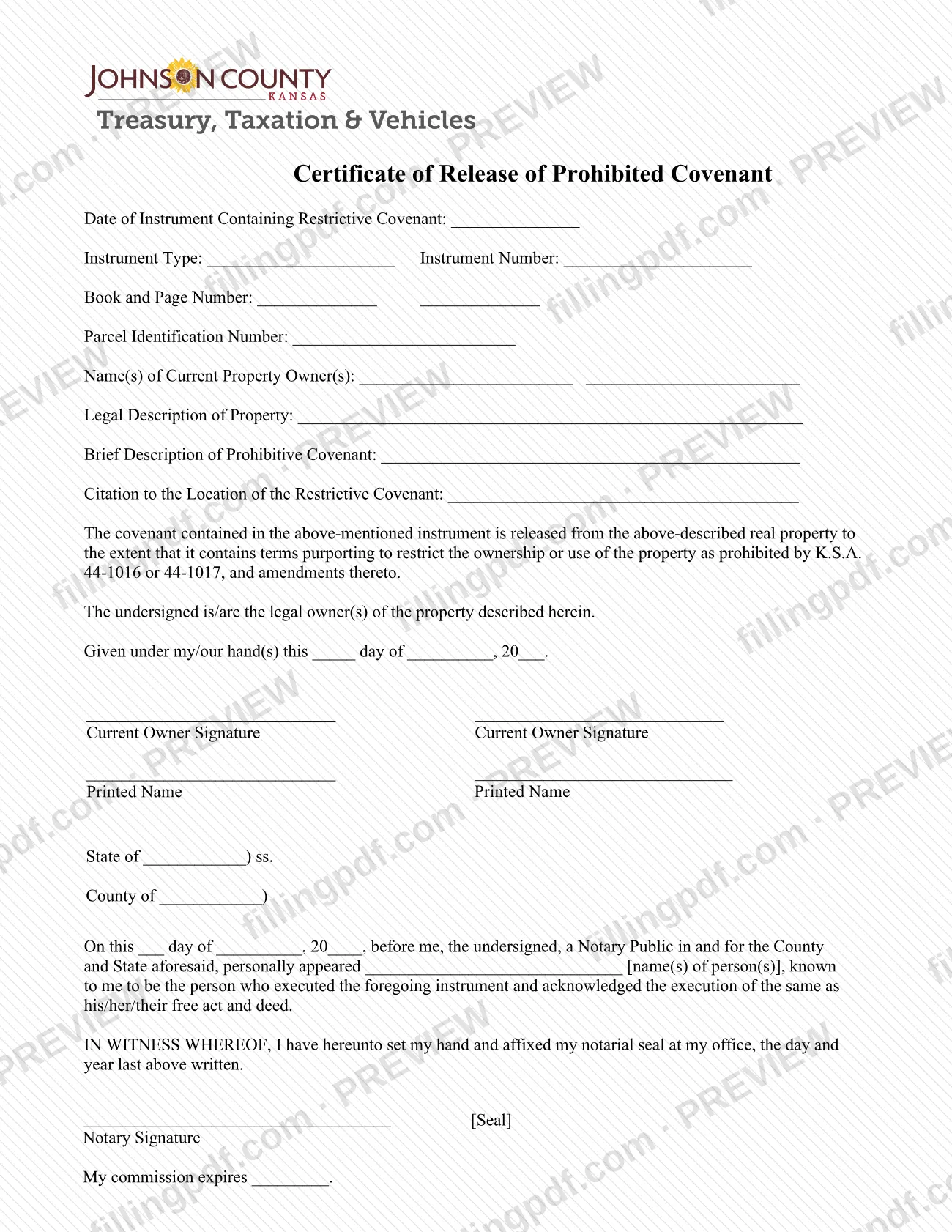
The Certificate of Release of Prohibited Covenant is a form published by Johnson County Treasury, Taxation & Vehicles, on its Register of Deeds forms page, for owners who want to release a restrictive covenant that K.S.A. 44-1016 or 44-1017 prohibits. The current owner or owners identify the instrument that contains the covenant, sign the certificate, and have the signature acknowledged before a notary public. On this page you can fill out the form online on FillingPDF and download or print the completed PDF; the original PDF is published by Johnson County at the official source link.
Last updated
What is Certificate of Release of Prohibited Covenant – Johnson County, KS?
The Certificate of Release of Prohibited Covenant is a Johnson County form on which the current owner or owners of a property release a restrictive covenant to the extent it restricts ownership or use as prohibited by K.S.A. 44-1016 or 44-1017.
The certificate is issued under the Johnson County Treasury, Taxation & Vehicles letterhead and appears on the county's Register of Deeds Forms and Resources page, which describes its forms as help with document filing needs. It is a one-page document with three parts:
- Identification of the instrument and property: date of the instrument containing the restrictive covenant, instrument type, instrument number, book and page number, parcel identification number, current owner name(s), legal description, a brief description of the prohibitive covenant, and a citation to where the covenant is located.
- The release statement and the owners' signatures, with printed names and the date the owners sign.
- A notary acknowledgment with State and County, the date, the name(s) of the person(s) appearing, the notary's signature, seal and commission expiration.
The release is limited by its own wording: the covenant is released only to the extent that it contains terms purporting to restrict the ownership or use of the property as prohibited by those statutes. The form is not a tax document, despite being issued by the department that carries the Treasury and Taxation name; it concerns a covenant recorded in a land instrument.
Who needs to file Certificate of Release of Prohibited Covenant – Johnson County, KS?
The main group is the current legal owner or owners of real property in Johnson County whose property is subject to a covenant, in a land instrument, that restricts ownership or use in a way K.S.A. 44-1016 or 44-1017 prohibits. The form states that the undersigned are the legal owners of the property described, so the person signing must be an owner.
- The form has two signature lines with printed names, so co-owners can sign together.
- A notary public must complete the acknowledgment, since the owners appear before the notary and acknowledge the signature.
- The form releases only the part of a covenant that the cited statutes prohibit. It does not release other restrictions in the same instrument.
The county's Register of Deeds page says that for help creating documents or choosing which form suits your needs, you should consult a real estate attorney or a title company, and that its forms are for general reference and not legal advice.
When to file Certificate of Release of Prohibited Covenant – Johnson County, KS
No due date or filing window is printed on the form. You complete it when the current owner or owners are ready to release the covenant: the owners date and sign it ("Given under my/our hand(s) this ___ day of , 20"), and a notary completes the acknowledgment with its own date and commission expiration. Gather the instrument details first, including its date, number, and book and page, because the certificate must point to the exact instrument that contains the covenant. For any timing rule that applies when the certificate is recorded, ask the Register of Deeds office.
How to fill out Certificate of Release of Prohibited Covenant – Johnson County, KS
Enter the instrument date
In Date of Instrument Containing Restrictive Covenant, write the date of the recorded or signed instrument that contains the covenant.
Identify the instrument
Fill in Instrument Type and Instrument Number. Then enter the Book and Page Number in the two spaces provided.
Enter the parcel and owners
Write the Parcel Identification Number. Then list the Name(s) of Current Property Owner(s) in the two name spaces.
Add the legal description
In Legal Description of Property, enter the legal description of the property from which the covenant is to be released.
Describe and locate the covenant
Give a Brief Description of Prohibitive Covenant. In Citation to the Location of the Restrictive Covenant, say where in the instrument the covenant appears.
Read the release statement
The printed text releases the covenant to the extent it restricts ownership or use as prohibited by K.S.A. 44-1016 or 44-1017, and confirms that the undersigned are the legal owners.
Date and sign as owner
Complete the "Given under my/our hand(s) this ___ day of , 20" line. Each current owner signs on a Current Owner Signature line and prints a name on the Printed Name line.
Complete the notary acknowledgment
The notary enters the State and County, the date, and the name(s) of the person(s) who appeared. The notary then signs, affixes the [Seal], and writes the commission expiration date.
Review and download the PDF
Check that the instrument details, parcel number, and legal description are complete, then download or print the completed PDF from FillingPDF. Take it to the notary for the signature and acknowledgment, then follow the steps under How to submit.
How to submit Certificate of Release of Prohibited Covenant – Johnson County, KS
The form prints no mailing address, portal, appointment rule, or payment instructions, so there is no channel to quote from it. Johnson County lists the certificate on its Register of Deeds Forms and Resources page, https://www.jocogov.org/department/treasury-taxation-and-vehicles/register-deeds/forms-and-resources, among forms meant to assist with document filing needs.
- Before you file: sign the certificate in front of a notary public so the acknowledgment, seal, and commission expiration are complete.
- Recording requirements: the county's page says additional recording requirements are on its document filing requirements page, and that a Cover Sheet is used for documents that do not comply with margin requirements.
- Questions: contact the Register of Deeds in Johnson County Treasury, Taxation & Vehicles for how and where to file this certificate and whether a fee applies.
FillingPDF lets you fill out and download the PDF; submission follows the county's channels.
Common mistakes to avoid
- Signing as an owner when you are not a current legal owner; the form states that the undersigned are the legal owners of the property described.
- Leaving out the instrument details (date, type, instrument number, book and page) so the certificate does not identify which instrument holds the covenant.
- Omitting the parcel identification number or the legal description of the property.
- Skipping the citation to the location of the restrictive covenant or the brief description of the prohibitive covenant.
- Signing before meeting the notary, when the acknowledgment says the owner personally appeared and acknowledged the execution.
- Leaving the notary's signature, seal, or commission expiration date incomplete.
- Expecting the certificate to release every restriction in the instrument; it releases the covenant only to the extent it contains terms prohibited by K.S.A. 44-1016 or 44-1017.
- Leaving the date line ("this ___ day of , 20") blank, or the printed names missing under the owner signatures.
Frequently asked questions
What is the Certificate of Release of Prohibited Covenant?
It is a Johnson County form on which current property owners release a restrictive covenant to the extent it restricts ownership or use as K.S.A. 44-1016 or 44-1017 prohibits. It identifies the instrument and property, carries the owners' signatures, and includes a notary acknowledgment.
Is this a Johnson County Kansas property tax form?
No. Although the form carries the Treasury, Taxation & Vehicles name and is listed on the Register of Deeds forms page, it does not report or change property taxes. It releases a covenant found in a land instrument. For tax questions, contact the county directly.
Who signs the Certificate of Release of Prohibited Covenant?
The current legal owner or owners of the property sign it; the form has two owner signature lines with printed names. A notary public then completes the acknowledgment, which states that the signer personally appeared and acknowledged the signing as a free act and deed.
Does the form need to be notarized?
Yes, the form includes a notary acknowledgment block with State, County, date, name(s) of the person(s) appearing, the notary's signature, seal, and commission expiration. Sign it in front of the notary so the acknowledgment is accurate.
What information do I need to complete it?
You need the date, type, number, and book and page of the instrument containing the covenant; the parcel identification number; the current owner name(s); the property's legal description; a brief description of the covenant; and a citation to where it appears.
Where do I file the Certificate of Release of Prohibited Covenant?
The form prints no filing address or channel. Johnson County lists it on its Register of Deeds Forms and Resources page, so ask the Register of Deeds in Treasury, Taxation & Vehicles where and how to file it and whether a fee applies.
Can I fill out this form online on FillingPDF?
You can fill out the PDF online on FillingPDF and download or print it. FillingPDF is an independent service and does not file the certificate, notarize it, or record it; you submit the signed, notarized form through Johnson County's channels.
Ready to fill out Certificate of Release of Prohibited Covenant – Johnson County, KS?
Fill out Certificate of Release of Prohibited Covenant – Johnson County, KS now