
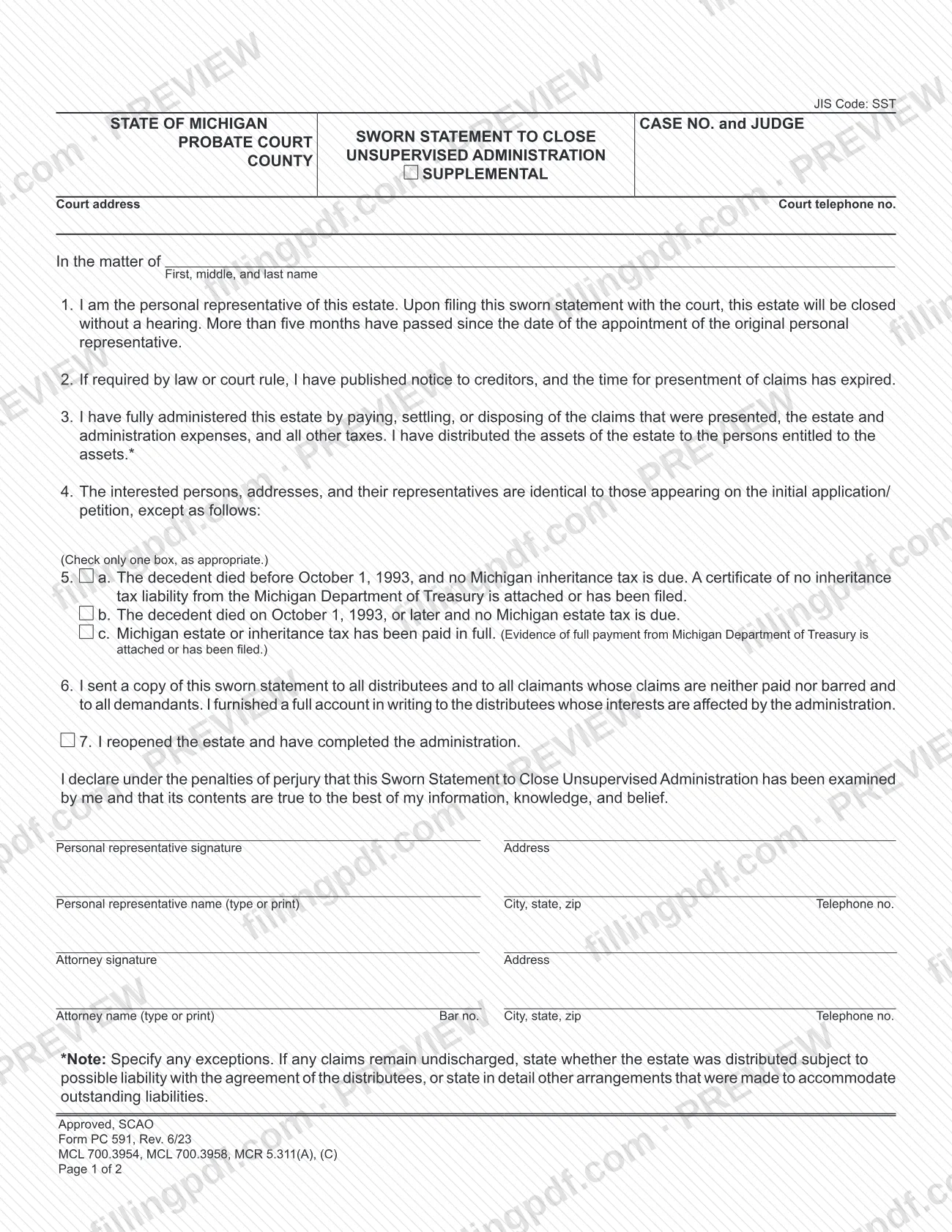

PC 591 is the Sworn Statement to Close Unsupervised Administration, a Michigan probate court form approved by the State Court Administrative Office (SCAO). A personal representative signs it under penalty of perjury to state that the estate has been fully administered, and the estate is then closed without a hearing once it is filed with the court. On this page you can fill out the form online on FillingPDF and download or print the completed PDF; the form itself is published by SCAO at courts.michigan.gov.
Last updated
What is PC 591?
Form PC 591, Sworn Statement to Close Unsupervised Administration, is the Michigan probate court form on which a personal representative swears that an estate in unsupervised administration has been fully administered, so that the estate can be closed without a hearing.
The form is approved by the State Court Administrative Office (SCAO) and cites MCL 700.3954, MCL 700.3958 and MCR 5.311(A), (C). It is filed in the probate court that holds the estate and carries that court's case number and judge. Its JIS code is SST.
By signing, the personal representative states that:
- more than five months have passed since the original personal representative was appointed;
- notice to creditors was published, if law or court rule required it, and the time for presenting claims has expired;
- claims, expenses and taxes have been paid, settled or otherwise disposed of, and the assets have been distributed to the persons entitled to them;
- the interested persons and their addresses match the initial application or petition, except as listed;
- Michigan estate or inheritance tax status fits one of three options (item 5);
- a copy of the statement and a full written account went to the people the form names (item 6).
Item 7 is used when the estate was reopened and the administration has been completed again. Page 2 carries a notice to interested persons about objecting to the statement.
Who needs to file PC 591?
The main user is the personal representative of an estate in unsupervised administration in a Michigan probate court who has finished administering the estate and wants it closed without a hearing. The form is signed by the personal representative, and it has a separate signature block for an attorney.
Conditions printed on the form:
- More than five months must have passed since the original personal representative was appointed.
- If law or court rule required notice to creditors, it must have been published and the time for presenting claims must have expired.
- The estate must have been fully administered: claims, expenses and taxes dealt with and assets distributed to the persons entitled. Any exceptions, such as undischarged claims, are specified in the note to item 3.
- A personal representative who reopened an estate and completed the administration again uses item 7.
Interested persons, distributees, claimants whose claims are neither paid nor barred, and demandants do not file this form. They receive a copy under item 6 and may object, as described in the notice on page 2.
When to file PC 591
File Form PC 591 after the administration is finished and more than five months have passed since the original personal representative was appointed. Before then, the first statement on the form cannot truthfully be made.
The form also assumes that required notice to creditors has been published and the time for presenting claims has expired, and that the assets have been distributed.
After filing, the timing rules run from the filing date, according to the notice on page 2. Interested persons have 28 days to file written objections. If no objection is filed in that time, the probate register issues a certificate stating that it appears the estate has been fully administered. If no action or proceeding involving the personal representative is pending in the court one year after the statement is filed, the appointment ends.
Documents you need
- Certificate of no inheritance tax liability from the Michigan Department of Treasury: attached or already filed, only if you check box 5a (decedent died before October 1, 1993, and no Michigan inheritance tax is due).
- Evidence of full payment from the Michigan Department of Treasury: attached or already filed, only if you check box 5c (Michigan estate or inheritance tax paid in full).
How to fill out PC 591
Enter court and case details
At the top, enter the county, court address and court telephone number, the case number and judge, and the name of the decedent in the matter of line (first, middle and last name).
Confirm items 1 and 2
Item 1 states that you are the personal representative and that more than five months have passed since the original personal representative was appointed. Item 2 states that creditor notice was published if required and the time for claims has expired.
Complete the administration statement
Item 3 states that claims, expenses and taxes were dealt with and the assets distributed. If any claims remain undischarged, write the exceptions beside the asterisk note, saying whether the estate was distributed subject to possible liability or what other arrangements were made.
List changes to interested persons
Item 4 says the interested persons, addresses and representatives match the initial application or petition. After the words "except as follows," list every difference.
Check one box in item 5
Check only one: 5a (decedent died before October 1, 1993, no inheritance tax due), 5b (died on October 1, 1993, or later, no Michigan estate tax due) or 5c (estate or inheritance tax paid in full). For 5a and 5c, attach or confirm the filed Treasury document.
Confirm notice to interested parties
Item 6 states that you sent a copy of this statement to all distributees, unpaid and unbarred claimants and demandants, and gave a full written account to affected distributees. Do this before you sign.
Use item 7 only for reopened estates
Item 7 states that you reopened the estate and have completed the administration. Complete it only if that is your situation.
Sign as personal representative
Sign under the penalties of perjury declaration, type or print your name, and enter your address, city, state, ZIP code and telephone number.
Complete the attorney block
If an attorney is involved, the attorney signs, prints their name and enters the bar number, address, city, state, ZIP code and telephone number.
Review and download the completed PDF
Check each item, the single box in item 5 and both signature blocks. Download or print the completed PDF from FillingPDF, then file it with the probate court as described under How to submit.
How to submit PC 591
The form is filed with the Michigan probate court that handles the estate; the court's name, county, address and telephone number are entered at the top of page 1 along with the case number and judge. The form names no other channel and prints no separate mailing address, so confirm the filing method with that court.
- Before filing: send a copy of the sworn statement to all distributees, to all claimants whose claims are neither paid nor barred, and to all demandants, and give distributees whose interests are affected a full written account (item 6).
- Attachments: if you check box 5a or 5c, the Michigan Department of Treasury document named there must be attached or already on file with the court.
- Signatures: the personal representative signs with address and telephone number; an attorney signs the separate block if one is involved.
A filing fee applies when an interested person files an objection, according to page 2; the amount is not printed here, so ask the probate court. FillingPDF lets you fill out and download the PDF; submission follows the court's channels.
Common mistakes to avoid
- Filing the statement when five months or less have passed since the original personal representative was appointed.
- Checking more than one box in item 5; the form says to check only one box, as appropriate.
- Checking box 5a or 5c without attaching the Michigan Department of Treasury certificate or evidence of payment, or confirming it is already on file.
- Leaving out exceptions in item 3 when claims remain undischarged; the note requires you to say whether the estate was distributed subject to possible liability or what other arrangements were made.
- Not sending a copy of the sworn statement to all distributees, unpaid and unbarred claimants and demandants, or skipping the written account to affected distributees.
- Ignoring changes to interested persons or addresses; item 4 requires you to list every way they differ from the initial application or petition.
- Signing without checking the contents, when the declaration says they are true under penalty of perjury.
- Choosing item 7 for an estate that was not reopened.
Frequently asked questions
What is Form PC 591 used for?
PC 591 is the Michigan probate court form a personal representative signs and files to close an unsupervised administration. By swearing the estate is fully administered, the personal representative asks that the estate be closed without a hearing.
How long must I wait before filing the PC 591?
More than five months must have passed since the original personal representative was appointed. Item 1 of the form states this, and you are swearing it is true under penalty of perjury.
Is a court hearing needed to close the estate with PC 591?
No. Item 1 says that upon filing the sworn statement, the estate will be closed without a hearing. Interested persons can still object in writing within 28 days of the filing, as stated in the notice on page 2.
What happens after I file Form PC 591?
If no objection is filed within 28 days, the probate register issues a certificate stating it appears you have fully administered the estate. If no action involving you is pending one year after filing, your appointment ends.
Which box do I check in item 5 of PC 591?
Check only one, based on the decedent's death date and tax status: 5a for a death before October 1, 1993, with no inheritance tax due; 5b for a death on or after that date with no estate tax due; 5c if tax was paid in full.
Do I attach anything to Form PC 591?
Only with boxes 5a and 5c. Box 5a needs a certificate of no inheritance tax liability from the Michigan Department of Treasury, and 5c needs evidence of full payment. Either can be attached or already on file with the court.
Who has to receive a copy of the sworn statement?
Item 6 says you sent a copy to all distributees, all claimants whose claims are neither paid nor barred, and all demandants. You also gave a full written account to distributees whose interests are affected.
Can I fill out Form PC 591 online?
Yes. You can fill out the PDF online on FillingPDF and download or print it. FillingPDF is an independent service and does not file the form; you file it with the probate court through the court's channels.
Ready to fill out PC 591?
Fill out PC 591 now