
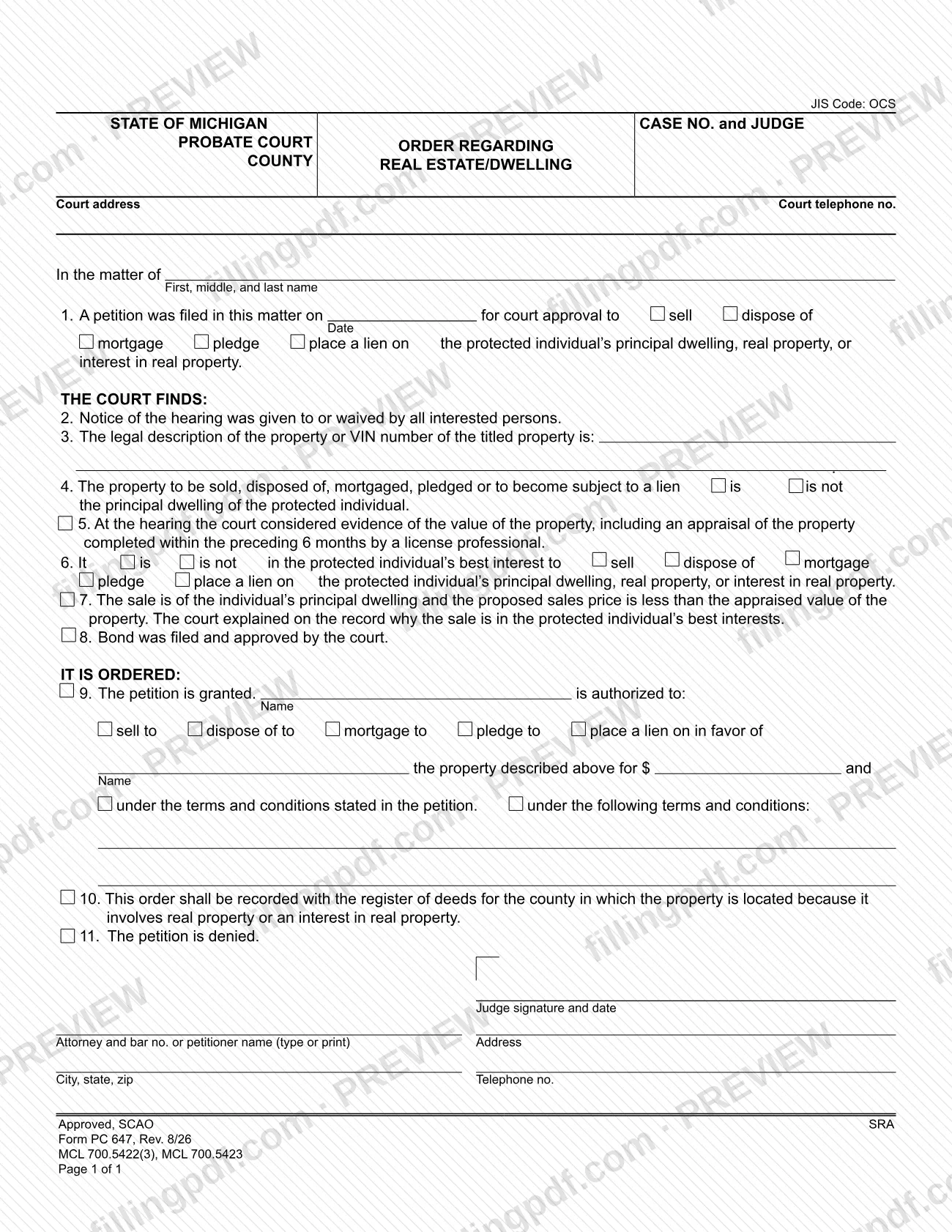
PC 647 is the Michigan probate court order that records the court's decision on a petition to sell, dispose of, mortgage, pledge or place a lien on a protected individual's principal dwelling, real property, or interest in real property. The State Court Administrative Office (SCAO) approves the form, and the judge signs it. On this page you can fill out the form online on FillingPDF and download or print the completed PDF; the original is published by the Michigan courts at courts.michigan.gov.
Last updated
What is PC 647?
Form PC 647, Order Regarding Real Estate/Dwelling, is a Michigan probate court order, approved by the State Court Administrative Office (SCAO), that states the court's findings and either grants or denies a petition to sell, dispose of, mortgage, pledge or place a lien on a protected individual's property.
The form is a single page. It opens by identifying the petition, its filing date and the action requested. Under THE COURT FINDS it records that notice of the hearing was given to or waived by all interested persons, the legal description of the property or the VIN number of titled property, and whether the property is the protected individual's principal dwelling. It also records that the court considered evidence of value, including an appraisal completed within the preceding 6 months by a licensed professional, and whether the proposed action is in the protected individual's best interest.
Two further findings are conditional: one applies when the sale is of the individual's principal dwelling at a price below the appraised value, in which case the court explained on the record why the sale is in the person's best interests; the other states that bond was filed and approved.
Under IT IS ORDERED, the court either grants the petition and authorizes a named person to carry out the transaction for a stated amount, on the terms in the petition or on terms written on the form, or denies the petition. A granted order is recorded with the register of deeds for the county where the property is located. The form cites MCL 700.5422(3) and MCL 700.5423.
Who needs to file PC 647?
The form is used in a Michigan probate court case in which a petition asks for court approval to sell, dispose of, mortgage, pledge or place a lien on the principal dwelling, real property, or interest in real property of a protected individual. The judge decides the petition and signs the order.
The form's bottom block asks for an attorney's name and bar number, or the petitioner's name, with address, city, state, ZIP code and telephone number. That block identifies the attorney or petitioner involved in the matter.
The order is specific to a petition about real estate or a dwelling. Other kinds of requests in a protected individual's case are not covered by what the form prints. The form is also not an order for a petition that was never filed: item 1 refers to a petition already filed on a stated date.
When to file PC 647
The order follows a petition that has already been filed for court approval and a hearing at which notice was given to or waived by all interested persons. Item 1 records the date the petition was filed, and the findings describe what the court considered at the hearing, so the order is completed for the judge's signature once the court has decided. No separate deadline is printed on the form.
If the petition is granted, item 10 requires the order to be recorded with the register of deeds for the county in which the property is located, because it involves real property or an interest in real property.
How to fill out PC 647
Enter case and court details
At the top, enter the case number and judge, the court address and the court telephone number. The JIS code OCS and the state and probate court headings are already printed.
Identify the protected individual
In the line under In the matter of, enter the first, middle and last name of the protected individual.
Complete item 1, the petition
Enter the date the petition was filed and mark the action requested: sell, dispose of, mortgage, pledge or place a lien on the protected individual's principal dwelling, real property, or interest in real property.
Confirm notice of the hearing
Item 2 states that notice of the hearing was given to or waived by all interested persons. It is a finding of the court.
Describe the property in item 3
Enter the legal description of the property, or the VIN number if the property is titled.
Answer the principal dwelling question
In item 4, mark whether the property is or is not the principal dwelling of the protected individual, after selecting the action that applies.
Review the evidence of value
Item 5 records that the court considered evidence of value, including an appraisal completed within the preceding 6 months by a licensed professional.
Mark the best-interest finding
In item 6, mark whether it is or is not in the protected individual's best interest to take the selected action on the property.
Handle items 7 and 8 as they apply
Item 7 applies only when a principal dwelling is sold below the appraised value. Item 8 states that bond was filed and approved by the court.
Complete the order in item 9
If the petition is granted, enter the name of the person authorized, the action and the other party, the dollar amount, and whether the terms are those in the petition or terms you write on the form.
Note recording or denial
Item 10 provides for recording with the register of deeds for the county where the property is located. If the court denies the petition, use item 11 instead of granting it.
Add signature and attorney block
The judge signs and dates the order. Enter the attorney's name and bar number or the petitioner's name, address, city, state, ZIP code and telephone number.
Review and download the completed PDF
Check that the findings, the choice between granting and denying, and the property description are consistent. Download or print the completed PDF from FillingPDF and deliver it as described under How to submit.
How to submit PC 647
The form names no filing channel, mailing address or portal. It is an order for the judge's signature in the probate case, and the court's address and telephone number are printed at the top of the form, so questions about how the court wants proposed orders delivered go to that court.
- Court: the completed order goes to the probate court handling the matter, identified by the case number, judge, court address and court telephone number at the top of the form.
- Register of deeds: when the petition is granted, item 10 states that the order shall be recorded with the register of deeds for the county where the property is located.
FillingPDF lets you fill out and download the PDF; submission follows the court's own channels.
Common mistakes to avoid
- Leaving item 3 without the legal description of the property or the VIN number of the titled property.
- Marking both is and is not in items 4 or 6, or leaving the choice unmarked, so the principal-dwelling and best-interest findings are unclear.
- Granting and denying in the same order by completing both item 9 (petition granted) and item 11 (petition denied).
- Relying on an appraisal older than the preceding 6 months, or one not completed by a licensed professional, when completing the item 5 finding.
- Overlooking item 7 when a principal dwelling is sold for less than the appraised value; the court must explain on the record why the sale is in the protected individual's best interests.
- Leaving the name, the action and the dollar amount blank in item 9, so it is unclear who is authorized to do what.
- Omitting the judge's signature and date, or the attorney and bar number or petitioner information at the bottom.
- Failing to have a granted order recorded with the register of deeds for the county where the property is located, as item 10 requires.
Frequently asked questions
What is Form PC 647 used for?
PC 647 is a Michigan probate court order on a petition to sell, dispose of, mortgage, pledge or place a lien on a protected individual's principal dwelling, real property, or interest in real property. It records the court's findings and either grants or denies the petition.
Who signs Form PC 647?
The judge signs and dates the order at the bottom of the form. The attorney or petitioner is identified in the separate block beneath the signature, with bar number or name, address and telephone number.
Does PC 647 have to be recorded with the register of deeds?
Yes, when the petition is granted. Item 10 states that the order shall be recorded with the register of deeds for the county in which the property is located, because it involves real property or an interest in real property.
Does an appraisal come into play on PC 647?
Yes. Item 5 records that the court considered evidence of the property's value, including an appraisal completed within the preceding 6 months by a licensed professional. Item 7 adds a finding for sales of a principal dwelling below the appraised value.
Can the PC 647 be used to deny a petition?
Yes. Item 11 reads "The petition is denied." Item 9 is the granting section, where the court names who is authorized to sell, mortgage, pledge or place a lien on the property and on what terms.
Can I fill out PC 647 online?
You can fill out the PC 647 PDF online on FillingPDF and download or print it. FillingPDF is an independent service and does not file the form with the court; the completed order goes to the probate court through its own channels.
What laws does Form PC 647 cite?
The form cites MCL 700.5422(3) and MCL 700.5423 at the bottom. It is marked as approved by the State Court Administrative Office (SCAO), with the revision printed as Rev. 8/26.
Ready to fill out PC 647?
Fill out PC 647 now