
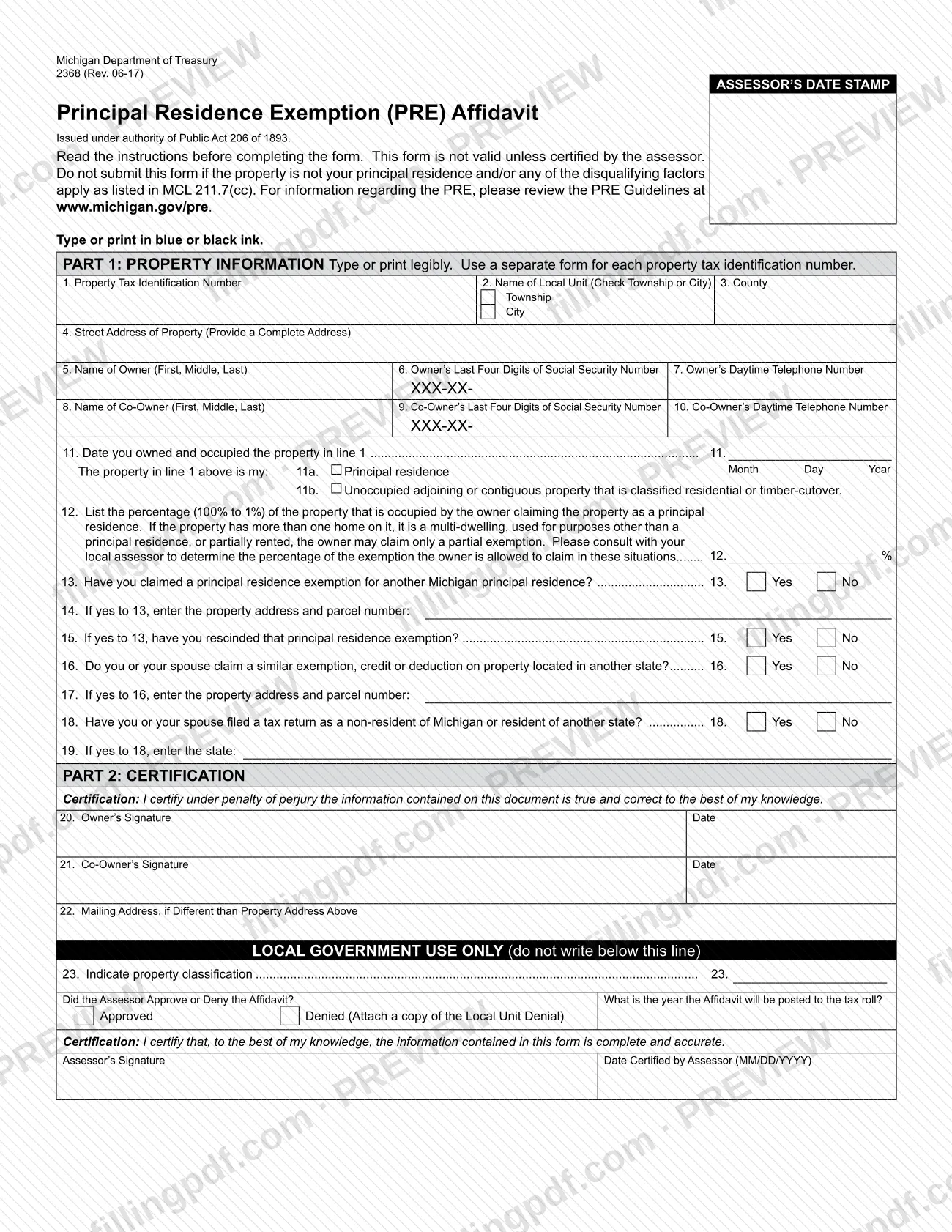
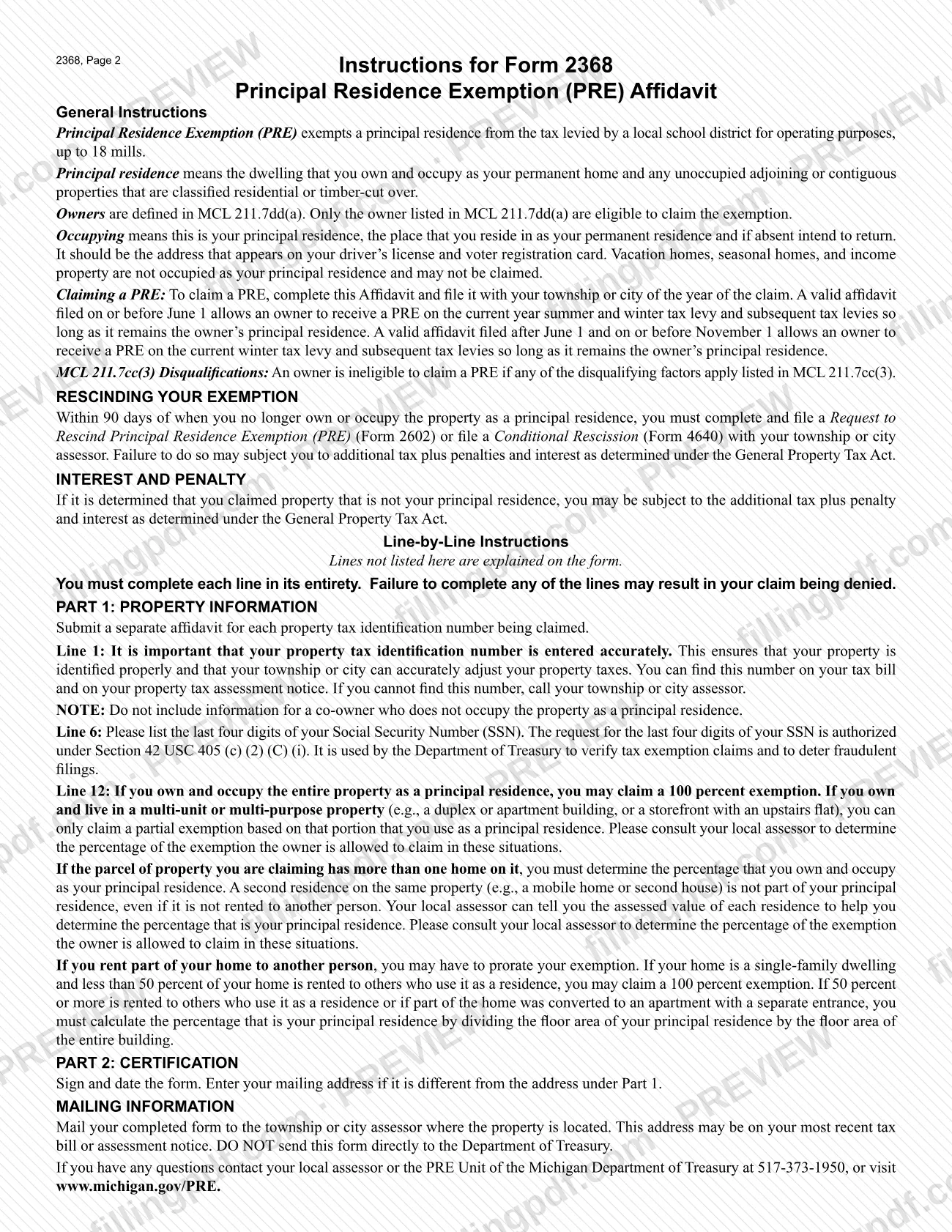
Form 2368, the Principal Residence Exemption (PRE) Affidavit, is the Michigan Department of Treasury form an owner files to claim the PRE on the home they own and occupy. The City of Wyoming, Michigan, Assessor/Equalization office accepts it, which makes it one of the Wyoming property tax forms homeowners meet when they buy or move into a home. On this page you can fill out the form online on FillingPDF and download or print the completed PDF; the form itself and the filing rules come from the Treasury and the City of Wyoming assessor.
Last updated
What is 2368?
Form 2368, Principal Residence Exemption (PRE) Affidavit, is the Michigan Department of Treasury form that an owner files with the township or city assessor to claim the PRE, which exempts a principal residence from the tax levied by a local school district for operating purposes, up to 18 mills.
The form is issued under authority of Public Act 206 of 1893. It is not valid unless the assessor certifies it, and the assessor's block at the bottom (lines for approval or denial, property classification and the year the affidavit is posted to the tax roll) is for local government use only.
The instructions define a principal residence as the dwelling you own and occupy as your permanent home, plus any unoccupied adjoining or contiguous property classified residential or timber-cutover. Occupying means it is the place you live permanently and, if absent, intend to return to. Vacation homes, seasonal homes and income property cannot be claimed.
In Wyoming, Michigan, the PRE affidavit is filed with the City of Wyoming Assessor/Equalization office, which publishes the form on its Real Property Tax Exemptions page.
Form 2368 is not the form for ending an exemption: a Request to Rescind Principal Residence Exemption (PRE) (Form 2602) or a Conditional Rescission (Form 4640) is used for that. It is also separate from Form 5107, Affidavit for Disabled Veterans Exemption.
Who needs to file 2368?
Owners who own and occupy a home in the City of Wyoming as their permanent residence and want the PRE on it file Form 2368. Only the owners listed in MCL 211.7dd(a) are eligible to claim the exemption. Buyers should note that an affidavit may have been available and signed at the house closing; if you are unsure, the city says to print the form and submit it to the assessor's office.
Conditions the form attaches:
- File a separate affidavit for each property tax identification number you claim.
- Do not include information for a co-owner who does not occupy the property as a principal residence.
- If you own a multi-unit or multi-purpose property, have more than one home on the parcel, or rent part of your home, you may claim only a partial exemption; line 12 asks for the percentage, and the assessor helps determine it.
Do not submit the form if the property is not your principal residence or if any of the disqualifying factors listed in MCL 211.7cc(3) apply. Vacation homes, seasonal homes and income property are not eligible.
Under Michigan law, the city notes, you are entitled to only one principal residence exemption, so a rescind form must be filed for your previous home before you qualify for the new one.
When to file 2368
File Form 2368 with the city assessor on or before June 1 to receive the PRE on the current year's summer and winter tax levies. A valid affidavit filed after June 1 and on or before November 1 gives the exemption on the current winter levy and later levies. In both cases the exemption continues on later levies as long as the property remains your principal residence.
The City of Wyoming states the same dates from the ownership side: you must own and occupy the home before June 1 for the summer tax bill and before November 1 for the winter tax bill, and ownership or possession after November 1 qualifies you for the following tax year.
When you no longer own or occupy the property as a principal residence, file Form 2602 or Form 4640 within 90 days. Failing to do so may lead to additional tax plus penalties and interest under the General Property Tax Act.
How to fill out 2368
Check eligibility before you start
Read the instructions on page 2. Do not submit the form if the property is not your principal residence or a disqualifying factor in MCL 211.7cc(3) applies. Use a separate form for each property tax identification number.
Enter the property information
Line 1: your property tax identification number from your tax bill or assessment notice. Line 2: the name of the local unit, checking Township or City. Line 3: the county. Line 4: the complete street address of the property.
Enter owner and co-owner details
Lines 5 to 7: owner's name (first, middle, last), last four digits of the Social Security number and daytime telephone number. Lines 8 to 10: the same for a co-owner, only if that co-owner occupies the property as a principal residence.
State the date and type of occupancy
Line 11: enter the date you owned and occupied the property in line 1 (month, day, year). Check 11a for a principal residence or 11b for unoccupied adjoining or contiguous residential or timber-cutover property.
Enter the percentage you occupy
Line 12: enter the percentage, from 100% to 1%, of the property you occupy as a principal residence. For multi-dwelling, partly rented or mixed-use property, ask the local assessor which percentage you may claim.
Answer the prior Michigan exemption questions
Line 13: check Yes or No for a previous Michigan principal residence exemption. If Yes, give the address and parcel number on line 14 and answer line 15 on whether you rescinded it.
Answer the other-state questions
Line 16: check Yes or No for a similar exemption, credit or deduction by you or your spouse on property in another state, and give the address and parcel number on line 17. Line 18: check Yes or No for a non-resident or other-state tax return, and enter the state on line 19.
Sign, date and add a mailing address
Lines 20 and 21: the owner and any co-owner sign and date the certification made under penalty of perjury. Line 22: enter a mailing address only if it differs from the property address.
Leave the local government section blank
Do not write below the line marked Local Government Use Only; the assessor enters the classification, approval or denial, posting year and certification.
Review and download the completed PDF
Check that every line is complete and the parcel number is accurate. Download or print the completed PDF from FillingPDF and file it with the city assessor as described under How to submit.
How to submit 2368
Form 2368 is filed with the assessor of the city or township where the property is located; for property in the City of Wyoming, Michigan, that is the City of Wyoming Assessor/Equalization office.
- City of Wyoming assessor: the city says PRE affidavits are filed with its office and that you can print the form and submit it there. The instructions say to mail the completed form to the township or city assessor where the property is located, and that the address may be on your most recent tax bill or assessment notice. No street or mailing address is printed on the form.
- Do not send it to the state: the instructions say not to send the form directly to the Department of Treasury.
The assessor must certify the form for it to be valid. For questions, contact the local assessor or the PRE Unit of the Michigan Department of Treasury at 517-373-1950, or visit www.michigan.gov/PRE. FillingPDF lets you fill out and download the PDF; submission follows the channels above.
Common mistakes to avoid
- Leaving lines blank. The instructions say to complete each line in its entirety and that an incomplete line may lead to the claim being denied.
- Using one affidavit for several parcels. A separate form is required for each property tax identification number.
- Entering a wrong property tax identification number on line 1; the number is on your tax bill and assessment notice.
- Listing a co-owner who does not occupy the property as a principal residence.
- Claiming 100% on line 12 for a duplex, a property with a second home, or a home where 50 percent or more is rented to others, instead of a partial percentage.
- Claiming a vacation home, seasonal home or income property, which cannot be a principal residence.
- Mailing the form directly to the Michigan Department of Treasury instead of the township or city assessor.
- Not filing Form 2602 or Form 4640 within 90 days after you stop owning or occupying the home, which may bring additional tax, penalties and interest.
- Writing in the Local Government Use Only section below the line; it is completed by the assessor.
Frequently asked questions
What is Form 2368, the Principal Residence Exemption affidavit?
Form 2368 is the Michigan Department of Treasury's Principal Residence Exemption (PRE) Affidavit. You file it with your city or township assessor to exempt your principal residence from the local school district operating tax, up to 18 mills. It is not valid until the assessor certifies it.
When is the deadline to file the PRE affidavit in Wyoming, MI?
File by June 1 to get the exemption on the current summer and winter taxes. A valid affidavit filed after June 1 and on or before November 1 applies to the current winter levy and later levies. Ownership or possession after November 1 qualifies you for the following tax year.
Where do I turn in the Principal Residence Exemption form in Wyoming, MI?
File it with the City of Wyoming Assessor/Equalization office, which is the city assessor for property in the city. The instructions say not to send it to the Department of Treasury; the assessor's address may be on your tax bill or assessment notice.
Can I claim the PRE on a vacation home or rental property?
No. The instructions say vacation homes, seasonal homes and income property are not occupied as your principal residence and cannot be claimed. If you rent part of your home, you may have to prorate the exemption on line 12.
What do I do when I sell my home or move out?
Within 90 days of no longer owning or occupying the home as your principal residence, file a Request to Rescind Principal Residence Exemption (PRE) (Form 2602) or a Conditional Rescission (Form 4640). Michigan allows one exemption, so rescind the old one before claiming the new one.
Do I need a separate Form 2368 for each property?
Yes. Submit a separate affidavit for each property tax identification number you claim. Enter the number on line 1 exactly as it appears on your tax bill or assessment notice; the assessor can help if you cannot find it.
What percentage do I enter on line 12 of Form 2368?
Enter 100% if you own and occupy the whole property as your principal residence. For a duplex, a second home on the parcel, or a home where 50 percent or more is rented to others, enter only the portion you occupy; the assessor helps determine it.
Can I fill out Form 2368 online on FillingPDF?
Yes. You can fill out the PDF online on FillingPDF and download or print it. FillingPDF is not the City of Wyoming or the Michigan Department of Treasury and does not file the affidavit; you submit it to the assessor yourself.
Ready to fill out 2368?
Fill out 2368 now