
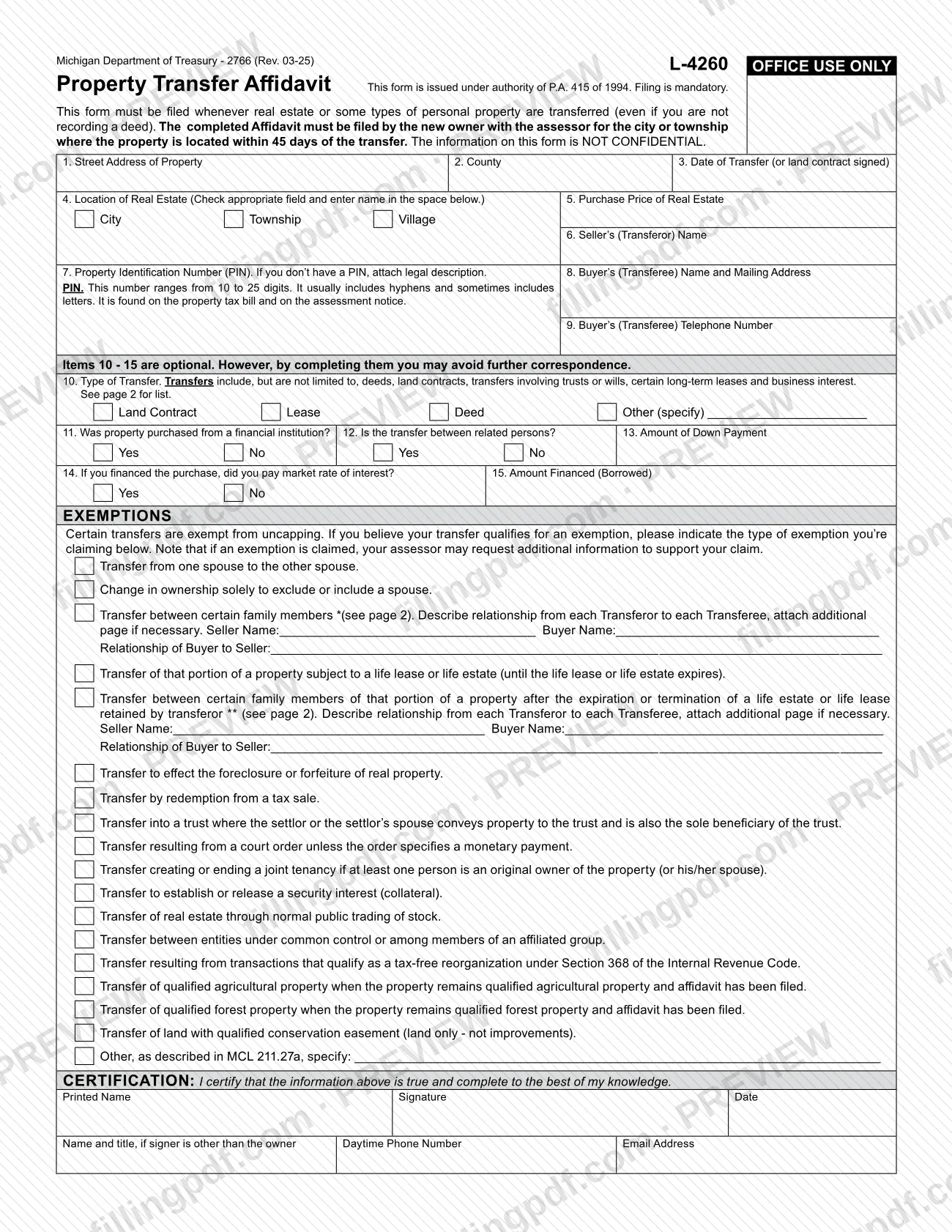
Form 2766, the Property Transfer Affidavit (L-4260), is the Michigan Department of Treasury form that a new owner files with the local assessor after real estate or certain personal property changes hands. The City of Wyoming, Michigan, lists it among its assessing forms, which makes it one of the Wyoming property tax forms; the form states that filing is mandatory, even if no deed is recorded. On this page you can fill out the form online on FillingPDF and download or print the completed PDF. The official PDF is published by the city at wyomingmi.gov.
Last updated
What is 2766?
Property Transfer Affidavit (L-4260), Michigan Department of Treasury Form 2766, is the affidavit a buyer or other new owner files with the assessor to report a transfer of ownership of real estate or of certain personal property, with the parties, date, price and parcel identification.
The form is issued under authority of P.A. 415 of 1994, and it states that filing is mandatory. It must be filed whenever real estate or some types of personal property are transferred, even if you are not recording a deed. The personal property covered is buildings on leased land, leasehold improvements and leasehold estates, as defined in the Michigan Compiled Laws (MCL) cited on page 2 of the form.
Items 1 through 9 are the core entries: property address, county, date of transfer, location, purchase price, seller, Property Identification Number (PIN), buyer and buyer's telephone. Items 10 through 15 are optional, but the form says completing them may avoid further correspondence. An exemptions section lets you indicate that the transfer is exempt from uncapping, for example a transfer between spouses, a foreclosure, or a transfer between certain family members.
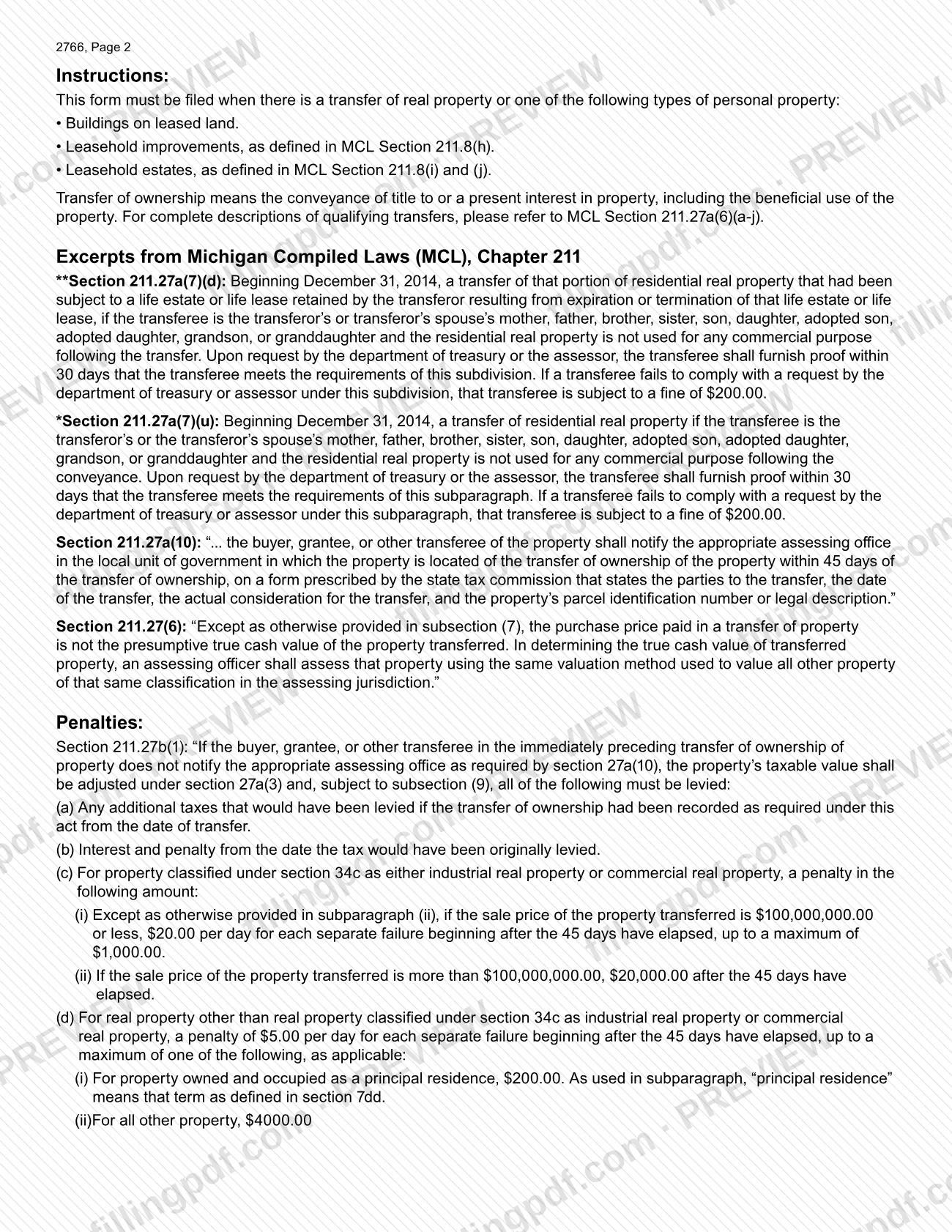
Page 2 holds the instructions, excerpts from MCL Chapter 211 and the penalties for not notifying the assessor. The information on the form is NOT CONFIDENTIAL. The City of Wyoming, Michigan, lists the form on its assessing forms page next to separate documents such as the Principal Residence Exemption Affidavit (Form 2368).
Who needs to file 2766?
The new owner files this affidavit. The form says the completed affidavit must be filed by the buyer, grantee or other transferee with the assessor for the city or township where the property is located.
You need it when any of these is transferred:
- real estate, including transfers by deed, land contract, trust, will, or certain long-term leases and business interests, even if no deed is recorded;
- buildings on leased land;
- leasehold improvements, as defined in MCL Section 211.8(h);
- leasehold estates, as defined in MCL Section 211.8(i) and (j).
"Transfer of ownership" means conveying title to, or a present interest in, property, including its beneficial use.
If you believe the transfer is exempt from uncapping, you still file the form and mark the exemption that applies. The assessor may then ask for more information to support the claim. For the family exemptions, the transferee must furnish proof within 30 days if the Department of Treasury or the assessor requests it.
If the signer is not the owner, the form asks for that person's name and title next to the signature.
When to file 2766
File the affidavit within 45 days of the transfer of ownership. The form and the quoted text of MCL 211.27a(10) both set that period, and item 3 asks for the date of transfer, or the date a land contract was signed.
The deadline applies even when you are not recording a deed. Missing it has stated consequences under MCL 211.27b(1): the property's taxable value is adjusted, additional taxes, interest and a penalty can be levied from the date of transfer, and a per-day penalty runs after the 45 days have elapsed, up to a maximum. The maximum is lower for property owned and occupied as a principal residence than for other property, and higher categories apply to industrial and commercial real property. Check page 2 of the form for the exact schedule.
The form sets no separate renewal or expiration; it is filed once for each transfer.
Documents you need
- A legal description of the property, attached only if you do not have a Property Identification Number (PIN) to enter on item 7.
- An additional page describing the relationship from each transferor to each transferee, only if you claim a family-transfer exemption and the form's space is not enough.
- Proof that the transferee meets the family-transfer requirements, furnished within 30 days only if the Department of Treasury or the assessor requests it.
- Additional information supporting an exemption claim, only if your assessor requests it.
How to fill out 2766
Enter address, county and date
Item 1: street address of the property. Item 2: county. Item 3: date of transfer, or the date the land contract was signed.
Mark location and purchase price
Item 4: check City, Township or Village and enter its name in the space below. Item 5: purchase price of the real estate.
Enter seller and PIN
Item 6: the seller's (transferor's) name. Item 7: the Property Identification Number from your tax bill or assessment notice; if you have no PIN, attach the legal description.
Enter buyer details
Item 8: the buyer's (transferee's) name and mailing address. Item 9: the buyer's telephone number.
Complete the optional items
Item 10: check Land Contract, Lease, Deed or Other (specify). Items 11, 12 and 14: Yes or No. Items 13 and 15: down payment and amount financed. These items are optional but may avoid further correspondence.
Check any exemption that applies
In the EXEMPTIONS section, mark the type of exemption you claim, such as a transfer from one spouse to the other. Mark nothing if you claim none; the assessor may request support for a claim.
Describe family relationships if needed
For the family-member exemptions, write the seller name, buyer name and the relationship of buyer to seller. Attach an additional page if necessary. For the last exemption, specify the MCL 211.27a reason.
Complete the certification
Enter your printed name, signature and date. If the signer is not the owner, add the name and title, then enter the daytime phone number and email address.
Review and download the completed PDF
Check the dates, PIN and exemption boxes, then download or print the completed PDF from FillingPDF and file it with the assessor as described under How to submit.
How to submit 2766
The form tells the new owner to file it with the assessor for the city or township where the property is located. It prints no mailing address, portal or fee.
- Assessor's office: for property in the City of Wyoming, Michigan, the issuing office listed is the City of Wyoming Assessor/Treasurer. The city publishes the form on its assessing forms page at https://www.wyomingmi.gov/assessing-forms; ask the assessor's office which delivery options it accepts.
- Other locations: if the property is in a different city or township, file with that local assessor instead.
Include everything the form calls for: a legal description if you have no PIN, and an additional page if you must describe family relationships for more than one seller and buyer. The information on the form is not confidential, so do not add private details beyond what it asks for.
FillingPDF lets you fill out and download the PDF; submission follows the channels above.
Common mistakes to avoid
- Filing later than 45 days after the transfer; the taxable value can be adjusted and a per-day penalty can apply after the 45 days.
- Skipping the affidavit because no deed is being recorded; the form says it is required even if you are not recording a deed.
- Leaving item 7 without a PIN and without an attached legal description.
- Claiming a family-transfer exemption without naming the seller, buyer and relationship in the lines provided.
- Not sending proof within 30 days when the assessor or Department of Treasury requests it for the family exemptions; a fine can apply.
- Having someone other than the owner sign without writing that person's name and title.
- Expecting the information to stay private; the form says it is NOT CONFIDENTIAL.
- Entering the recording date instead of the date of transfer, or the date the land contract was signed, in item 3.
Frequently asked questions
What is the Property Transfer Affidavit (L-4260)?
It is Michigan Department of Treasury Form 2766, the affidavit a new owner files with the assessor to report a transfer of real estate or certain personal property. It records the parties, date, price and parcel number, and lets you claim exemptions from uncapping.
Do I have to file Form 2766 if I'm not recording a deed?
Yes. The form says it must be filed whenever real estate or some types of personal property are transferred, even if you are not recording a deed. Filing is stated to be mandatory under P.A. 415 of 1994.
How long do I have to file the Property Transfer Affidavit?
Within 45 days of the transfer of ownership. The new owner files it with the assessor for the city or township where the property is located. Late filing can lead to an adjusted taxable value, additional taxes and a per-day penalty.
Who files the property transfer affidavit, the buyer or the seller?
The buyer, grantee or other transferee files it. The form says the completed affidavit must be filed by the new owner. Seller details go on item 6, and the buyer's name and mailing address on item 8.
What if I don't have a Property Identification Number?
Attach the legal description of the property. The PIN, which ranges from 10 to 25 digits and may include hyphens or letters, is on your property tax bill and on the assessment notice.
Which transfers are exempt from uncapping?
The form lists them, including transfers between spouses, foreclosure or forfeiture, redemption from a tax sale, court orders without a monetary payment, and transfers between certain family members. Mark the one you claim; the assessor may ask for support.
Are items 10 through 15 required?
No. The form calls them optional, but says completing them may avoid further correspondence from the assessor. They cover the type of transfer, financial institution purchase, related persons, down payment, interest rate and amount financed.
Can I fill out Form 2766 online on FillingPDF?
You can fill out the PDF online on FillingPDF and download or print it. FillingPDF is independent, is not connected to the City of Wyoming or the State of Michigan, and does not file the affidavit; you file it with the assessor.
Ready to fill out 2766?
Fill out 2766 now