
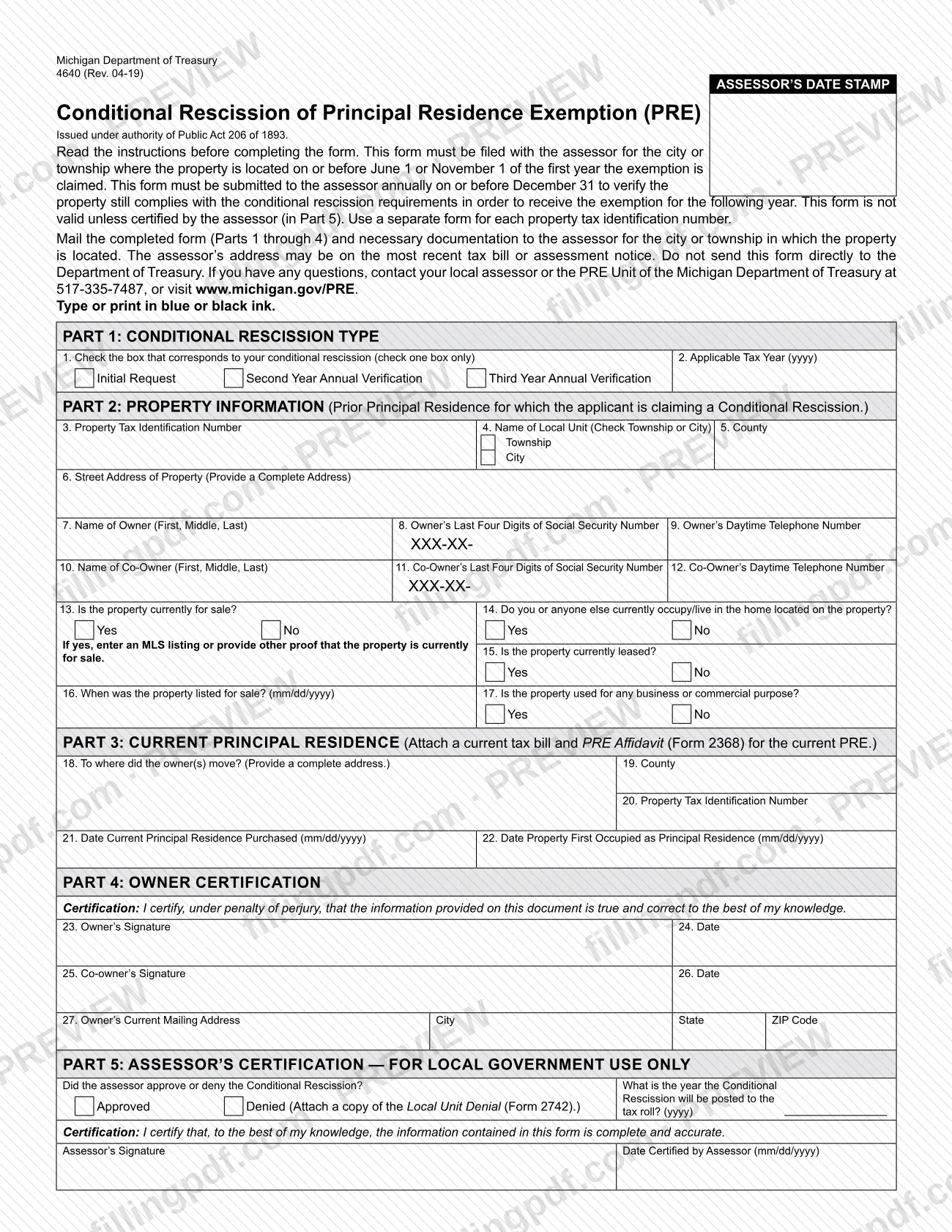
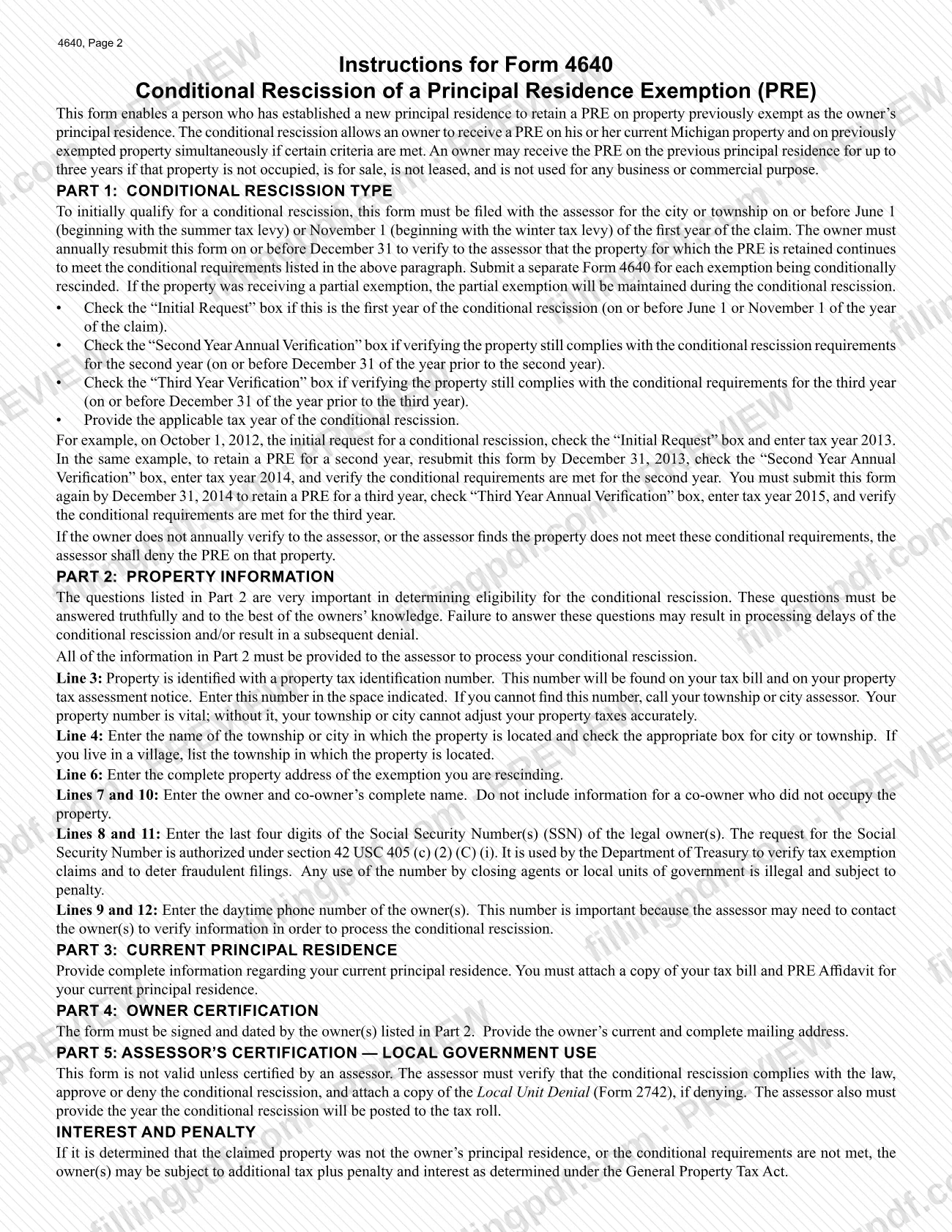
Form 4640, Conditional Rescission of Principal Residence Exemption (PRE), is the Michigan Department of Treasury form an owner files with the local assessor to keep a Principal Residence Exemption (PRE) on a former home after moving into a new principal residence. The City of Wyoming, Michigan, lists it among its assessing forms, so it is one of the Wyoming property tax forms homeowners may need when they move. On this page you can fill out the form online on FillingPDF and download or print the completed PDF; the form and its instructions are published by the Michigan Department of Treasury and the city.
Last updated
What is 4640?
Form 4640, Conditional Rescission of Principal Residence Exemption (PRE), is the Michigan Department of Treasury form that lets an owner who has established a new principal residence keep a Principal Residence Exemption (PRE) on the property that was previously exempt as the owner's principal residence.
The conditional rescission allows an owner to receive a PRE on the current Michigan home and on the previously exempted property at the same time, if certain criteria are met. The instructions say the owner may keep the PRE on the previous home for up to three years, provided that property is not occupied, is for sale, is not leased and is not used for any business or commercial purpose.
The form is issued under authority of Public Act 206 of 1893 and is filed with the assessor for the city or township where the property is located, not with the Department of Treasury. It has five parts: the conditional rescission type, the property information, the current principal residence, the owner certification, and the assessor's certification. The form is not valid unless the assessor certifies it in Part 5.
Use a separate Form 4640 for each property tax identification number. If the property was receiving a partial exemption, the partial exemption is maintained during the conditional rescission.
Who needs to file 4640?
The main group is Michigan homeowners who have moved into a new principal residence and want to keep the PRE on the home they previously occupied as their principal residence. The form states that the previous property must not be occupied, must be for sale, must not be leased and must not be used for any business or commercial purpose.
- Owners and co-owners listed in Part 2 sign Part 4. Do not include information for a co-owner who did not occupy the property.
- Owners with more than one exempt property use a separate form for each property tax identification number.
- Owners who already filed an initial request resubmit the form each year, checking the second-year or third-year verification box.
Assessors also handle the form: Part 5 is for local government use only, and the form is not valid until the assessor certifies it. The form does not describe who else may sign for an owner.
When to file 4640
For the initial request, file Form 4640 with the assessor on or before June 1 (beginning with the summer tax levy) or November 1 (beginning with the winter tax levy) of the first year the exemption is claimed.
To keep the exemption for the following year, resubmit the form to the assessor annually on or before December 31 and verify the property still meets the conditional requirements. The instructions give an example: an initial request made on October 1, 2012 uses tax year 2013; the second-year verification is due by December 31, 2013 with tax year 2014; and the third-year verification is due by December 31, 2014 with tax year 2015.
The PRE can be kept on the previous home for up to three years. If the owner does not verify annually, or the assessor finds the property does not meet the requirements, the assessor must deny the PRE on that property.
Documents you need
- A copy of the current tax bill for your current principal residence, attached under Part 3.
- A PRE Affidavit (Form 2368) for the PRE on your current principal residence, attached under Part 3.
- An MLS listing or other proof that the previous property is currently for sale, when you answer Yes to the line 13 question about the property being for sale.
- A copy of the Local Unit Denial (Form 2742), attached by the assessor in Part 5 only if the conditional rescission is denied.
How to fill out 4640
Check your conditional rescission type
On line 1, check one box only: Initial Request, Second Year Annual Verification or Third Year Annual Verification.
Enter the applicable tax year
On line 2, write the tax year in yyyy format. For an initial request made in 2012, the instructions' example enters 2013, and each verification adds one year.
Identify the former principal residence
Enter the property tax identification number on line 3 (found on your tax bill and assessment notice), the local unit on line 4 with the City or Township box checked, the county on line 5 and the complete street address on line 6.
Enter the owner's information
On line 7 write the owner's first, middle and last name, on line 8 the last four digits of the Social Security number, and on line 9 a daytime telephone number.
Enter the co-owner's information
If there is a co-owner who occupied the property, complete lines 10 to 12 with the name, last four SSN digits and daytime telephone number. Leave out a co-owner who did not occupy it.
Answer the sale, occupancy and lease questions
Answer Yes or No on line 13 (property for sale), line 14 (anyone occupying the home), line 15 (property leased) and line 17 (business or commercial use). If the property is for sale, enter an MLS listing or other proof.
Enter the date of listing
On line 16, enter the date the property was listed for sale in mm/dd/yyyy format.
Describe your current principal residence
On line 18 give the complete address you moved to, on line 19 the county and on line 20 the property tax identification number. Enter the purchase date on line 21 and the date first occupied on line 22, both mm/dd/yyyy.
Sign and date the certification
The owner signs and dates lines 23 and 24; a co-owner signs and dates lines 25 and 26. Certification is made under penalty of perjury.
Enter your mailing address
On line 27 write the owner's current and complete mailing address, with city, state and ZIP code.
Leave the assessor's part blank
Do not complete Part 5. The assessor approves or denies the request, enters the tax roll year and certifies the form.
Review, attach documents and download
Check every line, then download or print the completed PDF from FillingPDF. Attach the current tax bill, the Form 2368 and any listing proof, and send the package as described under How to submit.
How to submit 4640
Form 4640 goes to the local assessor by mail: send the completed form (Parts 1 through 4) and the necessary documentation to the assessor for the city or township where the property is located.
- Mail: the form says the assessor's address may be on the most recent tax bill or assessment notice. For property in the City of Wyoming, the form is listed on the city's assessing forms page at https://www.wyomingmi.gov/assessing-forms.
- Where not to send it: do not send the form directly to the Michigan Department of Treasury.
- Part 5: leave it blank. The assessor completes it, approves or denies the request, and attaches a copy of Form 2742 (Local Unit Denial) if denying.
- Questions: contact your local assessor or the PRE Unit of the Michigan Department of Treasury at 517-335-7487, or visit www.michigan.gov/PRE.
The form names no other channel and no fee. FillingPDF lets you fill out and download the PDF; submission follows the channels above.
Common mistakes to avoid
- Mailing the form directly to the Michigan Department of Treasury instead of the assessor for the city or township where the property is located.
- Filing the initial request after June 1 or November 1 of the first year of the claim.
- Not resubmitting the form on or before December 31 each year to verify the property still qualifies, which leads the assessor to deny the PRE.
- Checking more than one box on line 1 instead of one box only.
- Using one form for several properties; each property tax identification number needs its own Form 4640.
- Leaving out the current tax bill or the PRE Affidavit (Form 2368) for the current principal residence required in Part 3.
- Listing a co-owner who did not occupy the property in lines 10 to 12.
- Skipping or inaccurately answering the Part 2 questions, which can delay processing or lead to denial.
- Counting the form as complete without the assessor's certification in Part 5; it is not valid until certified.
Frequently asked questions
What is Form 4640 used for?
Form 4640 is the Michigan Department of Treasury's Conditional Rescission of Principal Residence Exemption. It lets an owner who has moved into a new principal residence keep the PRE on the previous home, for up to three years, while that home is unoccupied, for sale, not leased and not used for business.
When is Form 4640 due?
The initial request is due to the assessor on or before June 1 or November 1 of the first year of the claim. After that, resubmit the form on or before December 31 each year to verify the property still qualifies for the following year.
How long can I keep the PRE on my old home with Form 4640?
Up to three years, if the previous home stays unoccupied, is for sale, is not leased and is not used for any business or commercial purpose. You must verify this each year with a new Form 4640 checked as second-year or third-year verification.
Where do I send Form 4640?
Mail it to the assessor for the city or township where the property is located; the address may be on the most recent tax bill or assessment notice. Do not send it directly to the Michigan Department of Treasury.
What do I attach to Form 4640?
Attach a copy of the current tax bill and a PRE Affidavit (Form 2368) for your current principal residence. If the old property is for sale, the form also asks for an MLS listing or other proof of the sale listing.
What happens if I miss the yearly verification or no longer qualify?
The assessor must deny the PRE on that property. If the property was not your principal residence or the conditional requirements are not met, you may owe additional tax plus penalty and interest under the General Property Tax Act.
Do I need a separate Form 4640 for each property?
Yes. The form says to use a separate form for each property tax identification number, and to submit a separate Form 4640 for each exemption being conditionally rescinded.
Can I fill out Form 4640 online on FillingPDF?
Yes, you can fill out the PDF online on FillingPDF and download or print it. FillingPDF is an independent service, not connected to the City of Wyoming or the State of Michigan, and it does not file the form; you send it to the assessor yourself.
Ready to fill out 4640?
Fill out 4640 now