
Schedule PTE, Pass-through Entity Tax, is the Minnesota Department of Revenue schedule that a partnership, limited liability company (LLC) or S corporation completes to elect to file and pay pass-through entity tax at the entity level on behalf of its owners. It is filed with the entity's Form M3 or Form M8. On FillingPDF you can fill out the form online and download or print the completed PDF; the Department of Revenue publishes the original PDF and the instructions at the official source link.
Last updated
What is Schedule PTE?
2025 Schedule PTE, Pass-through Entity Tax is the Minnesota Department of Revenue schedule on which a partnership, LLC or S corporation elects to pay income tax at the entity level for its qualifying owners and calculates the tax due.
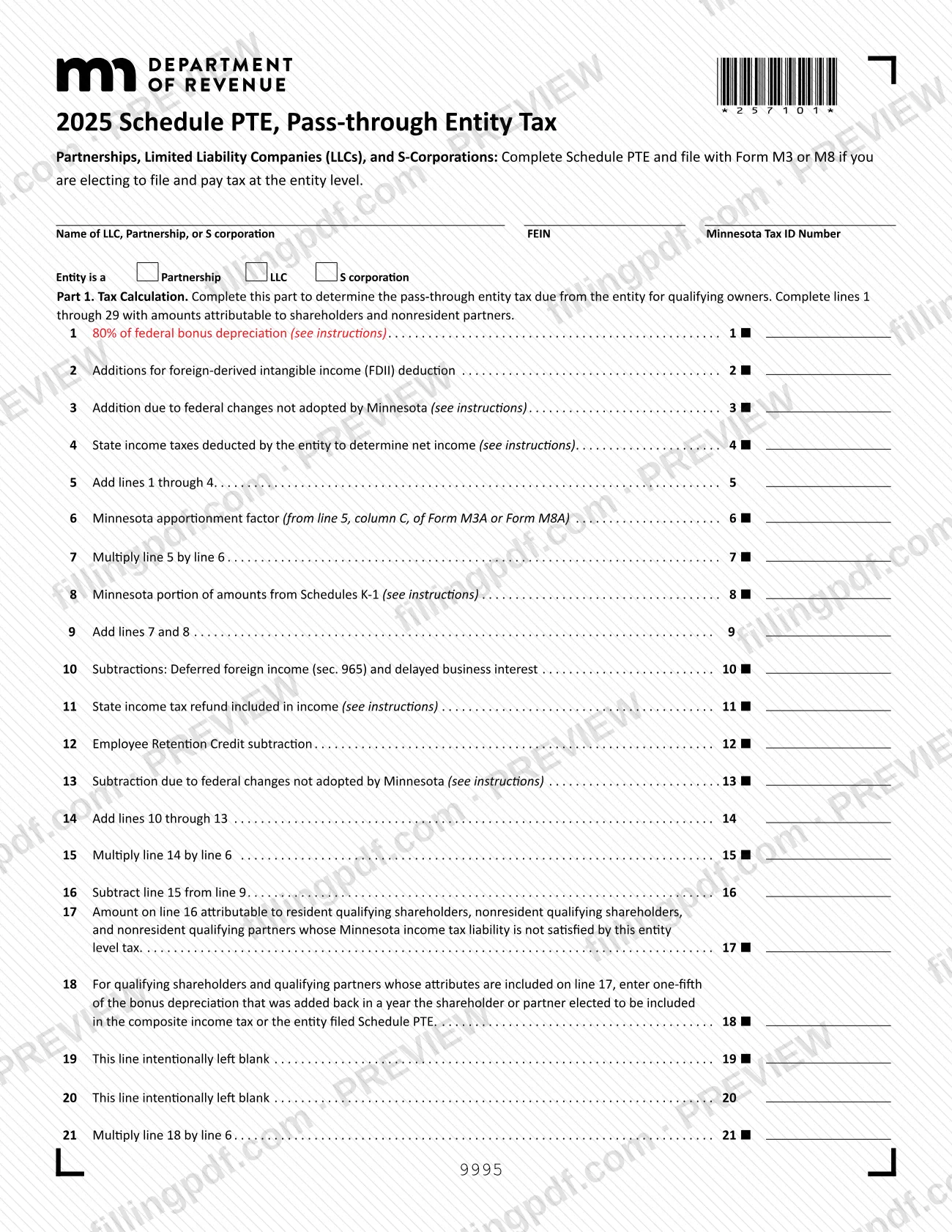
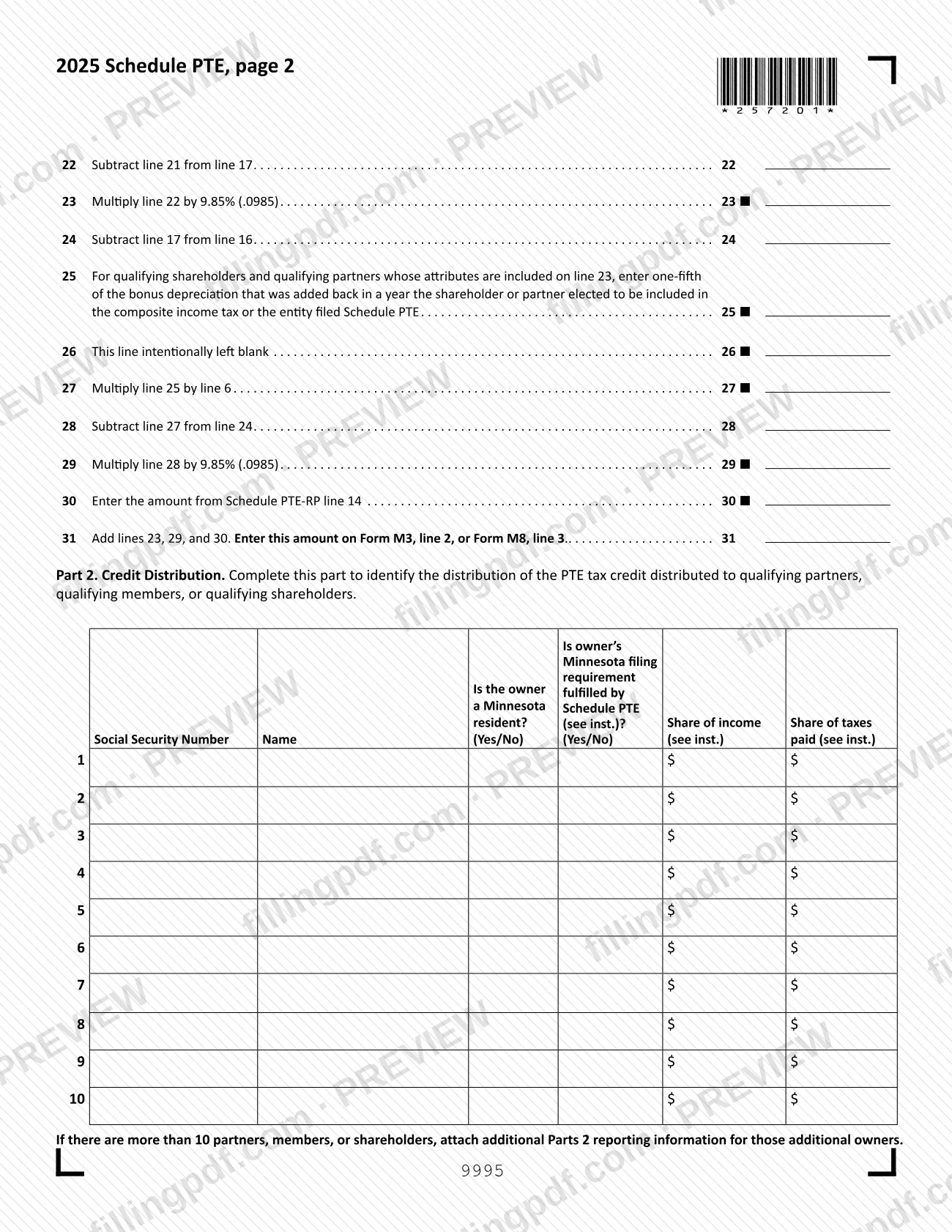
The schedule has two parts. Part 1, Tax Calculation (lines 1 through 31), starts from bonus depreciation, foreign-derived intangible income and other additions, applies the Minnesota apportionment factor from Form M3A or Form M8A, subtracts items such as deferred foreign income and the Employee Retention Credit subtraction, and ends with the tax. Line 31 carries the total to Form M3, line 2, or Form M8, line 3. Part 2, Credit Distribution, lists each owner with the share of income and the share of taxes paid, which identifies the credit distributed to the owners.
Filing the schedule is how the election is made. In the instructions, "partnership" and "S corporation" include LLCs taxed as one of them, and "partner" and "shareholder" also mean a member of an LLC. Owners can claim a refundable credit equal to the PTE tax paid on their behalf, reported on Schedule M1REF, Refundable Credits, or on Form M2, Income Tax Return for Estates and Trusts.
Schedule PTE works with companion schedules named on the form: Schedule PTE-RP, Pass-through Entity Tax for Resident Partners (its line 14 feeds line 30), and the owner schedules KPI and KS. It is not an individual return, and a single-member LLC not taxed as an S corporation cannot use it.
Who needs to file Schedule PTE?
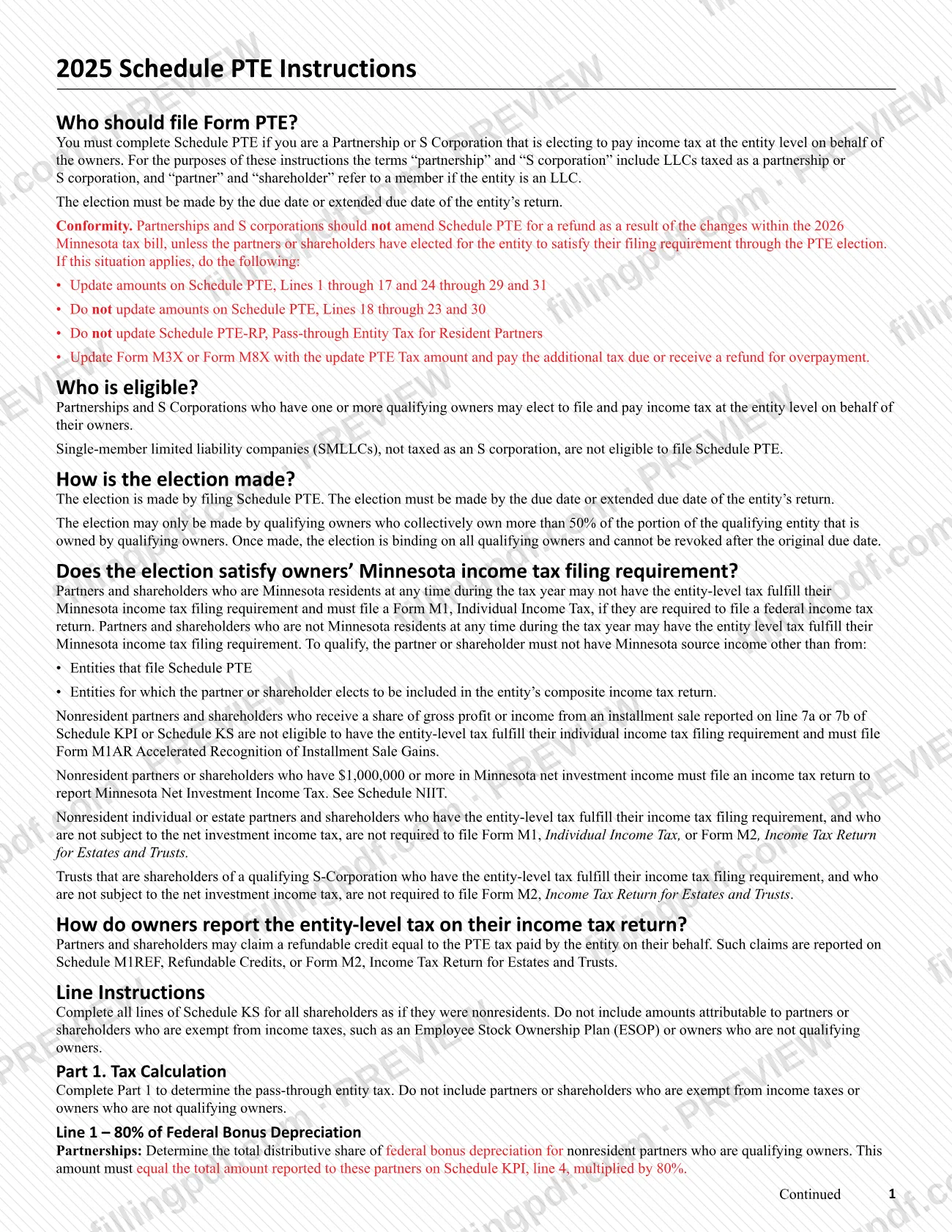
Partnerships and S corporations that have one or more qualifying owners and elect to pay income tax at the entity level on behalf of those owners complete Schedule PTE. LLCs taxed as a partnership or S corporation are included.
Conditions that apply:
- Single-member LLCs (SMLLCs) not taxed as an S corporation are not eligible.
- The election may be made only by qualifying owners who collectively own more than 50% of the portion of the entity owned by qualifying owners.
- Do not include amounts for owners who are exempt from income taxes, such as an Employee Stock Ownership Plan (ESOP), or for owners who are not qualifying owners.
Effect on owners: partners and shareholders who were Minnesota residents at any time during the tax year cannot have the entity-level tax satisfy their Minnesota filing requirement and must file Form M1 if they must file a federal return. Nonresident owners may have it satisfied if their only Minnesota source income comes from entities that file Schedule PTE or from composite income tax returns they elected to join. Nonresident owners with installment sale gains reported on line 7a or 7b of Schedule KPI or KS must file Form M1AR, and those with high Minnesota net investment income must report under Schedule NIIT.
When to file Schedule PTE
The election is made by filing Schedule PTE by the due date or extended due date of the entity's return. Once made, it is binding on all qualifying owners and cannot be revoked after the original due date.
The schedule has no separate due date: it is filed with Form M3 or Form M8, so it travels with that return.
If Minnesota's 2026 tax bill changes affect a return already filed, the instructions say partnerships and S corporations should not amend Schedule PTE for a refund unless the owners elected for the entity to satisfy their filing requirement through the PTE election. In that case, update lines 1 through 17, 24 through 29 and 31, leave lines 18 through 23 and 30 and Schedule PTE-RP unchanged, and report the new PTE tax amount on Form M3X or Form M8X, paying any additional tax or receiving a refund.
Documents you need
- Form M3 or Form M8: Schedule PTE is filed with the entity's return, and line 31 is carried to Form M3, line 2, or Form M8, line 3.
- Schedule PTE-RP, Pass-through Entity Tax for Resident Partners: the amount from its line 14 is entered on line 30 of Schedule PTE.
- Additional Parts 2: attach them if there are more than 10 partners, members or shareholders.
- A statement explaining how each owner's share of taxes paid was determined, for partnerships that include guaranteed payments or special allocations in the PTE tax calculation.
How to fill out Schedule PTE
Enter entity name, IDs and type
At the top, enter the name of the LLC, partnership or S corporation, its FEIN and its Minnesota Tax ID Number. Check whether the entity is a Partnership, LLC or S corporation.
Complete the additions on lines 1 to 5
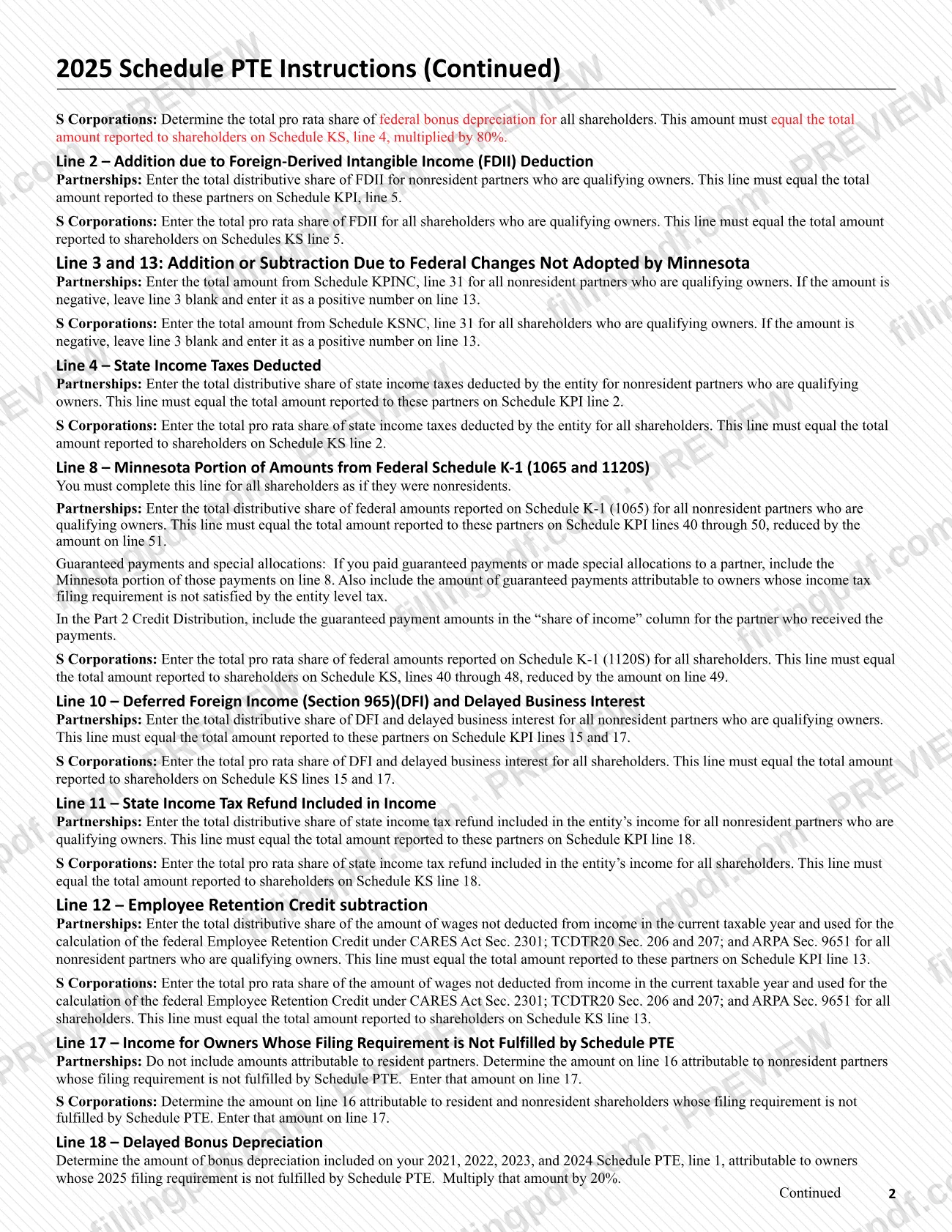
Line 1 is 80% of federal bonus depreciation, line 2 is the FDII addition, line 3 is the addition for federal changes not adopted by Minnesota and line 4 is state income taxes deducted. Each must match the stated Schedule KPI or KS line; add lines 1 through 4 on line 5.
Apply apportionment and Schedule K-1 amounts
Line 6: enter the Minnesota apportionment factor from line 5, column C, of Form M3A or Form M8A. Multiply line 5 by line 6 on line 7, enter the Minnesota portion of Schedules K-1 on line 8 and add lines 7 and 8 on line 9.
Enter the subtractions on lines 10 to 14
Enter deferred foreign income (sec. 965) and delayed business interest on line 10, the state income tax refund on line 11, the Employee Retention Credit subtraction on line 12 and any negative federal-change amount on line 13. Add lines 10 through 13 on line 14.
Calculate line 15 and line 16
Multiply line 14 by line 6 on line 15, then subtract line 15 from line 9 on line 16.
Separate owners not covered by the election
Line 17: enter the amount on line 16 attributable to owners whose Minnesota filing requirement is not fulfilled by Schedule PTE. On line 18, enter one-fifth of the bonus depreciation added back in earlier years for those owners.
Figure the tax on lines 21 to 23
Leave lines 19 and 20 blank. Multiply line 18 by line 6 on line 21, subtract line 21 from line 17 on line 22 and multiply line 22 by the rate printed on line 23.
Figure the tax for owners covered by the election
Subtract line 17 from line 16 on line 24. Enter delayed bonus depreciation on line 25, leave line 26 blank, multiply line 25 by line 6 on line 27, subtract it from line 24 on line 28 and apply the printed rate on line 29.
Total the tax on lines 30 and 31
Line 30: enter the amount from Schedule PTE-RP, line 14. Add lines 23, 29 and 30 on line 31, and enter that total on Form M3, line 2, or Form M8, line 3.
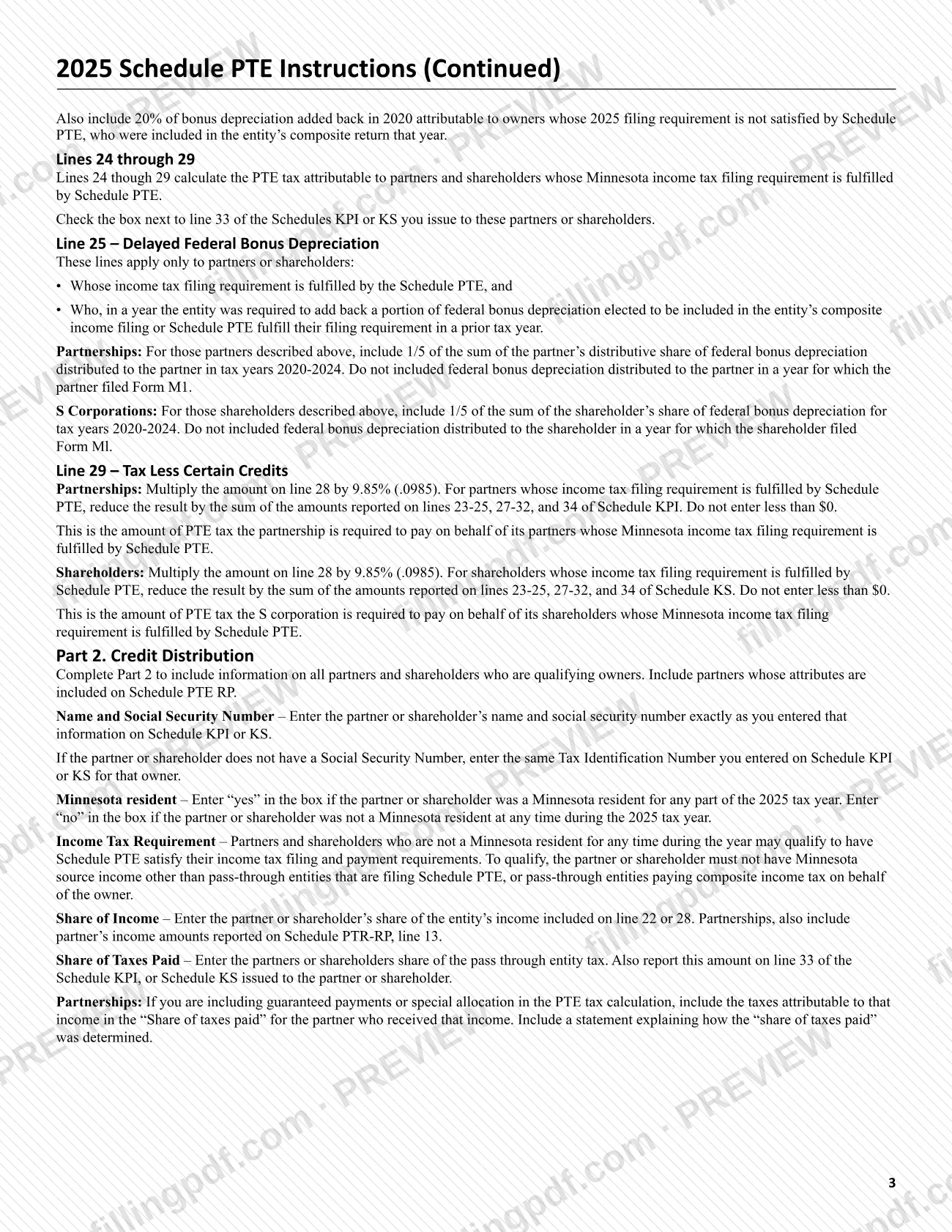
Complete Part 2, Credit Distribution
For each owner, enter the Social Security Number (or the same Tax Identification Number used on Schedule KPI or KS), the name, whether the owner was a Minnesota resident (Yes/No), whether Schedule PTE fulfills the owner's filing requirement (Yes/No), the share of income and the share of taxes paid. Attach additional Parts 2 for more than 10 owners.
Review and download the completed PDF
Check that each amount matches the Schedule KPI or KS lines the instructions cite, and that the share of taxes paid also appears on line 33 of each owner's schedule. Download or print the completed PDF from FillingPDF and file it with Form M3 or Form M8.
How to submit Schedule PTE
Schedule PTE has no filing channel of its own: it is filed with the entity's Form M3 or Form M8, and it goes wherever that return goes. The form prints no separate mailing address, portal or appointment rule.
- With Form M3 or Form M8: complete Schedule PTE and include it with the return. Carry the line 31 total to Form M3, line 2, or Form M8, line 3.
- More than 10 owners: attach additional Parts 2 for the extra partners, members or shareholders.
- Guaranteed payments or special allocations (partnerships): if you include them in the PTE tax calculation, attach a statement explaining how each owner's share of taxes paid was determined.
- Amended return: where the instructions allow an update, report the new PTE tax amount on Form M3X or Form M8X.
Enter the same share of taxes paid on line 33 of the Schedule KPI or KS issued to each owner. For questions about filing methods, use the Minnesota Department of Revenue's website at revenue.state.mn.us. FillingPDF lets you fill out and download the PDF; submission follows the channels above.
Common mistakes to avoid
- Filing Schedule PTE for a single-member LLC that is not taxed as an S corporation; the instructions say these entities are not eligible.
- Making the election after the due date or extended due date of the entity's return, or expecting to revoke it after the original due date.
- Including amounts for owners who are exempt from income taxes, such as an ESOP, or for owners who are not qualifying owners.
- Entering a negative Schedule KPINC or KSNC line 31 amount on line 3; leave line 3 blank and enter it as a positive number on line 13.
- Writing amounts on lines 19, 20 or 26, which the form marks as intentionally left blank.
- Completing Schedule KS for only some shareholders; the instructions say to complete all lines for all shareholders as if they were nonresidents.
- Entering a result below zero on line 29; the instructions say not to enter less than zero after reducing by the Schedule KPI or KS credit lines.
- Counting bonus depreciation on line 25 for a year in which the owner filed Form M1.
- Leaving out the statement explaining how share of taxes paid was determined when guaranteed payments or special allocations are included.
Frequently asked questions
What is the pass-through entity tax on Schedule PTE?
It is income tax that a partnership, LLC or S corporation elects to pay at the entity level on behalf of its qualifying owners in Minnesota. Schedule PTE makes the election and calculates the tax; owners then claim a refundable credit equal to the tax paid on their behalf.
Who can file Schedule PTE?
Partnerships and S corporations with one or more qualifying owners, including LLCs taxed as either. Single-member LLCs not taxed as an S corporation are not eligible. The election must come from qualifying owners who collectively own more than 50% of the portion owned by qualifying owners.
When is the Schedule PTE election due?
By the due date or extended due date of the entity's return. The election is binding on all qualifying owners once made and cannot be revoked after the original due date.
Do owners still have to file Form M1 if the entity files Schedule PTE?
Minnesota residents at any time during the year must still file Form M1 if they must file a federal return. Nonresident owners may have the entity-level tax satisfy their filing requirement if their only Minnesota source income is from entities filing Schedule PTE or composite returns they joined.
Where does the line 31 total of Schedule PTE go?
Enter it on Form M3, line 2, or Form M8, line 3. Line 31 is the sum of lines 23, 29 and 30, and Schedule PTE is filed together with that return.
What if I have more than 10 owners to list in Part 2?
Attach additional Parts 2 reporting the extra partners, members or shareholders. Part 2 has ten numbered rows, and the form tells you to attach more pages when the entity has more than ten owners.
Can I fill out Schedule PTE online?
Yes. You can fill out the PDF online on FillingPDF and download or print it. FillingPDF is independent of the Minnesota Department of Revenue and does not file the schedule; you file it with Form M3 or Form M8.
Where do I mail Schedule PTE?
The schedule prints no address of its own. It is filed with Form M3 or Form M8, so it is sent the way that return is sent. Check the Minnesota Department of Revenue website for the filing options of that return.
Ready to fill out Schedule PTE?
Fill out Schedule PTE now