
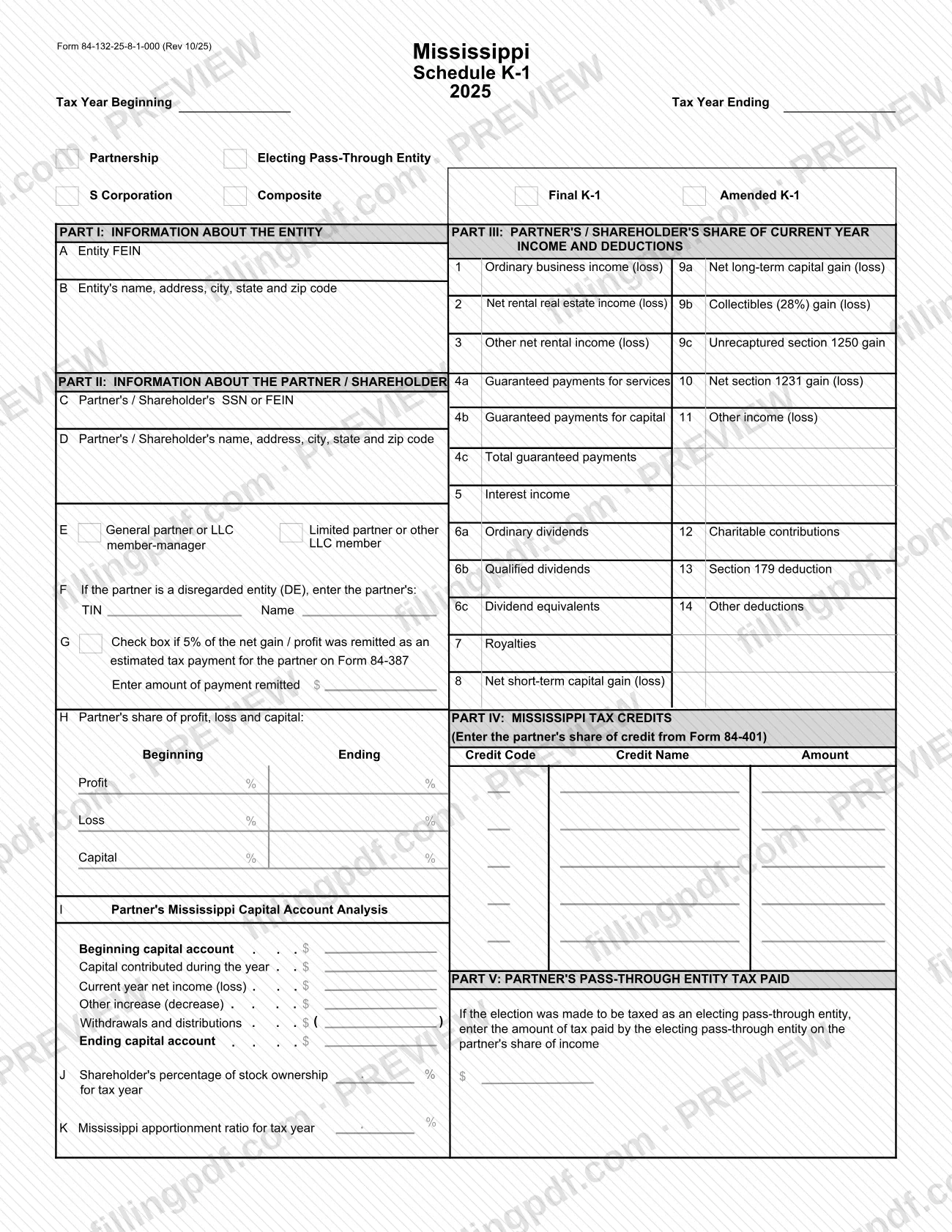
Mississippi Schedule K-1 (Form 84-132) is a Mississippi Department of Revenue (DOR) schedule for tax year 2025. It reports one partner's or S corporation shareholder's share of an entity's income, deductions, Mississippi tax credits and pass-through entity tax paid. It is organized around the entity (Part I) and the owner who receives the share (Part II). On this page you can fill out the form online on FillingPDF and download or print the completed PDF; the official PDF is published by the DOR.
Last updated
What is 84-132?
Mississippi Schedule K-1 (Form 84-132) is the Mississippi Department of Revenue (DOR) schedule that reports a partner's or shareholder's share of an entity's income, deductions, tax credits and pass-through entity tax paid for tax year 2025.
The form is printed as Form 84-132-25-8-1-000 (Rev 10/25). Boxes at the top let you mark the type of entity or schedule: Partnership, Electing Pass-Through Entity, S Corporation, Composite, Final K-1 and Amended K-1. The form has five parts:
- Part I: information about the entity, including its FEIN, name and address.
- Part II: information about the partner or shareholder, with items E through K covering the owner's type, disregarded entity details, estimated tax remitted on Form 84-387, share of profit, loss and capital, a Mississippi capital account analysis, stock ownership percentage and the Mississippi apportionment ratio.
- Part III: the owner's share of current-year income and deductions, lines 1 through 14.
- Part IV: Mississippi tax credits, taken from Form 84-401.
- Part V: pass-through entity tax paid, when the entity elected to be taxed as an electing pass-through entity.
This is the DOR's Schedule K-1 for partnerships and S corporations. The DOR's forms list shows a separate Fiduciary Schedule K-1 (Form 81-132) under its individual income tax forms; that is a different form.
Who needs to file 84-132?
The form is built for entities that pass income through to owners and for the owners who receive a share. The entity types printed at the top are partnership, electing pass-through entity, S corporation and composite.
- The entity completes Part I with its FEIN, name and address, and reports each owner's share on a separate schedule.
- The partner or shareholder is identified in Part II by SSN or FEIN, name and address. Item E marks a general partner or LLC member-manager, or a limited partner or other LLC member. Item J applies to an S corporation shareholder's percentage of stock ownership.
- A partner that is a disregarded entity (DE) enters its TIN and name in item F.
- Owners of an electing pass-through entity use Part V to show the tax the entity paid on their share of income.
The form does not state who signs or who may act for the entity or owner, and it prints no filing threshold. Fiduciary beneficiaries are not covered here: the DOR lists a separate Fiduciary Schedule K-1 (Form 81-132).
When to file 84-132
This version covers tax year 2025: you enter the tax year beginning and ending dates at the top of the form. No separate due date is printed on it. Check the DOR for the deadline that applies to the return it accompanies.
Two boxes at the top mark special situations: Final K-1 and Amended K-1. Mark the one that applies when the schedule is the last one for the owner or when it replaces a schedule already issued.
Documents you need
- Form 84-401: the form tells you to enter the partner's share of credit from this form in Part IV, Mississippi Tax Credits, so have it available when credits apply.
- Form 84-387: referenced in item G; relevant only if 5% of the net gain/profit was remitted as an estimated tax payment for the partner.
How to fill out 84-132
Enter the tax year and mark boxes
At the top, enter the tax year beginning and ending dates for 2025. Mark the entity type (Partnership, Electing Pass-Through Entity, S Corporation or Composite) and, if they apply, Final K-1 or Amended K-1.
Complete Part I: the entity
Enter the entity's FEIN on item A. On item B enter its name, address, city, state and ZIP code.
Identify the partner or shareholder
On item C enter the partner's or shareholder's SSN or FEIN. On item D enter name, address, city, state and ZIP code.
Mark the owner type and DE details
On item E mark general partner or LLC member-manager, or limited partner or other LLC member. If the partner is a disregarded entity, enter its TIN and name on item F.
Record estimated tax remitted
On item G, check the box if 5% of the net gain/profit was remitted as an estimated tax payment for the partner on Form 84-387, and enter the amount remitted.
Enter profit, loss and capital shares
On item H, enter the beginning and ending percentages for Profit, Loss and Capital.
Complete the capital account analysis
On item I, enter the beginning capital account, capital contributed, current-year net income (loss), other increase (decrease) and withdrawals and distributions, then the ending capital account.
Enter ownership and apportionment
On item J, enter the shareholder's percentage of stock ownership. On item K, enter the Mississippi apportionment ratio for the tax year.
Report income and deductions in Part III
Enter the owner's share on lines 1 through 14: ordinary business income, rental income, guaranteed payments (4a to 4c), interest, dividends, royalties, capital gains (8 and 9a to 9c), section 1231 gain, other income, charitable contributions, section 179 and other deductions.
List Mississippi tax credits
In Part IV, enter each credit's code, name and amount, using the partner's share of credit from Form 84-401.
Enter pass-through entity tax paid
In Part V, if the entity elected to be taxed as an electing pass-through entity, enter the tax it paid on the partner's share of income for the tax year.
Review and download the completed PDF
Check the entity and owner identification numbers, the boxes at the top and each amount. Download or print the completed PDF from FillingPDF, then deliver it as described under How to submit.
How to submit 84-132
The form prints no mailing address, portal or delivery instruction, so follow the filing channels of the Mississippi Department of Revenue (DOR) for the return this schedule accompanies. The DOR publishes the official PDF at https://www.dor.ms.gov/sites/default/files/tax-forms/business/84132258.pdf, and its forms list is at https://www.dor.ms.gov/forms-resources/form-search.
FillingPDF lets you fill out and download the PDF; submission follows the DOR channels.
Common mistakes to avoid
- Entering Part IV credits that are not the partner's share of credit from Form 84-401; the form directs you to take them from that form.
- Completing Part V when no election was made; it applies only if the entity elected to be taxed as an electing pass-through entity.
- Checking item G without entering the amount remitted, or checking it when the 5% was not remitted as an estimated tax payment on Form 84-387.
- Leaving item F blank when the partner is a disregarded entity; the form asks for the partner's TIN and name.
- Showing withdrawals and distributions in the capital account analysis as a positive amount; the line is printed in parentheses.
- Using this schedule for a fiduciary beneficiary; the DOR lists a separate Fiduciary Schedule K-1 (Form 81-132).
- Not marking Amended K-1 or Final K-1 when the schedule corrects an earlier one or is the last one for the owner.
Frequently asked questions
What is Mississippi Schedule K-1 (Form 84-132)?
It is the Mississippi Department of Revenue schedule, for tax year 2025, that reports a partner's or S corporation shareholder's share of an entity's income, deductions, Mississippi tax credits and pass-through entity tax paid. Part I identifies the entity and Part II the owner.
Which Schedule K-1 is Form 84-132?
Form 84-132 is the Mississippi Schedule K-1 issued by the Mississippi Department of Revenue (DOR). It is not the DOR's Fiduciary Schedule K-1, which is listed separately as Form 81-132 among the individual income tax forms.
What do the boxes at the top of the form mean?
They mark the entity or schedule type: Partnership, Electing Pass-Through Entity, S Corporation or Composite, plus Final K-1 and Amended K-1. Mark the ones that describe the schedule you are completing.
What is item G on Mississippi Schedule K-1?
Item G is a check box for when 5% of the net gain/profit was remitted as an estimated tax payment for the partner on Form 84-387. If you check it, enter the amount of payment remitted on the line beside it.
Where do Mississippi tax credits go on Form 84-132?
Part IV, Mississippi Tax Credits. For each credit enter the credit code, credit name and amount, using the partner's share of credit from Form 84-401.
What is Part V of Schedule K-1 (Form 84-132) for?
Part V shows the partner's pass-through entity tax paid. If the entity elected to be taxed as an electing pass-through entity, enter the tax the entity paid on the partner's share of income for the tax year.
Can I fill out Mississippi Schedule K-1 online?
Yes. You can fill out the PDF online on FillingPDF and download or print it. FillingPDF is an independent service and does not file the schedule; you deliver it through the Mississippi Department of Revenue's channels.
How do I correct a Schedule K-1 I already issued?
Mark the Amended K-1 box at the top of the form and complete the schedule with the corrected amounts. Use the Final K-1 box instead when the schedule is the last one for that partner or shareholder.
Ready to fill out 84-132?
Fill out 84-132 now