
The fee waiver form issued by the Montana Judicial Branch, printed as the Statement of Inability to Pay Court Costs and Fees, lets a party in a Montana court case ask the judge to waive filing and other court fees. A petitioner, plaintiff, respondent or defendant in a District Court, Justice Court, or Municipal or City Court case uses it when they cannot pay. On this page you can fill out the form online on FillingPDF and download or print the completed PDF; the official PDF is published by the Montana Judicial Branch at courts.mt.gov.
Last updated
What is Fee Waiver Form – Montana?
The Fee Waiver Form, printed as the Statement of Inability to Pay Court Costs and Fees, is the Montana Judicial Branch form for asking a court to waive filing or other court fees you cannot pay.
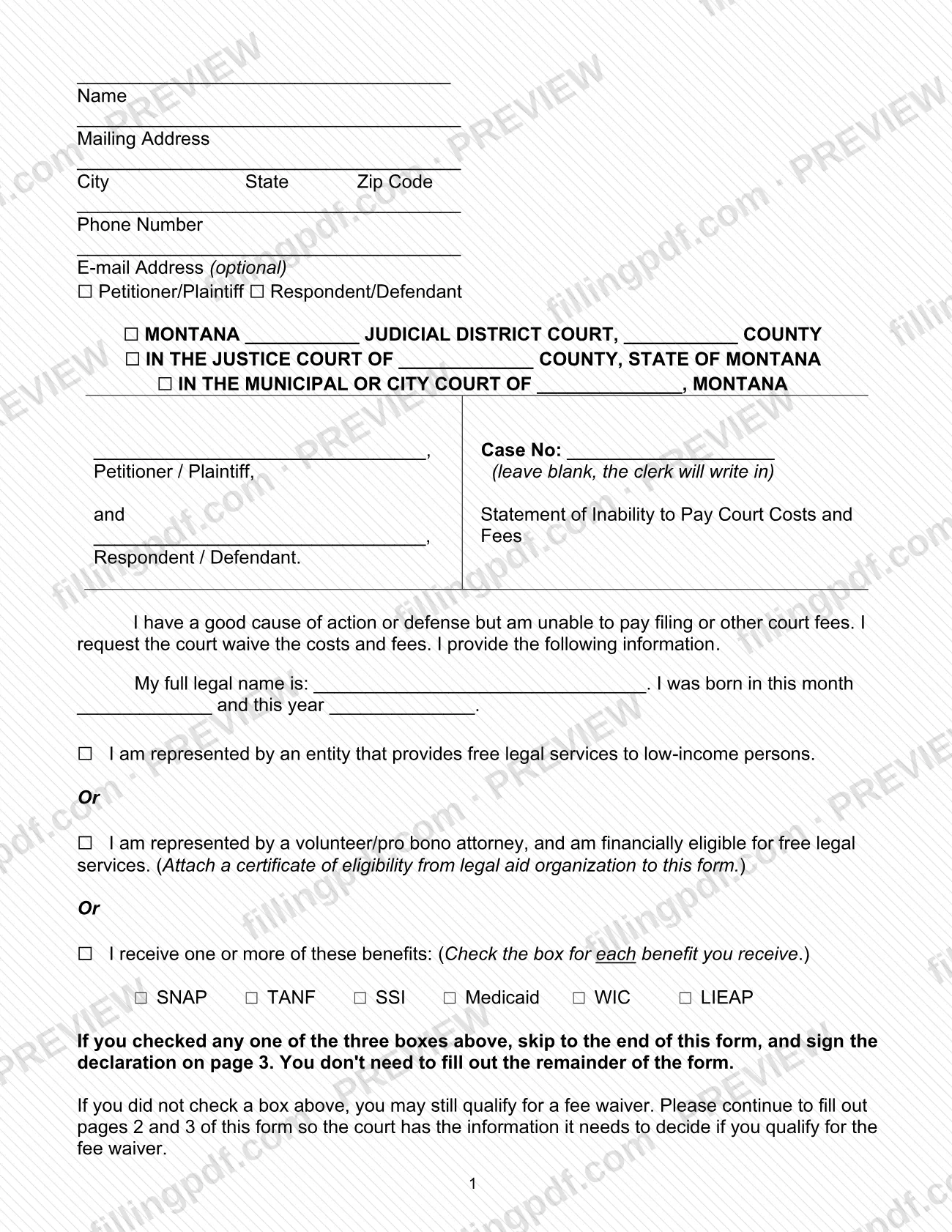
On the form you state that you have a good cause of action or defense but are unable to pay, and you give the court the information it needs to decide. You begin by saying why you may qualify: you are represented by an entity that provides free legal services to low-income persons, you are represented by a volunteer or pro bono attorney and are financially eligible for free legal services, or you receive one or more of these benefits: SNAP, TANF, SSI, Medicaid, WIC or LIEAP. If none of these applies, the form still lets you qualify by describing your finances in three sections: I. Income, II. Assets and III. Debts and Extraordinary Expenses. IV. Additional Information is optional. V. Declaration is required and is made under penalty of perjury.
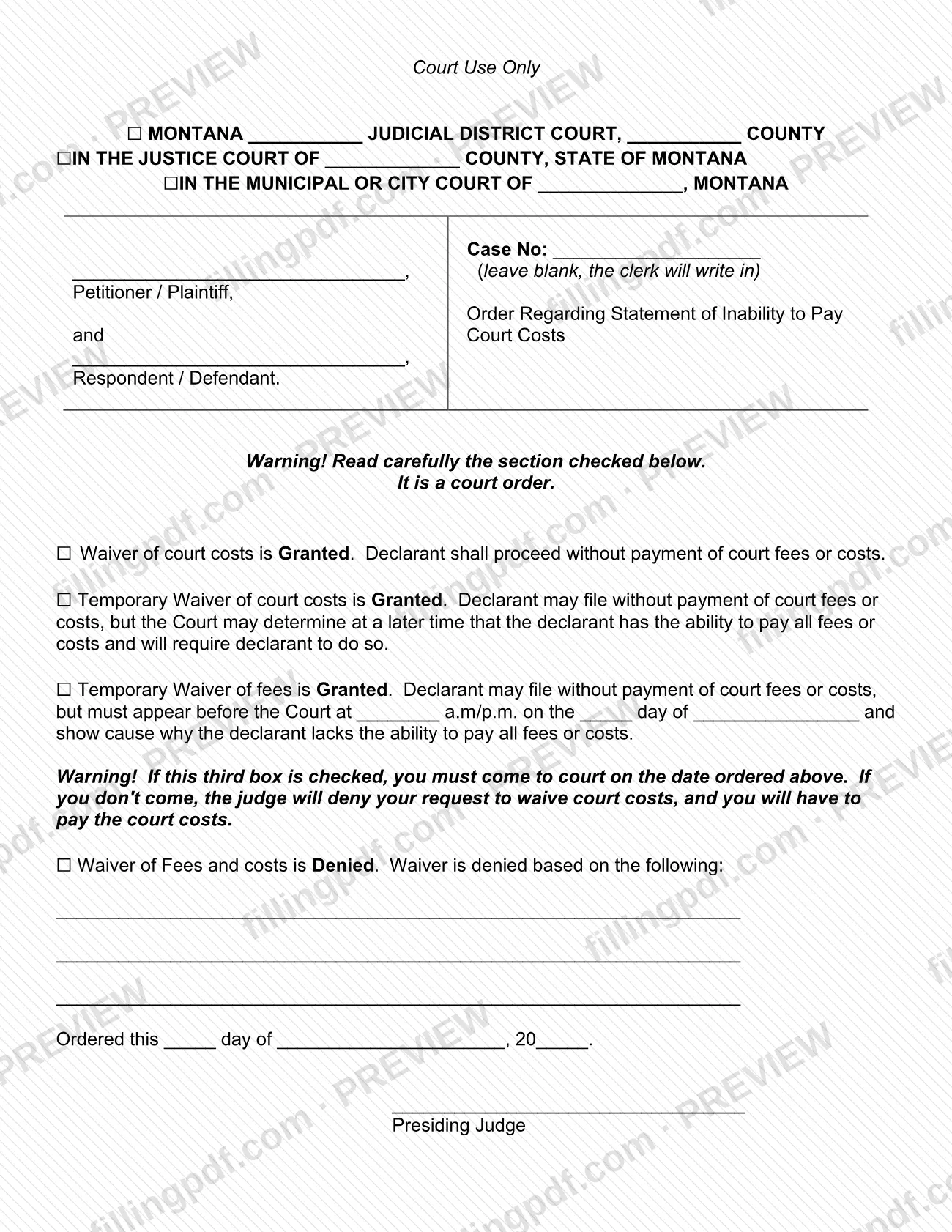
The form's caption covers three kinds of Montana court: a Judicial District Court, a Justice Court, and a Municipal or City Court. The last page is a Court Use Only order, Order Regarding Statement of Inability to Pay and Court Costs, on which the presiding judge grants, temporarily grants or denies the waiver. You do not complete that page.
The Montana courts' forms page notes that its information is not legal advice and cannot replace the advice of a lawyer.
Who needs to file Fee Waiver Form – Montana?
A person who is a party in a Montana court case and cannot pay filing or other court fees uses this form to ask the court to waive them. The form has boxes for Petitioner/Plaintiff and Respondent/Defendant, so either side of a case may complete it. It can be used in a Montana Judicial District Court, a Justice Court, or a Municipal or City Court.
Conditions the form attaches:
- If you are represented by an entity that provides free legal services to low-income persons, or you receive SNAP, TANF, SSI, Medicaid, WIC or LIEAP, you check that box and go straight to the declaration on page 3.
- If you are represented by a volunteer or pro bono attorney and are financially eligible for free legal services, you check that box and attach a certificate of eligibility from the legal aid organization.
- If you check none of these, you may still qualify: complete pages 2 and 3 so the court can decide.
- If you are not married, are separated, or one of you is filing for dissolution of marriage, you do not need to give your spouse's income.
The form asks for your own signature in the declaration. It does not describe anyone signing for you.
When to file Fee Waiver Form – Montana
Use this form when you are a party in a Montana court case and cannot pay the filing or other court fees, so the court can rule on a waiver. The form prints no due date of its own, and it states no processing time.
The caption asks you to name the court and leaves the case number blank for the clerk to write in, so the form is tied to the case in which you need the waiver.
A waiver can be temporary. The Court Use Only order allows the judge to grant a temporary waiver and decide later that you can pay all fees or costs, or to grant a temporary waiver and require you to appear on a stated date and time to show cause why you cannot pay. If you are ordered to appear and do not come, the judge will deny the request and you will have to pay the court costs.
Documents you need
- Certificate of eligibility from a legal aid organization: attach it only if you check the box saying you are represented by a volunteer or pro bono attorney and are financially eligible for free legal services.
- An extra page listing dependents: attach it only if you need more room than the five dependent lines, and check the box on the form to tell the court you attached it.
- An extra page of additional information: optional, for anything you want the court to consider about your inability to pay; check the box in Section IV if you attach one.
How to fill out Fee Waiver Form – Montana
Enter your contact information
At the top, write your name, mailing address, city, state and zip code, and phone number. The e-mail address is optional. Check Petitioner/Plaintiff or Respondent/Defendant.
Complete the court caption
Check one court box: the Montana Judicial District Court (district and county), the Justice Court of a county, or the Municipal or City Court of a city. Write the names of the Petitioner/Plaintiff and the Respondent/Defendant, and leave Case No blank for the clerk.
Give your legal name and birth date
Write your full legal name and the month and year you were born. The form does not ask for a full birth date.
Check your basis for the waiver
Check the free legal services box, the pro bono attorney box (and attach the certificate), or each benefit you receive: SNAP, TANF, SSI, Medicaid, WIC or LIEAP. If you check one of these, skip to the declaration on page 3.
Describe your work and household
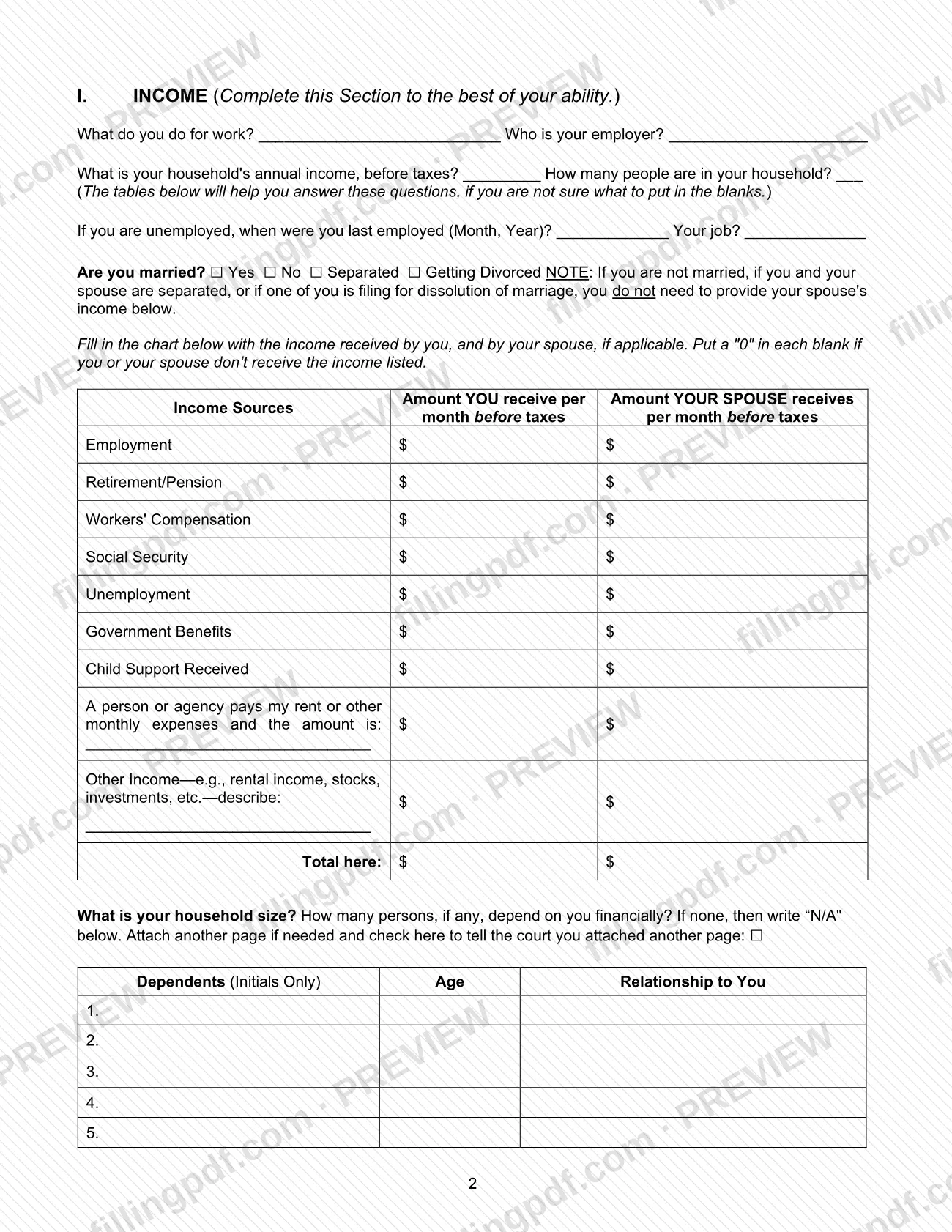
In Section I, enter your work, employer, household annual income before taxes and the number of people in your household. If unemployed, give the month and year you last worked and your job. Mark your marital status.
Fill in the income chart
For each source, enter the amount you receive per month before taxes, and your spouse's amount if it applies. Put "0" where there is no income, and describe any rent paid for you or other income, then enter the totals.
List your dependents
Enter initials only, age and relationship for each person who depends on you financially. Write "N/A" if none, and check the box if you attach another page.
List assets worth $600 or more
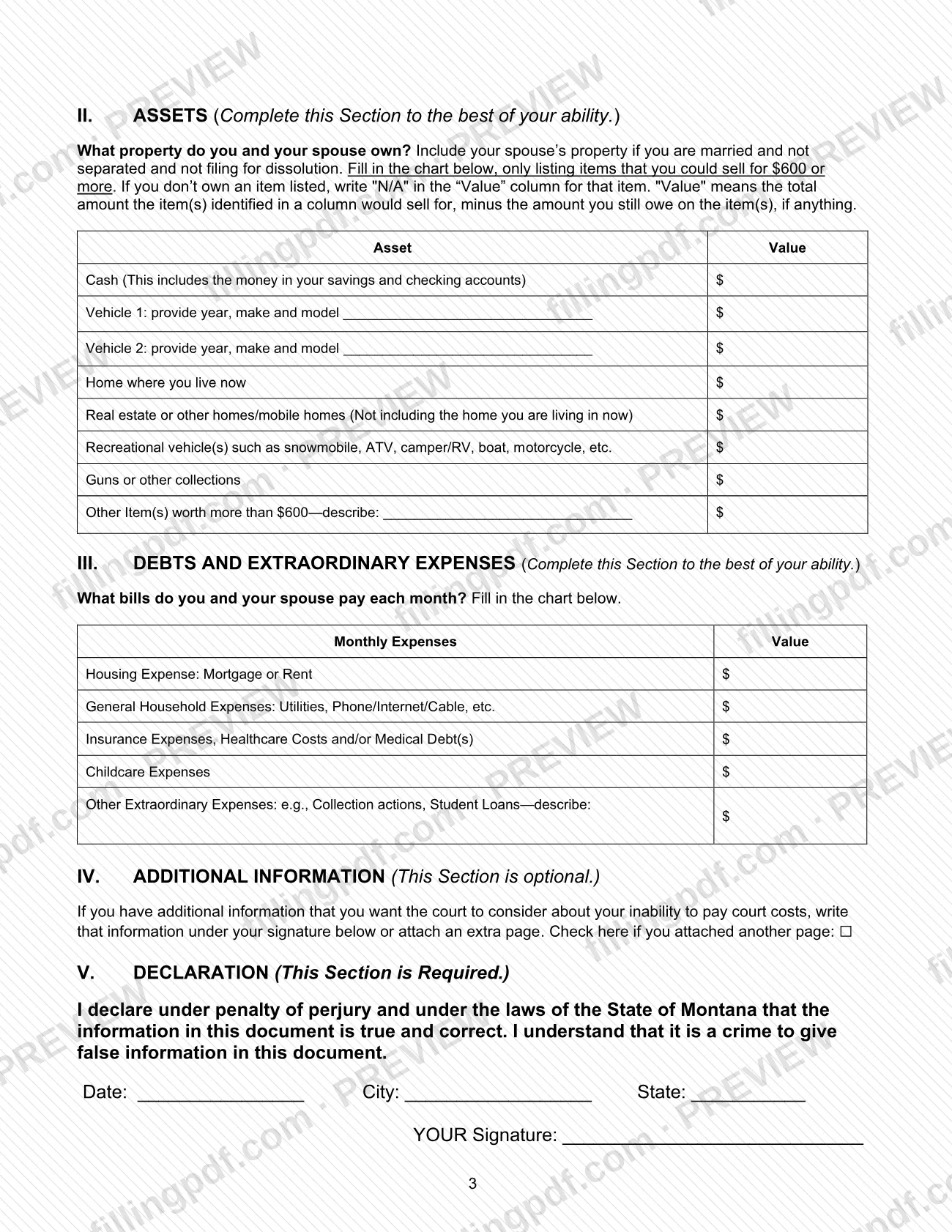
In Section II, give the value of each item you could sell for $600 or more, meaning its sale price minus what you still owe. Write "N/A" for items you do not own, and give year, make and model for Vehicles 1 and 2.
Enter your monthly expenses
In Section III, enter monthly housing, household, insurance and medical, childcare and other extraordinary expenses, describing any in the last line.
Add optional information
In Section IV, write anything else you want the court to consider under your signature or on an extra page, and check the box if you attached one.
Sign and date the declaration
In Section V, enter the date, city and state and sign. This section is required, and you declare the information is true under penalty of perjury.
Review and download the PDF
Check each section, leave the Court Use Only order blank, then download or print the completed PDF from FillingPDF and submit it through the channels described under How to submit.
How to submit Fee Waiver Form – Montana
The form prints no mailing address, portal or appointment rule, so it is submitted through the filing channels of the Montana court named in its caption. Details:
- Choose the court. Check one box for the Montana Judicial District Court (with the district and county), the Justice Court of a county, or the Municipal or City Court of a city, and fill in the blanks. Leave the case number blank: the form says the clerk will write it in.
- Follow that court's rules. The Montana Judicial Branch forms page tells filers to follow the local rules of the court where the case is filed, and links to the local rules at https://courts.mt.gov/forms/index. Ask the clerk of that court how it accepts filings.
- Attach what applies. Add the certificate of eligibility from the legal aid organization if you are represented by a pro bono attorney, and any extra page you mark on the form.
- Leave the order blank. The Court Use Only order on the last page is completed by the presiding judge.
FillingPDF lets you fill out and download the PDF; submission follows the channels above.
Common mistakes to avoid
- Skipping the Income, Assets and Debts sections without checking one of the qualifying boxes on page 1; only those boxes let you go straight to the declaration.
- Checking the pro bono attorney box without attaching the certificate of eligibility from the legal aid organization.
- Writing a case number in the caption; the form says to leave it blank because the clerk will write it in.
- Giving full names for dependents instead of initials only, or leaving the dependents lines empty instead of writing "N/A" when no one depends on you.
- Leaving income blanks empty; the form says to put a "0" where you or your spouse do not receive that income.
- Reporting an asset's full price instead of what it would sell for minus what you still owe, or listing items that would sell for less than $600.
- Leaving out your spouse's income and property when you are married, not separated and not filing for dissolution.
- Leaving the date, city, state or signature of the Declaration blank; Section V is required and is made under penalty of perjury.
- Writing in the Court Use Only order, which the presiding judge completes.
Frequently asked questions
What is the Montana fee waiver form?
The fee waiver form is the Montana Judicial Branch's Statement of Inability to Pay Court Costs and Fees. You sign it under penalty of perjury to tell the court you have a good cause of action or defense but cannot pay filing or other court fees, and you ask the court to waive them.
Do I have to fill out the whole fee waiver form?
Not if you check a qualifying box on page 1: represented by an entity giving free legal services, represented by a pro bono attorney and financially eligible, or receiving SNAP, TANF, SSI, Medicaid, WIC or LIEAP. Then skip to the declaration on page 3 and sign. Otherwise complete pages 2 and 3.
Can I fill out the fee waiver form online?
Yes. You can fill out the PDF online on FillingPDF and download or print it. FillingPDF is an independent service, not connected to the Montana Judicial Branch, and it does not file the form with a court; you submit it to the court yourself.
Where do I file the Montana fee waiver form?
The form prints no address or portal. You file it in the Montana court named in the caption, whether a District Court, Justice Court, or Municipal or City Court, and follow that court's local rules, as the Montana Judicial Branch advises. The clerk writes in the case number.
What can the judge decide on my fee waiver request?
The judge completes the Court Use Only order and can grant the waiver, grant a temporary waiver the court may later revisit, grant a temporary waiver with a hearing date to show cause why you cannot pay, or deny the waiver and give the reasons.
What happens if the judge sets a hearing on my fee waiver?
If the third box of the order is checked, you may file without paying but must appear on the date and time the order gives and show why you cannot pay. If you do not come, the judge will deny your request and you will have to pay the court costs.
Does the fee waiver form need to be signed?
Yes. Section V, the Declaration, is required: enter the date, city and state and sign. You declare under penalty of perjury and Montana law that the information is true and correct, and the form warns that giving false information is a crime.
What assets do I list on the fee waiver form?
List only items you could sell for $600 or more, giving each one's value as its sale price minus what you still owe, and write "N/A" for items you do not own. Include your spouse's property if you are married, not separated and not filing for dissolution.
Ready to fill out Fee Waiver Form – Montana?
Fill out Fee Waiver Form – Montana now