
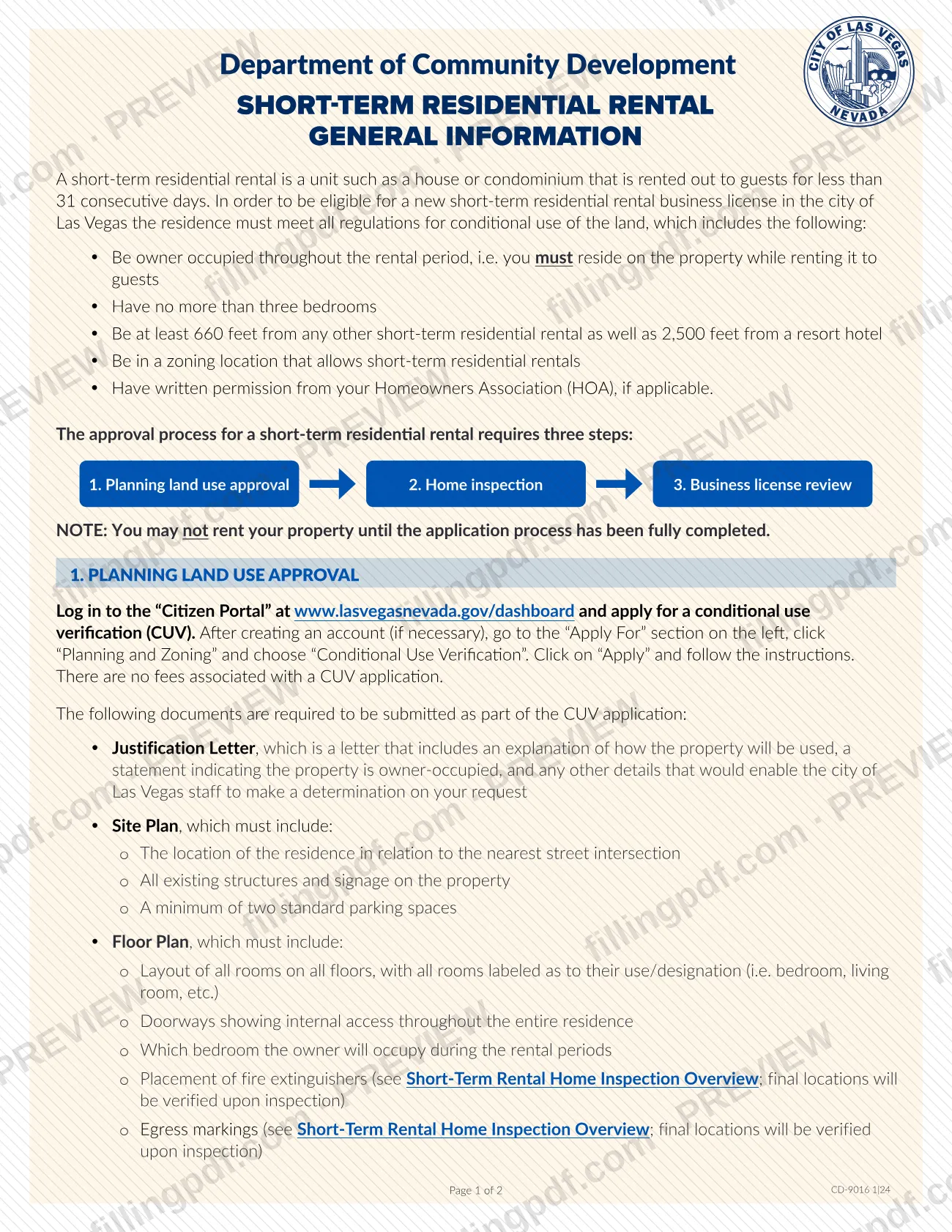
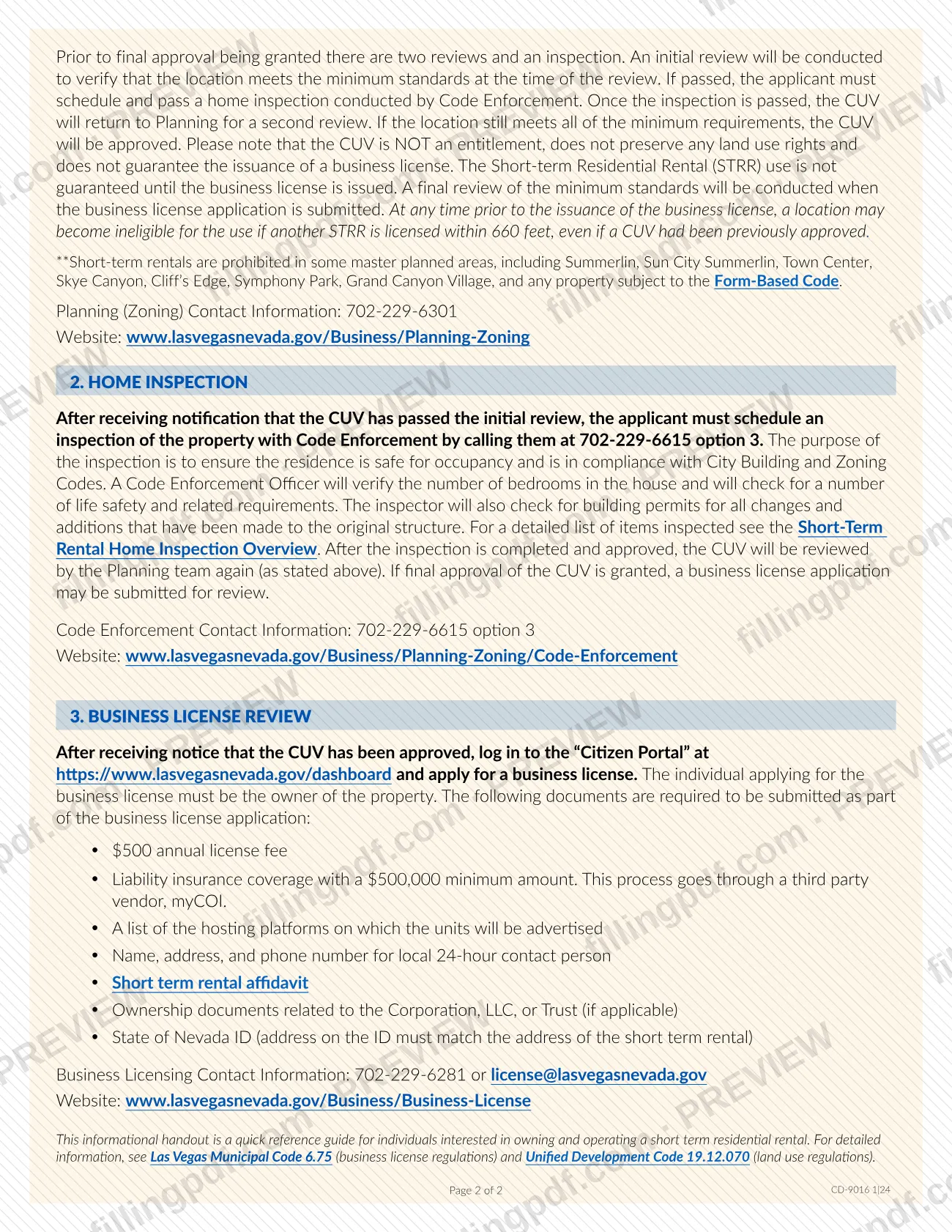
The Short-Term Rental Application Instructions (CD-9016) is a City of Las Vegas quick-reference handout, issued under the Department of Community Development, for people who want a short-term residential rental business license. It is one of the City's guides to getting a Las Vegas business license, and it lays out the three approval steps: planning land use approval, a home inspection and the business license review. On FillingPDF you can open the PDF and download or print it; the applications themselves are made through the City of Las Vegas Citizen Portal.
Last updated
What is CD-9016?
The Short-Term Rental Application Instructions (CD-9016) is a City of Las Vegas quick-reference handout that explains the three-step approval for a short-term residential rental: planning land use approval, a home inspection and a business license review.
The handout defines a short-term residential rental as a unit such as a house or condominium that is rented out to guests for less than 31 consecutive days. It lists the land-use rules a residence must meet to be eligible for a new short-term residential rental business license, and it states that you may not rent the property until the application process is fully completed.
It is a guide, not an application form. The applications are made online in the City's Citizen Portal: first a conditional use verification (CUV) through Planning and Zoning, then the business license application once the CUV is approved. The handout also gives the contact details for Planning (Zoning), Code Enforcement and Business Licensing.
The handout points to Las Vegas Municipal Code 6.75 (business license regulations) and Unified Development Code 19.12.070 (land use regulations) for detailed information, and to a separate Short-Term Rental Home Inspection Overview for the list of inspected items. It warns that a CUV is not an entitlement, does not preserve land use rights and does not guarantee a business license.
Who needs to file CD-9016?
Individuals interested in owning and operating a short-term residential rental in the city of Las Vegas use this handout. The person who applies for the business license must be the owner of the property.
To be eligible for a new license, the residence must meet the conditional use rules in the handout:
- The owner occupies the property throughout the rental period, meaning you live there while renting it to guests.
- The residence has no more than three bedrooms.
- It is at least 660 feet from any other short-term residential rental and 2,500 feet from a resort hotel.
- It sits in a zoning location that allows short-term residential rentals.
- You hold written permission from your Homeowners Association (HOA), if applicable.
Exclusions: short-term rentals are prohibited in some master planned areas, including Summerlin, Sun City Summerlin, Town Center, Skye Canyon, Cliff's Edge, Symphony Park, Grand Canyon Village, and any property subject to the Form-Based Code.
When to file CD-9016
The handout sets no calendar deadline; it sets an order. Start with the CUV application for planning land use approval. Schedule the home inspection only after you are notified that the CUV passed its initial review. Apply for the business license only after you receive notice that the CUV has been approved.
Do not rent the property until the whole process is complete. Timing matters for one more reason: at any time before the business license is issued, a location can become ineligible if another short-term residential rental is licensed within 660 feet, even when a CUV was already approved. A final review of the minimum standards also happens when the business license application is submitted.
Documents you need
- Justification Letter for the CUV application: explains how the property will be used, states that it is owner-occupied and gives any other details staff need to decide.
- Site Plan for the CUV application: shows the residence's location relative to the nearest street intersection, all existing structures and signage, and at least two standard parking spaces.
- Floor Plan for the CUV application: labels all rooms on all floors by use, shows internal doorways, marks which bedroom the owner occupies, and shows fire extinguisher placement and egress markings.
- Written permission from your Homeowners Association (HOA), if applicable; the handout lists it as an eligibility requirement.
- Payment of the annual license fee with the business license application; ask Business Licensing for the current amount.
- Proof of liability insurance coverage with a $500,000 minimum amount, processed through the third-party vendor myCOI.
- A list of the hosting platforms on which the units will be advertised.
- Name, address and phone number of a local 24-hour contact person.
- Short term rental affidavit.
- Ownership documents related to the Corporation, LLC or Trust, if applicable.
- State of Nevada ID whose address matches the address of the short-term rental.
How to fill out CD-9016
Check the eligibility rules
Confirm the residence is owner occupied during rentals, has no more than three bedrooms, and is at least 660 feet from another short-term rental and 2,500 feet from a resort hotel.
Confirm location and HOA permission
Make sure the zoning allows short-term rentals and the property is not in a prohibited area such as Summerlin. If you have an HOA, get its written permission.
Write the justification letter
Explain how the property will be used, state that it is owner-occupied, and add any detail that helps City staff decide your request.
Prepare the site plan and floor plan
The site plan shows the street intersection, structures, signage and at least two parking spaces. The floor plan labels every room, shows doorways, the owner's bedroom, fire extinguishers and egress markings.
Apply for the CUV in the portal
Log in to the Citizen Portal, go to Apply For, Planning and Zoning, Conditional Use Verification, and click Apply. Upload the three documents.
Schedule and pass the home inspection
After the initial review is passed, call Code Enforcement at 702-229-6615 option 3. The inspector verifies bedrooms, life safety items and building permits.
Wait for CUV approval
Once the inspection is passed, Planning reviews the CUV a second time. Do not apply for the license until you are notified of approval.
Apply for the business license
As the property owner, apply in the Citizen Portal with the fee, myCOI insurance, hosting platform list, 24-hour contact, affidavit, ownership documents if applicable, and Nevada ID.
Download or print the handout
Download or print the PDF from FillingPDF to keep the checklist and contact numbers at hand while you complete the applications in the Citizen Portal.
How to submit CD-9016
The process runs through the City of Las Vegas Citizen Portal, plus a phone call to schedule the inspection.
- Conditional use verification (CUV): log in to the Citizen Portal at https://www.lasvegasnevada.gov/dashboard, create an account if needed, choose "Apply For", then "Planning and Zoning", then "Conditional Use Verification", and click "Apply". The handout says no fees are associated with a CUV application. Planning (Zoning): 702-229-6301.
- Home inspection: after the CUV passes its initial review, call Code Enforcement at 702-229-6615 option 3 to schedule it.
- Business license: after the CUV is approved, apply in the same Citizen Portal. An annual license fee applies; contact Business Licensing for the current amount at 702-229-6281 or [email protected]. Liability insurance goes through a third-party vendor, myCOI.
FillingPDF lets you open and download the PDF handout; submission follows the City's channels above.
Common mistakes to avoid
- Renting the property before the CUV, the home inspection and the business license are all complete; the handout says you may not rent until the process is finished.
- Treating an approved CUV as a guarantee; it is not an entitlement and a location can become ineligible if another rental is licensed within 660 feet before your license issues.
- Applying for the business license before receiving notice that the CUV has been approved.
- Submitting a floor plan that leaves out room labels, internal doorways, the owner's bedroom, fire extinguisher placement or egress markings.
- Providing a site plan with fewer than two standard parking spaces or without existing structures and signage.
- Applying for a license for a property in a prohibited master planned area, such as Summerlin or Skye Canyon, or one subject to the Form-Based Code.
- Submitting a State of Nevada ID whose address does not match the short-term rental address.
- Having someone other than the property owner apply for the business license.
Frequently asked questions
How do I get a Las Vegas business license for a short-term rental?
Follow three steps in order: planning land use approval through a conditional use verification (CUV), a home inspection by Code Enforcement, then the business license application in the Citizen Portal. You may not rent until all three are complete.
Can I rent out my property in Las Vegas before the license is issued?
No. The handout states you may not rent your property until the application process has been fully completed. An approved CUV alone does not allow rentals, because the short-term rental use is not guaranteed until the business license is issued.
Does a CUV application cost anything?
No. The handout says there are no fees associated with a CUV application. The business license application does carry an annual license fee; call Business Licensing at 702-229-6281 or email [email protected] for the current amount.
Who can apply for a short-term rental business license in Las Vegas?
The individual applying must be the owner of the property. The home must also be owner occupied throughout the rental period, have no more than three bedrooms, and meet the distance and zoning rules, plus HOA permission if applicable.
Where are short-term rentals prohibited in Las Vegas?
The handout lists Summerlin, Sun City Summerlin, Town Center, Skye Canyon, Cliff's Edge, Symphony Park, Grand Canyon Village, and any property subject to the Form-Based Code. It describes these as some of the prohibited master planned areas.
How do I schedule the short-term rental home inspection?
After you are notified that the CUV passed its initial review, call Code Enforcement at 702-229-6615 option 3. The inspector checks bedrooms, life safety items and building permits for changes made to the original structure.
What do I need for the business license application?
You need the annual license fee, liability insurance with a $500,000 minimum through myCOI, a hosting platform list, a local 24-hour contact, the short term rental affidavit, ownership documents if a Corporation, LLC or Trust applies, and a Nevada ID matching the rental address.
Can I fill out the Las Vegas short-term rental application on FillingPDF?
No application is completed on FillingPDF. This PDF is an informational handout; you can open, download or print it here, but the CUV and business license applications are made in the City's Citizen Portal. FillingPDF is independent and does not submit anything to the City.
Ready to fill out CD-9016?
Fill out CD-9016 now