
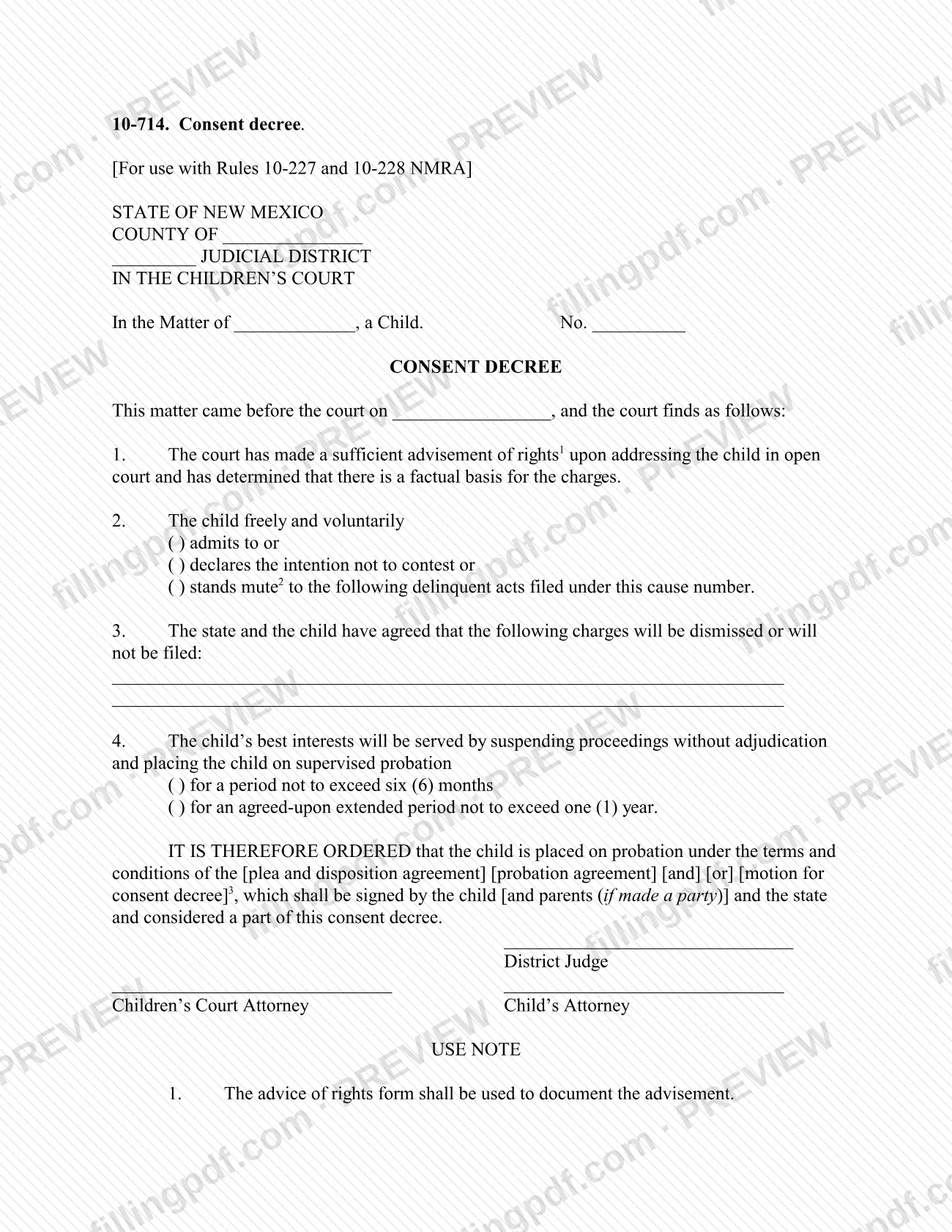
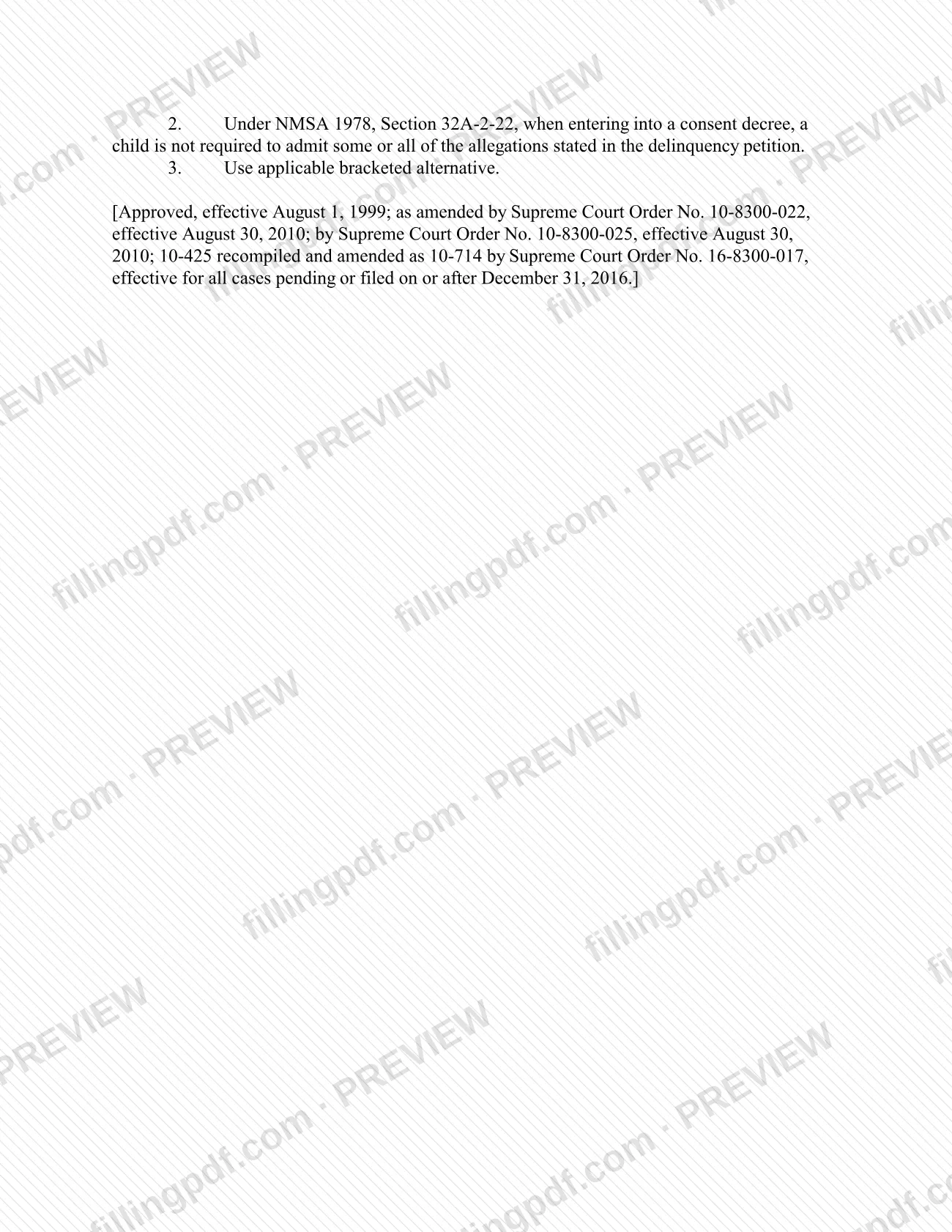
Form 10-714, Consent decree, is the New Mexico Children's Court order that suspends a child's delinquency proceedings without adjudication and places the child on supervised probation. It is a Supreme Court approved form published by the New Mexico Judicial Branch for use with Rules 10-227 and 10-228 NMRA. On this page you can fill out the form online on FillingPDF and download or print the completed PDF. The court's own forms library is the place where the agency publishes the original.
Last updated
What is 10-714?
Form 10-714, Consent decree, is the New Mexico Children's Court form that records the court's findings and orders a child's delinquency proceedings suspended without adjudication, with the child placed on supervised probation under an agreement.
The New Mexico Judicial Branch publishes it as a Supreme Court approved form "for use with Rules 10-227 and 10-228 NMRA." It carries the Children's Court caption (county, judicial district, the child's name and the case number) and then states the court's findings:
- the court made a sufficient advisement of rights to the child in open court and found a factual basis for the charges;
- the child freely and voluntarily admits, declares the intention not to contest, or stands mute to the delinquent acts filed under the case number;
- the state and the child agreed that listed charges will be dismissed or not filed;
- the child's best interests will be served by suspending proceedings and placing the child on supervised probation for a period not to exceed six months, or an agreed-upon extended period not to exceed one year.
The order then places the child on probation under the terms of a plea and disposition agreement, probation agreement or motion for consent decree, which is signed by the child (and parents, if made a party) and the state and becomes part of the decree. The form was previously numbered 10-425 and was recompiled and amended as 10-714. It is a court order, not a petition or application.
Who needs to file 10-714?
The form is used in a New Mexico Children's Court delinquency case in which the state and the child have agreed to a consent decree. It is completed for the court and signed by the district judge, with signature lines for the Children's Court Attorney and the Child's Attorney.
- The child and the child's attorney. The child is the person the decree places on probation. The form's use note says that, under NMSA 1978, Section 32A-2-22, a child entering a consent decree is not required to admit some or all of the allegations in the delinquency petition; that is why paragraph 2 also offers "declares the intention not to contest" and "stands mute."
- The state (Children's Court Attorney). The state agrees to the dismissal or non-filing of the charges listed in paragraph 3 and signs the agreement that becomes part of the decree.
- Parents. They sign the agreement with the child only when they have been made a party.
- The district judge. The judge makes the findings and signs the order.
The form is not a petition and is not meant for adult proceedings; it is built around a child and a Children's Court case number.
When to file 10-714
The form is completed when the delinquency matter comes before the court and the court makes its findings: it begins "This matter came before the court on" a date, and recites that the court advised the child of rights in open court and found a factual basis for the charges. The form prints no separate filing deadline. What it sets is the length of the probation it orders: a period not to exceed six (6) months, or an agreed-upon extended period not to exceed one (1) year. The 2016 recompilation as 10-714 applies to all cases pending or filed on or after December 31, 2016.
Documents you need
- The advice of rights form: the use note says it shall be used to document the advisement of rights referred to in paragraph 1.
- A plea and disposition agreement, probation agreement or motion for consent decree (use the applicable bracketed alternative): it sets the probation terms and is signed by the child and the state, and is considered part of the consent decree.
- Parents' signature on that agreement, only if the parents have been made a party to the case.
How to fill out 10-714
Complete the court caption
Enter the county, the judicial district number, the child's name in "In the Matter of _____, a Child" and the case number (No.).
Enter the hearing date
In the opening line, write the date the matter came before the court, after "This matter came before the court on."
Review the advisement finding
Paragraph 1 states that the court made a sufficient advisement of rights and found a factual basis for the charges. The advice of rights form documents the advisement.
Mark the child's response
In paragraph 2, mark one option: admits to, declares the intention not to contest, or stands mute to the delinquent acts filed under this cause number.
List the dismissed or unfiled charges
In paragraph 3, write on the lines the charges that the state and the child agreed will be dismissed or will not be filed.
Select the probation period
In paragraph 4, mark either a period not to exceed six (6) months or an agreed-upon extended period not to exceed one (1) year.
Choose the bracketed alternatives
In the order, keep the applicable alternative: plea and disposition agreement, probation agreement and/or motion for consent decree, and the parents wording only if they are made a party.
Collect the required signatures
The District Judge signs the order; the Children's Court Attorney and the Child's Attorney sign on their lines. The agreement is signed by the child, the state and parents if made a party.
Review and download the completed PDF
Check the case number, date, charges and probation period against the case file. Download or print the completed PDF from FillingPDF and handle it as described under How to submit.
How to submit 10-714
The form names no filing channel, mailing address or portal. It is an order entered in a pending Children's Court case, so it is prepared for that case under its case number and goes to the district judge for signature, with the Children's Court Attorney and the Child's Attorney signing on their lines.
- Within the case: complete the caption with the county, judicial district, child's name and case number, then route the form through the parties and the judge as the court directs.
- Companion agreement: the plea and disposition agreement, probation agreement or motion for consent decree is signed by the child (and parents, if made a party) and the state, and is part of the decree.
- Questions on handling: ask the Children's Court clerk or the child's attorney; the New Mexico Judicial Branch publishes the form at https://nmcourts.gov/forms-library/ under Children's Court.
FillingPDF lets you fill out and download the PDF; submission follows the court's channels above.
Common mistakes to avoid
- Leaving the bracketed alternatives in the order unresolved; the use note says to use the applicable bracketed alternative for the agreement or motion.
- Not selecting one of the three options in paragraph 2 (admits, declares the intention not to contest, or stands mute).
- Treating the decree as requiring an admission; under NMSA 1978, Section 32A-2-22, the child is not required to admit some or all of the allegations.
- Not selecting either probation period in paragraph 4, or describing a period longer than six months without it being an agreed-upon extended period not to exceed one year.
- Omitting the advice of rights form, which the use note says documents the advisement of rights.
- Leaving the paragraph 3 lines blank when the state and the child agreed that charges will be dismissed or not filed.
- Forgetting the case number or the date the matter came before the court in the caption and opening line.
- Leaving the district judge, Children's Court Attorney or Child's Attorney signature lines unsigned.
Frequently asked questions
What is Form 10-714, Consent decree, in New Mexico?
It is the New Mexico Children's Court order, approved by the Supreme Court for use with Rules 10-227 and 10-228 NMRA, that suspends a child's delinquency proceedings without adjudication and places the child on supervised probation under an agreement signed by the child and the state.
Does the child have to admit the charges in a consent decree?
No. The form's use note says that under NMSA 1978, Section 32A-2-22, a child entering a consent decree is not required to admit some or all of the allegations in the delinquency petition. Paragraph 2 lets the child admit, declare the intention not to contest, or stand mute.
How long can probation last under a consent decree?
Paragraph 4 allows supervised probation for a period not to exceed six (6) months, or for an agreed-upon extended period not to exceed one (1) year. You mark one of the two options on the form.
Who signs Form 10-714?
The District Judge signs the order, and the form has lines for the Children's Court Attorney and the Child's Attorney. The plea and disposition agreement, probation agreement or motion is signed by the child, the state, and the parents if they are made a party.
Can I fill out the consent decree form online?
Yes. You can fill out the PDF online on FillingPDF and download or print it. FillingPDF is an independent service and does not file the form with the court; it is handled through the Children's Court case.
Where do I submit a consent decree in New Mexico?
The form names no address or portal. It is an order in a pending Children's Court case, so it goes through that case to the district judge for signature. Ask the court clerk or the child's attorney how the court wants it filed.
What documents go with the consent decree?
The advice of rights form documents the advisement in paragraph 1. The order also refers to a plea and disposition agreement, probation agreement or motion for consent decree, signed by the child and the state, which is considered part of the decree.
Was Form 10-714 numbered differently before?
Yes. The form was numbered 10-425 and was recompiled and amended as 10-714 by Supreme Court Order No. 16-8300-017, effective for all cases pending or filed on or after December 31, 2016.
Ready to fill out 10-714?
Fill out 10-714 now