
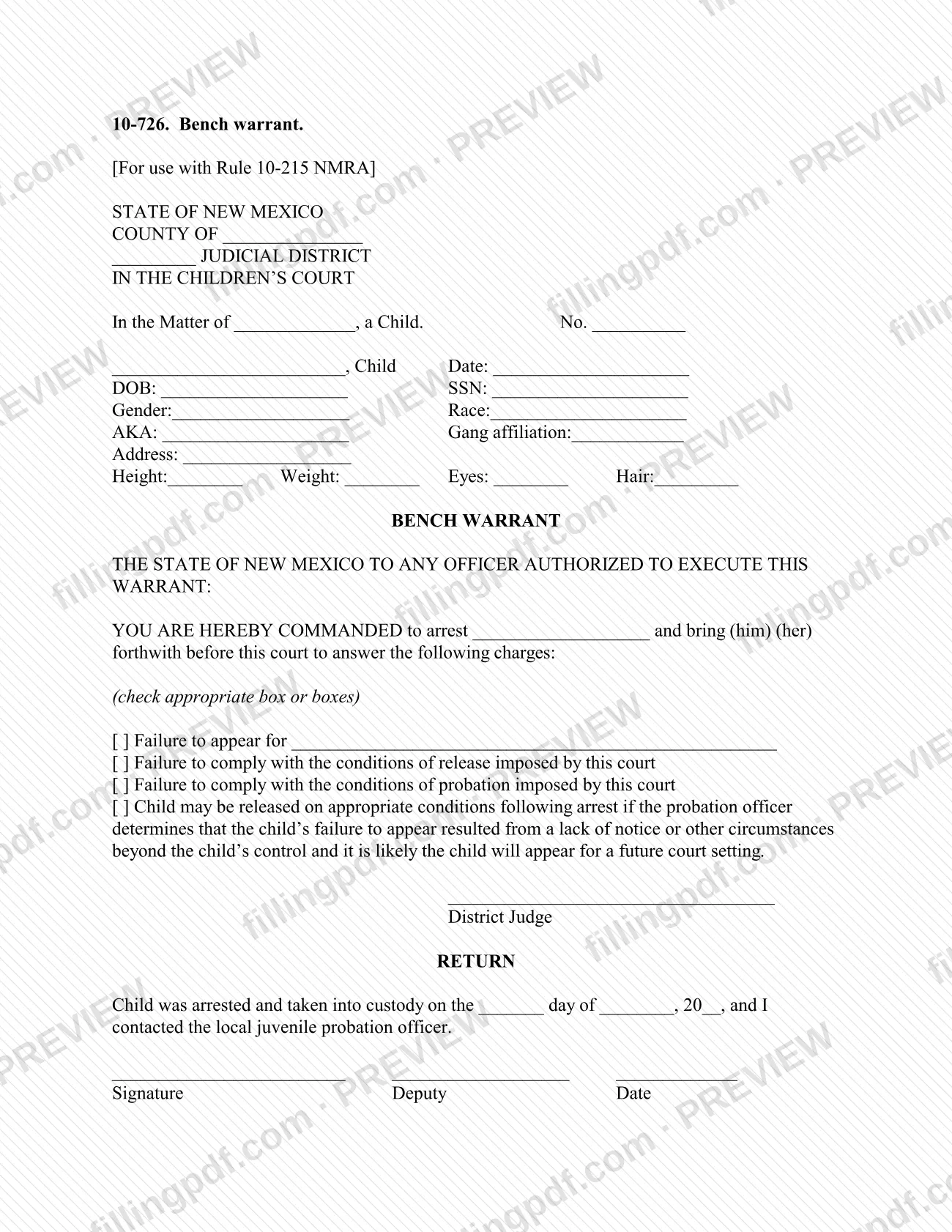
Form 10-726, Bench warrant, is a Supreme Court approved form of the New Mexico Judicial Branch for use in the Children's Court with Rule 10-215 NMRA. It is a bench warrant that commands any officer authorized to execute it to arrest a named child and bring the child before the court to answer the charges checked on the form. It also carries a return for the arresting officer and a probation officer determination. On FillingPDF you can fill out the form online and download or print the completed PDF; the official PDF is published by the New Mexico Judicial Branch at nmcourts.gov.
Last updated
What is 10-726?
Form 10-726, Bench warrant, is the New Mexico Children's Court warrant that orders any officer authorized to execute it to arrest a named child and bring the child forthwith before the court to answer the charges checked on the form. It is marked "For use with Rule 10-215 NMRA."
The form is published by the New Mexico Judicial Branch among its Supreme Court approved forms, in the Children's Court category of the court forms library, which covers juvenile cases. It was adopted by Supreme Court Order No. 10-8300-046, effective February 14, 2011. Form 10-412A was recompiled and amended as 10-726 by Supreme Court Order No. 16-8300-017, effective for all cases pending or filed on or after December 31, 2016.
One document holds three parts:
- The warrant itself, which identifies the child, states the charges and carries the District Judge's signature line.
- A Return, completed when the child is arrested and taken into custody, noting that the local juvenile probation officer was contacted.
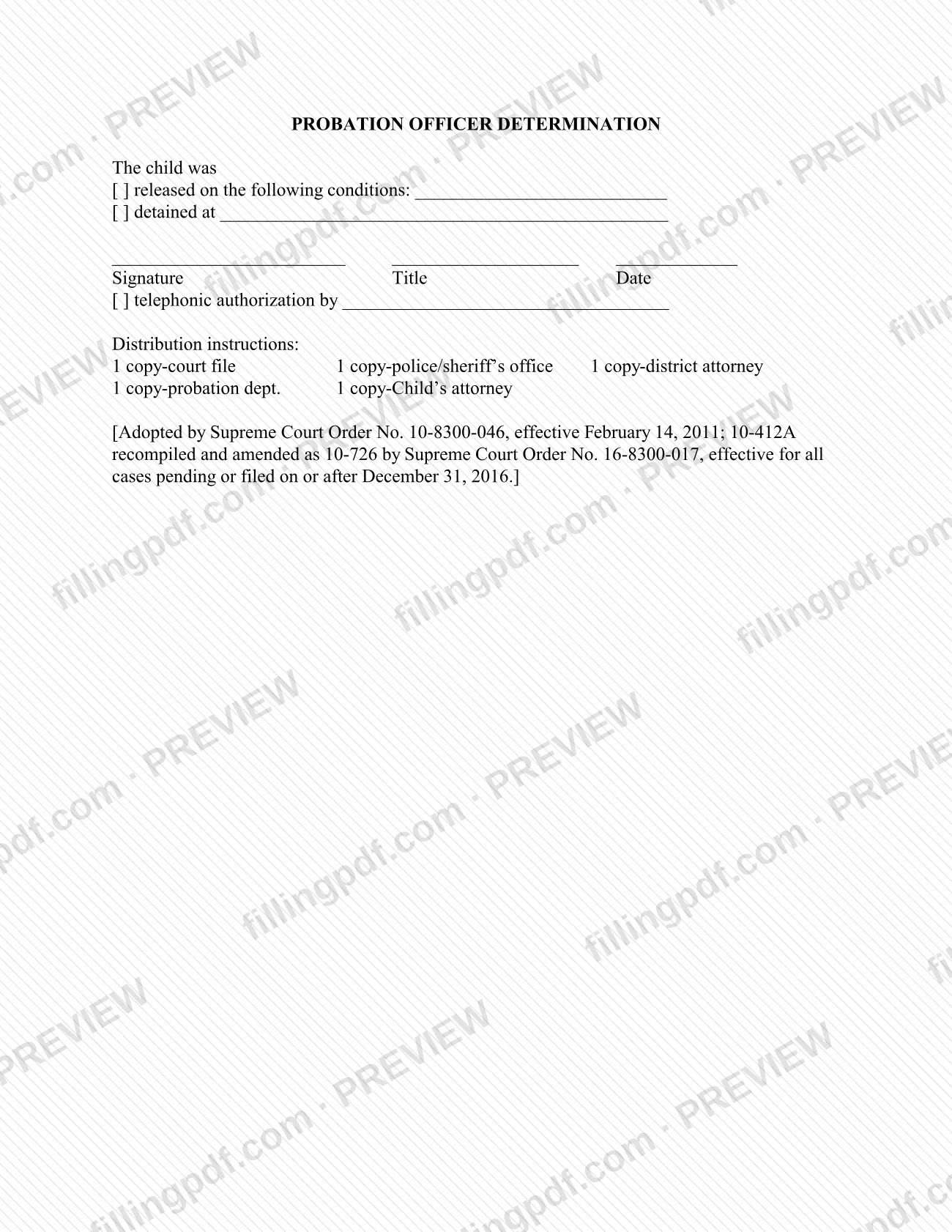
- A Probation Officer Determination, recording whether the child was released on conditions or detained, or whether authorization was given by telephone.
The charges listed are failure to appear, failure to comply with the conditions of release imposed by the court, and failure to comply with the conditions of probation imposed by the court. The form is a Children's Court warrant: its caption reads "In the Matter of ..., a Child."
Who needs to file 10-726?
The form is used in New Mexico Children's Court cases, where the caption names a child. The people who handle it, as the form is laid out, are:
- The District Judge, who signs the warrant above the line marked "District Judge."
- The officer who executes the warrant. The command is addressed to any officer authorized to execute it, and the Return is signed by the officer or deputy after the child is arrested and taken into custody.
- The local juvenile probation officer, who is contacted on arrest and completes the Probation Officer Determination, signing with a title and date.
- The court clerk and the parties' offices, which receive copies under the distribution instructions: court file, police or sheriff's office, district attorney, probation department and the child's attorney.
The form is not a general-purpose warrant: it is written for a child, and the printed grounds are limited to the three charges listed. Whoever completes it should use the court's own rules, including Rule 10-215 NMRA, for questions about when a warrant may issue.
When to file 10-726
The form is completed when the court orders a child's arrest on one of the grounds printed on it: failure to appear (with the hearing or event named on the form), failure to comply with the conditions of release imposed by the court, or failure to comply with the conditions of probation imposed by the court. No separate due date is printed on it.
The Return and the Probation Officer Determination are filled in later, after the child is arrested and taken into custody, with the day, month and year of the arrest and the local juvenile probation officer's determination of whether the child was released on conditions or detained.
How to fill out 10-726
Complete the court caption
Enter the county, the judicial district number, the case number after "No." and the child's name in "In the Matter of ..., a Child." Add the date of the warrant.
Enter the child's identifying details
Fill in the child's date of birth (DOB), SSN, gender, race, AKA, gang affiliation and address. Add height, weight, eye color and hair color.
Name the child to be arrested
In the command beginning "YOU ARE HEREBY COMMANDED to arrest," write the child's name and select (him) or (her).
Check the charges
Check each appropriate box: failure to appear (name the matter on the line after "Failure to appear for"), failure to comply with the conditions of release, or failure to comply with the conditions of probation.
Decide on the release-conditions box
Check the box stating that the child may be released on appropriate conditions after arrest only if it applies: the probation officer determines that the failure to appear came from lack of notice or circumstances beyond the child's control and the child is likely to appear again.
Add the judge's signature
The District Judge signs on the line above "District Judge." The form has no other signature block for the warrant itself.
Complete the Return after arrest
The arresting officer enters the day, month and year (20__) the child was arrested and taken into custody, and signs with the deputy line and date.
Record the probation officer determination
Check "released on the following conditions" and list them, or "detained at" and give the place. Add signature, title and date, and check "telephonic authorization by" with a name if authorization was given by phone.
Review, download and distribute copies
Check every blank against the court file, then download or print the completed PDF from FillingPDF. Prepare the five copies listed in the distribution instructions.
How to submit 10-726
The form names no filing portal, mailing address or fee. It gives distribution instructions instead: one copy each goes to the court file, the police or sheriff's office, the district attorney, the probation department and the child's attorney.
- Court file: the original or one copy stays in the Children's Court case file.
- Law enforcement: one copy goes to the police or sheriff's office that will execute the warrant.
- Prosecution and defense: one copy goes to the district attorney and one to the child's attorney.
- Probation: one copy goes to the probation department.
Ask the clerk of the district court handling the case how the signed warrant is delivered. FillingPDF lets you fill out and download the PDF; submission and distribution follow the court's own channels.
Common mistakes to avoid
- Leaving the caption incomplete: the county, the judicial district, the case number and the child's name in "In the Matter of" are all printed blanks.
- Checking no charge box, or checking "Failure to appear for" without naming what the child failed to appear for.
- Not selecting (him) or (her) in the command to arrest, so the sentence is left unresolved.
- Sending the warrant out without the District Judge's signature on the line marked "District Judge."
- Completing the Return before the child is arrested and taken into custody, or leaving out the arrest date and the deputy's signature.
- Checking neither "released on the following conditions" nor "detained at" in the Probation Officer Determination, or leaving the signature, title and date blank.
- Not distributing all five copies: court file, police or sheriff's office, district attorney, probation department and the child's attorney.
- Checking the release box without the probation officer's determination that the failure to appear resulted from lack of notice or circumstances beyond the child's control.
Frequently asked questions
What is Form 10-726, Bench warrant?
Form 10-726 is the New Mexico Children's Court bench warrant, for use with Rule 10-215 NMRA. It commands any authorized officer to arrest a named child and bring the child before the court to answer the charges checked on the form.
Who signs a bench warrant on Form 10-726?
The District Judge signs the warrant. The arresting officer or deputy signs the Return after the child is taken into custody, and the probation officer signs the Probation Officer Determination with a title and date.
What charges can be checked on a Children's Court bench warrant?
Three: failure to appear (with the matter named on the form), failure to comply with the conditions of release imposed by the court, and failure to comply with the conditions of probation imposed by the court.
Can a child be released after arrest under this bench warrant?
The form has a box saying the child may be released on appropriate conditions after arrest if the probation officer determines that the failure to appear resulted from lack of notice or circumstances beyond the child's control and the child is likely to appear in future.
How many copies of Form 10-726 are distributed?
Five: one each to the court file, the police or sheriff's office, the district attorney, the probation department and the child's attorney, as the distribution instructions on the form state.
Can I fill out the bench warrant form online?
You can fill out the PDF online on FillingPDF and download or print it. FillingPDF is an independent service, is not connected to the New Mexico Judicial Branch and does not issue, file or deliver the warrant; the court handles that.
Is Form 10-726 for adults or only for children?
The form is written for Children's Court. Its caption reads "In the Matter of ..., a Child," and the command is to arrest the child. It does not state that it applies to adult defendants.
When was Form 10-726 adopted?
It was adopted by Supreme Court Order No. 10-8300-046, effective February 14, 2011, as 10-412A. It was recompiled and amended as 10-726 by Order No. 16-8300-017, effective for cases pending or filed on or after December 31, 2016.
Ready to fill out 10-726?
Fill out 10-726 now