
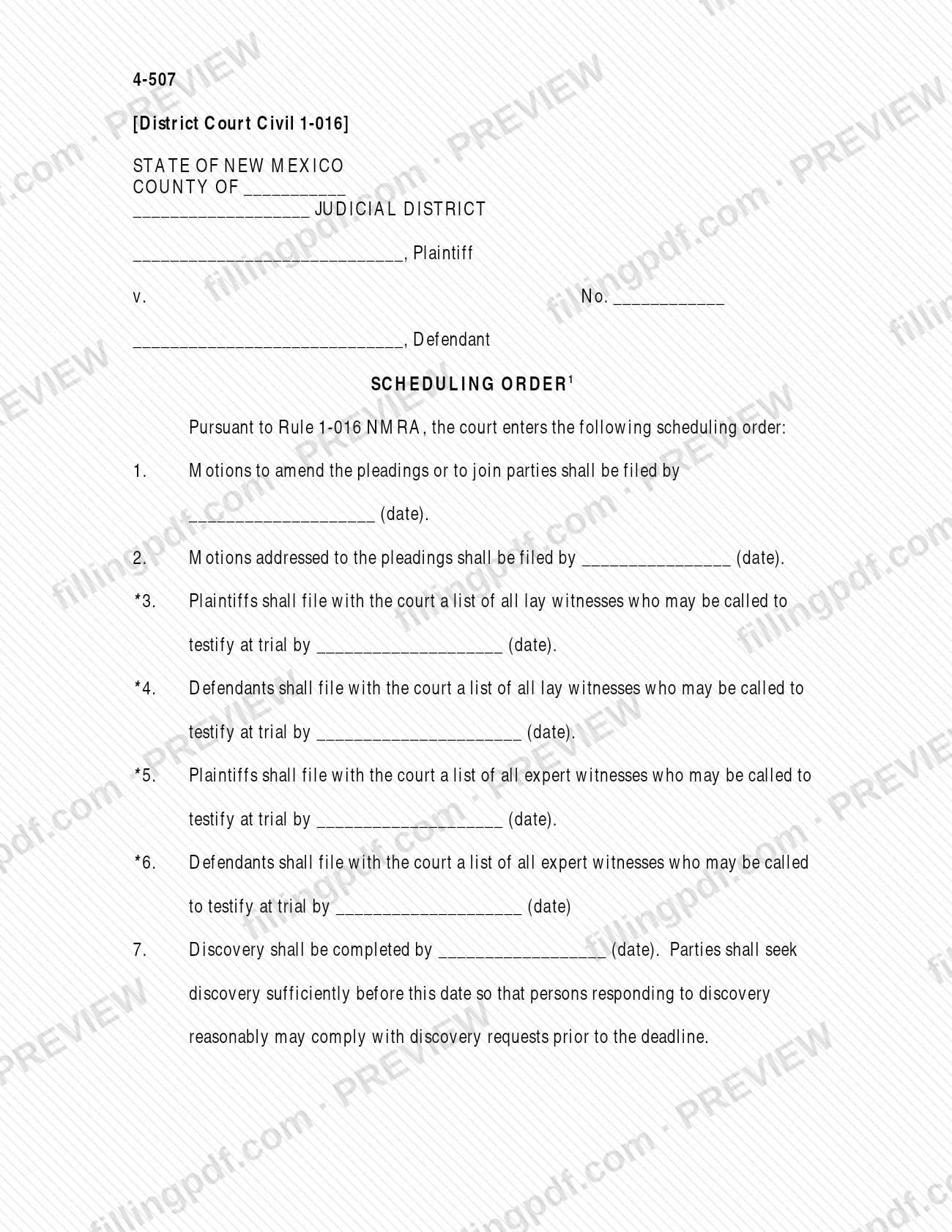
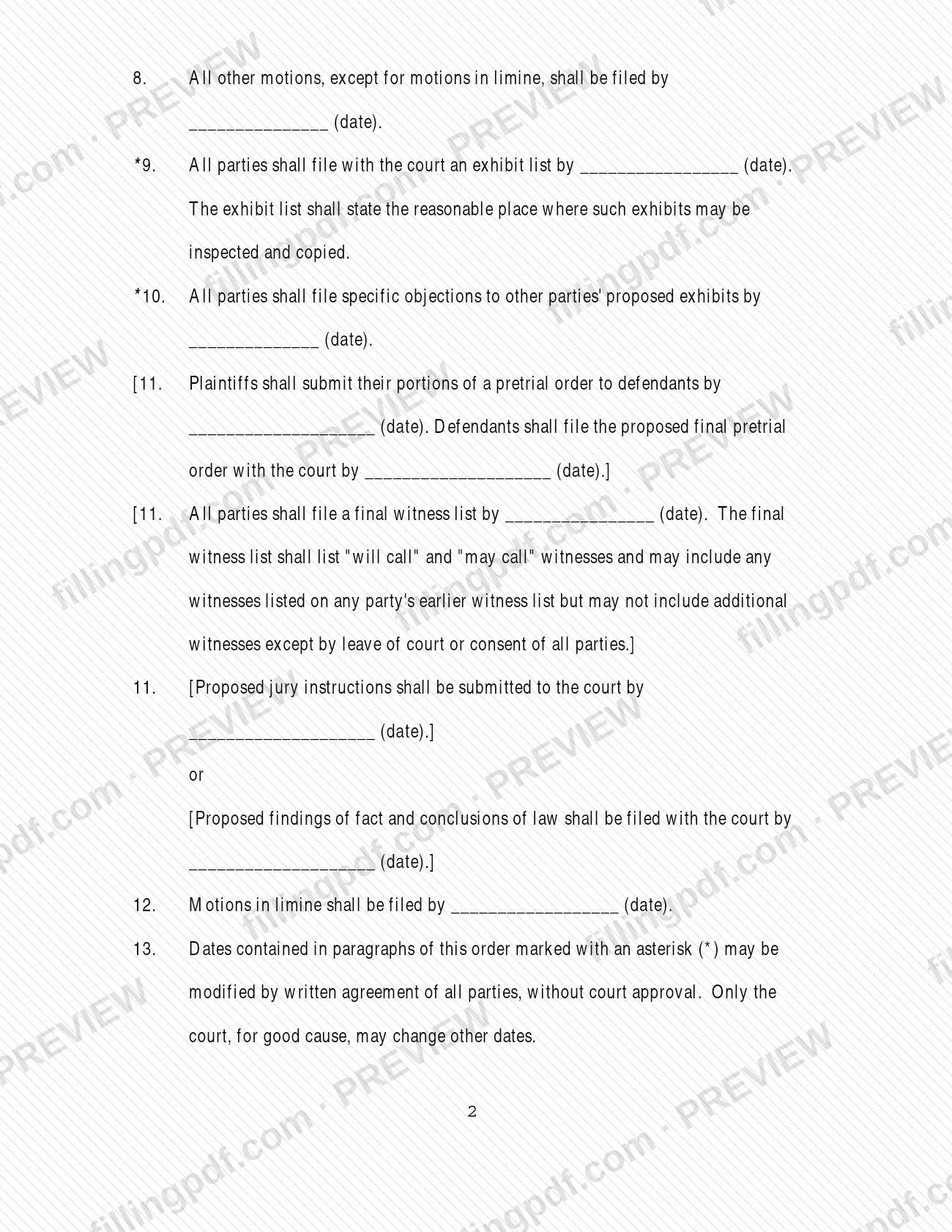
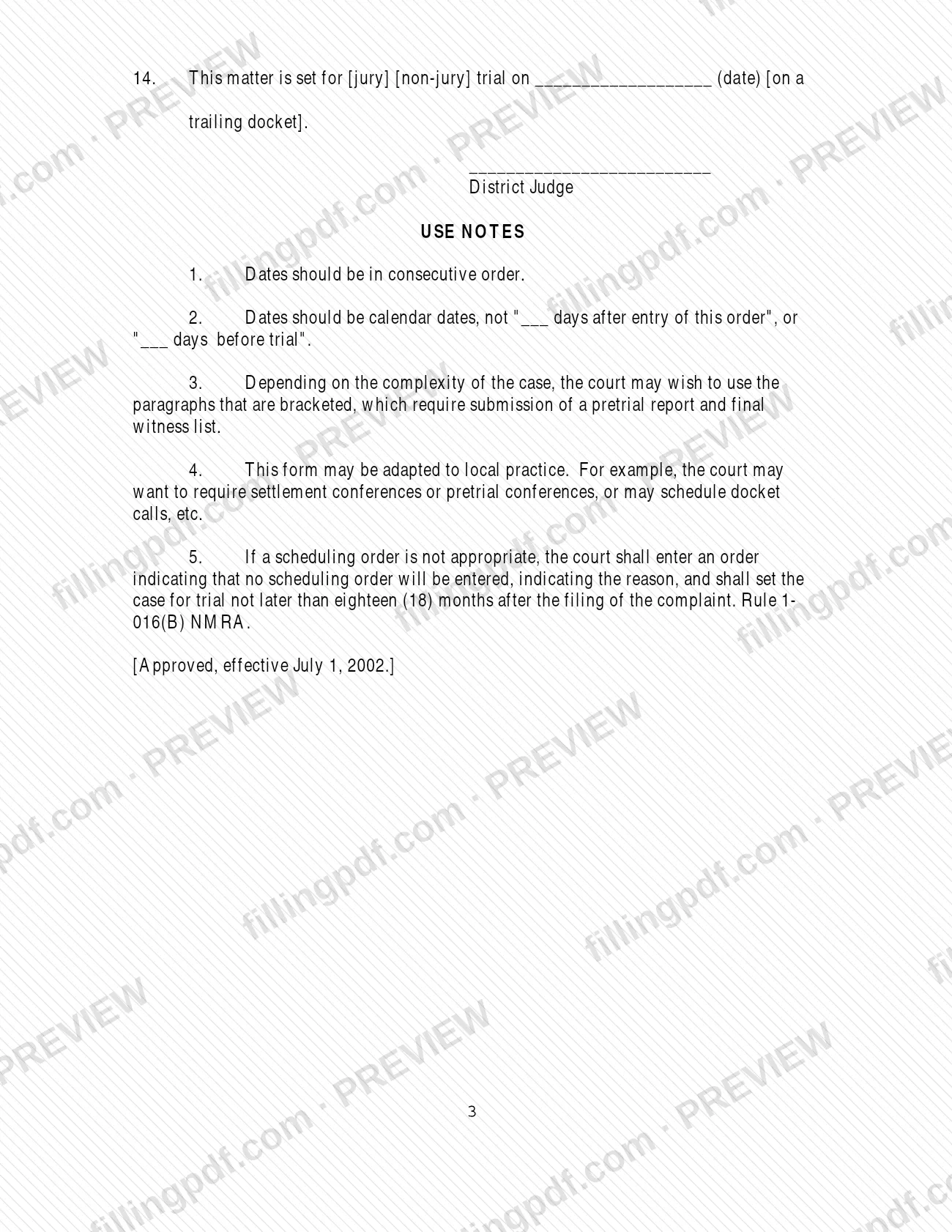
The scheduling order on Form 4-507 is the Supreme Court approved New Mexico district court form, cross-referenced as District Court Civil 1-016, that lists the deadlines and the trial date in a civil case under Rule 1-016 NMRA. The court enters it, and a District Judge signs it. It covers motions, witness lists, discovery, exhibits, pretrial filings and the trial setting. On this page you can fill out the form online on FillingPDF and download or print the completed PDF; the form itself is published by the New Mexico Judicial Branch at nmcourts.gov.
Last updated
What is 4-507?
Form 4-507, Scheduling Order, is the New Mexico district court form, approved by the Supreme Court, in which the court enters the calendar dates by which each step of a civil case must be completed, from motions to amend the pleadings through the trial date.
The form carries the reference [District Court Civil 1-016] and states that it is entered "pursuant to Rule 1-016 NMRA." Its caption names the county, the judicial district, the plaintiff, the defendant and the case number. The numbered paragraphs then set deadlines for:
- motions to amend the pleadings or to join parties, and motions addressed to the pleadings;
- lay witness and expert witness lists, separately for plaintiffs and defendants;
- completion of discovery, and all other motions except motions in limine;
- the exhibit list and objections to proposed exhibits;
- optional pretrial order, final witness list, and jury instructions or findings of fact and conclusions of law;
- motions in limine, and the trial date, jury or non-jury, with an option for a trailing docket.
Paragraph 13 explains that dates in asterisked paragraphs may be changed by written agreement of all parties without court approval, while only the court, for good cause, may change the other dates. The form's use notes say the court may adapt it to local practice, for example by adding settlement conferences, pretrial conferences or docket calls.
Who needs to file 4-507?
The form is used by the district court. It is an order that ends with a signature line for the District Judge, and it is entered in a civil case under Rule 1-016 NMRA. Plaintiffs and defendants are the parties it binds: most paragraphs tell plaintiffs, defendants or all parties what they must file and by when.
Use notes 3 and 4 give the court choices: it may use the bracketed paragraphs that require a pretrial report and a final witness list, depending on the complexity of the case, and it may adapt the form to local practice.
Do not use Form 4-507 when a scheduling order is not appropriate. In that situation use note 5 says the court must instead enter an order stating that no scheduling order will be entered and giving the reason, and must set the case for trial not later than eighteen (18) months after the filing of the complaint (Rule 1-016(B) NMRA).
When to file 4-507
The form does not print a date by which the court must enter it; it is entered under Rule 1-016 NMRA in a civil case. What the form does fix is how its dates are written and what happens when no order is entered. Dates should be calendar dates, not "___ days after entry of this order" or "___ days before trial," and they should be in consecutive order.
If the court decides a scheduling order is not appropriate, it enters an order saying so and sets the case for trial not later than eighteen (18) months after the complaint is filed.
Once the order is in place, dates in paragraphs marked with an asterisk (*) may be modified by written agreement of all parties without court approval. Only the court, for good cause, may change the other dates.
How to fill out 4-507
Complete the caption
Enter the county, the judicial district, the plaintiff's name, the defendant's name and the case number (No.) at the top of the form.
Set pleading and party deadlines
In paragraph 1, enter the date for motions to amend the pleadings or to join parties. In paragraph 2, enter the date for motions addressed to the pleadings.
Enter lay witness list dates
Paragraph 3 is the date for plaintiffs' lay witness list and paragraph 4 the date for defendants'. Both are asterisked, so they can later be changed by written agreement of all parties.
Enter expert witness list dates
Paragraph 5 is the date for plaintiffs' expert witness list and paragraph 6 the date for defendants'. Both are asterisked paragraphs.
Set discovery and other motion dates
Enter the discovery completion date in paragraph 7 and the deadline for all other motions, except motions in limine, in paragraph 8.
Set exhibit deadlines
Paragraph 9 is the date for all parties' exhibit lists, which must state where the exhibits may be inspected and copied. Paragraph 10 is the date for specific objections to other parties' proposed exhibits.
Choose the pretrial paragraph 11
Keep the bracketed pretrial order version or the final witness list version when the case's complexity calls for it, and fill in its dates. Delete the version you do not use.
Choose jury instructions or findings
In the last paragraph 11, keep either the date for proposed jury instructions or the date for proposed findings of fact and conclusions of law, and remove the other.
Enter the motion in limine date
In paragraph 12, enter the date by which motions in limine shall be filed.
Set the trial
In paragraph 14, select jury or non-jury, enter the trial date and keep or delete the trailing docket wording. Check that all dates are calendar dates in consecutive order.
Review, sign and download
Check the caption and every date, and add any local-practice paragraphs the court wants. The District Judge signs on the signature line; download or print the completed PDF from FillingPDF.
How to submit 4-507
The form names no filing channel, mailing address, portal or appointment rule. It is an order that the district court enters, and it is signed on the line marked District Judge. Use note 4 adds that the form may be adapted to local practice, so any added steps such as settlement conferences, pretrial conferences or docket calls come from the court handling the case.
The New Mexico Judicial Branch publishes the form at nmcourts.gov, and its forms library at https://nmcourts.gov/forms-library/ groups Supreme Court approved forms by subject, including Civil. FillingPDF lets you fill out and download the PDF; submission follows the court's own channels.
Common mistakes to avoid
- Writing deadlines as "___ days after entry of this order" or "___ days before trial" instead of calendar dates, which use note 2 requires.
- Entering dates out of sequence; use note 1 says the dates should be in consecutive order.
- Leaving the bracketed alternatives in place without choosing, such as the two versions of paragraph 11 or "jury" versus "non-jury" in paragraph 14.
- Treating every date as changeable by agreement: only dates in paragraphs marked with an asterisk (*) can be modified by written agreement of all parties; others need the court and good cause.
- Setting the discovery date in paragraph 7 without leaving time for responses, when the paragraph says discovery must be sought sufficiently before the date.
- Omitting the place where exhibits may be inspected and copied from the exhibit list required by paragraph 9.
- Using this form when the court has found a scheduling order inappropriate, instead of an order stating that none will be entered and the reason.
- Leaving the county, judicial district and case number blank in the caption.
Frequently asked questions
What is a scheduling order in a New Mexico district court?
It is the order, on Form 4-507, in which the court sets calendar dates for motions, witness lists, discovery, exhibits, pretrial filings and trial in a civil case. The form says it is entered pursuant to Rule 1-016 NMRA and is signed by the District Judge.
Who fills out and signs Form 4-507?
The court enters the order, and the signature line is for the District Judge. The parties are the ones bound by its deadlines: paragraphs address plaintiffs, defendants or all parties. The form does not say who drafts it.
Can the dates in a scheduling order be changed?
Yes, in two ways. Dates in paragraphs marked with an asterisk (*) may be changed by written agreement of all parties, without court approval. Only the court, for good cause, may change the other dates, under paragraph 13.
Can I use days instead of dates, like 30 days before trial?
No. Use note 2 says dates should be calendar dates, not "___ days after entry of this order" or "___ days before trial." Note 1 also says the dates should be in consecutive order.
What if the court does not enter a scheduling order?
If a scheduling order is not appropriate, the court enters an order saying no scheduling order will be entered, gives the reason, and sets the case for trial not later than eighteen (18) months after the complaint is filed, under Rule 1-016(B) NMRA.
Can the court add conferences to the scheduling order?
Yes. Use note 4 says the form may be adapted to local practice; the court may, for example, require settlement conferences or pretrial conferences, or schedule docket calls. Use note 3 also lets the court choose bracketed paragraphs requiring a pretrial report and final witness list.
Can I fill out the scheduling order online?
You can fill out the Form 4-507 PDF online on FillingPDF and download or print it. FillingPDF is an independent service and does not file the order or send it to the court; the court enters it through its own process.
Ready to fill out 4-507?
Fill out 4-507 now