
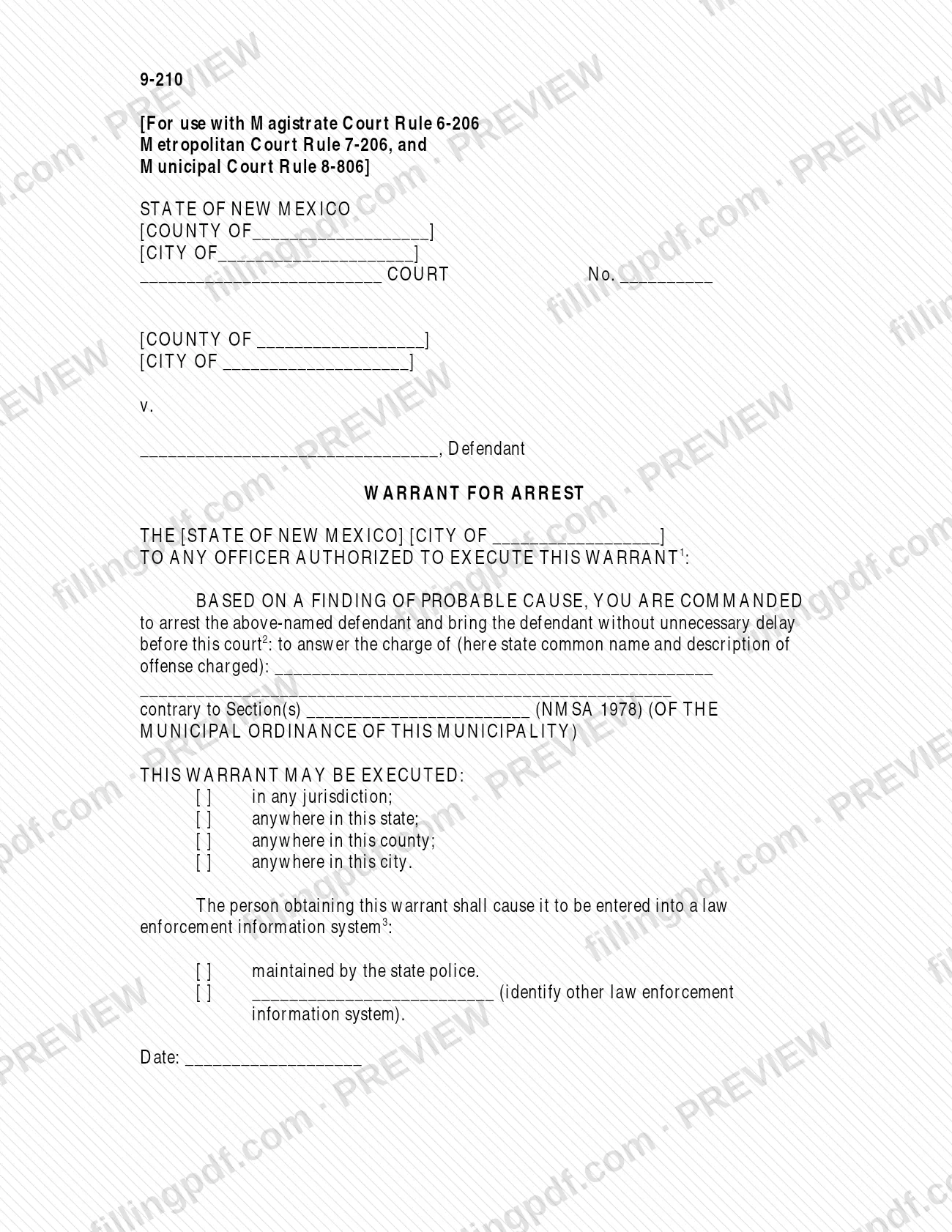
Form 9-210, Warrant for arrest, is a New Mexico Judicial Branch form (Supreme Court approved) that commands an authorized officer to arrest a named defendant and bring that person before the court. It is printed for use with Magistrate Court Rule 6-206, Metropolitan Court Rule 7-206 and Municipal Court Rule 8-806. On this page you can fill out the form online on FillingPDF and download or print the completed PDF; the official PDF and the court forms library are published by the New Mexico Judicial Branch at nmcourts.gov.
Last updated
What is 9-210?
Form 9-210, Warrant for arrest, is the New Mexico Supreme Court approved form by which a judge, on a finding of probable cause, commands an authorized officer to arrest a named defendant and bring the defendant before the court to answer a stated charge.
The form is issued by the New Mexico Judicial Branch and is marked for use with Magistrate Court Rule 6-206, Metropolitan Court Rule 7-206 and Municipal Court Rule 8-806. Its caption has bracketed alternatives for a state case (county) or a city case, so the same form serves state charges and municipal ordinance charges.
The warrant states the charge by its common name and description, cites the section of NMSA 1978 (or the municipal ordinance), and says where the warrant may be executed: in any jurisdiction, anywhere in the state, anywhere in the county or anywhere in the city. It also tells the person who obtains it to cause it to be entered into a law enforcement information system, either the one maintained by the state police or another one that is identified on the form.
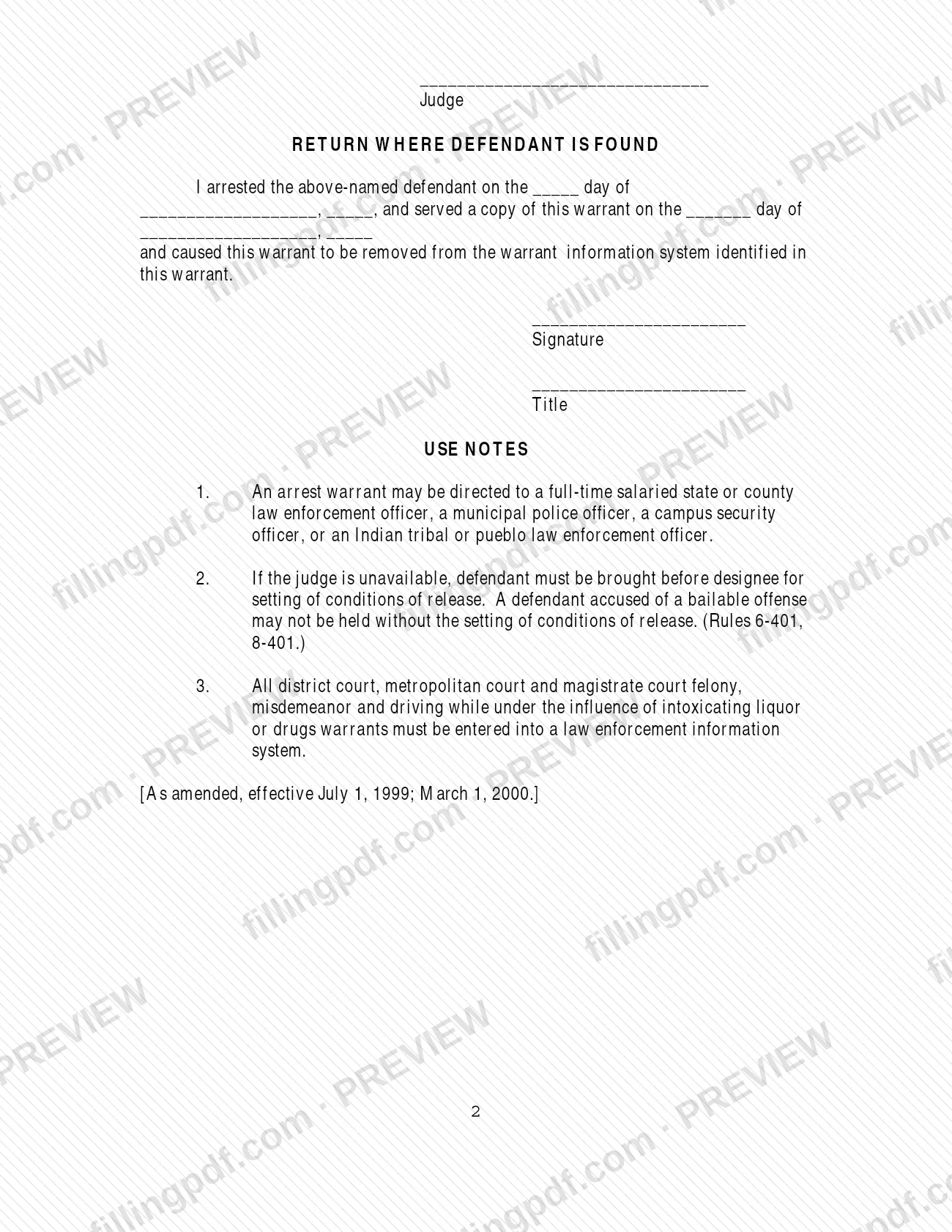
The lower part of the page is the Return Where Defendant Is Found. The officer records the date of the arrest, the date a copy of the warrant was served, and that the warrant was removed from the warrant information system, then signs with a title. The form's use notes explain who may receive the warrant, what happens if the judge is unavailable, and which warrants must be entered into an information system.
Who needs to file 9-210?
The form is built for the court that issues the arrest warrant. It is printed for use with Magistrate Court Rule 6-206, Metropolitan Court Rule 7-206 and Municipal Court Rule 8-806, and it carries a line for the judge's signature and date, so it is completed on behalf of the court after a finding of probable cause.
Other people who work with the completed warrant:
- The person obtaining the warrant must cause it to be entered into a law enforcement information system, either the one maintained by the state police or another system identified on the form.
- The executing officer completes the Return Where Defendant Is Found. Use note 1 says an arrest warrant may be directed to a full-time salaried state or county law enforcement officer, a municipal police officer, a campus security officer, or an Indian tribal or pueblo law enforcement officer.
The defendant is named on the form but does not complete it. The form does not describe any role for a representative or any group excluded from its use.
When to file 9-210
The warrant is completed when a judge has made a finding of probable cause and orders the arrest of the defendant; the form is dated and signed by the judge at that point. The form sets no filing deadline and no expiration date.
Use note 3 adds a timing-related duty: all district court, metropolitan court and magistrate court felony, misdemeanor and driving while under the influence of intoxicating liquor or drugs warrants must be entered into a law enforcement information system. The Return Where Defendant Is Found is completed later, when the defendant is arrested and a copy of the warrant is served.
Use note 2 covers a case where the judge is unavailable when the defendant is brought in: the defendant must be brought before a designee for the setting of conditions of release, and a defendant accused of a bailable offense may not be held without conditions of release being set (Rules 6-401, 8-401).
How to fill out 9-210
Complete the court caption
Enter the county or city in the bracketed lines under STATE OF NEW MEXICO, the court name and the court number (COURT No.), and the name of the defendant on the line before "Defendant".
Choose the issuing authority
On the line beginning THE [STATE OF NEW MEXICO] [CITY OF __________], keep the one that applies and, for a city, enter the city name.
Confirm the officer directive
The form is addressed to any officer authorized to execute the warrant. Use note 1 lists the officers to whom an arrest warrant may be directed.
State the charge
Under "to answer the charge of," write the common name and description of the offense charged, as the form instructs.
Cite the section or ordinance
On the "contrary to Section(s)" line, enter the NMSA 1978 section, or use the bracketed municipal ordinance wording when the charge is a municipal ordinance.
Mark where it may be executed
Check the box for any jurisdiction, anywhere in this state, anywhere in this county or anywhere in this city.
Identify the information system
Check the box for the system maintained by the state police, or check the second box and identify another law enforcement information system on the line.
Date and sign as judge
Enter the Date and have the judge sign above the line labeled Judge.
Leave the return for the officer
The section headed Return Where Defendant Is Found is for the officer: the day the defendant was arrested, the day a copy was served, a signature and a title.
Review and download the PDF
Check the caption, charge, section, execution boxes and information system choice against the court's order. Download or print the completed PDF from FillingPDF.
How to submit 9-210
Form 9-210 is not sent to an agency for review. It is signed by the judge, directed to an authorized officer, entered into a law enforcement information system and returned by the executing officer. The form prints no mailing address, portal or appointment rule.
- Court: the judge dates and signs the warrant. The form is directed to "any officer authorized to execute this warrant."
- Law enforcement information system: the person obtaining the warrant must cause it to be entered into the system maintained by the state police or another system identified on the form. Use note 3 requires entry for district court, metropolitan court and magistrate court felony, misdemeanor and driving while under the influence warrants.
- Execution and return: the officer completes the section headed Return Where Defendant Is Found with the arrest and service dates, confirms the warrant was removed from the warrant information system, and signs with a title.
Ask the issuing court's clerk how completed warrants are routed in that court. FillingPDF lets you fill out and download the PDF; submission follows the court procedures above.
Common mistakes to avoid
- Leaving all four execution boxes (any jurisdiction, anywhere in this state, anywhere in this county, anywhere in this city) unmarked, so the warrant does not say where it may be executed.
- Not marking either law enforcement information system box, or marking the second box without naming the other system.
- Leaving the bracketed alternatives unresolved, such as STATE OF NEW MEXICO versus CITY OF, or the NMSA 1978 section versus the municipal ordinance reference.
- Describing the charge without its common name and description, or omitting the section number on the "contrary to Section(s)" line.
- Directing the warrant to an officer outside the categories listed in use note 1.
- Leaving the date or the judge's signature line blank before the warrant is delivered for execution.
- Skipping entry into a law enforcement information system for a district, metropolitan or magistrate court felony, misdemeanor or DWI warrant, which use note 3 requires.
- Holding a defendant accused of a bailable offense without conditions of release when the judge is unavailable; the defendant must go before a designee.
Frequently asked questions
What is Form 9-210, Warrant for arrest?
Form 9-210 is the New Mexico Judicial Branch form by which a judge, based on a finding of probable cause, commands an authorized officer to arrest a named defendant and bring the defendant before the court to answer a stated charge.
Which New Mexico courts use this warrant for arrest form?
The form is printed for use with Magistrate Court Rule 6-206, Metropolitan Court Rule 7-206 and Municipal Court Rule 8-806. Its caption allows either a state case or a city case, with the NMSA 1978 section or the municipal ordinance cited.
Who can be ordered to execute the warrant?
Use note 1 says an arrest warrant may be directed to a full-time salaried state or county law enforcement officer, a municipal police officer, a campus security officer, or an Indian tribal or pueblo law enforcement officer.
Does the warrant have to be entered into a law enforcement database?
Yes for the listed warrants. Use note 3 says all district court, metropolitan court and magistrate court felony, misdemeanor and driving while under the influence warrants must be entered into a law enforcement information system, such as the one maintained by the state police.
What happens if the judge is not available when the defendant is arrested?
The defendant must be brought before a designee to set conditions of release. Use note 2 states that a defendant accused of a bailable offense may not be held without the setting of conditions of release (Rules 6-401, 8-401).
Can I fill out Form 9-210 online?
You can fill out the PDF online on FillingPDF and download or print it. FillingPDF is an independent service and does not issue, file or enter the warrant anywhere; the judge signs it and the court's procedures govern its use.
Where can the warrant be executed?
The judge marks one box: in any jurisdiction, anywhere in this state, anywhere in this county or anywhere in this city. The warrant may be executed only within the area that is checked on the form.
Who completes the Return Where Defendant Is Found?
The officer who arrests the defendant. The return records the day of the arrest, the day a copy of the warrant was served, that the warrant was removed from the warrant information system, and the officer's signature and title.
Ready to fill out 9-210?
Fill out 9-210 now