
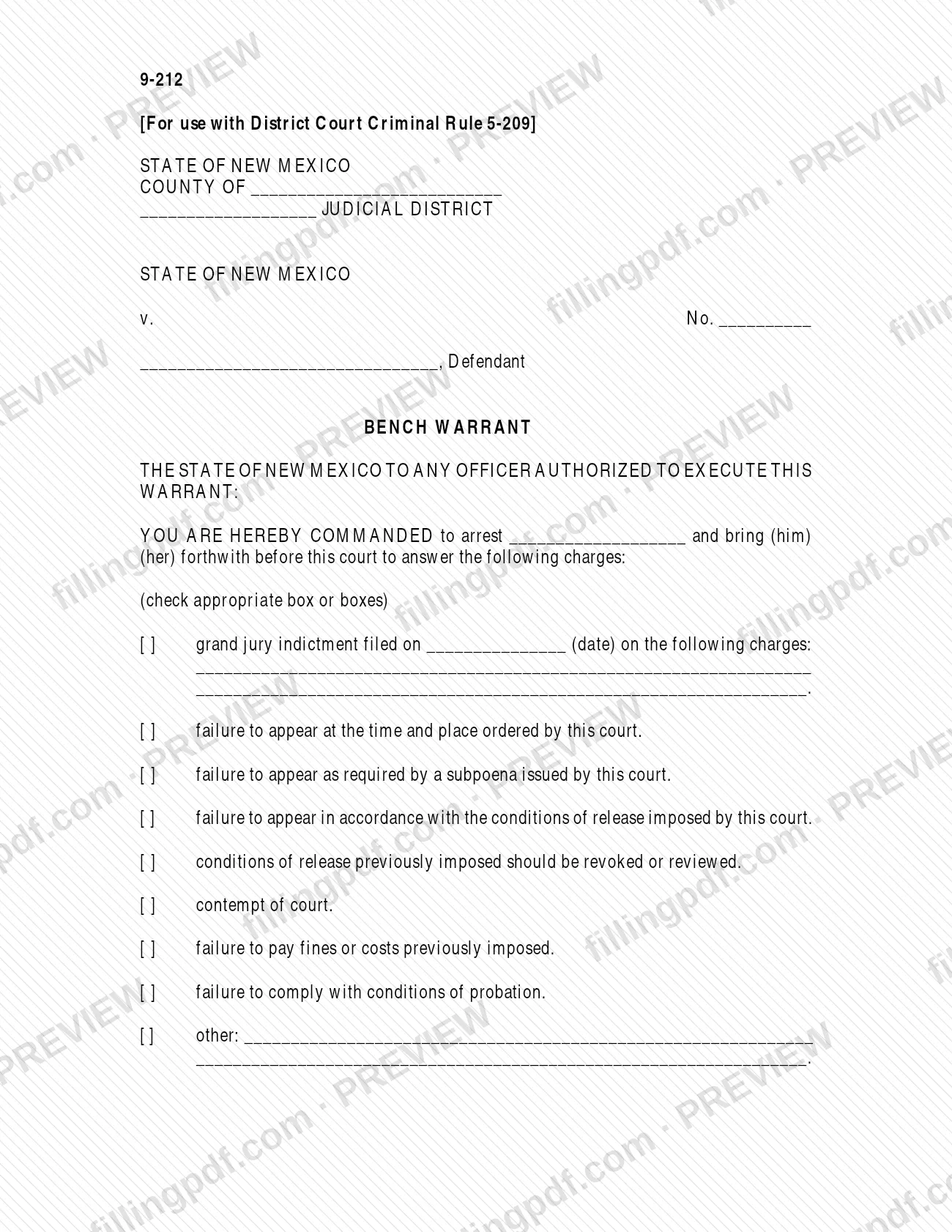

Form 9-212, Bench Warrant, is the New Mexico Judicial Branch form for a bench warrant in a District Court criminal case. It is printed for use with District Court Criminal Rule 5-209 and commands any officer authorized to execute it to arrest a named defendant and bring that person before the court. On this page you can fill out the form online on FillingPDF and download or print the completed PDF; the original is published by the New Mexico courts at nmcourts.gov.
Last updated
What is 9-212?
Form 9-212, Bench Warrant, is a New Mexico court form, printed for use with District Court Criminal Rule 5-209, that commands any officer authorized to execute it to arrest a named defendant and bring that person forthwith before the court to answer stated charges.
The form is a court order in a criminal case. Its caption names the State of New Mexico, the county, the judicial district, the case number and the defendant. The reasons for the warrant are chosen from a list of boxes:
- a grand jury indictment, with the filing date and the charges;
- failure to appear at the time and place ordered, or as required by a subpoena, or in accordance with the conditions of release;
- conditions of release that should be revoked or reviewed;
- contempt of court;
- failure to pay fines or costs previously imposed;
- failure to comply with conditions of probation;
- another reason, written in.
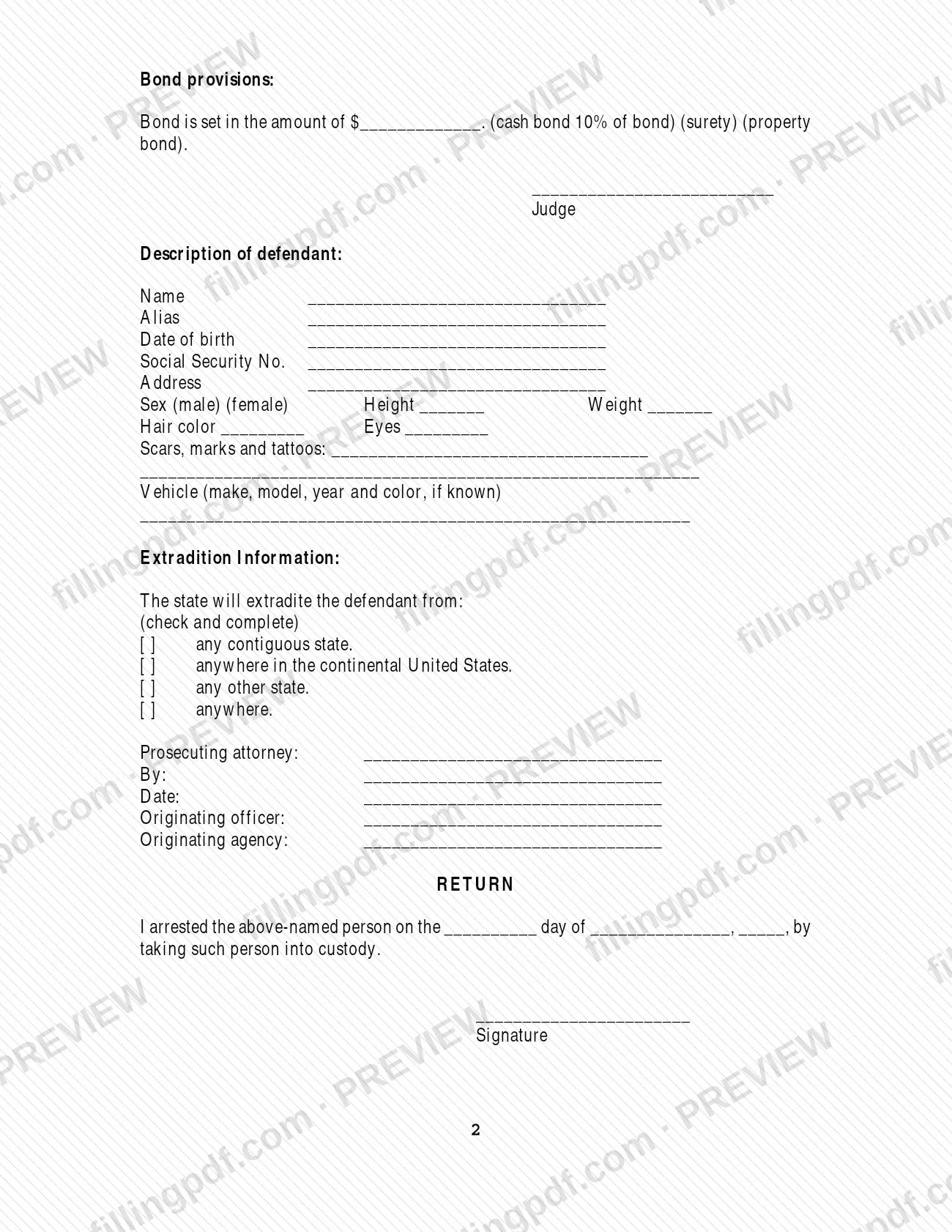
The form also carries bond provisions (the amount and whether it is a cash bond at 10% of bond, a surety bond or a property bond), a description of the defendant to help the officer, extradition information, the prosecuting attorney, the originating officer and agency, and a RETURN block that the arresting officer completes. The New Mexico Judicial Branch lists warrants among its Supreme Court approved criminal forms.
Who needs to file 9-212?
Form 9-212 is used in New Mexico District Court criminal cases governed by Criminal Rule 5-209. It is an order addressed to "any officer authorized to execute this warrant," so it is prepared for the court and signed by the judge, not completed by the defendant.
The people named on the form have these roles:
- Judge: signs under the bond provisions.
- Prosecuting attorney: is identified in the Prosecuting attorney, By and Date lines.
- Originating officer and originating agency: are named on the form.
- Arresting officer: completes the Return with the date of arrest, signature and title.
Anyone preparing the warrant for the court needs the defendant's name and case number, and may add the identifying details the form asks for (alias, date of birth, address, physical description, vehicle). The form does not say who may sign on behalf of the judge or the prosecutor.
When to file 9-212
The form sets no deadline of its own. It is prepared when one of the reasons printed on it applies in a criminal case before the District Court: a grand jury indictment has been filed, or the defendant failed to appear as ordered or subpoenaed, failed to follow conditions of release, is in contempt, failed to pay fines or costs, or failed to comply with conditions of probation. The warrant commands the officer to bring the defendant "forthwith" before the court. The officer completes the Return after taking the person into custody, entering the day, month and year of the arrest.
How to fill out 9-212
Complete the caption
Enter the county, the judicial district and the case number, and write the defendant's name on the line above "Defendant."
Name the person to be arrested
In the command, "YOU ARE HEREBY COMMANDED to arrest," enter the defendant's name and choose the pronoun (him) or (her) as printed.
Check the charges or grounds
Check each box that applies. For a grand jury indictment, add the filing date and the charges; for the other box, write the reason on the lines provided.
Enter the bond provisions
Write the bond amount and mark the type printed on the form: cash bond (10% of bond), surety or property bond. The judge signs on the line under the bond provisions.
Describe the defendant
Enter name, alias, date of birth, Social Security No., address, sex, height, weight, hair color, eyes, scars, marks and tattoos, and vehicle (make, model, year and color, if known).
Complete the extradition information
Check and complete the box that states from where the state will extradite: any contiguous state, anywhere in the continental United States, any other state or anywhere.
Add prosecutor and officer details
Fill in the prosecuting attorney, the By and Date lines, the originating officer and the originating agency.
Leave the Return for the arresting officer
The Return is completed after an arrest: the day, month and year, the officer's signature and the title.
Review and download the completed PDF
Check the case number, the boxes and the bond entry. Download or print the completed PDF from FillingPDF, then obtain the required signatures.
How to submit 9-212
The form prints no filing address, portal or other channel. It is a warrant directed to any officer authorized to execute it, and it takes effect through the court that issues it. The judge signs it, and the prosecuting attorney's and originating officer's details are entered on it. After an arrest, the officer completes the Return at the bottom of the form. For questions about how a warrant is issued or delivered in your case, contact the clerk of the District Court for your county, or find the form and related criminal forms in the forms library at https://nmcourts.gov/forms-library/. FillingPDF lets you fill out and download the PDF; submission follows the court's own procedures.
Common mistakes to avoid
- Checking no reason box; the form says to check the appropriate box or boxes for the charges or grounds.
- Checking the grand jury indictment box without the filing date and the charges on the lines provided.
- Checking the other box without writing the reason on the lines provided.
- Leaving the bond provisions incomplete: the amount and the type (cash bond 10% of bond, surety or property bond) both appear on that line.
- Checking an extradition box without completing it; the form says to check and complete.
- Omitting the case number or the county and judicial district in the caption, so the warrant cannot be tied to a case.
- Leaving the judge's signature line blank under the bond provisions.
- Leaving the Return unsigned, without the title or the date of arrest after the person is taken into custody.
Frequently asked questions
What is Form 9-212, Bench Warrant?
Form 9-212 is the New Mexico District Court form, for use with Criminal Rule 5-209, that commands any officer authorized to execute it to arrest a named defendant and bring the person before the court to answer the charges or grounds checked on the form.
What reasons can a New Mexico bench warrant list?
The form lists a grand jury indictment, failure to appear (as ordered, under a subpoena, or under conditions of release), revoking or reviewing conditions of release, contempt of court, failure to pay fines or costs, failure to comply with probation conditions, or another reason written in.
Can I fill out Form 9-212 online?
Yes. You can fill out the PDF online on FillingPDF and download or print it. FillingPDF is independent of the New Mexico courts and does not file or issue the warrant; the court's own procedures apply.
Who signs a bench warrant on Form 9-212?
The judge signs under the bond provisions. The form also has lines for the prosecuting attorney (By and Date), the originating officer and agency, and a Return that the arresting officer signs with a title after making the arrest.
What does the Return on Form 9-212 do?
The Return records the arrest. The officer enters the day, month and year the person was taken into custody, then signs and gives a title. It is the last block on the form.
What bond information does the bench warrant include?
The bond line states the amount set and the type printed on the form: a cash bond (10% of bond), a surety bond or a property bond. Check with the District Court clerk for the amount in a particular case.
Where can I find other New Mexico criminal forms?
The New Mexico Judicial Branch forms library at https://nmcourts.gov/forms-library/ has a Criminal category with forms for criminal lawsuits, including petitions, notices, subpoenas, summons and warrants.
Ready to fill out 9-212?
Fill out 9-212 now