
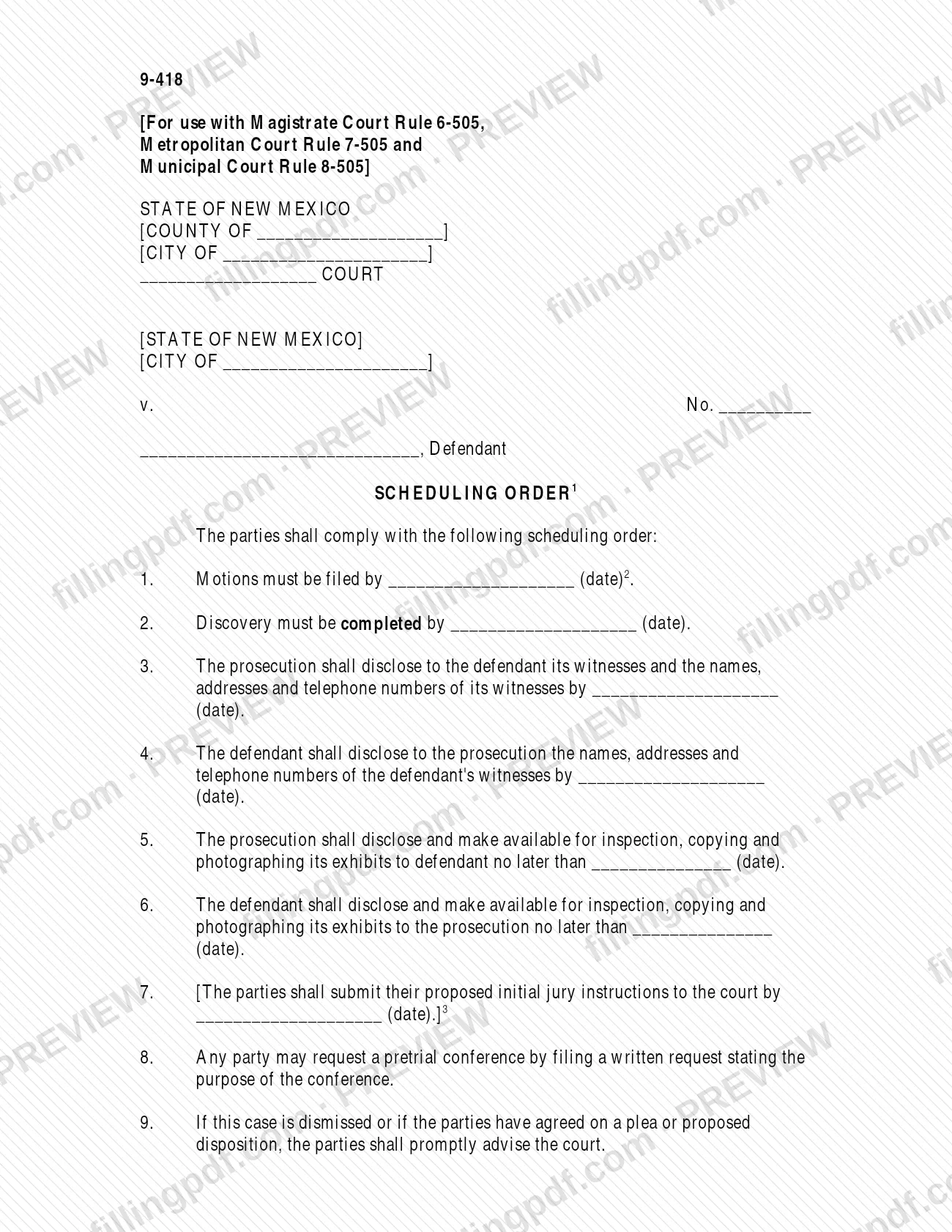
Form 9-418, Scheduling Order, is a New Mexico Supreme Court approved form for use with Magistrate Court Rule 6-505, Metropolitan Court Rule 7-505 and Municipal Court Rule 8-505. A scheduling order tells the prosecution and the defendant the dates by which motions, discovery and disclosures must be done, and when conferences, a motion hearing and trial are set. On this page you can fill out the form online on FillingPDF and download or print the completed PDF; the form itself is published by the New Mexico Judicial Branch at nmcourts.gov.
Last updated
What is 9-418?
Form 9-418, Scheduling Order, is a New Mexico court order form that tells the parties in a case between the State (or a city) and a defendant which dates they must meet for motions, discovery, witness and exhibit disclosures, and court settings.
The form is approved by the New Mexico Supreme Court and carries the note "For use with Magistrate Court Rule 6-505, Metropolitan Court Rule 7-505 and Municipal Court Rule 8-505." Its caption has bracketed alternatives for the county, the city and the name of the court, a case number and the defendant's name.
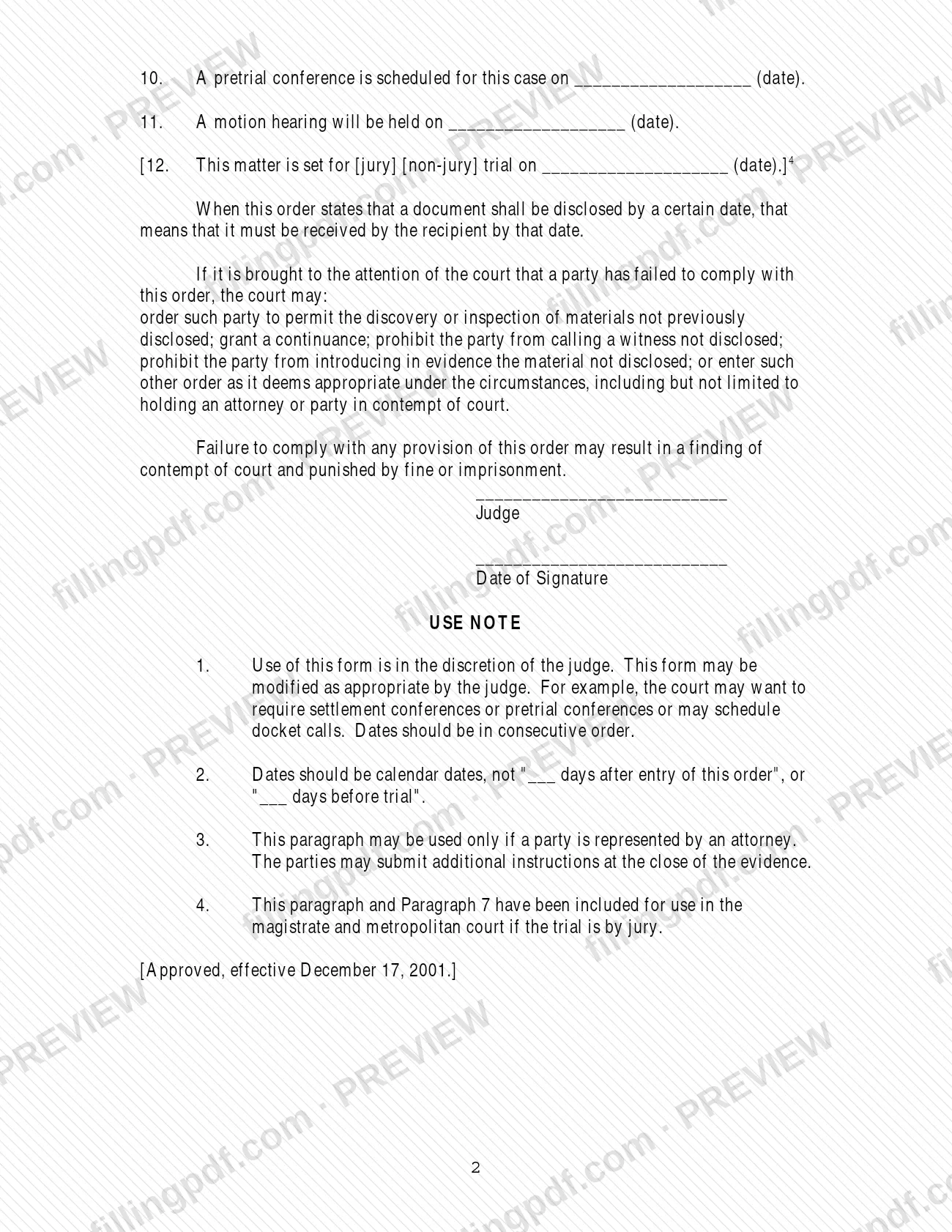
The numbered paragraphs set these dates: the last day to file motions; the last day to complete discovery; when the prosecution and the defendant must each disclose their witnesses, with names, addresses and telephone numbers; and when each must make exhibits available for inspection, copying and photographing. Bracketed paragraphs add a date for proposed initial jury instructions and a jury or non-jury trial setting. The order also schedules a pretrial conference and a motion hearing.
The form warns that failure to comply may lead the court to order disclosure, grant a continuance, bar a witness or exhibit, or hold an attorney or party in contempt of court. The judge signs and dates it at the bottom.
Who needs to file 9-418?
The judge in a case in magistrate, metropolitan or municipal court uses Form 9-418 when the judge decides to issue a scheduling order. The USE NOTE says use of the form is in the discretion of the judge, and the judge may modify it, for example to require settlement conferences or pretrial conferences or to schedule docket calls.
Once the order is signed, the prosecution and the defendant must comply with the dates it sets. Each side has its own disclosure paragraphs: paragraphs 3 and 5 bind the prosecution, and paragraphs 4 and 6 bind the defendant.
Some paragraphs apply only in certain cases:
- Paragraph 7, proposed initial jury instructions, may be used only if a party is represented by an attorney.
- Paragraph 7 and paragraph 12 (the jury or non-jury trial setting) are included for use in the magistrate and metropolitan court if the trial is by jury.
The form does not say that a party must request it, and it does not describe who may prepare the draft for the judge's signature.
When to file 9-418
The form sets no filing deadline of its own: it is used when the judge decides to issue a scheduling order in a case, and the dates inside it are the deadlines the parties then follow. Every date must be a calendar date, not "___ days after entry of this order" or "___ days before trial," and the dates should be in consecutive order.
A document that must be disclosed by a certain date must be received by the recipient by that date. Under paragraph 9, if the case is dismissed or the parties have agreed on a plea or proposed disposition, they must promptly advise the court. Under paragraph 8, any party may request a pretrial conference by filing a written request that states its purpose.
How to fill out 9-418
Complete the court caption
Fill in the bracketed lines: the county or city, the name of the court, and whether the case is State of New Mexico or City of ___ against the defendant. Delete the bracketed alternatives that do not apply.
Enter the case number and defendant
Write the case number after No. and the defendant's name on the line before "Defendant."
Set the motions deadline
In paragraph 1, enter the date by which motions must be filed. Use a calendar date, not a number of days.
Set the discovery deadline
In paragraph 2, enter the date by which discovery must be completed, in a calendar date.
Enter witness disclosure dates
Paragraph 3 is the prosecution's date to disclose its witnesses, and paragraph 4 is the defendant's date to disclose the names, addresses and telephone numbers of the defendant's witnesses.
Enter exhibit disclosure dates
In paragraph 5, enter the prosecution's date, and in paragraph 6 the defendant's date, to make exhibits available for inspection, copying and photographing.
Decide on jury instructions
In paragraph 7, enter the date for proposed initial jury instructions only if a party is represented by an attorney and the trial is by jury. Otherwise remove the paragraph.
Enter conference and hearing dates
Paragraph 10 takes the date of the pretrial conference and paragraph 11 the date of the motion hearing. Paragraphs 8 and 9 are printed text and need no entry.
Complete the trial setting
In paragraph 12, choose [jury] or [non-jury] and enter the trial date, where a trial setting is used. Keep the dates in consecutive order.
Review, sign and download the PDF
Check that every date is a calendar date and in consecutive order. The judge signs and enters the Date of Signature; then download or print the completed PDF from FillingPDF.
How to submit 9-418
Form 9-418 is an order of the court, and it prints no mailing address, portal, fee or other filing channel. The judge signs and dates it at the bottom, and the parties then follow the deadlines it sets.
- Court that issues it: the magistrate, metropolitan or municipal court handling the case, in the name that appears in the caption.
- What must be received: documents the order requires to be disclosed must be received by the other side by the stated date, not merely sent by then.
- Written requests under the order: a request for a pretrial conference is made by filing a written request that states the purpose of the conference.
- Questions about delivery or filing: ask the clerk of the court hearing the case.
You can find the form and other Supreme Court approved forms through the New Mexico Judicial Branch forms library at https://nmcourts.gov/forms-library/. FillingPDF lets you fill out and download the PDF; submission follows the court's own channels.
Common mistakes to avoid
- Writing deadlines as "___ days after entry of this order" or "___ days before trial"; the USE NOTE says dates must be calendar dates.
- Listing the dates out of order; the USE NOTE says dates should be in consecutive order.
- Keeping paragraph 7 on jury instructions when no party is represented by an attorney; the form allows it only if a party has an attorney.
- Leaving the bracketed text in the caption, such as both the county and city lines, instead of choosing the one that fits the court.
- Leaving paragraph 12 without choosing [jury] or [non-jury] when a trial date is set.
- Treating a disclosure as timely because it was mailed by the date; the order says the recipient must receive it by that date.
- Leaving the judge's signature line or the Date of Signature blank.
- Assuming the form is required in every case; the USE NOTE says its use is in the judge's discretion.
Frequently asked questions
What is a scheduling order in New Mexico court?
Form 9-418, Scheduling Order, is the New Mexico Supreme Court approved form a judge can use to set dates for motions, discovery, witness and exhibit disclosures, a pretrial conference, a motion hearing and trial in magistrate, metropolitan and municipal court cases.
Is a scheduling order required in every case?
No. The USE NOTE on Form 9-418 says that use of the form is in the discretion of the judge, and the judge may modify it, for example to add settlement conferences, pretrial conferences or docket calls.
Which courts use Form 9-418?
It is for use with Magistrate Court Rule 6-505, Metropolitan Court Rule 7-505 and Municipal Court Rule 8-505, as printed at the top of the form.
Can I write "30 days before trial" for a deadline?
No. The USE NOTE says dates should be calendar dates, not "___ days after entry of this order" or "___ days before trial," and that the dates should be in consecutive order.
What does "disclosed by" a certain date mean?
The order says a document to be disclosed by a date must be received by the recipient by that date. Sending it on that date is not enough if it arrives later.
What happens if a party does not follow the scheduling order?
The court may order disclosure or inspection, grant a continuance, bar an undisclosed witness or evidence, or enter another order, including holding an attorney or party in contempt. Failure to comply may be punished by fine or imprisonment.
When can paragraph 7 on jury instructions be used?
Only if a party is represented by an attorney. Paragraph 7 and paragraph 12 are included for use in magistrate and metropolitan court if the trial is by jury, and the parties may submit additional instructions at the close of the evidence.
Can I fill out the scheduling order online on FillingPDF?
Yes. You can fill out the PDF online on FillingPDF and download or print it. FillingPDF is an independent service and does not file the order with any court; the judge signs it and the court handles it.
Ready to fill out 9-418?
Fill out 9-418 now