
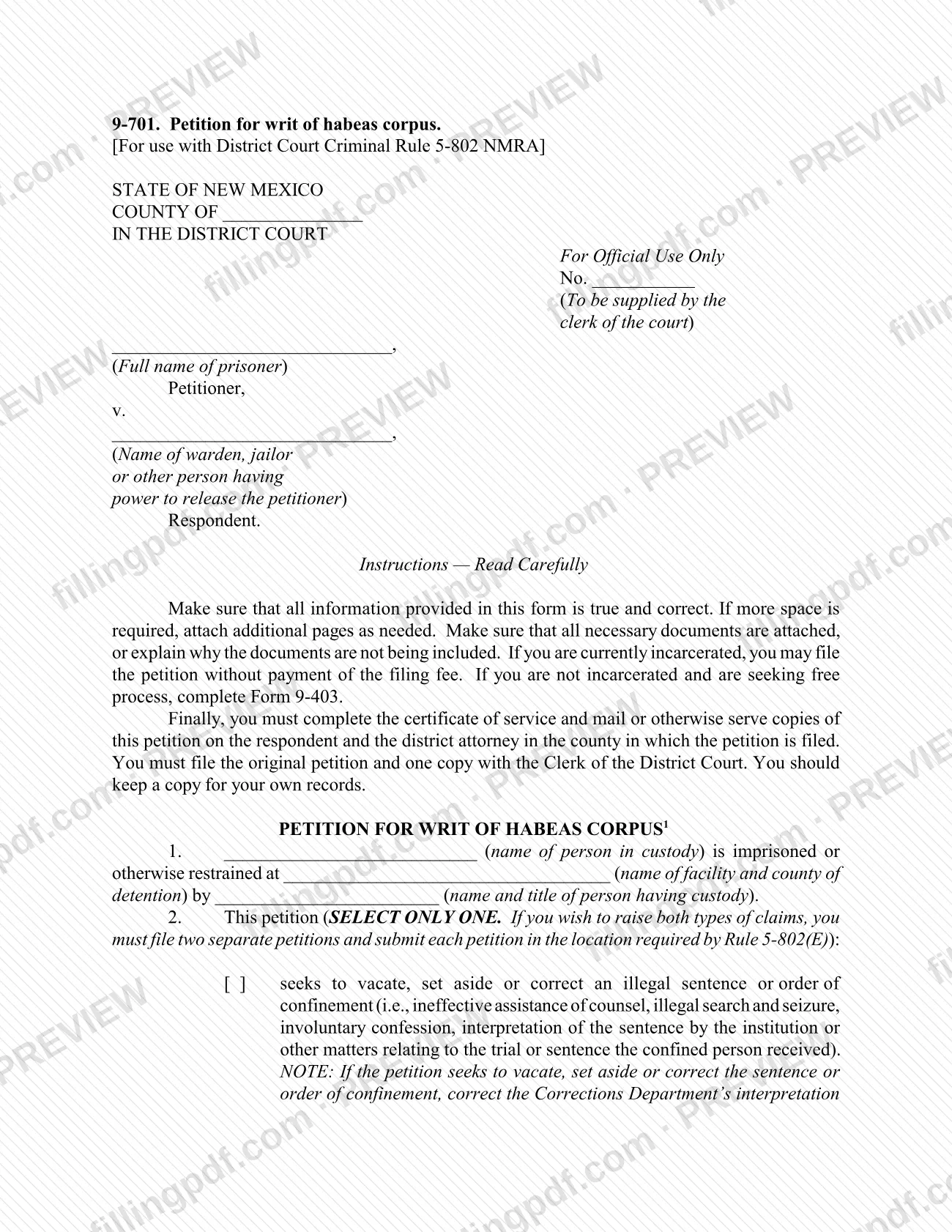
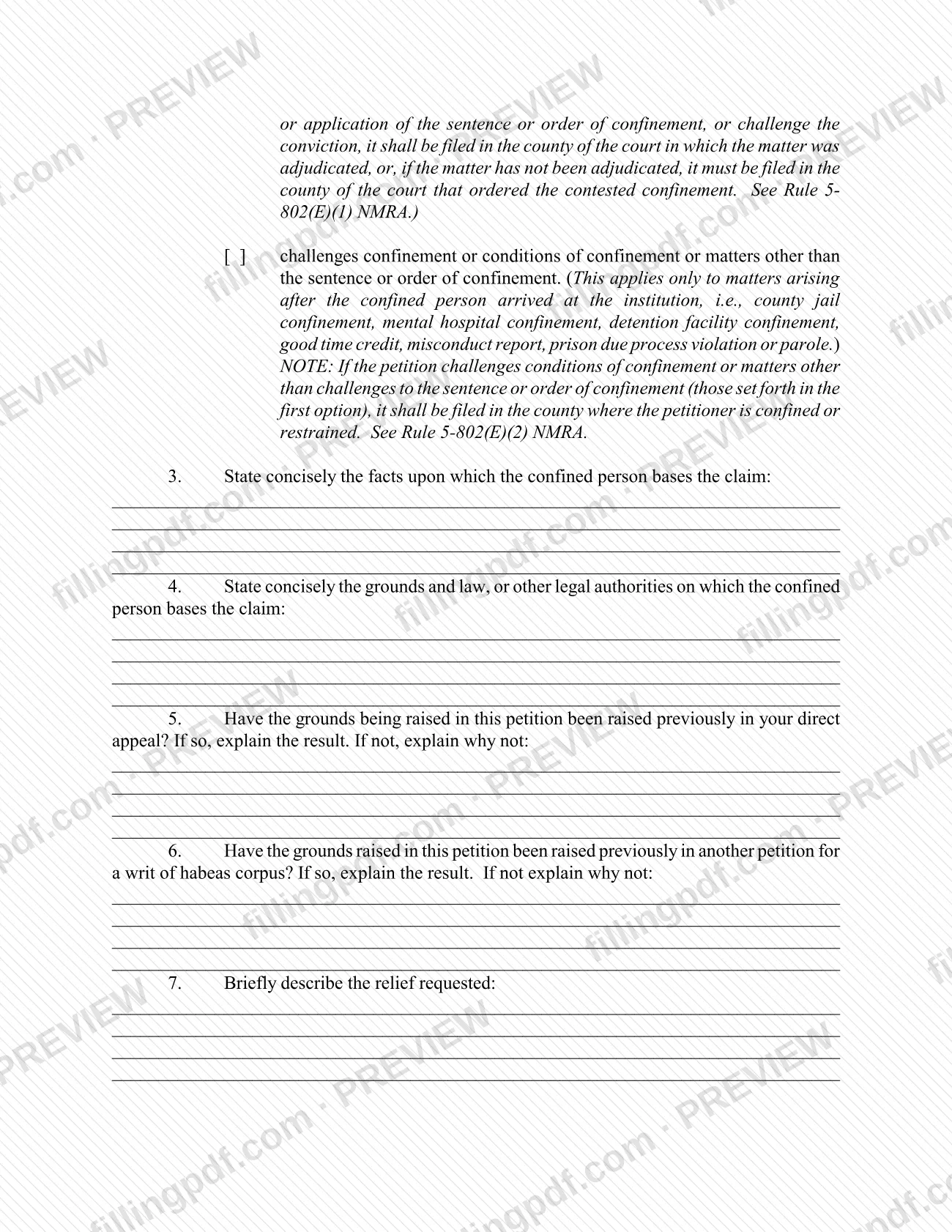
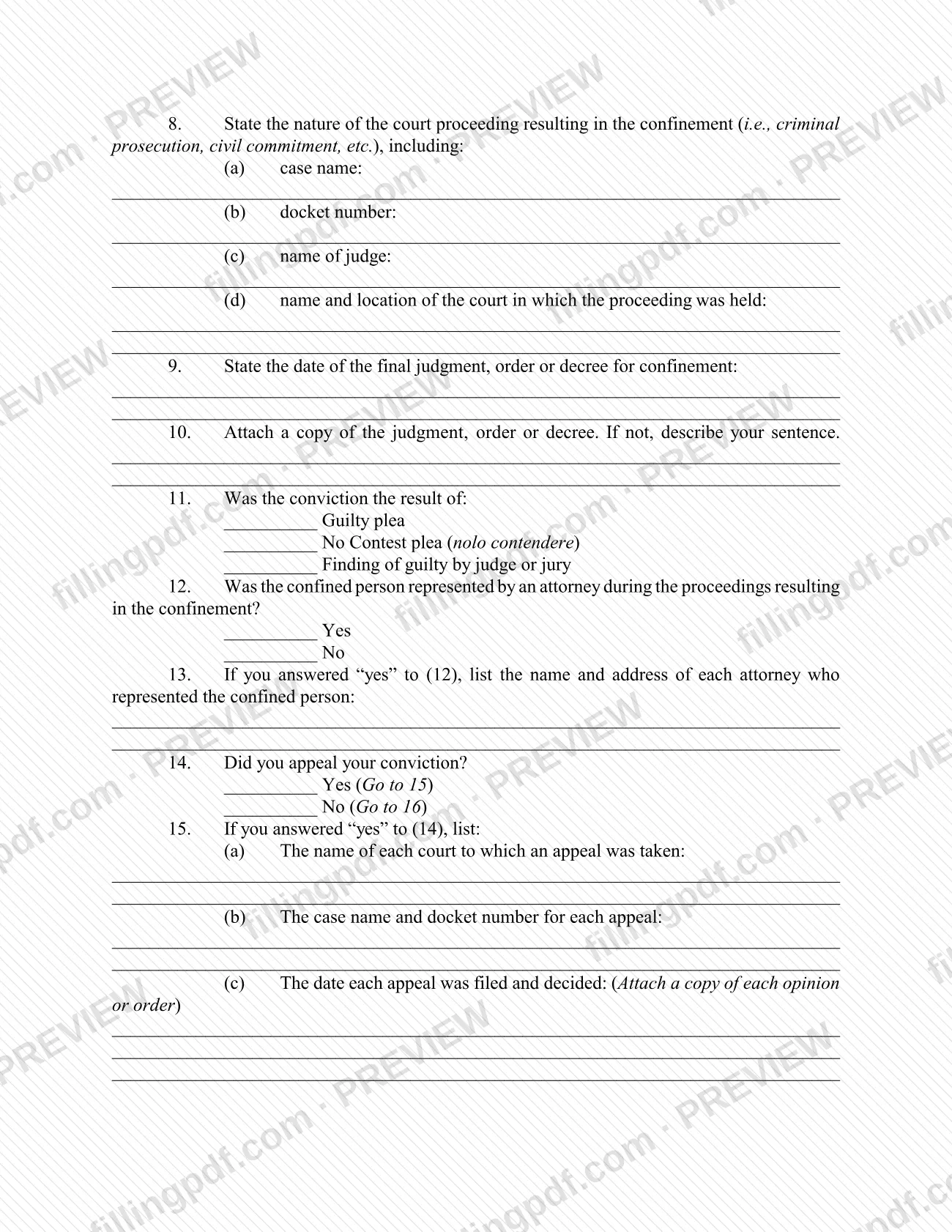
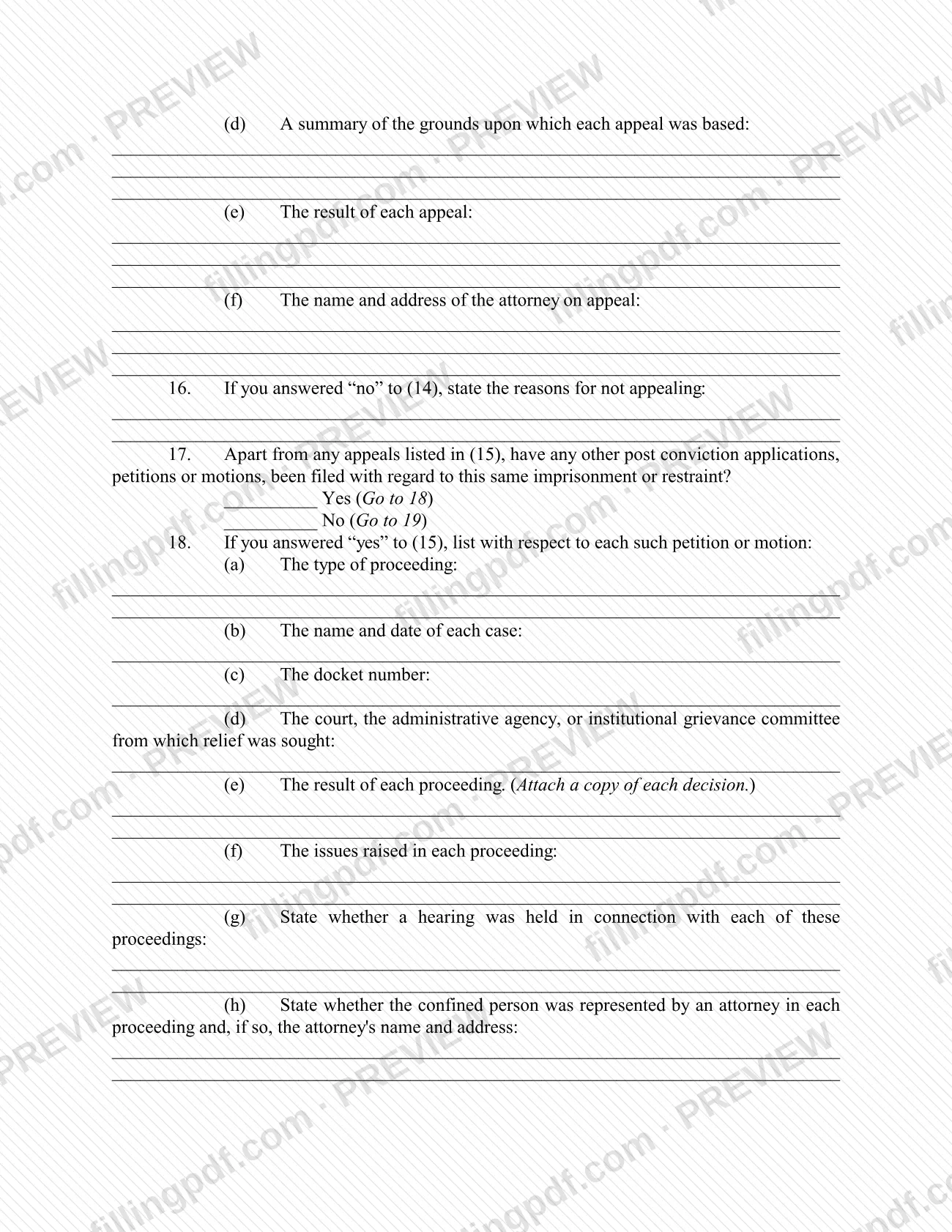
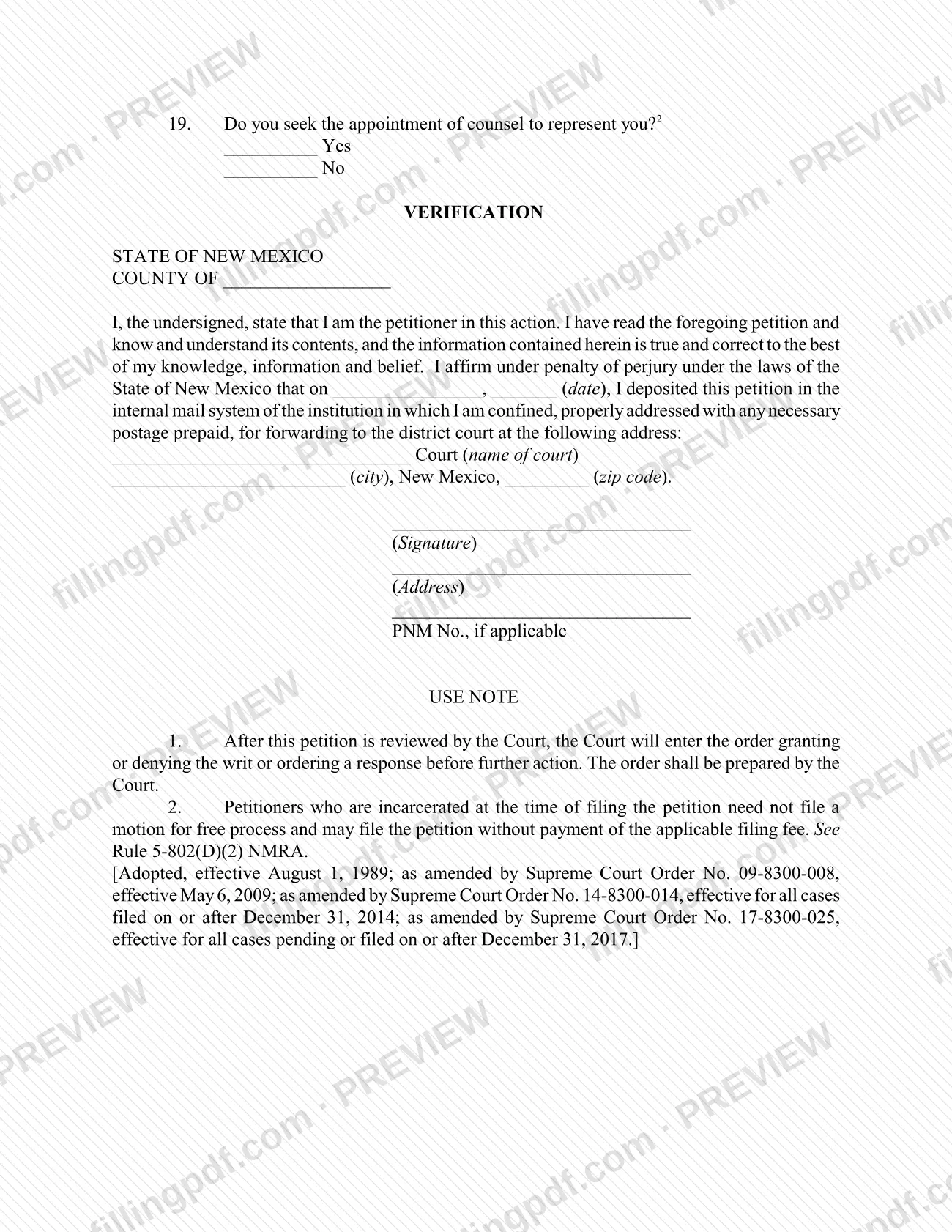
The petition for writ of habeas corpus (Form 9-701) is the form approved by the New Mexico Supreme Court and published by the New Mexico Judicial Branch for use with District Court Criminal Rule 5-802 NMRA. A person who is imprisoned or otherwise restrained uses it to challenge a sentence, an order of confinement or the conditions of confinement in a district court. On this page you can fill out the form online on FillingPDF and download or print the completed PDF; the original PDF is published by the New Mexico courts.
Last updated
What is 9-701?
Form 9-701, Petition for writ of habeas corpus, is the New Mexico form, for use with District Court Criminal Rule 5-802 NMRA, on which a person imprisoned or otherwise restrained asks a district court to review a sentence, confinement order or confinement conditions.
The form is a district court pleading. It names the person in custody as petitioner and the warden, jailor or other person with power to release the petitioner as respondent. The petitioner states the facts, the grounds and legal authorities, the relief requested, the court proceeding that led to the confinement, any appeals, and any earlier post-conviction petitions or motions about the same imprisonment.
On item 2 you must select only one of two types of claim:
- a claim to vacate, set aside or correct an illegal sentence or order of confinement, which is filed in the county of the court that handled the matter (Rule 5-802(E)(1) NMRA);
- a challenge to confinement, conditions of confinement or other matters that arose after arrival at the institution, which is filed in the county where the petitioner is confined (Rule 5-802(E)(2) NMRA).
The form's use note says that after the court reviews the petition, it enters an order granting or denying the writ or ordering a response before further action, and that the court prepares that order. The form is signed under a verification, not before a notary.
Who needs to file 9-701?
A person who is imprisoned or otherwise restrained in New Mexico and wants a district court to review a sentence, an order of confinement or the conditions of confinement files Form 9-701 as the petitioner. The verification is signed by the petitioner.
Which claim you select on item 2 decides where the petition is filed:
- Challenges to the sentence, the conviction or an order of confinement, or to how the Corrections Department interprets or applies the sentence, go to the county of the court that adjudicated the matter or, if it was not adjudicated, the county of the court that ordered the confinement.
- Challenges to county jail, mental hospital or detention facility confinement, good time credit, misconduct reports, prison due process or parole go to the county where the petitioner is confined.
If you want to raise both types of claims, the form says you must file two separate petitions, each in the location Rule 5-802(E) requires.
People who are currently incarcerated may file without paying the filing fee. People who are not incarcerated and want free process must complete Form 9-403.
When to file 9-701
File Form 9-701 when you are imprisoned or otherwise restrained and want a district court to consider a claim about your sentence, order of confinement or conditions of confinement. The form prints no filing deadline.
Check items 5, 6, 14 and 17 before filing: they ask whether the same grounds were raised in a direct appeal or an earlier habeas corpus petition, whether you appealed, and whether other post-conviction petitions or motions were filed about the same imprisonment. Gather the dates and results of those proceedings first.
The verification asks for the date on which you deposited the petition in the institution's internal mail system, so fill in that date when you actually mail it. After the court reviews the petition, it enters an order granting or denying the writ or ordering a response; the form gives no processing time.
Documents you need
- A copy of the judgment, order or decree for confinement (item 10). If you do not attach it, the form asks you to describe your sentence.
- A copy of each opinion or order from any appeal you list, if you appealed your conviction (item 15(c)).
- A copy of each decision from any other post-conviction petition, motion or proceeding you list (item 18(e)).
- Any other documents needed to support the petition, or an explanation of why they are not included; the instructions say all necessary documents must be attached.
- Additional pages, if the lines on the form do not give you enough space.
- Form 9-403, only if you are not incarcerated and are seeking free process.
- A completed certificate of service for the copies served on the respondent and the district attorney.
How to fill out 9-701
Complete the caption
Enter the county, the full name of the prisoner as petitioner, and the name of the warden, jailor or other person with power to release the petitioner as respondent. Leave the case number blank: the clerk supplies it.
Identify the custody (items 1 and 2)
Item 1: enter the name of the person in custody, the facility and county of detention, and the name and title of the person with custody. Item 2: select only one type of claim, because the choice decides the county of filing.
State facts, grounds and relief
Item 3: state the facts concisely. Item 4: state the grounds and the law or other legal authorities. Item 7: briefly describe the relief requested. Attach extra pages if needed.
Report earlier challenges (items 5 and 6)
Item 5: say whether the grounds were raised in your direct appeal, with the result or the reason they were not. Item 6: do the same for any earlier habeas corpus petition.
Describe the court proceeding (items 8 to 10)
Item 8: give the nature of the proceeding, case name, docket number, judge, and the name and location of the court. Item 9: the date of the final judgment, order or decree. Item 10: attach it or describe your sentence.
Answer about plea and attorney (items 11 to 13)
Item 11: mark guilty plea, no contest plea or finding of guilty by judge or jury. Item 12: mark Yes or No for representation by an attorney. Item 13: if Yes, list each attorney's name and address.
Describe any appeal (items 14 to 16)
Item 14: mark Yes or No. If Yes, complete 15(a) to (f): courts, case names and docket numbers, dates, grounds, results and the appeal attorney. If No, give your reasons on item 16.
List other post-conviction filings (items 17 and 18)
Item 17: mark Yes or No for other applications, petitions or motions about the same imprisonment. If Yes, complete 18(a) to (h) for each, including the court or body, result, issues, hearing and attorney, and attach each decision.
Answer the counsel question (item 19)
Mark Yes or No on whether you seek the appointment of counsel to represent you.
Complete the verification and sign
Enter the county, the date you deposit the petition in the institution's mail system, the court name, city and ZIP code. Sign, and add your address and PNM No., if applicable.
Review and download the completed PDF
Check that every item is answered or explained and that the attachments are ready. Download or print the completed PDF from FillingPDF, add the certificate of service, and file and serve it as described under How to submit.
How to submit 9-701
Form 9-701 is filed with the Clerk of the District Court, and you also serve it on the respondent and the district attorney.
- Filing: File the original petition and one copy with the Clerk of the District Court in the county that Rule 5-802(E) requires for the type of claim you checked on item 2. Keep a copy for your records.
- From an institution: The verification states that the petition was deposited in the institution's internal mail system, properly addressed with any necessary postage prepaid, for forwarding to the district court. Enter the court name, city and ZIP code of that court in the verification.
- Service: Complete the certificate of service and mail or otherwise serve copies of the petition on the respondent and on the district attorney in the county where the petition is filed.
- Fee: If you are currently incarcerated, you may file without paying the filing fee and need not file a motion for free process. If you are not incarcerated and want free process, complete Form 9-403. Otherwise, ask the clerk about the filing fee.
The form gives no street address; use the clerk of the district court for the county that applies. FillingPDF lets you fill out and download the PDF; submission follows the channels above.
Common mistakes to avoid
- Selecting both boxes on item 2. The form says to select only one; to raise both types of claims, file two separate petitions.
- Filing in the wrong county. A sentence or confinement-order claim goes to the county of the adjudicating or ordering court; a conditions claim goes to the county where you are confined.
- Filing only the original. The instructions require the original petition and one copy for the Clerk of the District Court.
- Skipping the certificate of service or not serving the respondent and the district attorney in the county where the petition is filed.
- Leaving out the copy of the judgment, order or decree without describing your sentence on item 10.
- Not attaching the opinion or order of each appeal (item 15(c)) or the decision of each other proceeding (item 18(e)).
- Using vague statements on items 3 and 4; the form asks you to state facts and grounds concisely, and extra pages may be attached.
- Leaving the verification date, court name, city and ZIP code blank, or leaving the petition unsigned.
Frequently asked questions
What is a petition for writ of habeas corpus in New Mexico?
It is a district court pleading on which a person who is imprisoned or otherwise restrained challenges a sentence, an order of confinement or the conditions of confinement. New Mexico's Form 9-701 is the Supreme Court approved version, used with District Court Criminal Rule 5-802 NMRA.
Where do I file Form 9-701?
With the Clerk of the District Court. Sentence and confinement-order claims go to the county of the court that adjudicated the matter or ordered the confinement; conditions claims go to the county where you are confined (Rule 5-802(E)).
Do I have to pay a filing fee if I am in prison?
No. If you are currently incarcerated you may file without paying the filing fee and need not file a motion for free process. If you are not incarcerated and want free process, complete Form 9-403. Ask the clerk about any fee that applies to you.
Can I raise a sentence claim and a conditions claim in one petition?
No. Item 2 says to select only one. If you want to raise both types of claims, you must file two separate petitions, each in the location Rule 5-802(E) requires.
Who do I have to serve with the petition?
The respondent and the district attorney in the county where the petition is filed. Complete the certificate of service and mail or otherwise serve copies on them. File the original petition and one copy with the clerk, and keep a copy.
What happens after I file Form 9-701?
The court reviews the petition and enters an order granting or denying the writ, or ordering a response before further action. The court prepares that order. The form states no deadline for the court or a processing time.
Can I fill out Form 9-701 online?
You can fill out the PDF online on FillingPDF and download or print it. FillingPDF is an independent service and does not file or serve the petition; you file it with the district court and serve it yourself as the form directs.
Ready to fill out 9-701?
Fill out 9-701 now