
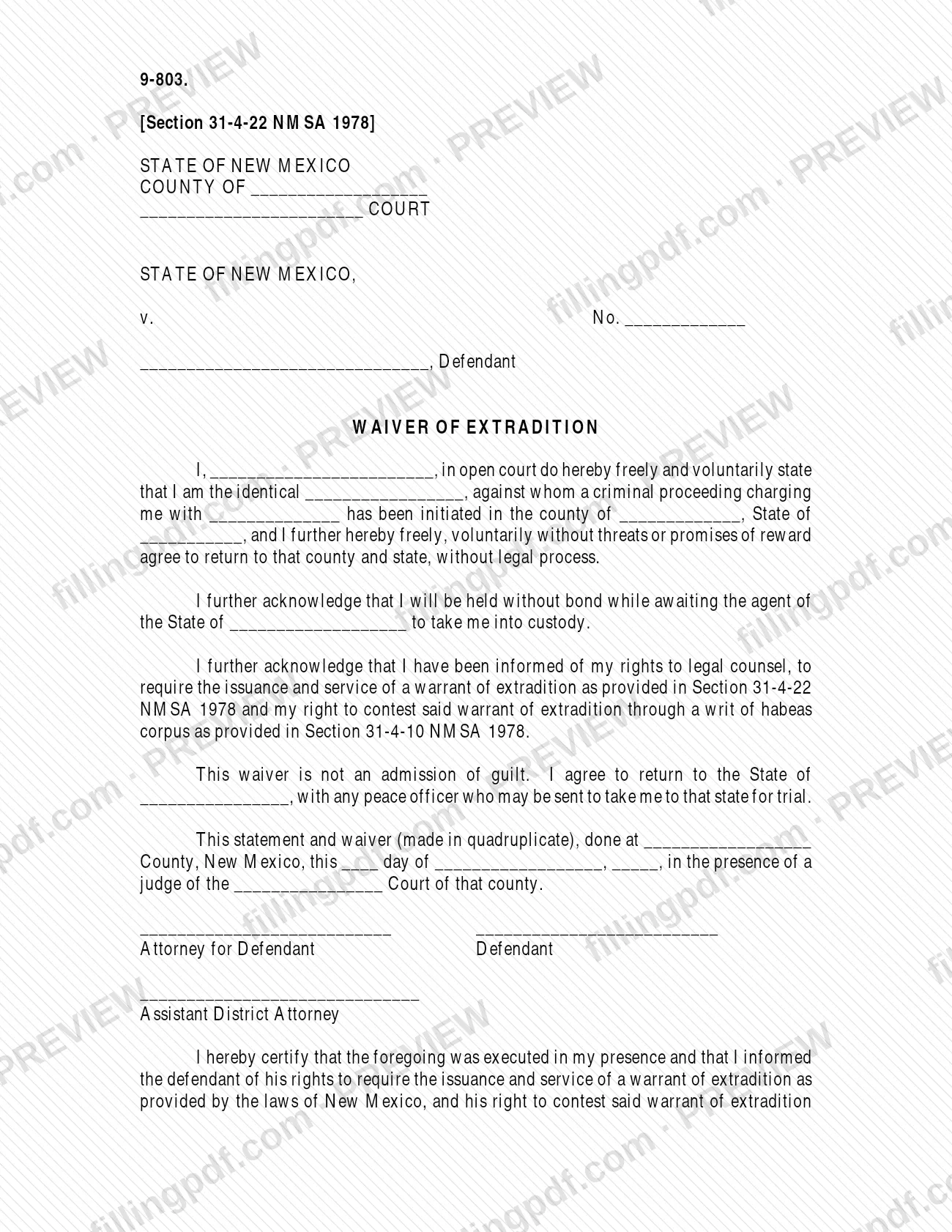
Form 9-803, Waiver of extradition, is a New Mexico court form, approved by the Supreme Court and published by the New Mexico Judicial Branch, on which a defendant agrees to return to another state without extradition proceedings. It cites Section 31-4-22 NMSA 1978 and is signed in the presence of a judge. On this page you can fill out the form online on FillingPDF and download or print the completed PDF; the official PDF is published by the New Mexico courts at nmcourts.gov.
Last updated
What is 9-803?
Waiver of extradition (Form 9-803) is the New Mexico court form on which a defendant states, in open court, that he or she freely and voluntarily agrees to return to the county and state where a criminal proceeding has been started, without legal process.
The form is issued under Section 31-4-22 NMSA 1978 and appears among the criminal forms approved by the Supreme Court and published by the New Mexico Judicial Branch. It is a single document with three parts: the defendant's statement, the signatures of the defense attorney, the defendant and an assistant district attorney, and a judge's certificate.
In the statement, the defendant identifies himself or herself as the person charged, names the charge, the county and the state where the proceeding began, and acknowledges being held without bond while awaiting the agent of that state. The defendant also acknowledges having been informed of the right to legal counsel, the right to require a warrant of extradition under Section 31-4-22 NMSA 1978, and the right to contest that warrant through a writ of habeas corpus under Section 31-4-10 NMSA 1978.
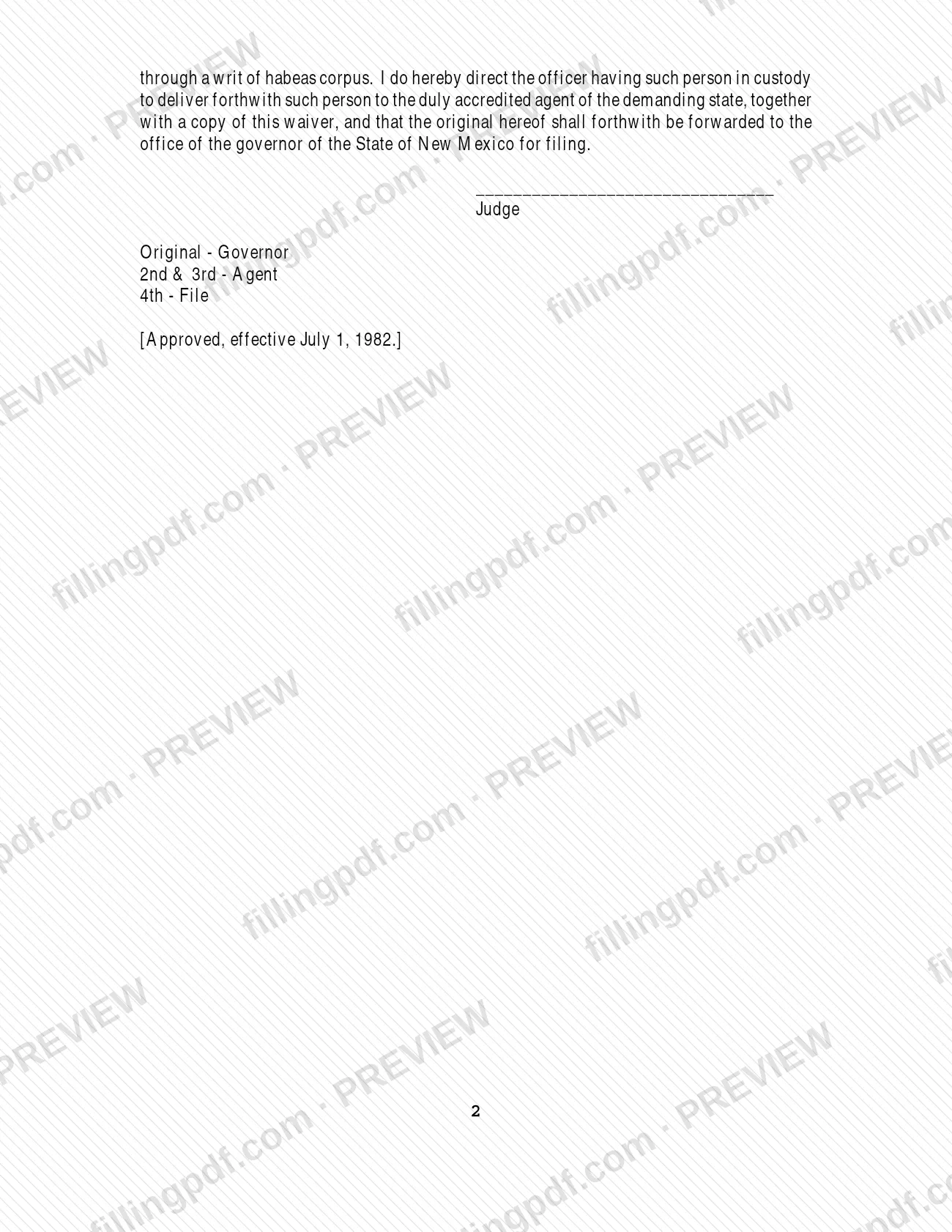
The form states that the waiver is not an admission of guilt. The judge's certificate directs the officer holding the defendant to deliver him or her to the accredited agent of the demanding state with a copy of the waiver.
Who needs to file 9-803?
The form is for a defendant in a New Mexico court who has been charged with a crime in another state and chooses to waive extradition by agreeing, in open court, to return to that state. The defendant states on the form that he or she is the person named in the out-of-state charge.
Others who take part in completing it:
- Defendant: signs the waiver and fills in the identifying details.
- Attorney for Defendant: signs on the line provided for the attorney.
- Assistant District Attorney: signs on the line provided for the prosecutor.
- Judge: completes the certificate, confirming the waiver was executed in the judge's presence and that the defendant was told of his or her rights.
The form is executed before a judge of a New Mexico court, so it is not something a defendant completes alone outside court. The form itself does not describe who else may sign on a defendant's behalf.
When to file 9-803
The waiver is executed at the hearing at which the defendant agrees to return to the other state, because the form says it is made in open court and in the presence of a judge of the named court. The form prints the date of execution and the county where it is done. It sets no separate deadline of its own. After the judge certifies it, the officer holding the defendant is directed to deliver the defendant forthwith to the demanding state's agent with a copy of the waiver, and the original is to be forwarded forthwith to the office of the governor of New Mexico.
How to fill out 9-803
Complete the case caption
Enter the county, the name of the court and the case number (No.) at the top, and the defendant's name on the line above "Defendant".
State your identity and the charge
In the first paragraph, enter the defendant's name, the name under which you are identical to the person charged, the charge, the county where the proceeding was started and the state.
Name the demanding state
Enter the State in the custody paragraph, where you acknowledge being held without bond while awaiting that state's agent, and again in the paragraph agreeing to return with a peace officer.
Review the acknowledged rights
Read the paragraph on the rights to legal counsel, to a warrant of extradition under Section 31-4-22 NMSA 1978, and to contest it by writ of habeas corpus under Section 31-4-10 NMSA 1978, before signing.
Enter place, date and court
In the closing paragraph, enter the county in New Mexico where the waiver is made, the day, month and year, and the name of the court whose judge is present.
Collect the three signatures
The defendant signs on the Defendant line, the defense attorney on the Attorney for Defendant line and the prosecutor on the Assistant District Attorney line, in the judge's presence.
Have the judge certify the waiver
The judge signs on the Judge line, certifying that the waiver was executed in the judge's presence and that the defendant was informed of his or her rights.
Review, download and make copies
Check the names, the demanding state and the dates, then download or print the completed PDF from FillingPDF. The form says it is made in quadruplicate: original to the Governor, 2nd and 3rd to the agent, 4th to the file.
How to submit 9-803
This form is not mailed or filed online by the defendant. It is completed in court and routed by the court. The form prints the distribution of the four copies it is made in:
- Original: goes to the Governor. The judge's certificate says the original is to be forwarded forthwith to the office of the governor of the State of New Mexico for filing.
- 2nd and 3rd copies: go to the agent of the demanding state. A copy of the waiver accompanies the defendant when the officer delivers him or her to the accredited agent.
- 4th copy: is kept in the court file.
The form names no portal, address or fee. Questions about the court's procedures go to the court where the waiver is executed. FillingPDF lets you fill out and download the PDF; submission follows the channels above.
Common mistakes to avoid
- Signing the waiver outside the presence of a judge; the form states it is made in open court before a judge of the named court.
- Entering different states in the blanks that name the demanding state; the form refers to the same state in the statement, the custody paragraph and the agreement to return.
- Treating the waiver as an admission of guilt; the form says it is not, and it covers only agreeing to return to the other state.
- Leaving the judge's certificate unsigned; the directions to deliver the defendant and forward the original rely on it.
- Preparing fewer than the four copies the form says it is made in.
- Sending the copies to the wrong place; the form assigns the original to the Governor, the 2nd and 3rd to the agent and the 4th to the file.
- Omitting the date, county or name of the court where the waiver was executed, which the closing paragraph requires.
- Leaving the signature lines for the defense attorney or the assistant district attorney blank.
Frequently asked questions
What is a waiver of extradition?
A waiver of extradition is a statement by a defendant, made in open court, agreeing to return to the state where a criminal proceeding has begun without legal process. In New Mexico, Form 9-803 is the approved form, issued under Section 31-4-22 NMSA 1978.
Is a waiver of extradition an admission of guilt?
No. Form 9-803 states in its own text that the waiver is not an admission of guilt. The defendant agrees only to return to the demanding state with a peace officer sent to take him or her there for trial.
What rights does the defendant acknowledge on Form 9-803?
The defendant acknowledges being informed of the right to legal counsel, the right to require the issuance and service of a warrant of extradition under Section 31-4-22 NMSA 1978, and the right to contest that warrant through a writ of habeas corpus under Section 31-4-10 NMSA 1978.
Who has to sign Form 9-803?
The form has signature lines for the Attorney for Defendant, the Defendant and an Assistant District Attorney. A judge also signs a certificate that the waiver was executed in the judge's presence and that the defendant was informed of his or her rights.
Will the defendant be held in custody after waiving extradition?
Yes, according to the form: the defendant acknowledges being held without bond while awaiting the agent of the demanding state. The judge's certificate directs the officer holding the defendant to deliver him or her forthwith to that agent with a copy of the waiver.
Where do the copies of the waiver go?
The form is made in quadruplicate: the original goes to the Governor's office for filing, the 2nd and 3rd copies go to the agent of the demanding state, and the 4th copy stays in the court file.
Can I fill out the waiver of extradition online?
You can fill out the PDF online on FillingPDF and download or print it. FillingPDF does not file it or send it to the court or the Governor; the form is executed before a judge and routed as the form describes.
Ready to fill out 9-803?
Fill out 9-803 now