
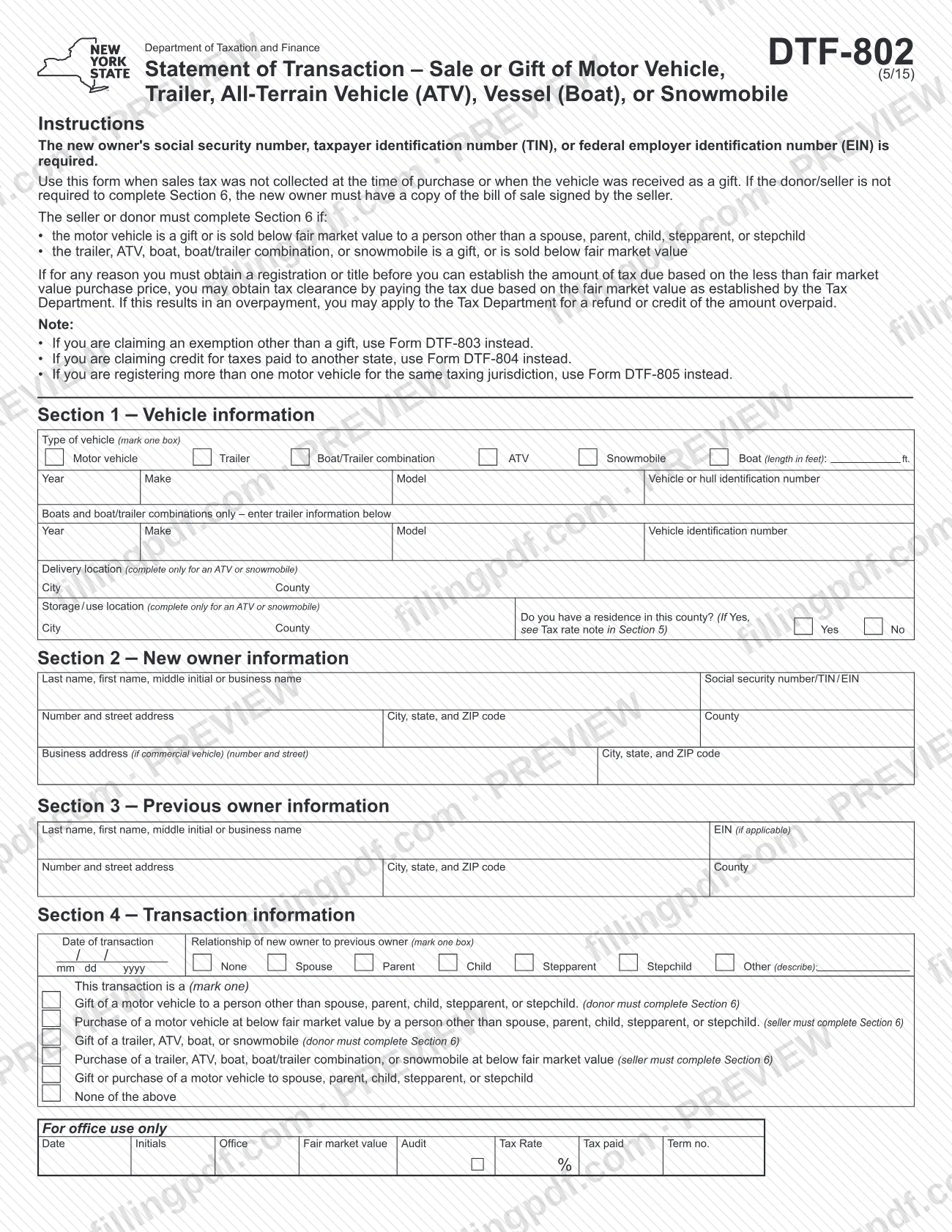
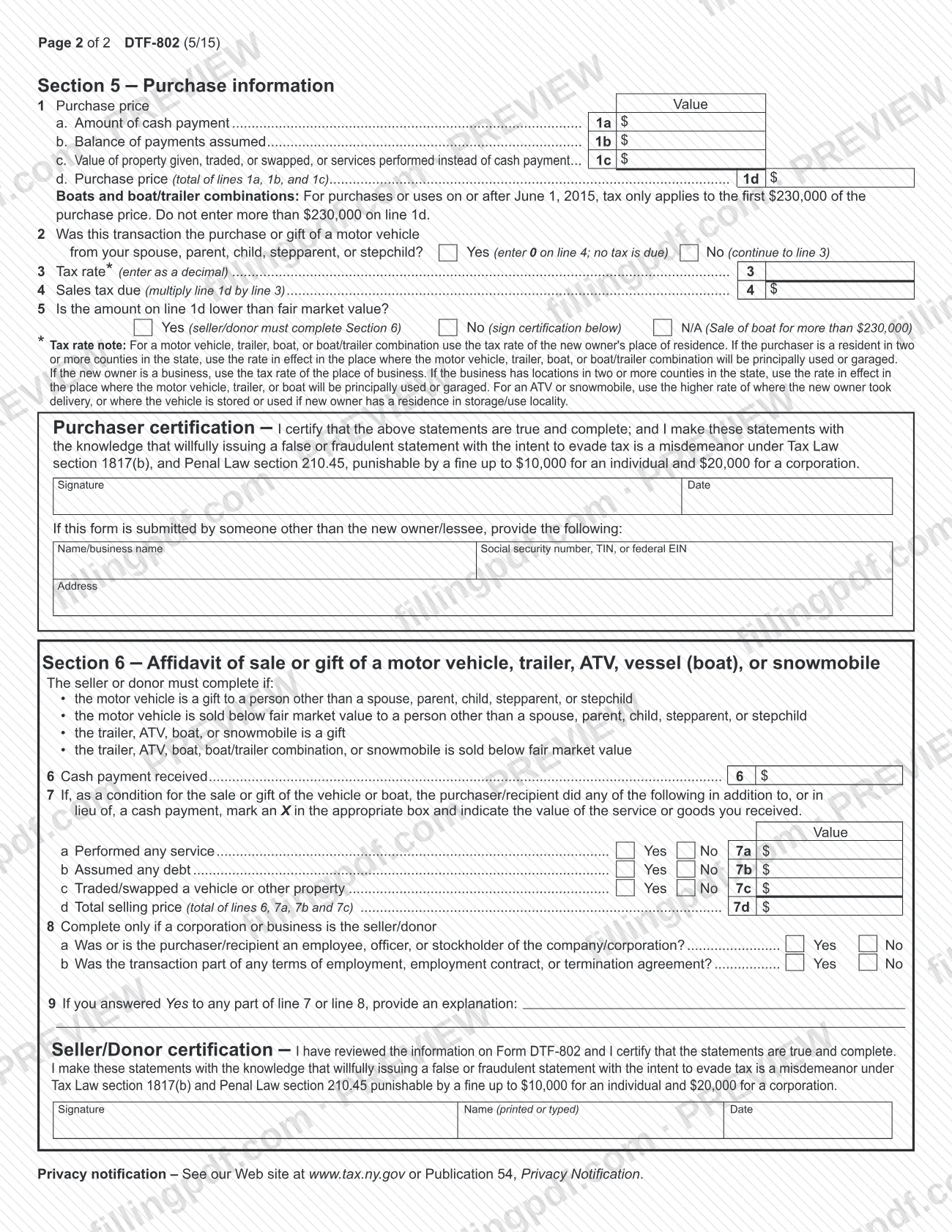
DTF-802 is the Statement of Transaction that the New York State Department of Taxation and Finance uses when a motor vehicle, trailer, all-terrain vehicle (ATV), boat or snowmobile changes hands as a gift, or in a sale where sales tax was not collected at purchase. The new owner reports the purchase price and figures the sales tax due, and the seller or donor completes an affidavit when the form requires it. On this page you can fill out the form online on FillingPDF and download or print the completed PDF; the form itself is published by the Tax Department.
Last updated
What is DTF-802?
Form DTF-802, Statement of Transaction – Sale or Gift of Motor Vehicle, Trailer, All-Terrain Vehicle (ATV), Vessel (Boat), or Snowmobile is the New York State Department of Taxation and Finance form on which a new owner reports a vehicle or boat transaction and the sales tax due on it.
The Tax Department's instructions on the form say to use it when sales tax was not collected at the time of purchase or when the vehicle was received as a gift. The form is divided into six sections: vehicle information, new owner information, previous owner information, transaction information, purchase information with the tax calculation, and an affidavit of sale or gift for the seller or donor.
The new owner's social security number, taxpayer identification number (TIN) or federal employer identification number (EIN) is required. The new owner certifies the statements in Section 5. The seller or donor certifies Section 6 only in the cases the form lists, such as a gift or a sale below fair market value.
DTF-802 is not the only Tax Department statement of this kind. The form tells you to use Form DTF-803 instead if you are claiming an exemption other than a gift, Form DTF-804 if you are claiming credit for taxes paid to another state, and Form DTF-805 if you are registering more than one motor vehicle for the same taxing jurisdiction.
Who needs to file DTF-802?
The new owner of a motor vehicle, trailer, boat, boat/trailer combination, ATV or snowmobile uses DTF-802 when sales tax was not collected at the time of purchase or when the vehicle was received as a gift.
The seller or donor must also complete Section 6 (the affidavit) if:
- the motor vehicle is a gift, or is sold below fair market value, to a person other than a spouse, parent, child, stepparent or stepchild;
- the trailer, ATV, boat, boat/trailer combination or snowmobile is a gift, or is sold below fair market value.
If the donor or seller is not required to complete Section 6, the new owner must have a copy of the bill of sale signed by the seller.
Do not use this form in these cases:
- You are claiming an exemption other than a gift: use Form DTF-803.
- You are claiming credit for taxes paid to another state: use Form DTF-804.
- You are registering more than one motor vehicle for the same taxing jurisdiction: use Form DTF-805.
If someone other than the new owner submits the form, that person's name or business name, social security number, TIN or federal EIN, and address must be provided in the space under the purchaser certification.
When to file DTF-802
Complete DTF-802 when sales tax was not collected at the time of purchase or when the vehicle was received as a gift. The form prints no separate due date.
If you must obtain a registration or title before the tax can be figured on a purchase price below fair market value, the instructions allow you to obtain tax clearance by paying the tax due based on the fair market value established by the Tax Department. If that results in an overpayment, you may apply to the Tax Department for a refund or credit of the amount overpaid.
Documents you need
- A copy of the bill of sale signed by the seller, which the new owner must have when the donor or seller is not required to complete Section 6.
- The new owner's social security number, taxpayer identification number (TIN) or federal employer identification number (EIN), which the form requires to be entered (information, not a separate attachment).
How to fill out DTF-802
Mark the type of vehicle
In Section 1, mark one box: Motor vehicle, Trailer, Boat/Trailer combination, ATV, Snowmobile or Boat. For a boat, enter its length in feet.
Enter the vehicle details
Enter the year, make, model and vehicle or hull identification number. For a boat or boat/trailer combination, also enter the trailer's year, make, model and vehicle identification number.
Add ATV or snowmobile locations
Only for an ATV or snowmobile, enter the delivery location and the storage/use location (city and county) and answer whether you have a residence in that county. A Yes answer ties to the Tax rate note in Section 5.
Enter the new owner information
In Section 2, enter the last name, first name and middle initial or business name, and the social security number, TIN or EIN. Add the street address, city, state, ZIP code and county, plus a business address if it is a commercial vehicle.
Enter the previous owner information
In Section 3, enter the previous owner's name or business name, EIN if applicable, street address, city, state, ZIP code and county.
Describe the transaction
In Section 4, enter the date of transaction as mm dd yyyy and mark one relationship box (None, Spouse, Parent, Child, Stepparent, Stepchild or Other with a description). Then mark one box under This transaction is a, which says whether the donor or seller must complete Section 6.
Enter the purchase price
In Section 5, enter the cash payment on line 1a, balance of payments assumed on 1b, and the value of property traded or services performed on 1c. Line 1d is the total; for boats and boat/trailer combinations do not enter more than $230,000 for purchases or uses on or after June 1, 2015.
Calculate the sales tax due
On line 2, mark Yes (enter 0 on line 4) or No for a motor vehicle from a spouse, parent, child, stepparent or stepchild. Otherwise enter the tax rate as a decimal on line 3, following the Tax rate note, and multiply line 1d by line 3 for line 4.
Answer line 5 and sign
On line 5, mark Yes if line 1d is lower than fair market value, No, or N/A for a sale of a boat for more than $230,000. The new owner signs and dates the purchaser certification; if someone else submits the form, add that person's name, number and address.
Complete the seller's affidavit
When Section 6 applies, the seller or donor enters cash received on line 6, answers line 7 (service, debt, trade) with values and gives the total on 7d. Corporate sellers answer line 8, anyone answering Yes to line 7 or 8 explains on line 9, and the seller signs, prints a name and dates.
Review and download the completed PDF
Check every section, the signatures and the tax calculation against the instructions. Then download or print the completed PDF from FillingPDF and keep the seller's signed bill of sale if Section 6 does not apply.
How to submit DTF-802
The form prints no mailing address, portal or appointment rule, so the channel is not named on the document itself. Before you send or present it, check what it must contain:
- the new owner's signature and date in the purchaser certification at the end of Section 5;
- Section 6 signed by the seller or donor, in the cases where the form requires it;
- a copy of the bill of sale signed by the seller, if the donor or seller is not required to complete Section 6.
The Tax Department's instructions say to see www.tax.ny.gov or Publication 54, Privacy Notification, for privacy information. Ask the Tax Department about the current submission details and any tax payment. FillingPDF lets you fill out and download the PDF; submission follows the agency's channels.
Common mistakes to avoid
- Using DTF-802 to claim an exemption other than a gift, credit for taxes paid to another state, or to register more than one motor vehicle in the same taxing jurisdiction; the form sends these to DTF-803, DTF-804 and DTF-805.
- Leaving out the new owner's social security number, TIN or EIN, which the instructions say is required.
- Skipping Section 6 for a gift, or for a sale below fair market value, when the seller or donor must complete it.
- Entering more than $230,000 on line 1d for a boat or boat/trailer combination purchased or used on or after June 1, 2015.
- Using the wrong tax rate on line 3, such as not following the residence, principal-use or place-of-business rules in the Tax rate note.
- Entering tax on line 4 for a motor vehicle purchased or received as a gift from a spouse, parent, child, stepparent or stepchild; the form says to enter 0 on line 4.
- Filling in the delivery and storage/use locations for a vehicle that is not an ATV or snowmobile; these are for ATVs and snowmobiles only.
- Signing without the seller's signed bill of sale on hand when the donor or seller is not required to complete Section 6.
Frequently asked questions
What is Form DTF-802 used for?
DTF-802 is the New York State Tax Department's Statement of Transaction. The new owner uses it when sales tax was not collected at the time of purchase, or when a motor vehicle, trailer, ATV, boat or snowmobile was received as a gift, to report the price and figure the sales tax due.
Who has to complete Section 6 of DTF-802?
The seller or donor, in set cases: a motor vehicle given or sold below fair market value to someone other than a spouse, parent, child, stepparent or stepchild, or a trailer, ATV, boat, boat/trailer combination or snowmobile that is a gift or is sold below fair market value.
Do I owe tax on a vehicle gifted by a parent or spouse?
For a motor vehicle bought or received as a gift from a spouse, parent, child, stepparent or stepchild, line 2 says to mark Yes, enter 0 on line 4, and that no tax is due. Other gifts and below-market sales go through the rest of the calculation.
What is the difference between DTF-802, DTF-803, DTF-804 and DTF-805?
DTF-802 covers gifts and sales where tax was not collected. The form says to use DTF-803 for an exemption other than a gift, DTF-804 to claim credit for taxes paid to another state, and DTF-805 when registering more than one motor vehicle for the same taxing jurisdiction.
Which tax rate do I use on line 3 of DTF-802?
For a motor vehicle, trailer or boat, use the rate of the new owner's place of residence, or of the place of business for a business. If there are two or more counties, use the place where it will be principally used or garaged. For an ATV or snowmobile, use the higher of the delivery and storage/use rates.
Can I fill out DTF-802 online?
You can fill out the DTF-802 PDF online on FillingPDF and download or print it. FillingPDF is an independent service and does not file the form or collect tax; the agency receives it only through its own channels.
What if I need to register the vehicle before the tax is determined?
If you must obtain a registration or title before the tax on a below-fair-market price can be established, you may pay the tax based on fair market value as set by the Tax Department to get tax clearance. If you overpay, you may apply to the Tax Department for a refund or credit.
What happens if I give false information on DTF-802?
Both certifications state that willfully issuing a false or fraudulent statement with the intent to evade tax is a misdemeanor under Tax Law section 1817(b) and Penal Law section 210.45, punishable by a fine, with higher limits for a corporation than for an individual.
Ready to fill out DTF-802?
Fill out DTF-802 now