
IT-2663 is the form the New York State Department of Taxation and Finance provides for nonresident individuals, estates and trusts to estimate and pay personal income tax on the gain from selling or transferring New York real property. This 2026 edition covers conveyances after December 31, 2025, but before January 1, 2027. You hand the completed form and any payment to the county recording officer when the deed is recorded, not to the Tax Department. On this page you can fill out the form online on FillingPDF and download or print the completed PDF; the official PDF and its instructions are published by the Department.
Last updated
What is IT-2663?
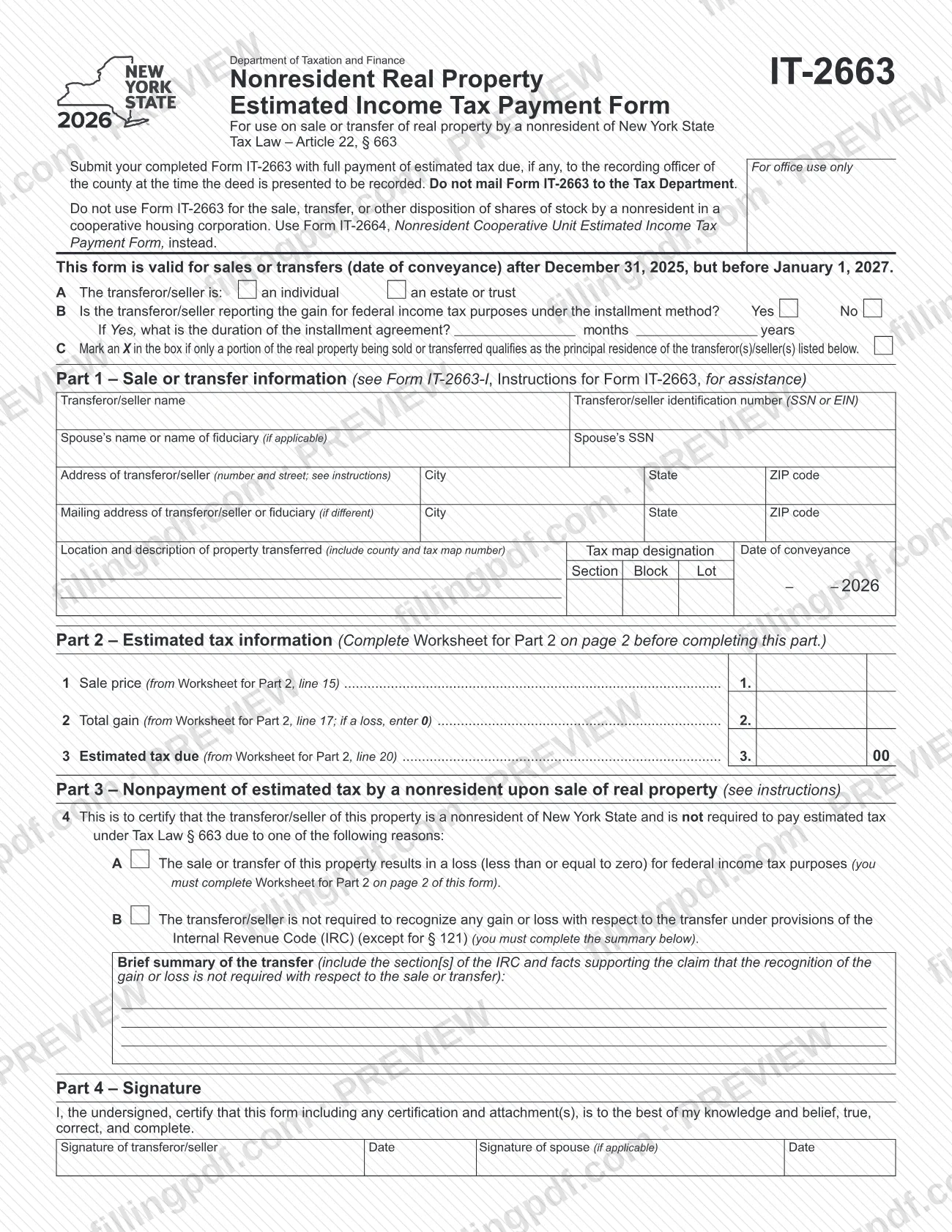
Form IT-2663, Nonresident Real Property Estimated Income Tax Payment Form, is the New York State Department of Taxation and Finance form used on the sale or transfer of real property by a nonresident of New York State to compute the gain or loss and pay the estimated tax due, if any, under Tax Law Article 22, § 663.
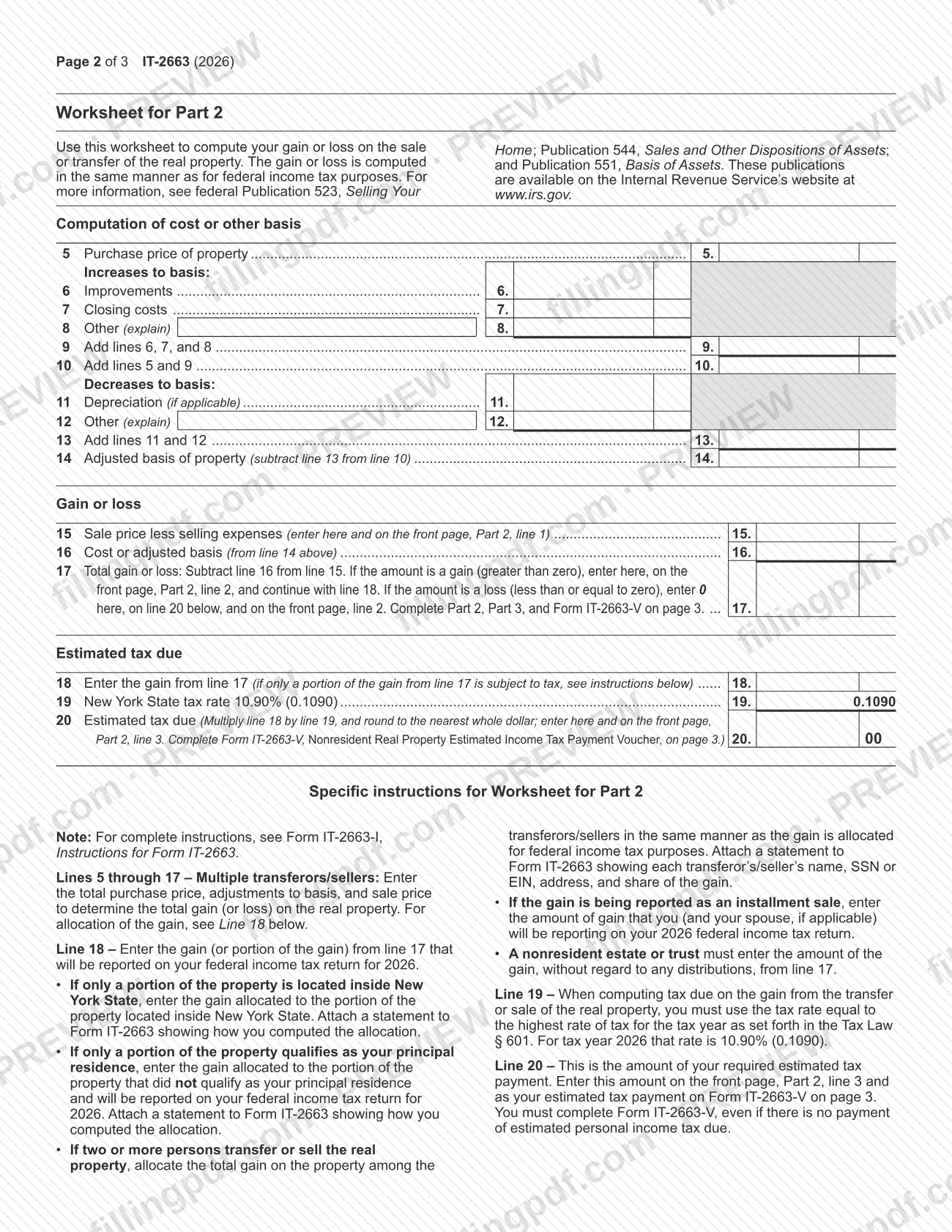
The form has four parts. Part 1 identifies the seller and the property. Part 2 reports the sale price, total gain and estimated tax due, using the Worksheet for Part 2 on page 2, which computes gain or loss the same way as for federal income tax. Part 3 is a certification that no estimated tax is due because the sale produced a loss or because no gain or loss must be recognized under the Internal Revenue Code. Part 4 is the signature.
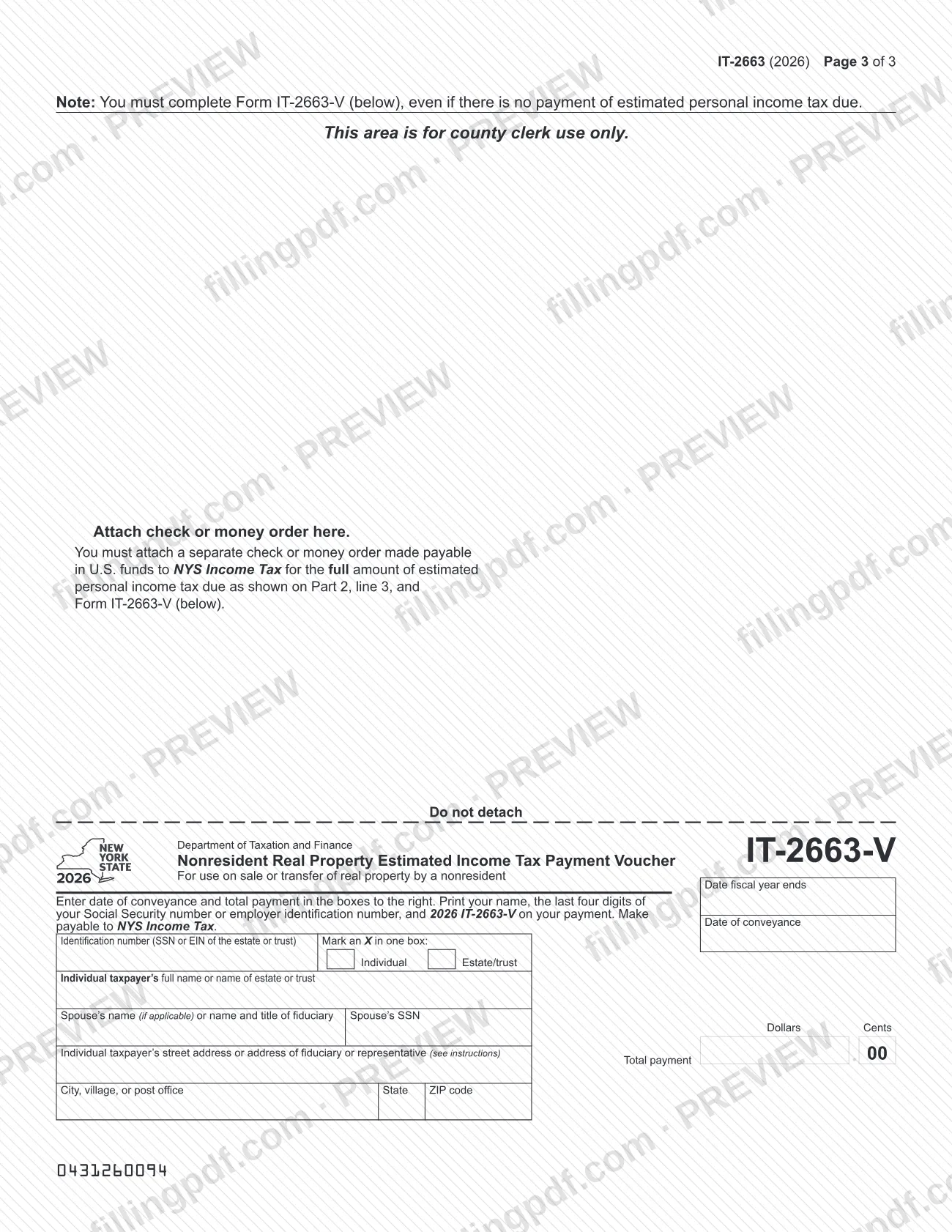
Page 3 holds Form IT-2663-V, the Nonresident Real Property Estimated Income Tax Payment Voucher, which stays attached to the form and must be completed even when no payment is due. The instructions are published as Form IT-2663-I.
This form is not for shares of stock in a cooperative housing corporation: Form IT-2664, Nonresident Cooperative Unit Estimated Income Tax Payment Form, is used for those. Claims of exemption from the payment are made on Form TP-584, Schedule D (or Form TP-584-NYC for certain New York City conveyances).
Who needs to file IT-2663?
Nonresident individuals, estates and trusts that sell or transfer a fee simple interest in New York State real property must use Form IT-2663 to compute the gain or loss and pay the estimated tax due, unless the transfer is exempt. A revocable living trust, or any trust in which an individual is treated as the owner, marks the individual box in item A.
A nonresident is not required to file the form if:
- the property qualifies in total as the seller's principal residence under IRC § 121;
- the seller is a mortgagor conveying the mortgaged property to a mortgagee in foreclosure or in lieu of foreclosure with no additional consideration; or
- the transferor or transferee is one of the agencies, authorities or entities named in Tax Law § 663(c)(3), such as a U.S. or New York State agency, Fannie Mae, Freddie Mac, Ginnie Mae or a private mortgage insurance company.
Residents of New York State at the time of the sale are not subject to the estimated tax requirement. If only part of the property is your principal residence, you still pay on the gain allocable to the rest.
With more than one nonresident seller, each completes a separate form; married couples may file one. An authorized agent with a power of attorney may sign.
When to file IT-2663
Submit Form IT-2663 at the time the deed is presented to the county recording officer to be recorded. This edition is valid only for sales or transfers (date of conveyance) after December 31, 2025, but before January 1, 2027.
File a separate form for each sale or transfer of New York real property, unless the seller is exempt under Tax Law § 663(c). For an installment sale, you pay estimated tax only on the part of the gain you will report on your 2026 federal return; for installment payments received after 2026, use Form IT-2105 or Form IT-2106 instead.
Estimated tax paid with this form cannot be refunded before you file an income tax return; any refund due can be claimed on your 2026 New York State return.
Documents you need
- A separate check or money order in U.S. funds payable to NYS Income Tax for the full estimated tax on Part 2, line 3; required only when tax is due.
- Form IT-2663-V, the payment voucher on page 3; keep it attached to Form IT-2663 even when no payment is due.
- A statement showing each transferor's/seller's name, SSN or EIN, address and share of the gain; attach it when there are multiple transferors/sellers allocating the gain.
- A statement showing how you computed the allocation, when only part of the property is inside New York State.
- A statement showing how you computed the allocation, when only part of the property qualifies as your principal residence.
- A brief summary of the transfer on the form itself, citing the IRC section(s), when you mark box 4B because no gain or loss is recognized.
How to fill out IT-2663
Mark items A, B and C
In item A mark whether the seller is an individual or an estate or trust. In item B mark Yes or No for installment-method reporting and, if Yes, give the duration in months (12 or less) or years. Mark item C only if part of the property qualifies as a principal residence.
Enter seller and spouse details
In Part 1 enter the transferor/seller's name, SSN or EIN, address and any different mailing address. Add the spouse's name and SSN if married and filing one form; for an estate or trust, enter the fiduciary on the second name line.
Describe the property and conveyance date
Enter the location and description of the property, including county and tax map number (Section, Block, Lot) if known. Enter the date of conveyance from Form TP-584, Schedule A.
Compute adjusted basis on the worksheet
On the Worksheet for Part 2, enter the purchase price on line 5 and improvements, closing costs and other increases on lines 6 to 8. Add them on lines 9 and 10, subtract depreciation and other decreases (lines 11 to 13), and enter the adjusted basis on line 14.
Figure total gain or loss
Enter the sale price less selling expenses on line 15 and the adjusted basis on line 16. Subtract line 16 from line 15 on line 17; if it is a loss or zero, enter 0 on line 17, line 20 and front-page line 2.
Calculate the estimated tax due
On line 18 enter the gain reportable on your 2026 federal return, adjusted for any in-state allocation or non-principal-residence portion. Line 19 prints the New York State tax rate; multiply line 18 by it on line 20 and round to the nearest whole dollar.
Complete Part 2 lines 1 to 3
Copy line 15 to Part 2, line 1, line 17 to line 2, and line 20 to line 3. Skip Part 2 and the worksheet if no gain or loss must be recognized, and go to Part 3.
Complete the Part 3 certification
Mark box 4A if the worksheet shows a loss. Mark box 4B if no gain or loss is recognized under the IRC (other than § 121) and write a brief summary citing the IRC section(s) and supporting facts.
Complete voucher Form IT-2663-V
On page 3 enter the date of conveyance, your name, spouse's name or fiduciary, SSN or EIN, address, the Individual or Estate/trust box, and the total payment from Part 2, line 3 (0 if none).
Review, sign and download the PDF
Sign and date Part 4; both spouses sign if filing one form. Check every entry, then download or print the completed PDF from FillingPDF and submit it to the county recording officer with any payment.
How to submit IT-2663
Form IT-2663 is submitted in person to the recording officer of the county, at the time the deed is presented for recording. Do not mail it to the Tax Department.
- Form and voucher: Submit the completed form with Form IT-2663-V attached. Do not detach the voucher, and complete it even if no payment is due.
- Payment: If tax is due, attach a separate check or money order in U.S. funds payable to NYS Income Tax for the full amount on Part 2, line 3. Print your name, the last four digits of your SSN or EIN, and 2026 IT-2663-V on it. Do not combine it with payment of any other tax or fee.
- Several sellers: Each nonresident seller submits a separate form and, if tax is due, a separate check or money order. Married couples may use one form and one payment.
- Returned payments: The instructions state that a fee applies when a payment is returned by a bank; ask the Department for the current amount.
For help, visit www.tax.ny.gov or call the Personal Income Tax Information Center at 518-457-5181. FillingPDF lets you fill out and download the PDF; submission follows the channels above.
Common mistakes to avoid
- Mailing Form IT-2663 to the Tax Department; it goes to the county recording officer when the deed is presented for recording.
- Detaching Form IT-2663-V from the form, or skipping the voucher because no tax is due; it must be completed either way.
- Combining the estimated tax payment with another tax or fee in one check; it must be a separate check or money order payable to NYS Income Tax.
- Using Form IT-2663 for shares of stock in a cooperative housing corporation instead of Form IT-2664.
- Leaving off the spouse's name and entire SSN when a married couple files one form, which may leave payments uncredited.
- Giving only a PO Box as the mailing address; the instructions say to include the street address too.
- Entering the full gain when only part of it is reportable in 2026, is allocable to property inside New York, or is not principal residence, without attaching the allocation statement.
- Using an out-of-range conveyance date; this 2026 form applies only to dates after December 31, 2025, but before January 1, 2027.
- Entering a gain on line 2 when the worksheet shows a loss; enter 0 and complete Part 3, box 4A.
Frequently asked questions
What is Form IT-2663 used for?
IT-2663 is the New York form on which a nonresident individual, estate or trust computes the gain or loss on selling New York real property and pays the estimated income tax due, if any. It also lets the seller certify that no tax is due because of a loss or an unrecognized gain.
Where do I send Form IT-2663?
Submit it, with full payment if any is due, to the recording officer of the county when the deed is presented to be recorded. The form says not to mail it to the Tax Department. Keep the payment voucher, Form IT-2663-V, attached.
Do I need to file IT-2663 if I sold my principal residence?
Not if the property qualifies in total as your principal residence under IRC § 121, even if part of the gain exceeds the exclusion. If only a portion qualifies, estimated tax is required on the gain from the rest, and you mark item C.
What do I do if there is no tax due on my sale?
Still complete the form and Form IT-2663-V, entering 0 where tax would be due, and complete Part 3. Mark box 4A for a loss or box 4B if no gain or loss is recognized under the IRC, with a brief summary of the transfer.
Can I pay the IT-2663 estimated tax with a check?
Yes. Attach a separate check or money order in U.S. funds payable to NYS Income Tax for the amount on Part 2, line 3. Write your name, the last four digits of your SSN or EIN, and 2026 IT-2663-V on it, and do not combine it with other payments.
Can married sellers file one IT-2663?
Yes. Married nonresident couples who sell their interest in New York real property may file one Form IT-2663 with one check or money order, and both spouses sign. Other co-owners must each complete a separate form and payment.
Can I get the estimated tax refunded?
Not right away. Payments made with Form IT-2663 cannot be refunded before you file an income tax return. Take the payment into account on your 2026 New York State return, where any refund due can be claimed.
What is the difference between IT-2663 and IT-2664?
Form IT-2663 covers sales of real property by nonresidents. Form IT-2664, Nonresident Cooperative Unit Estimated Income Tax Payment Form, is used instead for a nonresident's sale or disposition of shares of stock in a cooperative housing corporation.
Can I fill out Form IT-2663 online?
You can fill out the IT-2663 PDF online on FillingPDF and download or print it. FillingPDF is an independent service and does not file the form or accept payment; you submit it to the county recording officer.
Ready to fill out IT-2663?
Fill out IT-2663 now