
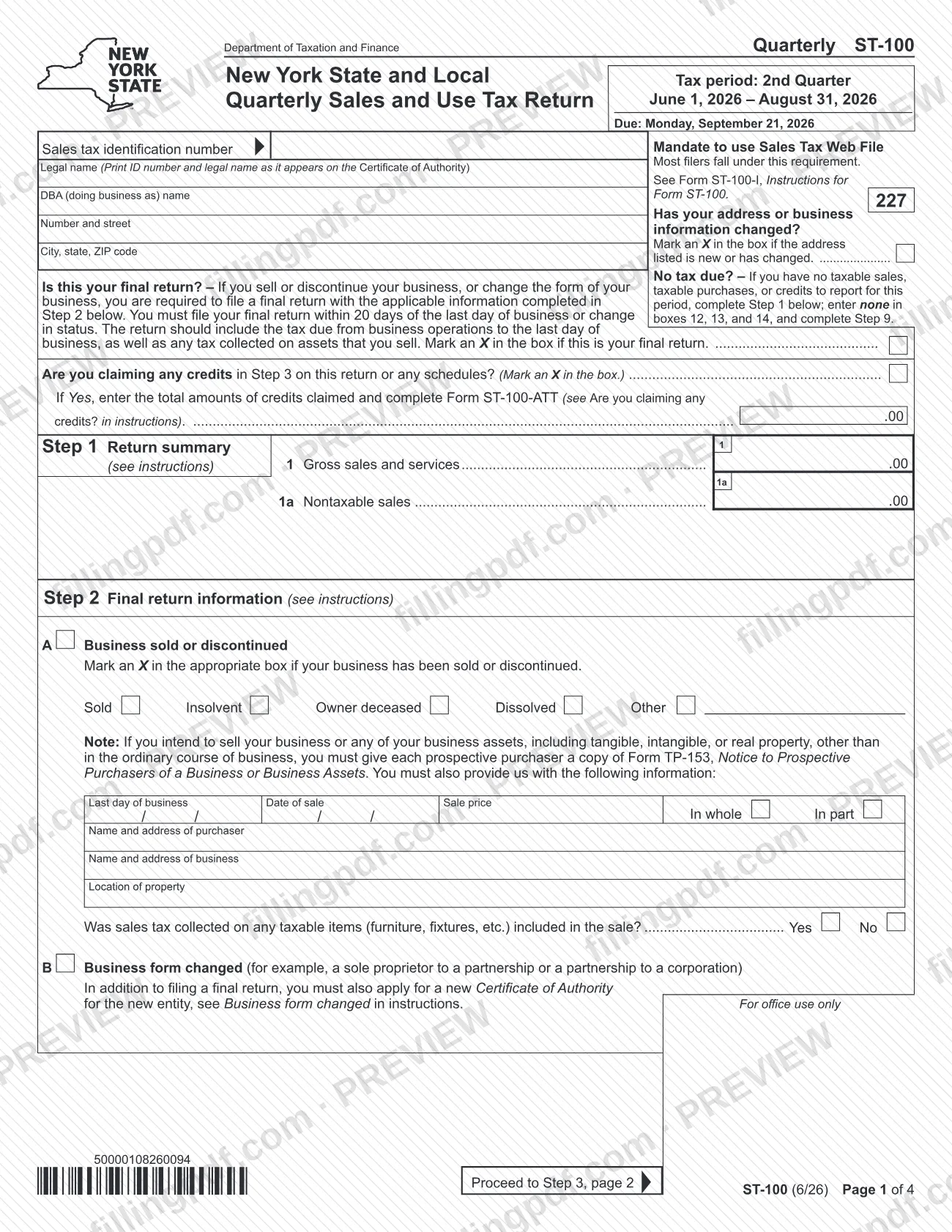
ST-100 is the New York State and Local Quarterly Sales and Use Tax Return, the form the NY Department of Taxation and Finance (DTF) uses to collect sales and use tax from registered businesses each quarter. The edition on this page, ST-100 (6/26), covers the 2nd quarter, June 1, 2026 – August 31, 2026. On this page you can fill out the form online on FillingPDF and download or print the completed PDF; the form, its instructions (Form ST-100-I) and Sales Tax Web File are published by the DTF.
Last updated
What is ST-100?
Form ST-100, New York State and Local Quarterly Sales and Use Tax Return, is the New York State Department of Taxation and Finance (DTF) return on which a business reports its sales, purchases subject to tax, special taxes and fees for a quarter, and figures the amount it owes.
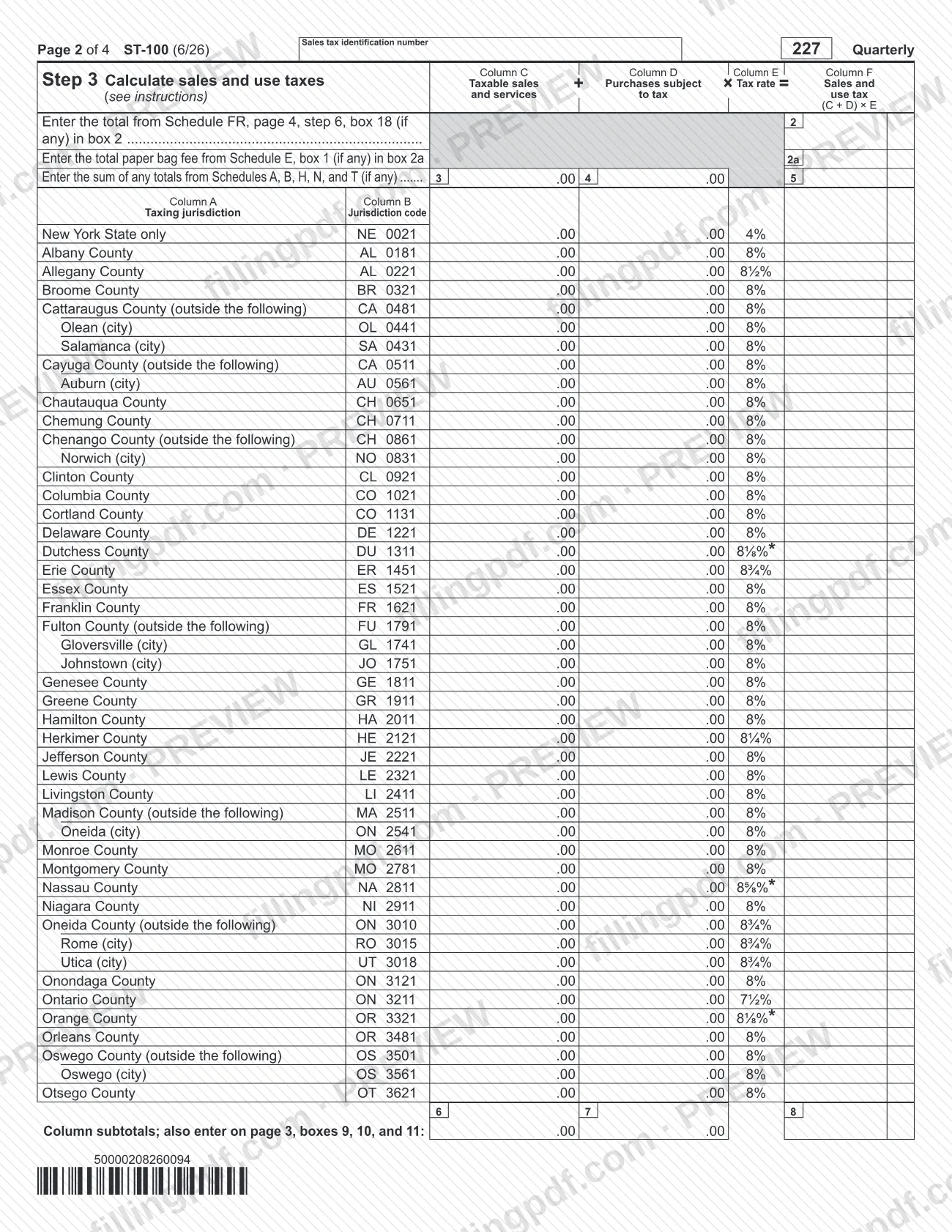
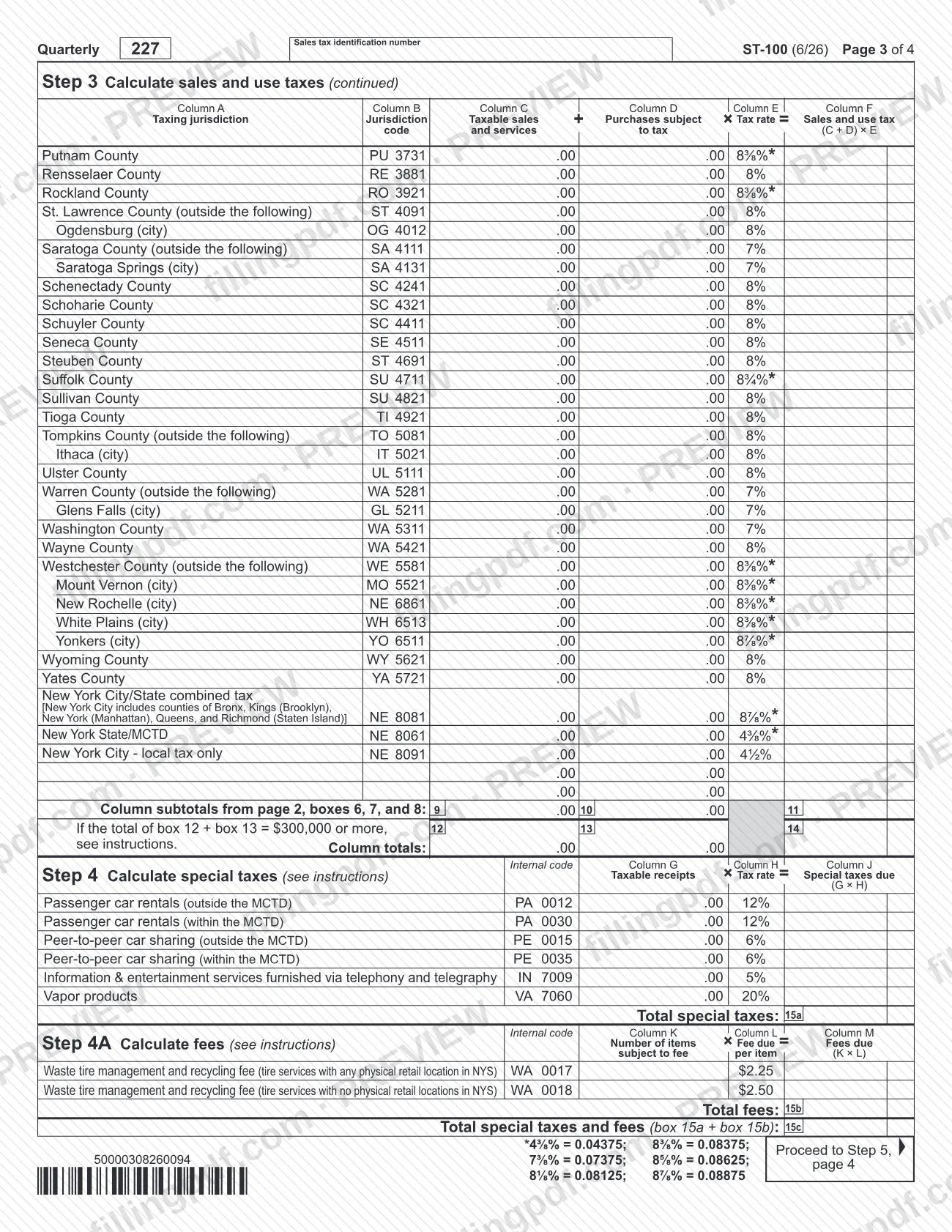
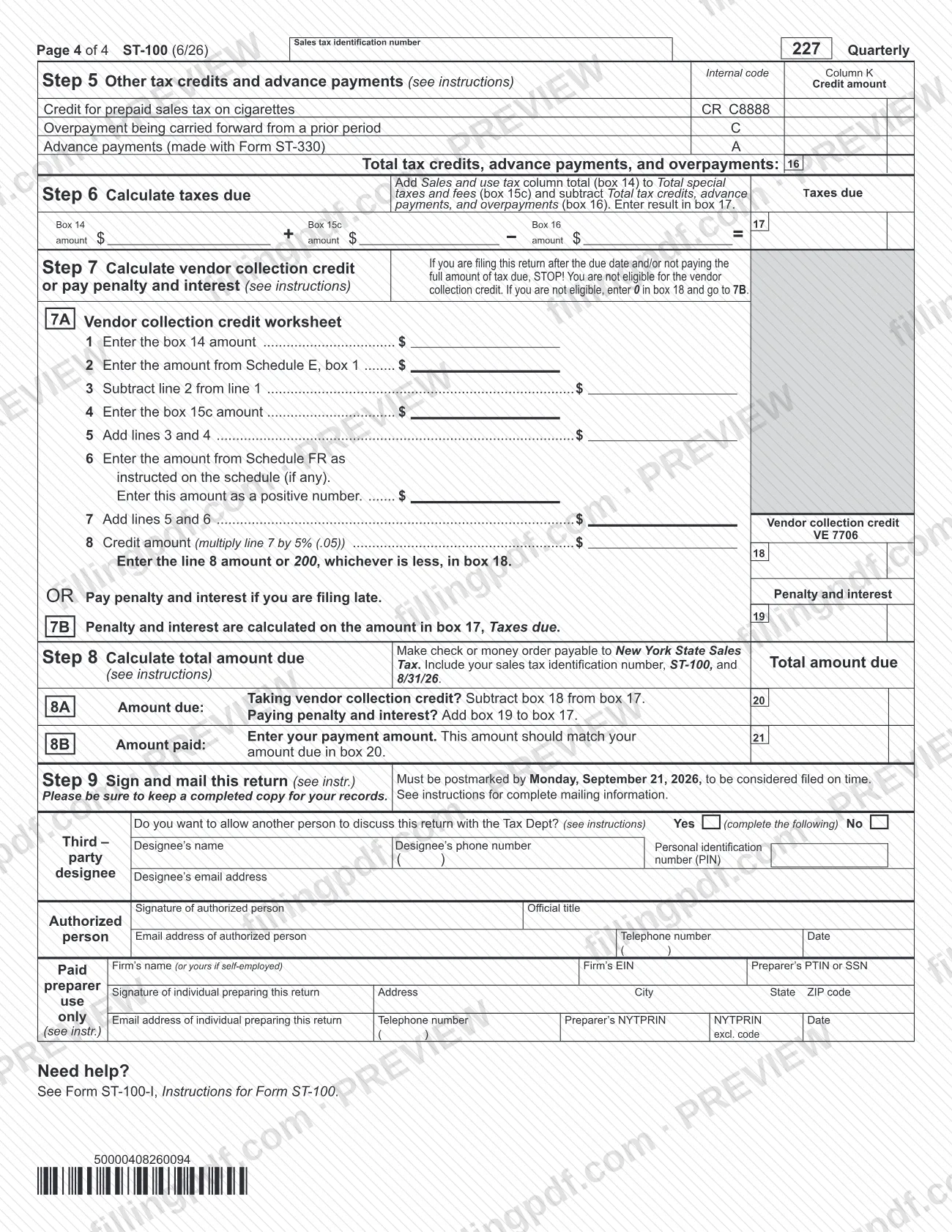
The return is organized in steps. Step 1 is the return summary (gross sales and services, nontaxable sales). Step 2 collects final return information when a business is sold, discontinued or changes form. Step 3 calculates sales and use taxes by taxing jurisdiction, using the jurisdiction code and tax rate printed for each county or city. Step 4 covers special taxes, such as passenger car rentals, peer-to-peer car sharing and vapor products, and Step 4A covers the waste tire management and recycling fee. Step 5 reports tax credits, advance payments and overpayments. Steps 6 to 8 work out the taxes due, the vendor collection credit or penalty and interest, and the total amount due. Step 9 is the signature block.
Totals from Schedules A, B, H, N, T, FR and E carry into the boxes of Step 3, and credits claimed in Step 3 are reported on Form ST-100-ATT. The DTF's Form ST-100-I, Instructions for Form ST-100, explains each box. The form prints a mandate to use Sales Tax Web File, which the DTF says most filers fall under.
Who needs to file ST-100?
Businesses that hold a sales tax identification number and a Certificate of Authority from the DTF and file quarterly use Form ST-100. The form asks for your legal name exactly as it appears on the Certificate of Authority.
- Filers who must use Sales Tax Web File. The DTF says you must Web File your return if you do not use a tax preparer to file, use a computer to prepare, document or calculate your tax forms, and have broadband Internet access. Most filers fall under this requirement.
- Filers who may use the paper form. If you do not meet all three conditions, the DTF directs you to continue with paper Form ST-100.
- Businesses with nothing to report. If you have no taxable sales, taxable purchases or credits for the period, you still complete Step 1 and Step 9 and enter none in boxes 12, 13 and 14.
- Businesses closing, selling or changing form. A business that sells or discontinues, or changes its form (for example, a sole proprietor becoming a partnership), must file a final return. A business whose form changed must also apply for a new Certificate of Authority for the new entity.
Another person may discuss the return with the Tax Department only if you complete the third-party designee section in Step 9.
When to file ST-100
The edition on this page is for the 2nd quarter, June 1, 2026 – August 31, 2026, and is due Monday, September 21, 2026. A paper return must be postmarked by that date to be considered filed on time.
A final return is due within 20 days of the last day of business or change in status. It should include the tax due from business operations to the last day of business, as well as any tax collected on assets that you sell.
Filing late has consequences printed on the form: if you file after the due date or do not pay the full amount of tax due, you are not eligible for the vendor collection credit, and you pay penalty and interest, which are calculated on the amount in box 17, Taxes due. If you have no taxable sales, taxable purchases or credits for the period, the return is still filed on the same schedule.
Documents you need
- Form ST-100-ATT, when you mark Yes to claiming credits in Step 3 on the return or any schedule and enter the total credits claimed.
- Schedule FR, Schedule E and Schedules A, B, H, N and T, only when they apply to you: their totals are entered in boxes 2, 2a and 3 to 5 of Step 3.
- Check or money order payable to New York State Sales Tax, when you pay with the paper return; include your sales tax identification number, ST-100 and 8/31/26.
- Form TP-153, Notice to Prospective Purchasers of a Business or Business Assets, only if you intend to sell your business or business assets outside the ordinary course of business; you give a copy to each prospective purchaser.
How to fill out ST-100
Enter your business identification
Print your sales tax identification number and your legal name as it appears on the Certificate of Authority. Add the DBA name, number and street, and city, state and ZIP code, and mark an X if the address is new or has changed.
Answer the final return and credit questions
Mark an X if this is your final return. Mark an X if you are claiming credits in Step 3; if so, enter the total credits claimed and complete Form ST-100-ATT.
Complete the Step 1 return summary
Enter gross sales and services in box 1 and nontaxable sales in box 1a. If you have no taxable sales, taxable purchases or credits, enter none in boxes 12, 13 and 14 and go to Step 9.
Fill in Step 2 for final returns
Only if your business was sold or discontinued, mark Sold, Insolvent, Owner deceased, Dissolved or Other, and give the last day of business, sale details and whether sales tax was collected on items included in the sale. If the business form changed, mark section B.
Calculate sales and use taxes in Step 3
For each taxing jurisdiction where you made sales, enter taxable sales and services in Column C and purchases subject to tax in Column D, then compute (C + D) × the printed rate in Column F. Enter Schedule FR, Schedule E and Schedule A, B, H, N and T totals in boxes 2, 2a and 3 to 5.
Total the Step 3 columns
Carry the page 2 subtotals from boxes 6, 7 and 8 to boxes 9, 10 and 11 on page 3, add the page 3 entries, and enter the column totals in boxes 12, 13 and 14. If boxes 12 and 13 reach the threshold printed on the form, see the instructions.
Report special taxes and fees
In Step 4, enter taxable receipts for each special tax that applies and total them in box 15a. In Step 4A, enter the number of items subject to the waste tire fee in box 15b. Add them in box 15c.
Enter credits and advance payments
In Step 5, enter the credit for prepaid sales tax on cigarettes, any overpayment carried forward from a prior period and any advance payments made with Form ST-330. Total them in box 16.
Calculate the taxes due
In Step 6, add box 14 and box 15c, subtract box 16, and enter the result in box 17.
Choose vendor credit or pay penalty
If you are on time and paying in full, complete the Step 7A worksheet and enter the result in box 18; otherwise enter 0 in box 18. If you are filing late, enter the penalty and interest in box 19.
Figure the total amount due
In Step 8A, subtract box 18 from box 17 if taking the vendor collection credit, or add box 19 to box 17 if paying penalty and interest, and enter the result in box 20. Enter your payment in box 21; it should match box 20.
Review, sign and download the PDF
In Step 9, complete the third-party designee section if you want another person to discuss the return, then have the authorized person sign and date it; a paid preparer completes the preparer block. Download or print the completed PDF from FillingPDF and keep a copy.
How to submit ST-100
You can file Form ST-100 through Sales Tax Web File online or by mailing the paper return.
- Sales Tax Web File (online). Log in to, or create, an Online Services account on the DTF website at https://www.tax.ny.gov/bus/ads/webst100.htm. The DTF describes Web File as free, with automatic calculation of amounts due, current taxing jurisdiction information, scheduled payments up to the due date and instant filing confirmation. Filers who meet the e-file mandate conditions must use it.
- By mail. Sign the return in Step 9 and mail it so that it is postmarked by Monday, September 21, 2026. The form does not print the mailing address; it refers you to the complete mailing information in Form ST-100-I, Instructions for Form ST-100.
- Payment with a paper return. Make your check or money order payable to New York State Sales Tax, and include your sales tax identification number, ST-100 and 8/31/26. The amount you pay in box 21 should match the amount due in box 20.
Keep a completed copy for your records. FillingPDF lets you fill out and download the PDF; submission follows the DTF channels above.
Common mistakes to avoid
- Mailing the paper return so that it is postmarked after Monday, September 21, 2026, which means it is not considered filed on time.
- Using the paper form when you meet all Web File conditions (no tax preparer, computer-prepared forms, broadband access), since the DTF says you must Web File.
- Entering a legal name that differs from the one on the Certificate of Authority; the form asks for that name and ID number.
- Taking the vendor collection credit on a late return or when not paying the full amount due; the form says to enter 0 in box 18 in that case.
- Marking that you are claiming credits in Step 3 without entering the total credits and completing Form ST-100-ATT.
- Skipping Step 9 on a no-tax-due return; you complete Step 1, enter none in boxes 12, 13 and 14, and still sign Step 9.
- Filing a final return later than 20 days after the last day of business or change in status.
- Changing business form without also applying for a new Certificate of Authority for the new entity.
- Writing a payment amount in box 21 that does not match the amount due in box 20.
Frequently asked questions
What is Form ST-100 used for?
Form ST-100 is the New York State and Local Quarterly Sales and Use Tax Return. Registered businesses use it to report taxable sales and purchases by taxing jurisdiction, special taxes and fees, credits, and the total amount due for the quarter.
When is the ST-100 due for June 1 – August 31, 2026?
It is due Monday, September 21, 2026. A paper return must be postmarked by that date to be considered filed on time. A final return is due within 20 days of the last day of business or change in status.
Do I have to use Sales Tax Web File instead of paper?
Yes, if you do not use a tax preparer to file, use a computer to prepare or calculate your tax forms, and have broadband Internet access. If you do not meet those conditions, the DTF says to continue with paper Form ST-100.
What do I do on the ST-100 if I have no tax due?
Complete Step 1 and Step 9. If you have no taxable sales, taxable purchases or credits to report for the period, enter none in boxes 12, 13 and 14. The form directs you to Form ST-100-I for details.
Who is eligible for the vendor collection credit?
Only filers who file on time and pay the full tax due. The form says that if you file after the due date or do not pay the full amount, you are not eligible, and you enter 0 in box 18. The Step 7A worksheet figures the credit.
How do I pay when I mail the ST-100?
Make a check or money order payable to New York State Sales Tax and include your sales tax identification number, ST-100 and 8/31/26. The payment in box 21 should match the amount due in box 20.
How do I file a final ST-100 if I sell my business?
Mark the final return box, complete Step 2 and file within 20 days of the last day of business or change in status. The return includes tax due to the last day of business and tax collected on assets you sell.
Can I fill out the ST-100 online on FillingPDF?
You can fill out the PDF online on FillingPDF and download or print it. FillingPDF does not file the return or accept payment; you file through Sales Tax Web File or by mail, following the DTF's channels.
Ready to fill out ST-100?
Fill out ST-100 now