
ST-120.1 is the Contractor Exempt Purchase Certificate issued by the New York State Department of Taxation and Finance (the Tax Department). A contractor registered for sales tax gives it to a vendor, or to a subcontractor for services, to buy qualifying property or services for one project without paying New York State and local sales and use tax. On FillingPDF you can fill out the form online and download or print the completed PDF. The official PDF and its instructions are published by the Tax Department.
Last updated
What is ST-120.1?
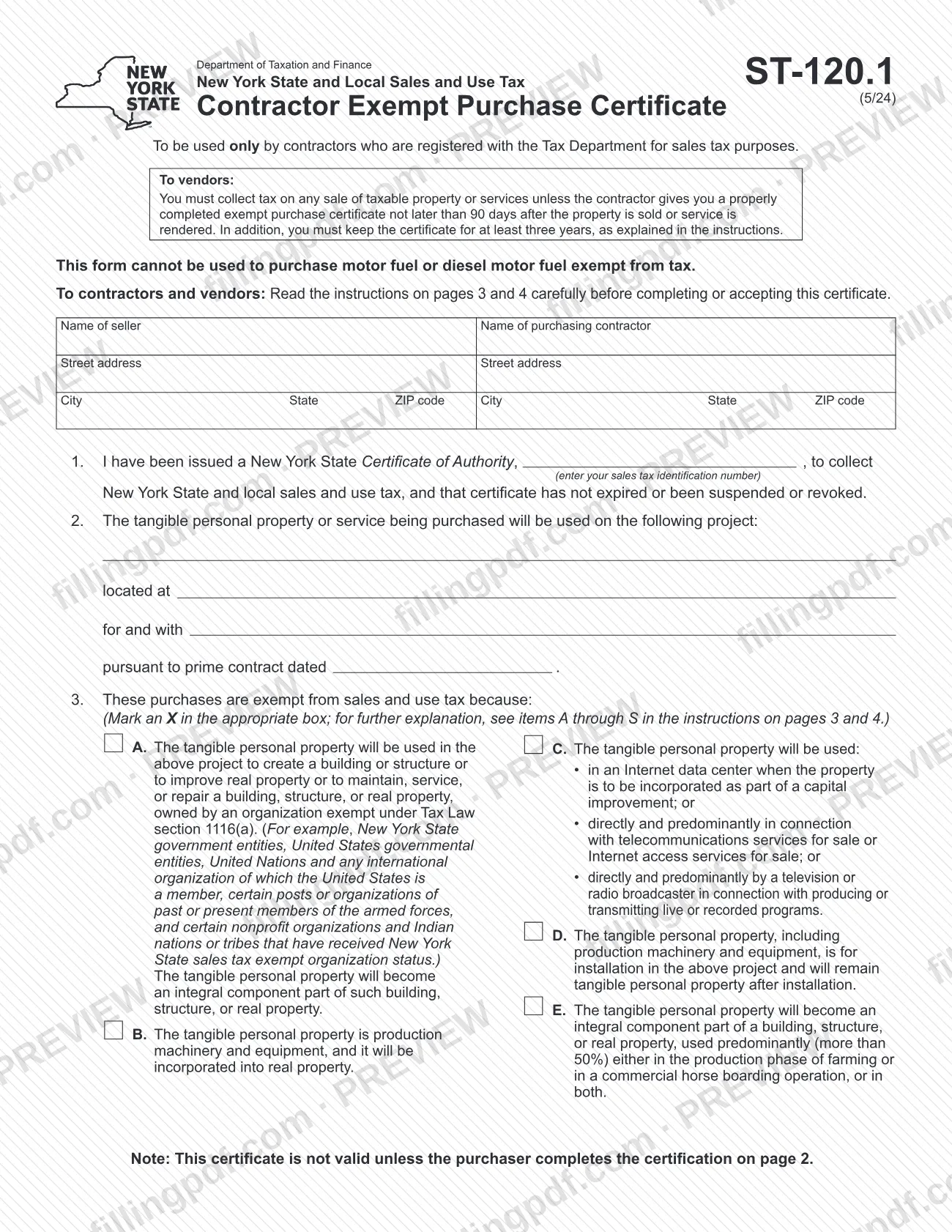
Form ST-120.1, Contractor Exempt Purchase Certificate, is the New York State and Local Sales and Use Tax certificate that a registered contractor gives a vendor or subcontractor to buy tangible personal property or services for a specific project without paying sales or use tax.
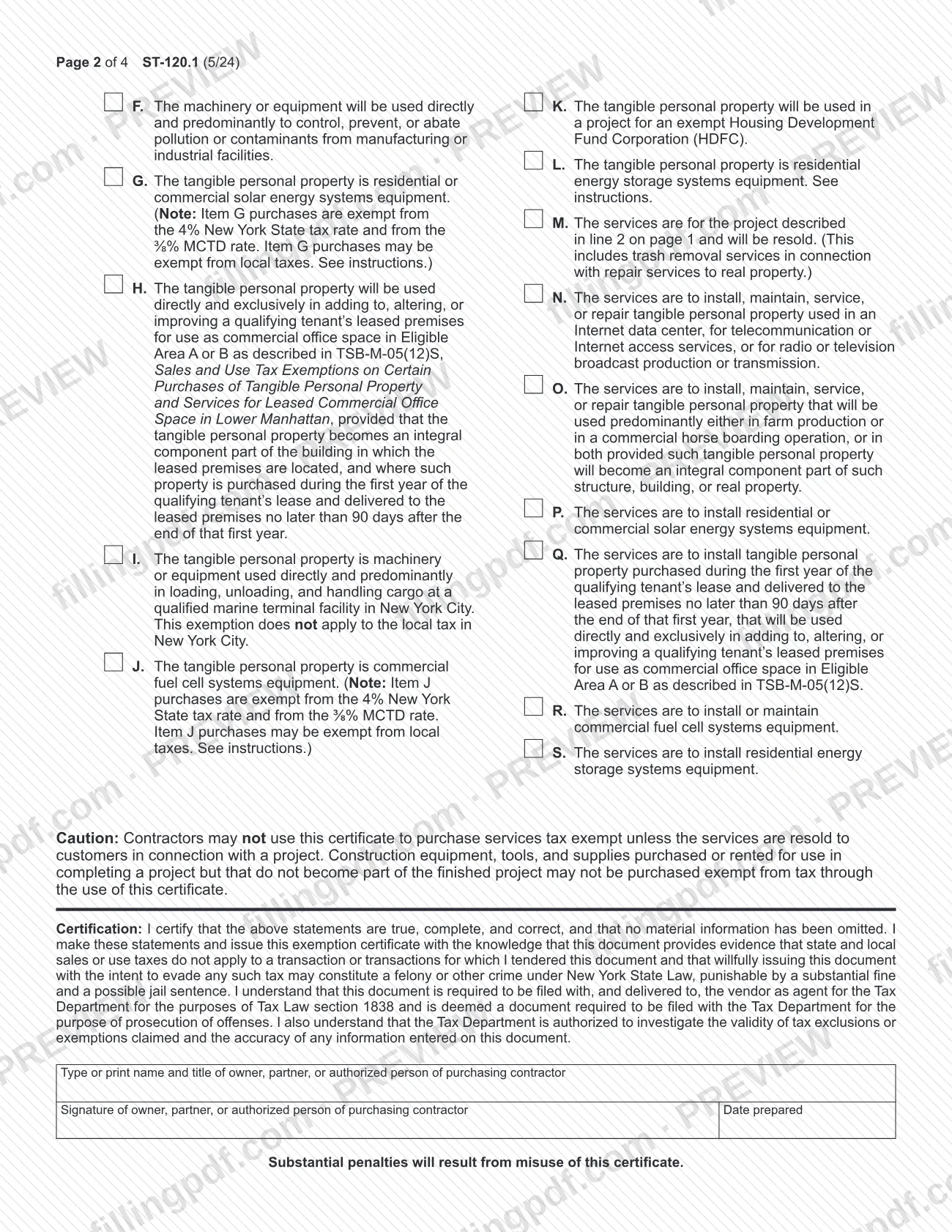
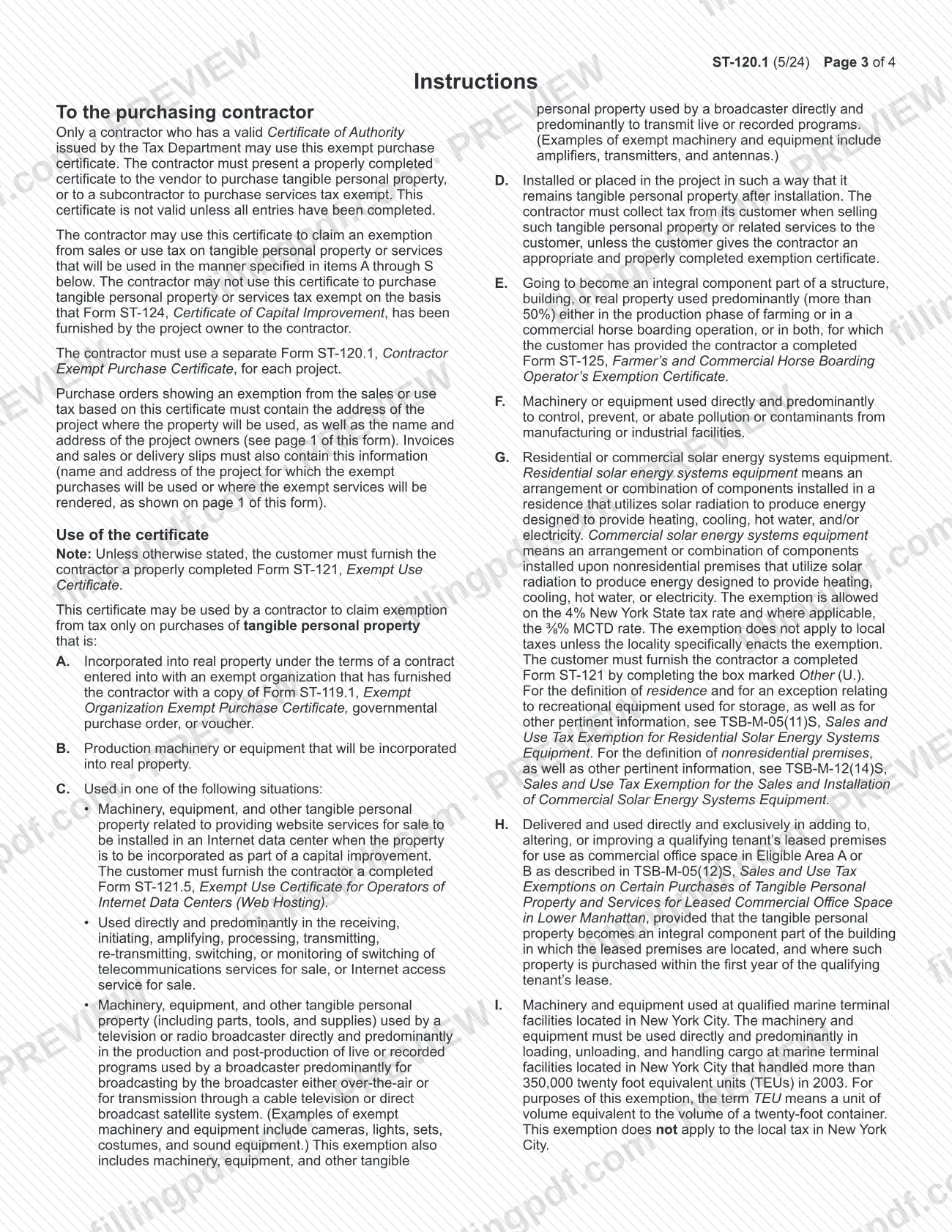
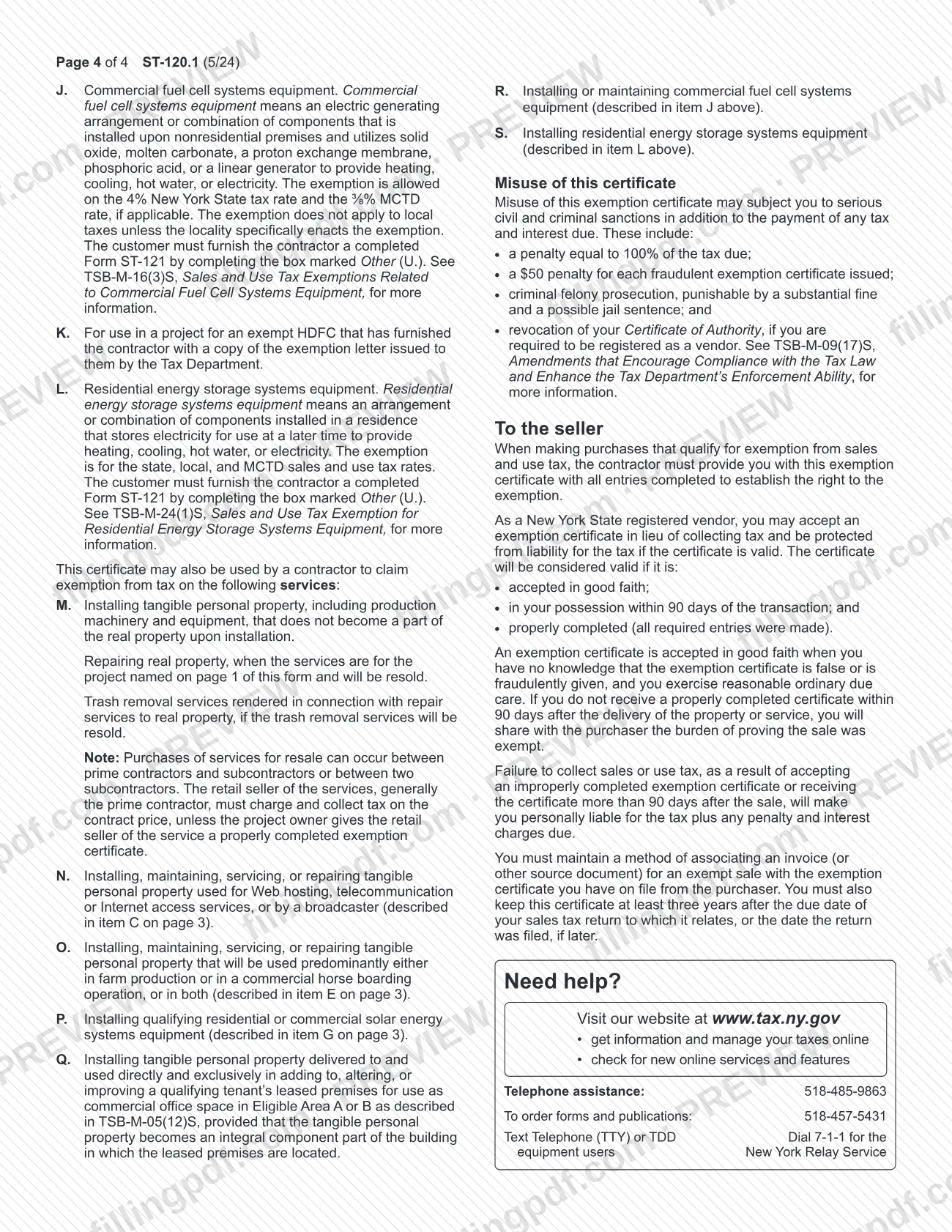
The Tax Department prints it for use only by contractors registered with it for sales tax purposes. The contractor states a Certificate of Authority number, describes the project (its location, the owner, and the prime contract date) and marks the box for the reason the purchase is exempt. Those reasons are items A through S, explained in the instructions on pages 3 and 4. Items A through L cover tangible personal property, for example property incorporated into real property for an exempt organization, production machinery and equipment, solar energy systems equipment, or equipment for an exempt Housing Development Fund Corporation (HDFC). Items M through S cover services, such as services that will be resold or the installation of qualifying equipment.
The certificate is evidence for the vendor. A vendor that accepts a valid certificate in good faith is protected from liability for the tax. A separate ST-120.1 is required for each project.
It is not a general-purpose exemption. The form says it cannot be used to buy motor fuel or diesel motor fuel exempt from tax, and a contractor may not use it on the basis of Form ST-124, Certificate of Capital Improvement, furnished by a project owner.
Who needs to file ST-120.1?
Contractors who hold a valid New York State Certificate of Authority and are buying property or services for a project that fits one of items A through S use this certificate. The form is to be used only by contractors registered with the Tax Department for sales tax purposes. The Certificate of Authority must not have expired or been suspended or revoked.
Vendors and subcontractors receive it. A vendor takes it in place of collecting tax on a qualifying sale of tangible personal property. A subcontractor takes it for services, including services purchased between prime contractors and subcontractors or between two subcontractors.
Exclusions in the instructions:
- Contractors may not use it to buy services exempt from tax unless the services are resold to customers in connection with a project.
- Construction equipment, tools and supplies bought or rented for a project but not becoming part of the finished project may not be bought exempt with it.
- It cannot be used to buy exempt motor fuel or diesel motor fuel.
- It cannot be used on the basis of Form ST-124 supplied by the project owner.
The certification must be signed by the owner, partner, or authorized person of the purchasing contractor.
When to file ST-120.1
Complete the certificate before or when you make an exempt purchase, because the vendor must have it within 90 days after the property is sold or the service is rendered. Without a properly completed certificate in that period, the vendor must collect tax on the sale of taxable property or services. A vendor that receives a properly completed certificate more than 90 days after delivery shares with the purchaser the burden of proving the sale was exempt.
You need a new ST-120.1 for each project. The form is not valid unless every entry is completed, including the purchaser's certification on page 2. The form prints no expiration date and no separate filing deadline with the Tax Department; the vendor keeps it on file.
Documents you need
- Form ST-121, Exempt Use Certificate: the customer must furnish it to the contractor unless the instructions state otherwise; the contractor holds it, it is not attached to ST-120.1.
- Form ST-119.1, Exempt Organization Exempt Purchase Certificate, governmental purchase order, or voucher: from the exempt organization, for item A.
- Form ST-121.5, Exempt Use Certificate for Operators of Internet Data Centers (Web Hosting): from the customer, for the Internet data center situation under item C.
- Form ST-125, Farmer's and Commercial Horse Boarding Operator's Exemption Certificate: completed by the customer, for item E.
- Form ST-121 completed in the box marked Other (U.): from the customer, for items G (solar), J (fuel cell) and L (energy storage).
- A copy of the exemption letter issued by the Tax Department to the exempt HDFC: provided by the HDFC, for item K.
How to fill out ST-120.1
Enter seller and contractor details
Fill in the name and street address, city, state and ZIP code of the seller, and of the purchasing contractor. Read the instructions on pages 3 and 4 first.
Enter your Certificate of Authority number
In line 1, enter your sales tax identification number from your New York State Certificate of Authority. The certificate must not have expired or been suspended or revoked.
Describe the project
In line 2, enter the project, its location, the owner it is for and with, and the date of the prime contract. Use a separate ST-120.1 for each project.
Mark the reason for tangible property
In line 3, mark an X in the box for items A through L that matches how the property will be used. Check the matching item in the instructions, for example A for exempt organization contracts or G for solar equipment.
Mark the reason for services
If you are buying services, mark an X in the box for items M through S, such as M for services that will be resold. Do not use the form to buy services that will not be resold in connection with a project.
Confirm the supporting customer forms
Make sure you hold what the selected item calls for, such as Form ST-121, ST-119.1, ST-121.5 or ST-125, or the HDFC exemption letter, before you present the certificate.
Complete the certification on page 2
Type or print the name and title of the owner, partner, or authorized person of the purchasing contractor. That person signs and enters the date prepared. The certificate is not valid without this certification.
Review, download and deliver
Check that every entry is complete and the project details are right. Download or print the completed PDF from FillingPDF and give it to the vendor as described under How to submit.
How to submit ST-120.1
The contractor delivers the completed certificate to the vendor, or to the subcontractor when buying services. The form says it is required to be filed with, and delivered to, the vendor as agent for the Tax Department. It names no Tax Department mailing address, portal or appointment process.
- To the vendor or subcontractor: give the signed certificate with all entries completed at the time of purchase, and within 90 days of the sale or service at the latest.
- On purchase paperwork: purchase orders showing an exemption based on this certificate must contain the project address and the name and address of the project owners. Invoices and sales or delivery slips must also carry this information.
- Vendor record keeping: the vendor must be able to link each exempt invoice or source document to the certificate on file, and must keep the certificate at least three years after the due date of the sales tax return it relates to, or the date the return was filed, if later.
For help, the Tax Department lists www.tax.ny.gov, telephone assistance at 518-485-9863, forms and publications at 518-457-5431, and TTY/TDD through 7-1-1 (New York Relay Service). FillingPDF lets you fill out and download the PDF; submission follows the channels above.
Common mistakes to avoid
- Using the certificate to buy motor fuel or diesel motor fuel exempt from tax; the form says it cannot be used for that.
- Using one ST-120.1 for several projects; the instructions require a separate certificate for each project.
- Giving the vendor a certificate with blank entries or without the page 2 certification; it is not valid unless all entries are completed.
- Claiming exemption for construction equipment, tools or supplies that do not become part of the finished project.
- Buying services exempt when they will not be resold to customers in connection with a project.
- Basing the exemption on Form ST-124, Certificate of Capital Improvement, from the project owner; the instructions do not allow this.
- Omitting the project address, or the project owner's name and address, on purchase orders, invoices, or sales or delivery slips.
- Delivering the certificate more than 90 days after the sale or service, which leaves the vendor liable and shares the burden of proof with the purchaser.
- Using the certificate without a valid Certificate of Authority, or after it has expired, been suspended or revoked.
Frequently asked questions
What is Form ST-120.1 used for?
Form ST-120.1 is the Contractor Exempt Purchase Certificate. A registered contractor gives it to a vendor to buy qualifying tangible personal property for a project, or to a subcontractor to buy qualifying services, without paying New York State and local sales and use tax.
Who can use the ST-120.1 form?
Only contractors registered with the New York Tax Department for sales tax who hold a valid Certificate of Authority. The certificate must not have expired or been suspended or revoked. Customers and other buyers cannot use this form.
How long does a vendor have to get the certificate?
The vendor must have it within 90 days after the property is sold or the service is rendered. If it arrives later or is not properly completed, the vendor may be personally liable for the tax plus penalty and interest.
Can I use one ST-120.1 for several projects?
No. The instructions require a separate Form ST-120.1 for each project. The project, its location, its owner and the prime contract date go on line 2.
How long must a vendor keep ST-120.1?
At least three years after the due date of the sales tax return it relates to, or the date the return was filed, if later. The vendor must also be able to match each exempt invoice to the certificate on file.
Can I buy motor fuel with ST-120.1?
No. The form states it cannot be used to buy motor fuel or diesel motor fuel exempt from tax. It also cannot be used for construction equipment, tools or supplies that do not become part of the finished project.
What is the difference between ST-120.1 and ST-124?
ST-124 is the Certificate of Capital Improvement, which a project owner gives the contractor. The instructions say a contractor may not use ST-120.1 to buy property or services exempt on the basis of an ST-124.
What are the penalties for misusing ST-120.1?
The instructions list a penalty equal to the tax due, a penalty for each fraudulent certificate issued, possible felony prosecution, and revocation of a Certificate of Authority. Tax and interest are also due. Ask the Tax Department for details.
Can I fill out ST-120.1 online?
You can fill out the PDF online on FillingPDF and download or print it. FillingPDF is an independent service and does not file or deliver the certificate; you give it to your vendor or subcontractor yourself.
Ready to fill out ST-120.1?
Fill out ST-120.1 now