
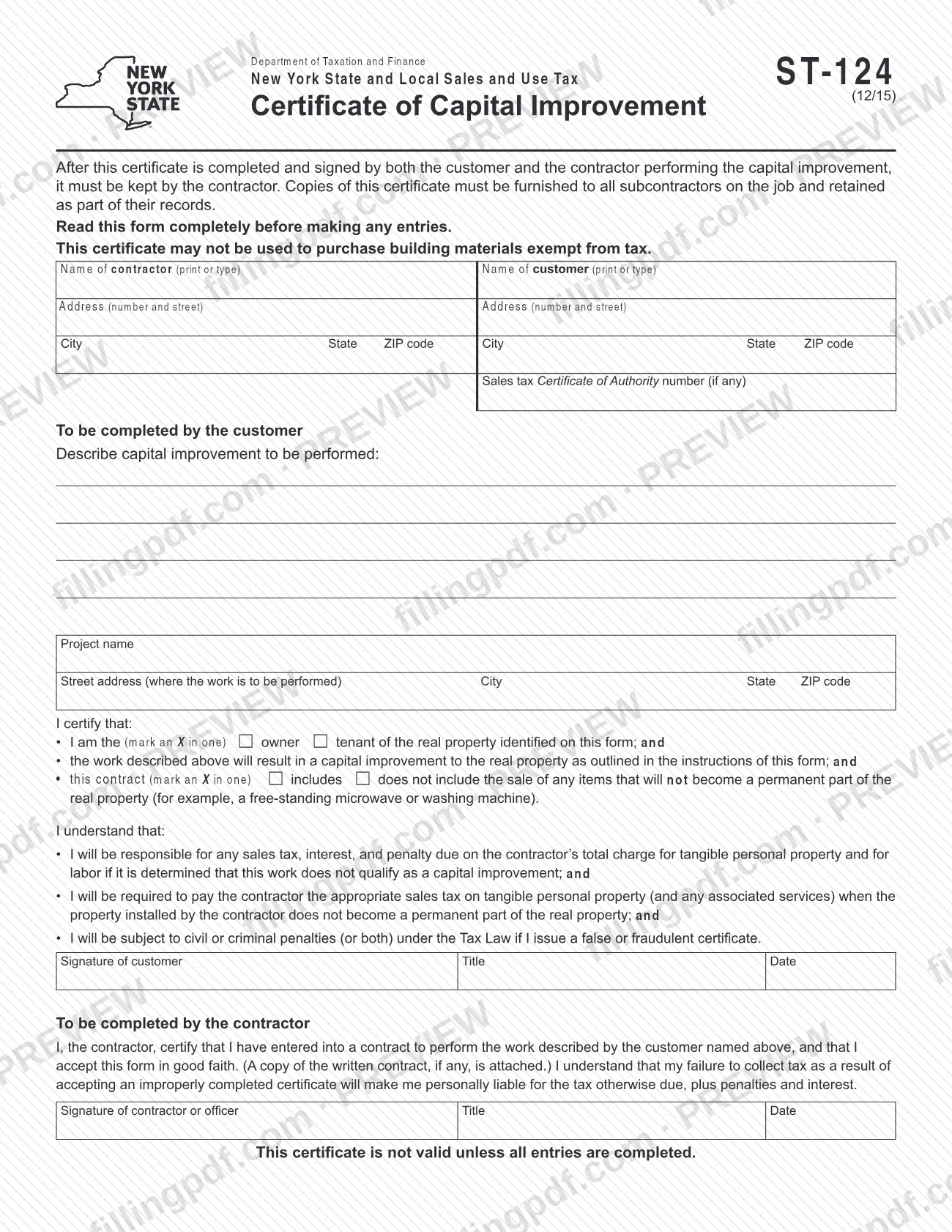
ST-124 is the New York State and Local Sales and Use Tax Certificate of Capital Improvement, issued by the New York State Department of Taxation and Finance. The customer completes it and gives it to the contractor, and it serves as evidence that the work to be performed will result in a capital improvement to real property. On this page you can fill out the form online on FillingPDF and download or print the completed PDF; the form and its instructions are published by the Department at tax.ny.gov.
Last updated
What is ST-124?
Form ST-124, Certificate of Capital Improvement, is the New York State and Local Sales and Use Tax form on which a customer certifies that work a contractor will perform on real property is a capital improvement. When the contractor accepts it in good faith, it is evidence that the work qualifies.
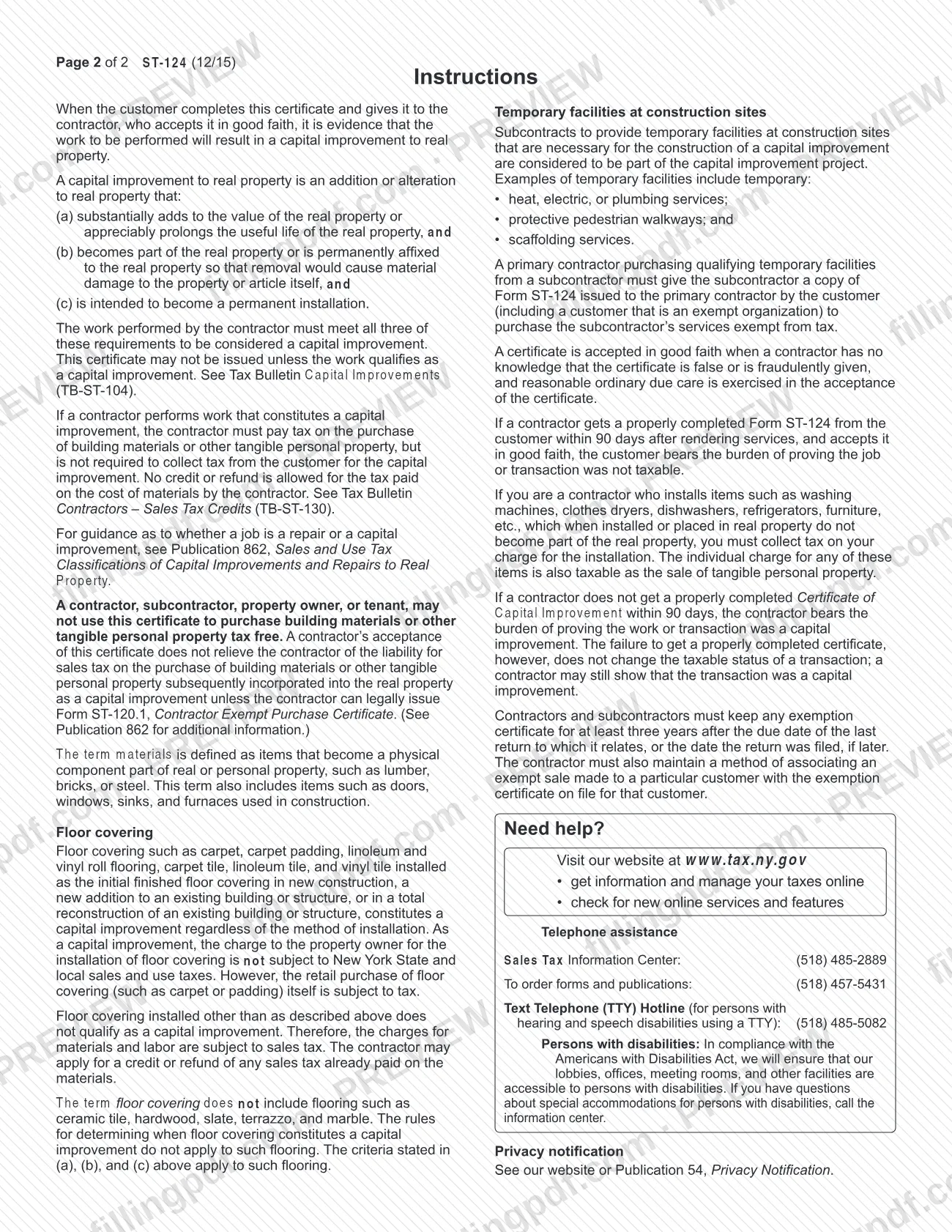
The Department of Taxation and Finance's instructions define a capital improvement as an addition or alteration to real property that (a) substantially adds to its value or appreciably prolongs its useful life, (b) becomes part of the real property or is permanently affixed so that removal would cause material damage, and (c) is intended to become a permanent installation. The work must meet all three requirements. The certificate may not be issued unless the work qualifies.
If the work is a capital improvement, the contractor pays tax on the building materials and other tangible personal property it buys, but does not collect tax from the customer for the capital improvement. The instructions point to Tax Bulletin Capital Improvements (TB-ST-104), Tax Bulletin Contractors – Sales Tax Credits (TB-ST-130) and Publication 862, Sales and Use Tax Classifications of Capital Improvements and Repairs to Real Property.
The form is not a purchase exemption. It may not be used to buy building materials tax free, and it is different from Form ST-120.1, Contractor Exempt Purchase Certificate, which is the separate certificate a contractor may legally use for exempt purchases.
Who needs to file ST-124?
The customer who owns or rents (as tenant) the real property and has a contractor perform work that will be a capital improvement completes the customer section of Form ST-124. The contractor performing the work completes the contractor section and keeps the certificate.
- Customers: an owner or tenant of the real property, including a customer that is an exempt organization, certifies the work, its location and whether the contract includes items that will not become a permanent part of the property.
- Contractors: the contractor signs to accept the form in good faith. A contractor or officer signs for the contractor.
- Subcontractors: they receive copies of the signed certificate and keep them in their records. A primary contractor buying qualifying temporary facilities, such as temporary heat, electric or plumbing services, protective pedestrian walkways or scaffolding, from a subcontractor gives the subcontractor a copy of the ST-124 the customer issued.
Do not use this certificate to buy building materials or other tangible personal property tax free: a contractor, subcontractor, property owner or tenant may not do so. Do not issue it for work that does not qualify as a capital improvement.
When to file ST-124
Complete Form ST-124 when a customer and a contractor enter into a contract for work that will result in a capital improvement. The form sets no filing deadline of its own, but the instructions tie timing to the 90 days after the contractor renders services.
If the contractor gets a properly completed ST-124 from the customer within 90 days after rendering services and accepts it in good faith, the customer bears the burden of proving the job or transaction was not taxable. If the contractor does not get a properly completed certificate within 90 days, the contractor bears the burden of proving the work was a capital improvement. Failing to get a certificate does not change the taxable status of the transaction, and the contractor may still show that it was a capital improvement.
Contractors and subcontractors must keep the certificate for at least three years after the due date of the last return to which it relates, or the date the return was filed, if later.
Documents you need
- A copy of the written contract, if there is one: the contractor section states it is attached to the certificate.
- A copy of the signed ST-124 for each subcontractor on the job: the contractor furnishes it, and subcontractors retain it in their records.
- A copy of the ST-124 issued to the primary contractor by the customer, given by the primary contractor to a subcontractor supplying qualifying temporary facilities, so the subcontractor can sell its services exempt from tax.
How to fill out ST-124
Read the form and instructions
Read Form ST-124 completely before making any entries, including the capital improvement definition on page 2. Confirm that the work meets all three requirements (a), (b) and (c).
Enter contractor and customer names
Print or type the Name of contractor and the Name of customer in the two columns at the top.
Enter both addresses
Under each name, enter the address (number and street), city, state and ZIP code for the contractor and for the customer.
Add the Certificate of Authority number
Enter the contractor's sales tax Certificate of Authority number if it has one; the form marks it as "if any".
Describe the capital improvement
In the customer section, enter the project name, a description of the capital improvement to be performed, and the street address, city, state and ZIP code where the work will be done.
Mark owner or tenant
The customer marks an X in one box to say whether they are the owner or tenant of the real property identified on the form.
Answer the contract items question
Mark an X in one box to show whether the contract includes or does not include the sale of items that will not become a permanent part of the real property.
Sign as the customer
The customer signs and enters their title and the date after reading the certifications and acknowledgments, including the liability for tax, interest and penalty if the work does not qualify.
Complete the contractor certification
The contractor signs and enters the title (contractor or officer) and date, certifying the contract and good-faith acceptance. Attach a copy of the written contract, if any.
Review, download and keep copies
Check that every entry is completed, since the certificate is not valid otherwise. Download or print the completed PDF from FillingPDF; the contractor keeps it and gives copies to subcontractors.
How to submit ST-124
Form ST-124 is not filed with the Department of Taxation and Finance. The customer completes it and gives it to the contractor, and both sign.
- Contractor: after both the customer and the contractor have signed, the contractor must keep the certificate. If there is a written contract, a copy is attached.
- Subcontractors: the contractor furnishes copies of the signed certificate to all subcontractors on the job, and they retain them as part of their records.
- Retention: keep the certificate at least three years after the due date of the last return to which it relates, or the date the return was filed, if later. The contractor must also keep a way of associating an exempt sale to a customer with that customer's certificate on file.
The form prints no mailing address for it. For questions, the Sales Tax Information Center is at (518) 485-2889; to order forms and publications call (518) 457-5431; the TTY hotline is (518) 485-5082. The Department's website is www.tax.ny.gov. FillingPDF lets you fill out and download the PDF; submission follows the channels above.
Common mistakes to avoid
- Leaving any entry blank: the form states the certificate is not valid unless all entries are completed.
- Issuing the certificate for work that is only a repair or does not meet all three capital improvement requirements; it may not be issued unless the work qualifies.
- Using ST-124 to buy building materials or other tangible personal property tax free; a contractor, subcontractor, owner or tenant may not do so.
- Signing by only one party: the certificate must be signed by both the customer and the contractor, and the contractor must keep it.
- Marking the wrong box for items that will not become part of the property, such as a free-standing microwave or washing machine; the customer then owes tax on them.
- Not giving copies to subcontractors, or a primary contractor not passing a copy of the customer's ST-124 to a subcontractor providing qualifying temporary facilities.
- Accepting a certificate the contractor knows is false; acceptance in good faith requires no knowledge of falsity and reasonable ordinary due care.
- Discarding the certificate before the three-year retention period ends after the due date of the last related return.
Frequently asked questions
What is Form ST-124 used for?
Form ST-124 is the New York Certificate of Capital Improvement. A customer completes it and gives it to the contractor to certify that the work will be a capital improvement to real property. Accepted in good faith, it is evidence that the work qualifies, so the contractor does not collect sales tax from the customer.
Who completes and signs the ST-124?
Both parties sign. The customer, an owner or tenant of the property, completes the customer section and signs. The contractor completes the contractor section and signs. The contractor then keeps the certificate and gives copies to all subcontractors on the job.
Can I use ST-124 to buy building materials tax free?
No. The form states it may not be used to purchase building materials exempt from tax, and the instructions say a contractor, subcontractor, owner or tenant may not use it to buy materials or other tangible personal property tax free. Contractors who can legally do so use Form ST-120.1.
What is a capital improvement under the ST-124 instructions?
It is an addition or alteration to real property that substantially adds to its value or appreciably prolongs its useful life, becomes part of or is permanently affixed to the property so removal would cause material damage, and is intended to be permanent. It must meet all three requirements.
How long must a contractor keep Form ST-124?
At least three years after the due date of the last return to which the certificate relates, or the date that return was filed, if later. The contractor must also keep a way to link an exempt sale to a customer with that customer's certificate on file.
What is the 90-day rule on the ST-124?
If the contractor gets a properly completed ST-124 within 90 days after rendering services and accepts it in good faith, the customer must prove the job was not taxable. Without a proper certificate in 90 days, the contractor must prove the work was a capital improvement.
Where do I send Form ST-124?
You do not send it to the Department of Taxation and Finance. The customer gives it to the contractor, who keeps it and furnishes copies to subcontractors. For questions, call the Sales Tax Information Center at (518) 485-2889.
Can I fill out Form ST-124 online on FillingPDF?
Yes. You can fill out the fillable PDF online on FillingPDF and download or print it. FillingPDF is an independent service, not affiliated with the Department, and does not file or store the certificate; the contractor keeps the signed copy.
Ready to fill out ST-124?
Fill out ST-124 now