
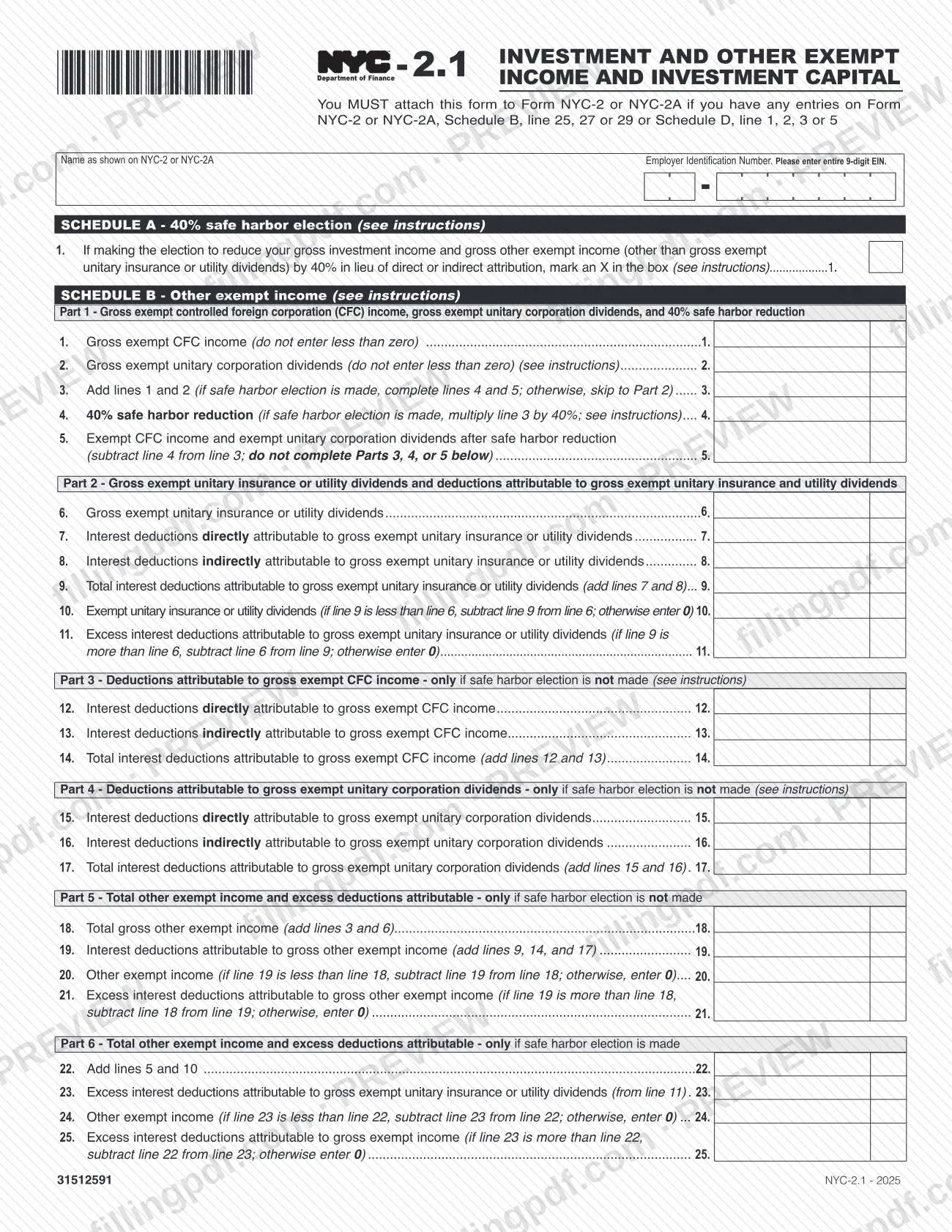
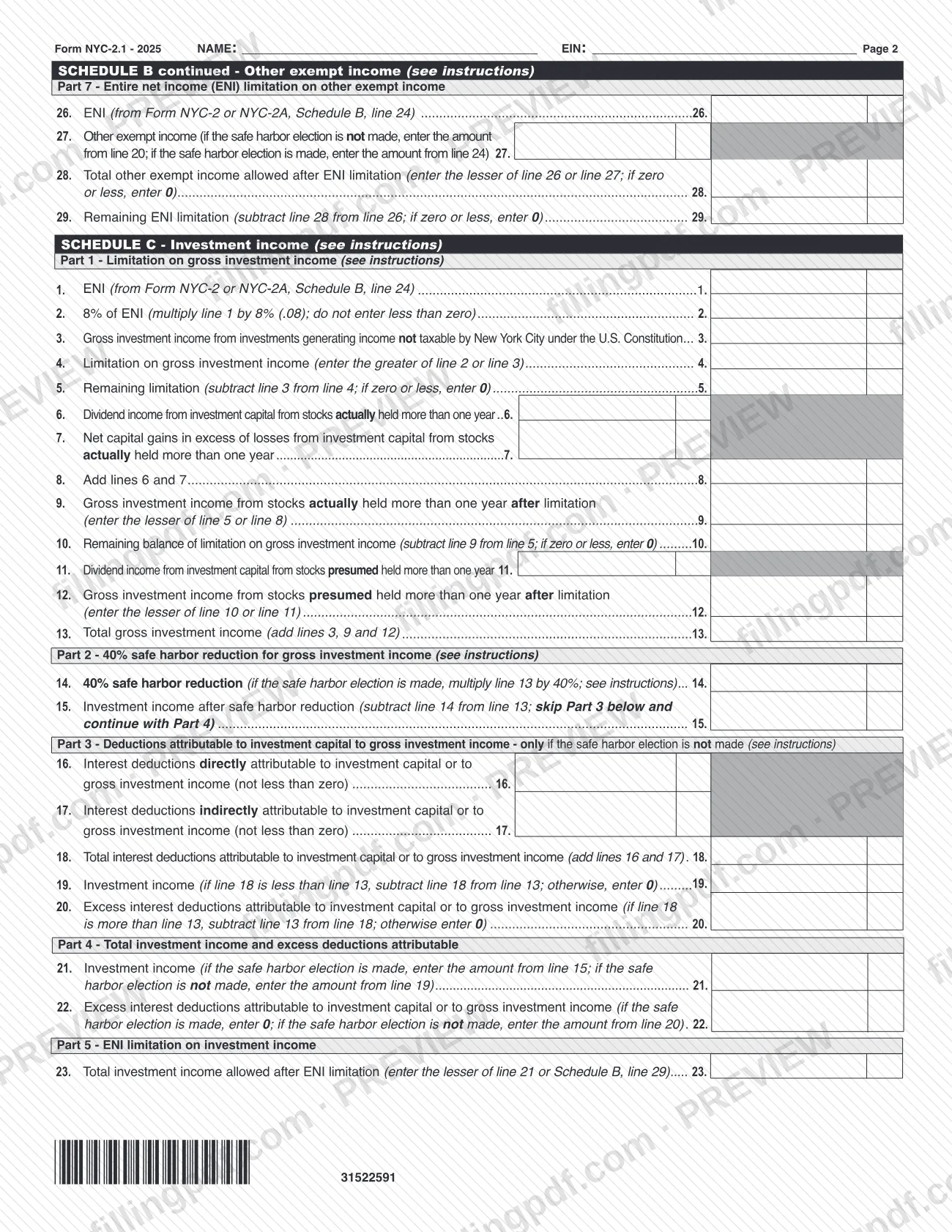
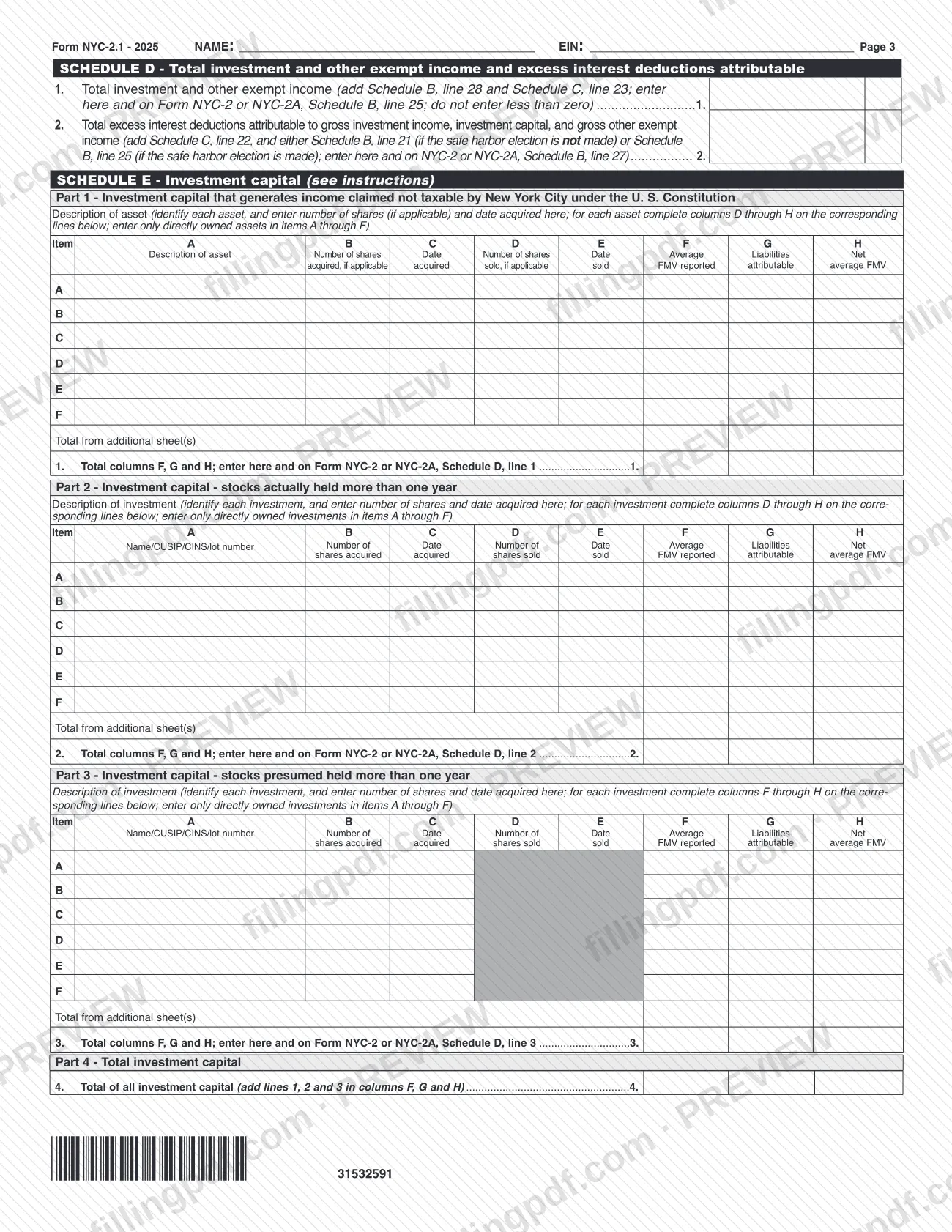
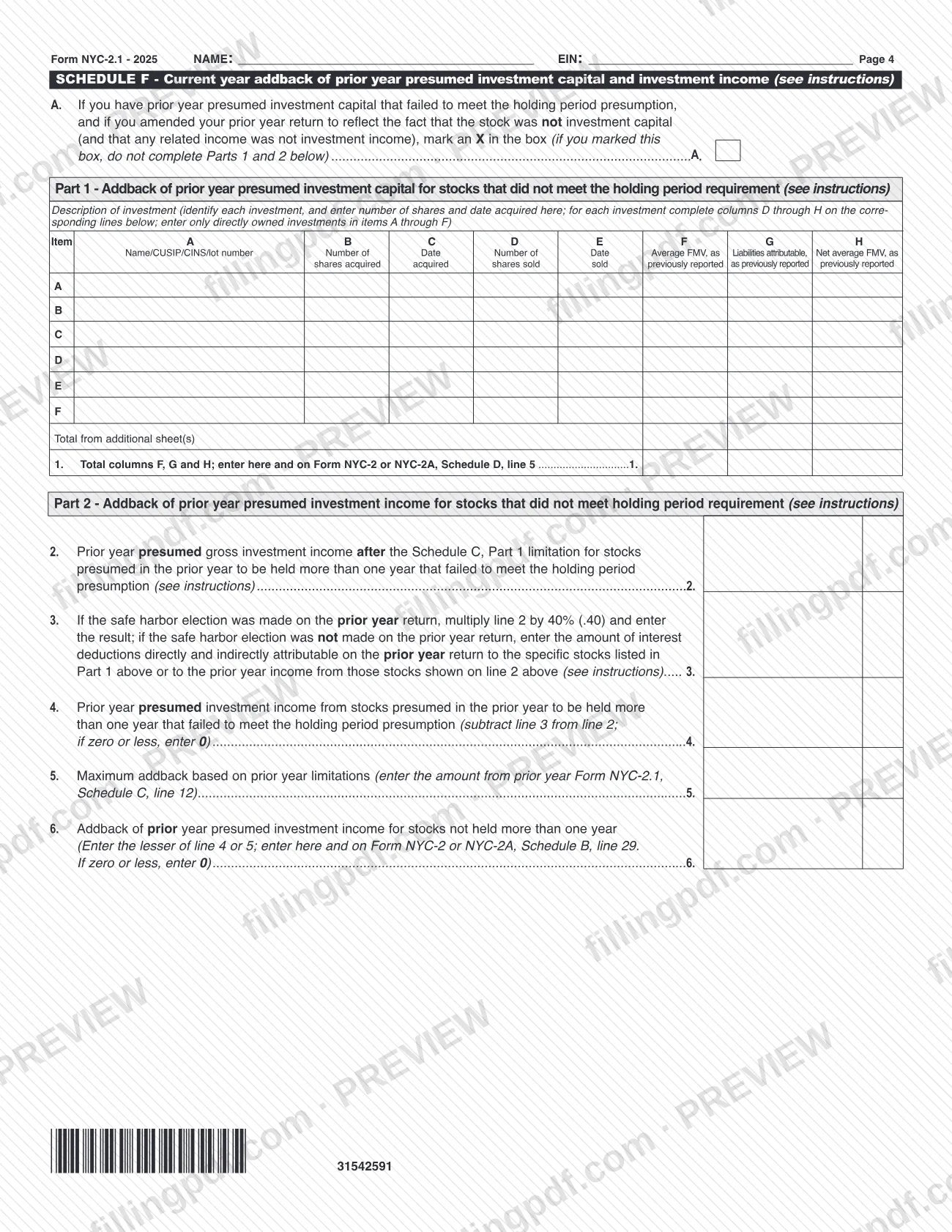
Form NYC-2.1, Investment and Other Exempt Income and Investment Capital, is the schedule the New York City Department of Finance (DOF) requires you to attach to Form NYC-2 or NYC-2A when your business corporation tax return has entries for investment income, other exempt income or investment capital. It breaks down the amounts that feed Schedules B and D of the parent return and carries the optional 40% safe harbor election. On FillingPDF you can fill out the form online and download or print the completed PDF; the official PDF and its instructions are published by DOF, and the schedule is filed with the return.
Last updated
What is NYC-2.1?
Form NYC-2.1, Investment and Other Exempt Income and Investment Capital, is the New York City Department of Finance (DOF) schedule that supplies the detail behind investment income, other exempt income and investment capital reported on Form NYC-2 or NYC-2A under the business corporation tax.
The DOF instructions explain that investment income and other exempt income are subtracted from entire net income (ENI) when business income is computed, and that investment capital is subtracted from total net assets when the capital base is computed. The form has six schedules:
- Schedule A: the revocable 40% safe harbor election, used instead of attributing actual interest deductions.
- Schedule B: other exempt income, meaning exempt controlled foreign corporation (CFC) income and exempt unitary corporation dividends, with the ENI limitation.
- Schedule C: investment income and its limitations.
- Schedule D: the totals that carry to Schedule B of Form NYC-2 or NYC-2A.
- Schedule E: investment capital, listed asset by asset with average fair market value (FMV), attributable liabilities and net average FMV.
- Schedule F: the current-year addback of prior-year presumed investment capital and income for stocks that failed the holding period presumption.
Form NYC-2.1 is not a return and has no tax computation of its own. The parent return is Form NYC-2 or, for combined groups, Form NYC-2A. It belongs to the business corporation tax, not to real property tax.
Who needs to file NYC-2.1?
You must attach Form NYC-2.1 to Form NYC-2 or NYC-2A if you have any entries on Schedule B, line 25, 27 or 29, or on Schedule D, line 1, 2, 3 or 5, of that return. This applies to corporations subject to the business corporation tax.
Further conditions from the DOF instructions:
- You must complete Schedules B and C when you own any assets that could generate other exempt income or investment income, whether or not that income is actually earned in the tax year.
- A combined group files one NYC-2.1 for the group, treated as a single corporation. Enter the legal name and employer identification number (EIN) of the group's designated agent.
- A corporate partner using the aggregate method must include its distributive share of partnership items when computing these amounts.
- Investments held through a partnership go on additional sheets, not in items A through F of Schedule E.
The DOF business corporation tax page states that federal S corporations are not subject to this tax, so this schedule does not accompany their returns. Stocks in unitary corporations, in corporations in your combined return, or issued by you are not investment capital.
When to file NYC-2.1
Form NYC-2.1 is due whenever you file Form NYC-2 or NYC-2A with entries on Schedule B, line 25, 27 or 29, or Schedule D, line 1, 2, 3 or 5. It has no separate due date: it travels with the return and follows the return's deadline.
DOF's business corporation tax page describes Form NYC-EXT, which gives an automatic six-month extension for business income tax returns when it is filed on or before the original due date and the tax was estimated correctly and paid. Check that page for the filing dates that apply to your tax year.
Two timing rules are specific to this schedule. The 40% safe harbor election is revocable, and you revoke it by filing an amended return using actual attribution. Stock presumed to be held more than one year must be added back in the immediately succeeding tax year, on Schedule F, if it does not meet the holding period; instead you may amend the prior-year return and mark the box on Schedule F, line A.
Documents you need
- Form NYC-2 or Form NYC-2A: Form NYC-2.1 must be attached to it whenever Schedule B line 25, 27 or 29 or Schedule D line 1, 2, 3 or 5 has an entry.
- Additional sheets in the same format as Schedule E, Parts 1 to 3, if you need more space for investment capital items; add their amounts to the "Total from additional sheet(s)" line.
- Additional sheets in the same format as Schedule F, Part 1, if you need more space for prior-year presumed investment capital items.
- For investments owned through a partnership: additional sheets listing the name and EIN of each partnership and your proportionate share of columns A through H.
- Your prior-year Form NYC-2.1: Schedule F asks for information as previously reported on it, and columns other than D and E must match what you reported.
How to fill out NYC-2.1
Enter your name and EIN
At the top, enter the name as shown on Form NYC-2 or NYC-2A and your entire 9-digit EIN. For a combined return, enter the legal name and EIN of the group's designated agent.
Decide on the safe harbor election
On Schedule A, line 1, mark an X in the box only if you elect to reduce gross investment income and gross other exempt income by 40% instead of attributing actual interest deductions. The election is revocable and does not apply to gross exempt unitary insurance or utility dividends.
Enter gross exempt income in Schedule B, Part 1
On line 1 enter gross exempt CFC income and on line 2 gross exempt unitary corporation dividends, neither less than zero; add them on line 3. If you made the safe harbor election, multiply line 3 by 40% on line 4 and subtract it on line 5.
Complete Schedule B, Part 2
Enter gross exempt unitary insurance or utility dividends on line 6 and the directly and indirectly attributable interest deductions on lines 7 and 8; add them on line 9. Lines 10 and 11 give the exempt dividends or the excess deductions.
Complete the attribution parts that apply
If you did not make the safe harbor election, complete Parts 3 and 4 (lines 12 to 17) and Part 5 (lines 18 to 21). If you did, complete Part 6 (lines 22 to 25) instead.
Apply the ENI limitation in Part 7
Enter ENI from Form NYC-2 or NYC-2A, Schedule B, line 24 on line 26 and your other exempt income on line 27 (from line 20 or line 24, depending on the election). Line 28 is the lesser of lines 26 and 27, and line 29 is the remaining ENI limitation.
Compute gross investment income in Schedule C
Part 1 starts with ENI on line 1 and 8% of ENI on line 2. Enter income from investments claimed not taxable by New York City on line 3, set the limitation on line 4, and work through lines 5 to 13 using the income from Schedule E, Parts 1 to 3.
Finish Schedule C, Parts 2 to 5
With the safe harbor election, take the 40% reduction on line 14 and the result on line 15; otherwise enter attributable interest deductions on lines 16 to 20, not less than zero. Lines 21 and 22 pick the right amounts, and line 23 applies the ENI limitation.
Total the amounts in Schedule D
Add Schedule B, line 28 and Schedule C, line 23 on line 1, and enter the result on Schedule B, line 25 of Form NYC-2 or NYC-2A. Line 2 totals the excess interest deductions and carries to Schedule B, line 27 of the parent return.
List investment capital in Schedule E
In Parts 1, 2 and 3, describe each directly owned asset in items A through F with shares and dates, then enter average FMV (column F), attributable liabilities (column G) and net average FMV (column H). Total the columns on lines 1 to 3, and line 4 gives total investment capital; use the Column G worksheet for indirect liabilities.
Add back prior-year presumed capital
In Schedule F, mark box A if you amended the prior-year return and skip Parts 1 and 2. Otherwise list the failed items in Part 1 (total on line 1, which goes to Schedule D, line 5) and compute the income addback on lines 2 to 6 (line 6 goes to Schedule B, line 29).
Review and download the completed PDF
Check that EIN and name match the parent return, that each total carries to the right line of Form NYC-2 or NYC-2A and that additional sheets are attached. Then download or print the completed PDF from FillingPDF to attach to your return.
How to submit NYC-2.1
Form NYC-2.1 is not filed on its own. It is attached to Form NYC-2 or NYC-2A and goes to the Department of Finance (DOF) through whichever channel you use for that return.
- With the return: attach the completed NYC-2.1 to Form NYC-2 or NYC-2A. The form prints no separate mailing address, portal or appointment rule.
- Extra pages: if you need more space on Schedule E or Schedule F, attach additional sheets in the same format and enter their sums on the "Total from additional sheet(s)" line.
- Where to look: the DOF page at https://www.nyc.gov/site/finance/business/business-corporation-tax.page lists the business corporation tax forms, instructions and extension forms.
FillingPDF lets you fill out and download the PDF; submission follows the DOF channels used for the parent return.
Common mistakes to avoid
- Filing Form NYC-2 or NYC-2A without attaching Form NYC-2.1 although Schedule B line 25, 27 or 29 or Schedule D line 1, 2, 3 or 5 has an entry; the form says you must attach it.
- Completing Parts 3, 4 and 5 of Schedule B after making the safe harbor election; those parts are for taxpayers who did not make it.
- Applying the 40% safe harbor reduction to gross exempt unitary insurance or utility dividends; interest deductions must always be attributed to them.
- Entering less than zero on lines marked "do not enter less than zero", such as Schedule B, lines 1 and 2, or Schedule C, lines 16 and 17.
- Entering only part of the EIN; the form asks for the entire 9-digit number.
- Listing the same asset in Schedule E Part 1 and again in Part 2 or Part 3.
- Reporting sold stock in Schedule E Part 3; stock that has been sold is never reported as presumed investment capital.
- Completing column G before column F in Schedule E, or letting column H fall below zero; net average FMV of an item cannot be less than zero.
- Listing reverse repurchase agreements, securities borrowing agreements or their underlying securities as investment capital; they are business capital.
Frequently asked questions
What is Form NYC-2.1 used for?
Form NYC-2.1 gives the detail behind investment income, other exempt income and investment capital reported on Form NYC-2 or NYC-2A. It also holds the 40% safe harbor election on Schedule A. The New York City Department of Finance requires it as an attachment when certain lines of the return are used.
Is Form NYC-2.1 an NYC property tax form?
No. Although people search for it with terms like nyc property tax, Form NYC-2.1 is a schedule of the business corporation tax return, Form NYC-2 or NYC-2A. It reports investment income, other exempt income and investment capital, not real property taxes.
When do I have to attach Form NYC-2.1?
Attach it to Form NYC-2 or NYC-2A if you have any entries on Schedule B, line 25, 27 or 29, or on Schedule D, line 1, 2, 3 or 5. The form states this requirement directly. You must also complete Schedules B and C if you own assets that could generate such income.
Where do I send Form NYC-2.1?
It goes with the return, not separately. Attach it to Form NYC-2 or NYC-2A and use the DOF channel for that return. The form prints no separate address or portal; DOF lists the business corporation tax forms on its business corporation tax page.
What is the 40% safe harbor election on Schedule A?
It is a revocable election to reduce gross investment income and gross other exempt income by 40% instead of attributing actual interest deductions. It does not apply to gross exempt unitary insurance or utility dividends. To revoke it, file an amended return using actual attribution.
Can I fill out Form NYC-2.1 online on FillingPDF?
Yes. You can fill out the PDF online on FillingPDF and download or print it. FillingPDF is an independent service, not the Department of Finance, and does not file the form; you submit it with your Form NYC-2 or NYC-2A through DOF's channels.
Which parts do I complete if I make the safe harbor election?
For Schedule B, complete Parts 1, 2, 6 and 7. For Schedule C, complete Parts 1, 2, 4 and 5. Without the election, complete Schedule B Parts 1 through 5 and Part 7, and Schedule C Part 1 and Parts 3, 4 and 5.
What goes on Schedule F of Form NYC-2.1?
Schedule F adds back prior-year presumed investment capital and the related income for stocks that did not meet the more-than-one-year holding period. The capital total goes to Schedule D, line 5, and the income to Schedule B, line 29. Alternatively, amend the prior-year return and mark box A.
How do I complete Form NYC-2.1 for a combined group?
File one form for the group, entering the legal name and EIN of the designated agent. The group is treated as a single corporation, and intercompany transactions and activity are eliminated when computing these amounts.
Ready to fill out NYC-2.1?
Fill out NYC-2.1 now