
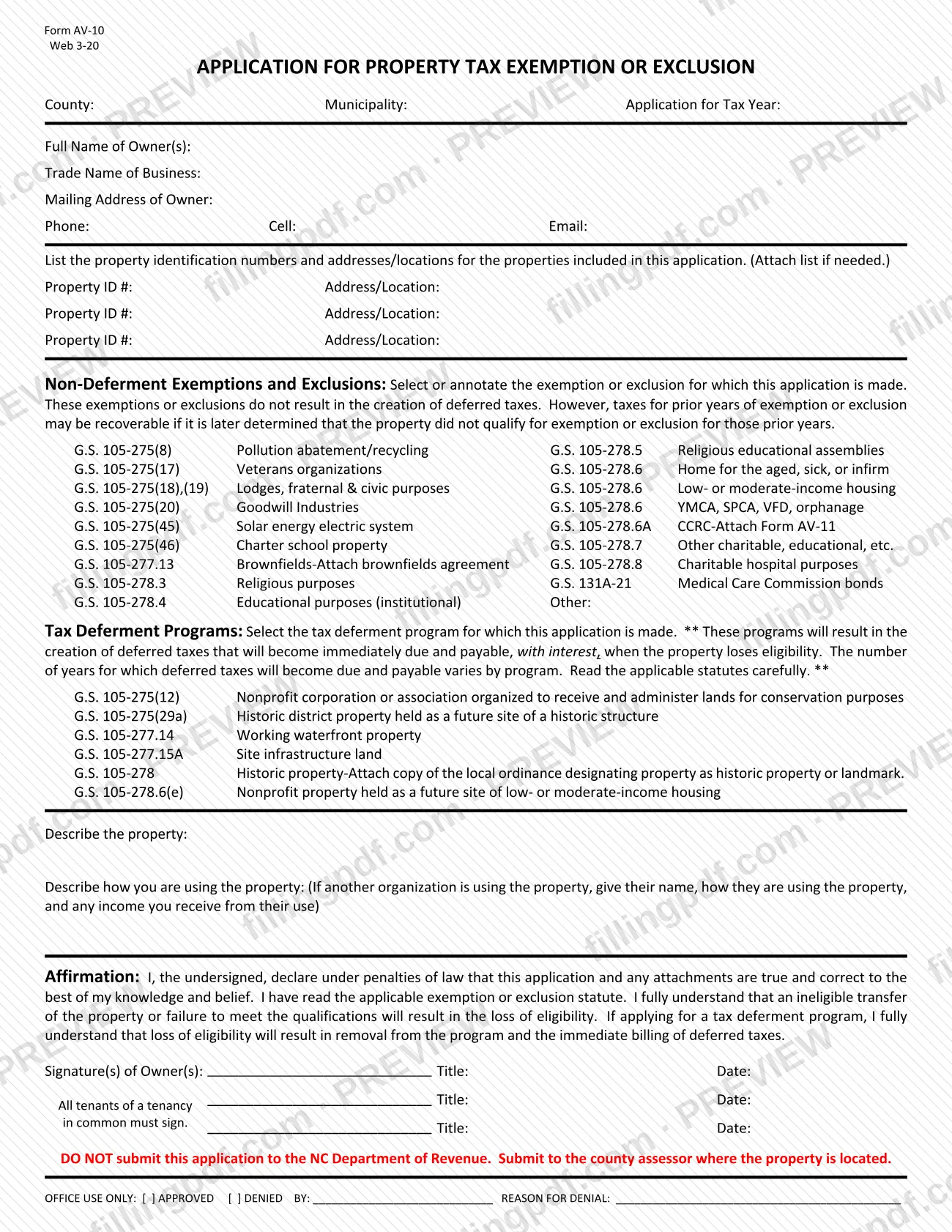
Form AV-10, Application for Property Tax Exemption or Exclusion, is the form a property owner uses to ask for an exemption or exclusion from property tax, or to apply for a tax deferment program, under the North Carolina General Statutes printed on it. Durham County Tax Administration publishes the PDF, and it is one of the Durham County property tax forms that owners of qualifying property use. On this page you can fill out the form online on FillingPDF and download or print the completed PDF; the official PDF lives at the county's website.
Last updated
What is AV-10?
Form AV-10, Application for Property Tax Exemption or Exclusion, is the form property owners use to request a property tax exemption or exclusion, or to apply for a tax deferment program, under the North Carolina General Statutes listed on the form.
The form sorts the requests into two groups:
- Non-Deferment Exemptions and Exclusions. These do not create deferred taxes. The form warns, however, that taxes for prior years of exemption or exclusion may be recoverable if it is later determined that the property did not qualify for those years. The list covers items such as religious purposes (G.S. 105-278.3), educational purposes (G.S. 105-278.4), charitable hospital purposes (G.S. 105-278.8), veterans organizations (G.S. 105-275(17)), charter school property (G.S. 105-275(46)), a solar energy electric system (G.S. 105-275(45)) and an Other: line.
- Tax Deferment Programs. These create deferred taxes that become immediately due and payable, with interest, when the property loses eligibility. The years of deferred taxes vary by program. The programs listed include historic property (G.S. 105-278), working waterfront property (G.S. 105-277.14) and site infrastructure land (G.S. 105-277.15A).
The applicant describes the property and how it is used, then signs an affirmation under penalties of law. A block marked OFFICE USE ONLY records approval or denial and the reason for denial. The form is submitted to the county assessor, not to the NC Department of Revenue.
Who needs to file AV-10?
Owners of real property in North Carolina who want the property treated as exempt or excluded from property tax, or who want to enter a tax deferment program, complete Form AV-10 for the statute that fits their property.
- Owners applying under a non-deferment exemption or exclusion, for example religious, educational, charitable, veterans organization, fraternal or civic purposes, a home for the aged, sick or infirm, or charter school property.
- Owners applying under a tax deferment program, such as historic property, working waterfront property, site infrastructure land, or nonprofit land held for conservation purposes. They must understand that losing eligibility removes the property from the program and triggers immediate billing of deferred taxes.
- Every owner of the property. If the property is held as a tenancy in common, all tenants must sign.
The form states that an ineligible transfer of the property, or failing to meet the qualifications, results in loss of eligibility. Read the statute that applies to you before you apply; the affirmation says you have done so. Do not send the application to the NC Department of Revenue.
When to file AV-10
File Form AV-10 when you are ready to claim an exemption, an exclusion or a deferment program for a particular tax year: the form has an Application for Tax Year line, so each application is tied to a year you name. No due date is printed on the form itself, so confirm the timing for your tax year with Durham County Tax Administration or the county assessor who handles your property.
Timing also matters after approval. The form says that an ineligible transfer of the property or a failure to meet the qualifications results in loss of eligibility. For a deferment program, loss of eligibility means removal from the program and immediate billing of deferred taxes with interest. For a non-deferment exemption or exclusion, taxes for prior years may be recoverable if the property is later found not to have qualified for those years.
Documents you need
- Form AV-11, if you apply under G.S. 105-278.6A for a continuing care retirement community (CCRC); the form says to attach it.
- A brownfields agreement, if you apply under G.S. 105-277.13 for brownfields property.
- A copy of the local ordinance designating the property as historic property or a landmark, if you apply under G.S. 105-278 for historic property.
- A list of property identification numbers and addresses or locations, if the properties in the application do not fit on the three lines printed on the form.
How to fill out AV-10
Enter county, municipality and tax year
At the top, fill in County, Municipality and Application for Tax Year so the application is tied to the year you are applying for.
Enter owner information
Write the Full Name of Owner(s), the Trade Name of Business if there is one, the Mailing Address of Owner, and your phone, cell and email.
List the properties
For each property in the application, enter the Property ID # and the Address/Location. The form has three lines; attach a list if you need more.
Select a non-deferment exemption or exclusion
If your request does not create deferred taxes, select or annotate the statute that fits, such as G.S. 105-278.3 for religious purposes. Use Other: for a statute not listed, and attach Form AV-11 or the brownfields agreement where the line says so.
Or select a tax deferment program
If you apply for a deferment program, select it under Tax Deferment Programs. Read the statute first, and attach the local ordinance if you select G.S. 105-278 historic property.
Describe the property
In Describe the property, explain what the property is.
Describe how you use the property
In Describe how you are using the property, explain the use. If another organization uses it, give its name, how it uses the property and any income you receive from that use.
Sign the affirmation
Read the affirmation, then sign, enter your title and date. All tenants in common must sign, each on their own line.
Leave the office block blank
Do not complete the OFFICE USE ONLY section; the county uses it to record approval or denial.
Review and download the completed PDF
Check that the statute, tax year, property IDs and signatures are correct and that your attachments are ready. Download or print the completed PDF from FillingPDF and submit it as described under How to submit.
How to submit AV-10
Submit the completed, signed Form AV-10 to the county assessor of the county where the property is located. The form names no other channel and prints no address or portal.
- County assessor: Send or deliver the application to the assessor's office for the county in which the property sits. For property in Durham County, contact Durham County Tax Administration for its current mailing address, in-person hours and any online option.
- Do not send it to the NC Department of Revenue. The form says in capital letters not to submit the application there.
Before you send it, attach whatever your exemption or program requires: Form AV-11 for the G.S. 105-278.6A continuing care retirement community option, the brownfields agreement for G.S. 105-277.13, a copy of the local ordinance designating historic property or a landmark for G.S. 105-278, and a list of properties if the three lines on the form are not enough. Every owner must sign, and all tenants in common must sign. Leave the OFFICE USE ONLY block blank. FillingPDF lets you fill out and download the PDF; submission follows the channels above.
Common mistakes to avoid
- Submitting the application to the NC Department of Revenue instead of the county assessor where the property is located.
- Signing for only some owners when the property is held as a tenancy in common; the form says all tenants in common must sign.
- Choosing a tax deferment program without understanding that deferred taxes become immediately due, with interest, when the property loses eligibility.
- Leaving out Form AV-11 when applying under G.S. 105-278.6A for a CCRC, or the brownfields agreement when applying under G.S. 105-277.13.
- Applying for historic property under G.S. 105-278 without attaching a copy of the local ordinance designating it as historic property or a landmark.
- Not listing the other organization's name, its use and the income you receive when another organization uses the property.
- Listing more properties than the three lines allow without attaching a list.
- Filling in the OFFICE USE ONLY block, which records the approval or denial and is not for the applicant.
Frequently asked questions
What is Form AV-10 used for?
Form AV-10 is the application for a property tax exemption or exclusion, or for a tax deferment program, under the North Carolina General Statutes listed on it. You select the statute that fits your property, describe the property and its use, and sign an affirmation.
Where do I submit Form AV-10?
Submit it to the county assessor where the property is located. The form tells you not to send it to the NC Department of Revenue. For property in Durham County, contact Durham County Tax Administration for its current address and options.
What is the difference between an exemption or exclusion and a deferment program?
Exemptions and exclusions do not create deferred taxes, though prior years' taxes may be recoverable if the property did not qualify. Deferment programs create deferred taxes that become immediately due, with interest, when the property loses eligibility.
What do I attach to Form AV-10?
It depends on the statute. Attach Form AV-11 for a CCRC under G.S. 105-278.6A, the brownfields agreement for G.S. 105-277.13, and the local historic ordinance for G.S. 105-278. Also attach a property list if you have more than three properties.
Who has to sign Form AV-10?
The owner or owners sign the affirmation, with title and date. If the property is held as a tenancy in common, all tenants in common must sign. Signing means you declare, under penalties of law, that the application and attachments are true and correct.
What happens if my property stops qualifying?
You lose eligibility. For a tax deferment program, the property is removed from the program and deferred taxes are billed immediately. For an exemption or exclusion, taxes for prior years may be recoverable if the property did not qualify in those years.
Can I fill out Form AV-10 online?
You can fill out the PDF online on FillingPDF and download or print it. FillingPDF is an independent service and does not submit the application to the assessor; you deliver it through the county's channels.
Ready to fill out AV-10?
Fill out AV-10 now