
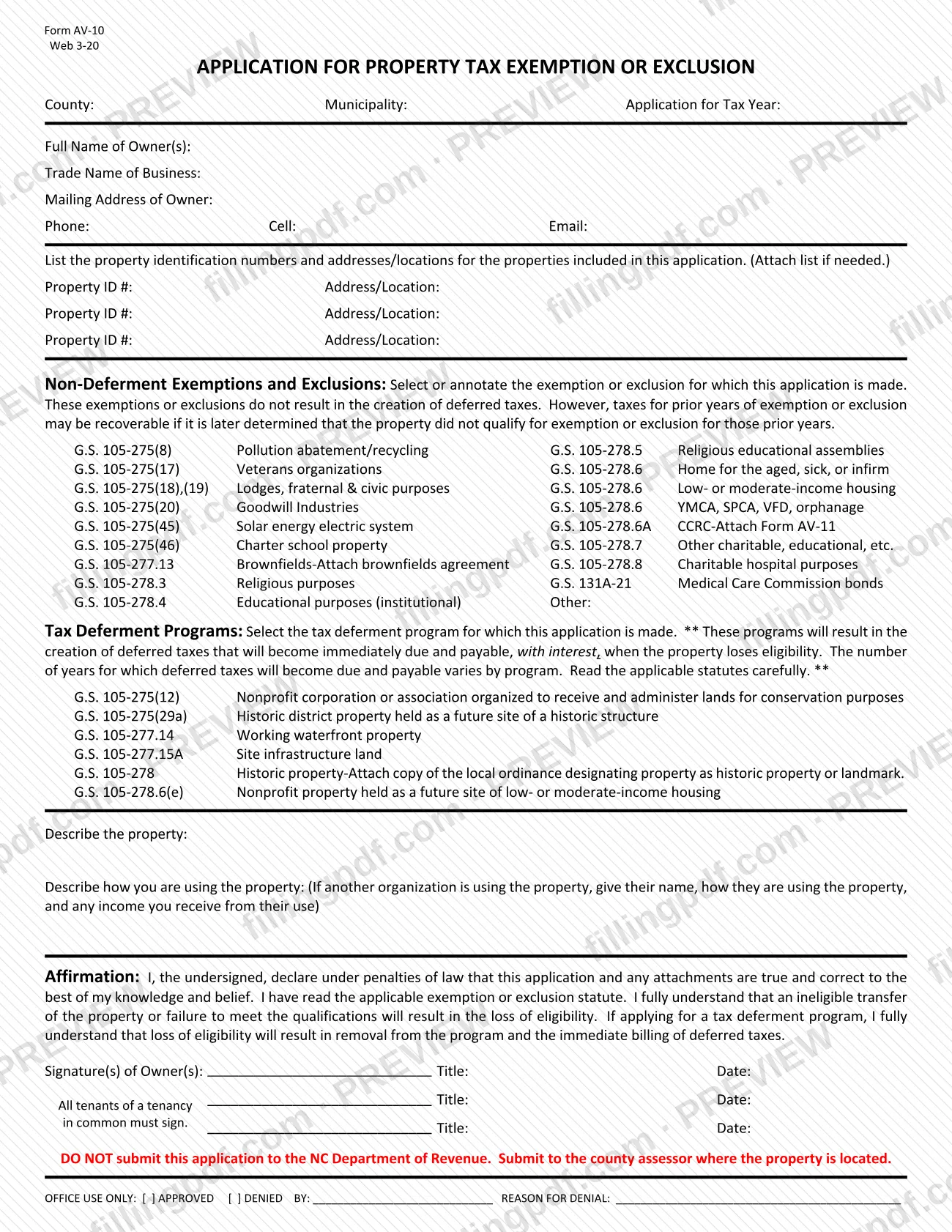
Form AV-10, Application for Property Tax Exemption or Exclusion, is the application an owner completes to ask for a property tax exemption or exclusion under the North Carolina General Statutes. It is one of the Durham County property tax relief forms published by Durham County Tax Administration. Owners of property used for purposes such as religious, educational, charitable or conservation use, among the others the form lists, use it. On this page you can fill out the form online on FillingPDF and download or print the completed PDF; the original PDF is published by the county.
Last updated
What is AV-10?
Form AV-10, Application for Property Tax Exemption or Exclusion, is the form on which a property owner asks the county assessor to exempt or exclude a property from property tax under a specific North Carolina General Statute that the owner selects or writes in.
The form is divided by consequence. The first group, Non-Deferment Exemptions and Exclusions, lists statutes such as G.S. 105-275(8) pollution abatement/recycling, G.S. 105-278.3 religious purposes, G.S. 105-278.4 educational purposes (institutional), G.S. 105-278.8 charitable hospital purposes and G.S. 105-275(46) charter school property, plus an Other line. These do not create deferred taxes, although taxes for prior years may be recoverable if the property is later found not to have qualified for those years.
The second group, Tax Deferment Programs, covers G.S. 105-275(12), 105-275(29a), 105-277.14, 105-277.15A, 105-278 and 105-278.6(e). These programs create deferred taxes that become immediately due and payable, with interest, when the property loses eligibility.
The applicant also lists the properties by identification number and location, describes the property and its use, and signs an affirmation under penalties of law. Durham County Tax Administration lists Form AV-10 among its Property Tax Relief Applications. Other forms in that group are separate documents, such as the Application for Motor Vehicle Property Tax Exemption (AV-10V) and the Application for Elderly Disabled, Disabled Veteran and Circuit Breaker Homestead Exclusions (AV-9).
Who needs to file AV-10?
Owners of property who believe it qualifies for one of the exemptions, exclusions or deferment programs printed on Form AV-10 use it to apply. That includes organizations and businesses, since the form has a line for a trade name of business.
- Owners applying under a non-deferment statute, such as religious purposes, educational purposes, veterans organizations, lodges and fraternal or civic purposes, solar energy electric systems, charter school property or brownfields.
- Owners applying for a tax deferment program, such as conservation land held by a nonprofit, historic property, working waterfront property or site infrastructure land. These owners should read the statute first, because loss of eligibility means immediate billing of deferred taxes.
- Co-owners: all tenants of a tenancy in common must sign.
- Owners of a continuing care retirement community (CCRC) must attach Form AV-11.
The form is not sent to the NC Department of Revenue. It goes to the county assessor where the property is located. Motor vehicles, and the elderly, disabled and disabled veteran homestead exclusions, use other forms that Durham County Tax Administration lists separately (AV-10V and AV-9).
When to file AV-10
File Form AV-10 when you are applying for an exemption, exclusion or deferment for a particular tax year: the form asks for the Application for Tax Year at the top, so each application is tied to the year you enter. No due date is printed on the form itself.
If a deadline for that year has passed, Durham County Tax Administration lists a separate form on its Tax Forms & Publications page: Request for Approval of Property Tax Exemption, Exclusion, or Deferral Due to Showing of Good Cause for Failure to Make a Timely Application. Contact the office to confirm which deadline applies to your situation.
The form also warns that failing to meet the qualifications, or making an ineligible transfer of the property, results in loss of eligibility.
Documents you need
- A list of additional properties (property ID number and address or location), only if the application covers more than the three lines printed on the form.
- Form AV-11, only when applying under G.S. 105-278.6A for a CCRC.
- A brownfields agreement, only when applying under G.S. 105-277.13 for brownfields.
- A copy of the local ordinance designating the property as historic property or landmark, only when applying under G.S. 105-278 for historic property.
How to fill out AV-10
Enter county, municipality and tax year
At the top, fill in County, Municipality and Application for Tax Year.
Enter owner and business details
Write the Full Name of Owner(s), the Trade Name of Business if one applies, the Mailing Address of Owner, and Phone, Cell and Email.
List the properties
Under the property list, enter each Property ID # and Address/Location. Use the three lines provided and attach a list if you need more.
Select a non-deferment exemption or exclusion
If your application is for a non-deferment program, check the statute that fits, such as G.S. 105-278.3 religious purposes, or write it on the Other line. Attach Form AV-11 or the brownfields agreement where the line says so.
Or select a tax deferment program
If you are applying for deferment, check the program that applies, such as G.S. 105-277.14 working waterfront property. For G.S. 105-278 historic property, attach a copy of the local ordinance designating it.
Describe the property
In Describe the property, state what the property is in your own words.
Describe how you use the property
In Describe how you are using the property, explain the use. If another organization uses it, give its name, how it uses the property and any income you receive from that use.
Read the affirmation and sign
Read the affirmation and the applicable statute. Each owner signs and enters Title and Date; all tenants in common must sign.
Review and download the completed PDF
Check the statute selected, attachments and signatures, leave OFFICE USE ONLY blank, then download or print the completed PDF from FillingPDF and submit it as described under How to submit.
How to submit AV-10
Submit the completed, signed Form AV-10 to the county assessor where the property is located. The form names no mail, online or in-person channel and says plainly: do not submit it to the NC Department of Revenue.
- Where: the county assessor for the county in which the property sits. For Durham County, Durham County Tax Administration lists its main office at 201 East Main Street, 3rd Floor, Administration Bldg. II, Durham, NC 27701, open 8:30 AM-5:00 PM, telephone 919-560-0350. Call to confirm how the office accepts applications.
- What to include: the signed form with every owner's signature, a list of properties if you have more than the three lines provided, and any attachment your selected statute requires (see the documents list).
- Office use: leave the approved/denied box and the reason for denial to the county.
The form states no fee. FillingPDF lets you fill out and download the PDF; submission follows the county channels above.
Common mistakes to avoid
- Sending the application to the NC Department of Revenue; the form says to submit it to the county assessor where the property is located.
- Leaving off a required attachment: Form AV-11 for a CCRC, the brownfields agreement, or the historic-designation ordinance.
- Signing as a single owner when the property is held as a tenancy in common; all tenants in common must sign.
- Choosing a Tax Deferment Program without reading the statute; loss of eligibility makes deferred taxes immediately due with interest.
- Marking an exemption in the wrong group instead of the non-deferment or deferment list that matches the statute.
- Not naming another organization that uses the property, how it uses it, and the income you receive from that use.
- Listing more than three properties without attaching a list.
- Writing in the OFFICE USE ONLY block.
Frequently asked questions
What is Form AV-10 used for?
Form AV-10 is the application for a property tax exemption or exclusion. You select or write in the North Carolina statute that applies, list the properties, describe the property and its use, and sign an affirmation under penalties of law. It also covers listed tax deferment programs.
Where do I submit Form AV-10?
To the county assessor where the property is located, not to the NC Department of Revenue. Durham County Tax Administration lists its main office at 201 East Main Street, 3rd Floor, Administration Bldg. II, Durham, NC 27701, telephone 919-560-0350.
What is the difference between an exemption and a deferment program on Form AV-10?
The non-deferment exemptions and exclusions do not create deferred taxes, though prior years may be recoverable if the property did not qualify. The deferment programs create deferred taxes that become due immediately, with interest, when the property loses eligibility.
Do I need to attach anything to Form AV-10?
Only in some cases: Form AV-11 for a CCRC, the brownfields agreement under G.S. 105-277.13, the local historic-designation ordinance under G.S. 105-278, and a list of properties if you have more than three.
Who has to sign Form AV-10?
The owner or owners sign, with title and date. If the property is held as a tenancy in common, all tenants in common must sign. The signature affirms that the application is true and correct and that you have read the statute.
Is there a deadline for Form AV-10?
The form prints no due date; it asks for the tax year being applied for. Durham County Tax Administration also lists a separate request form for exemptions, exclusions or deferrals when a timely application was not made and good cause is shown.
Is AV-10 the same form as AV-10V?
No. Durham County Tax Administration lists the Application for Motor Vehicle Property Tax Exemption (AV-10V) as a separate document. Form AV-10 is the application for property tax exemption or exclusion.
Can I fill out Form AV-10 online on FillingPDF?
Yes. You can fill out the PDF online on FillingPDF and download or print it. FillingPDF is an independent service, not connected to Durham County, and it does not file or submit the application; you deliver it to the county assessor.
Ready to fill out AV-10?
Fill out AV-10 now