
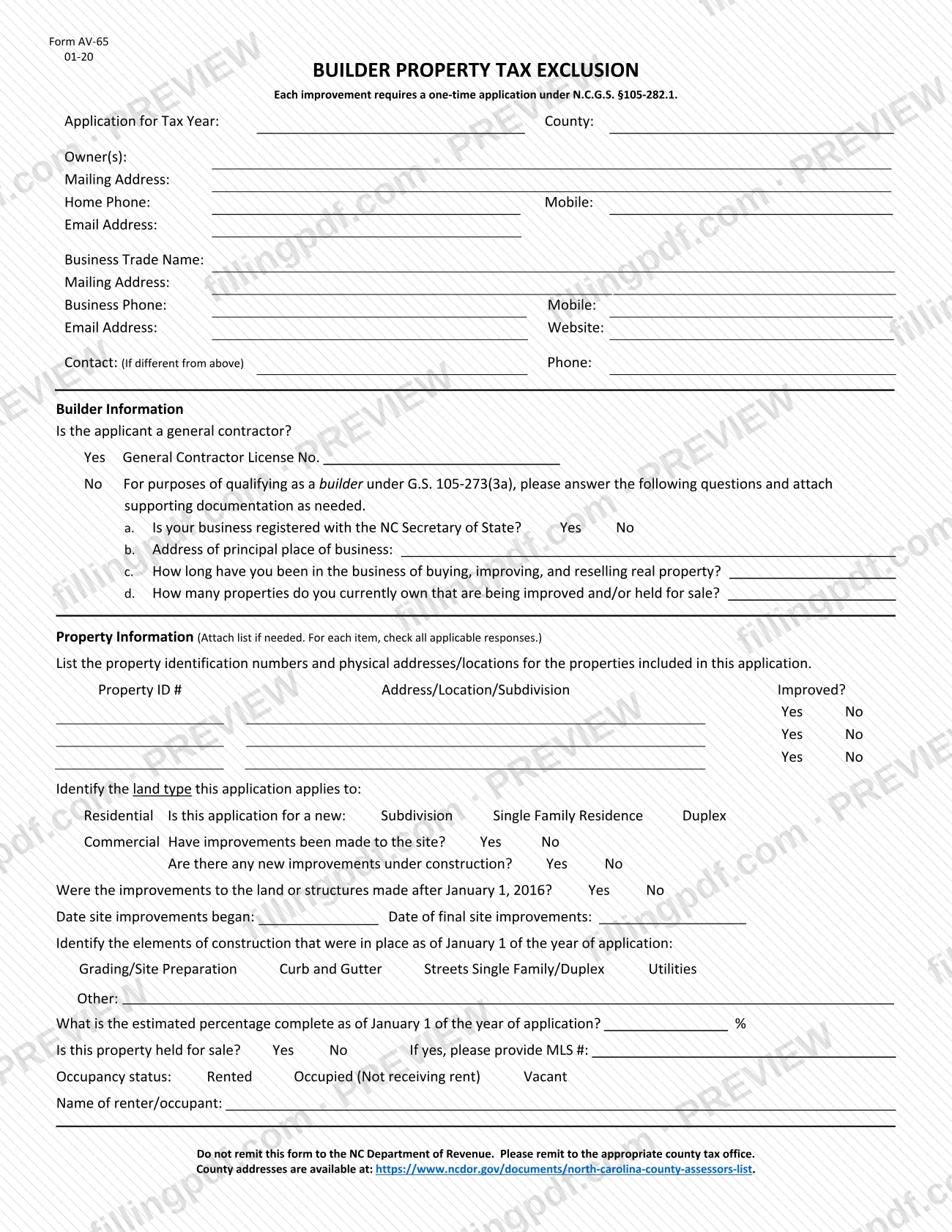
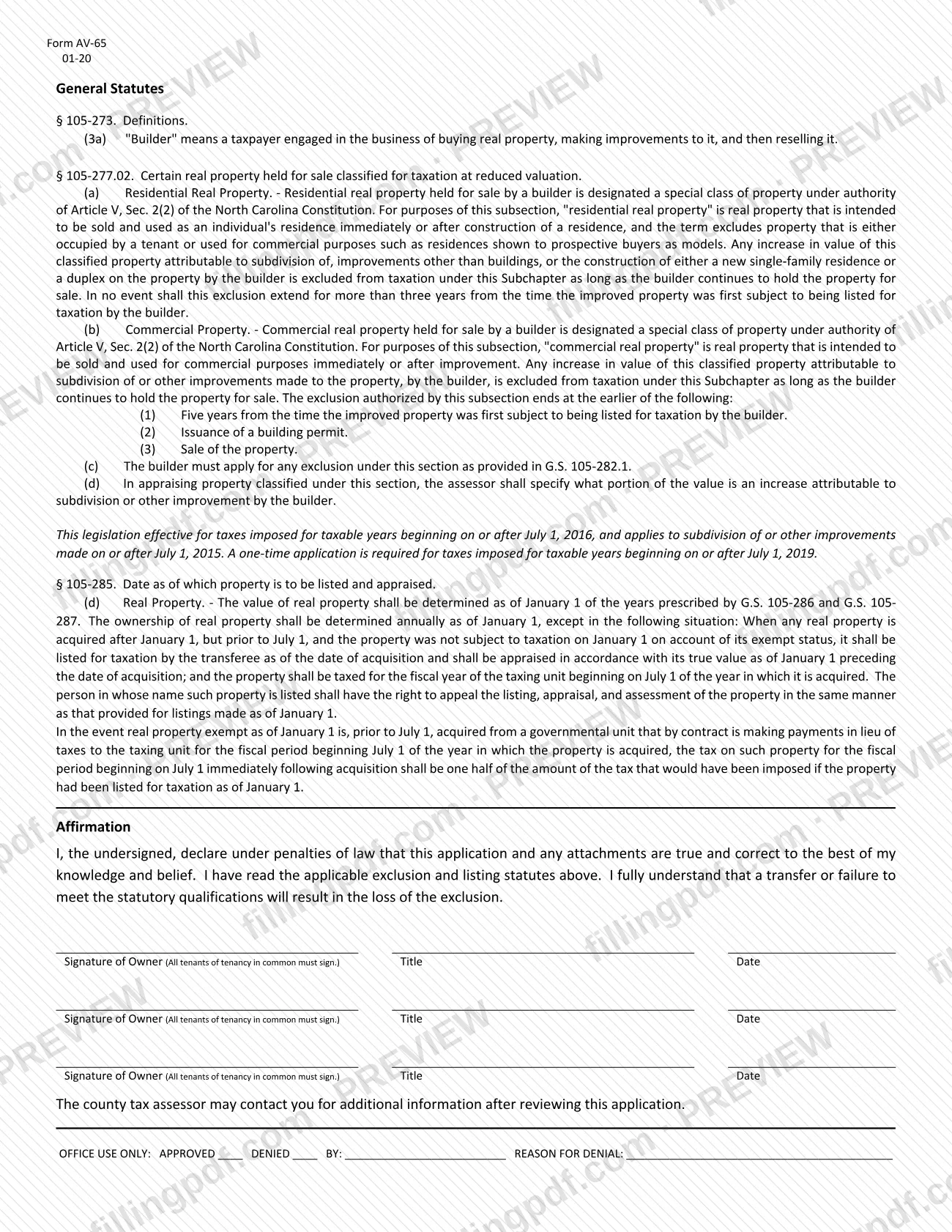
Form AV-65, Builder Property Tax Exclusion, is the application a builder submits to the county tax office to exclude from taxation the value added by subdivision or improvements to real property held for sale. It is one of the Durham County property tax relief applications that Durham County Tax Administration publishes, and each improvement needs one application. On this page you can fill out the form online on FillingPDF and download or print the completed PDF; the form itself is published by the county at the official link.
Last updated
What is AV-65?
Form AV-65, Builder Property Tax Exclusion, is the application a builder files with a North Carolina county tax office to exclude from taxation the value added by subdivision or improvements to real property held for sale, under N.C.G.S. §105-277.02 and §105-282.1.
The form states that each improvement requires a one-time application. It collects the owner and business details, the builder qualification answers, the property identification numbers and addresses, the land type (residential or commercial), the construction status as of January 1 of the year of application, sale and occupancy information, and the owner's signed affirmation.
The statutes printed on the form define a "builder" as a taxpayer engaged in the business of buying real property, making improvements to it, and then reselling it. For residential property, the excluded increase is the value attributable to subdivision, improvements other than buildings, or construction of a new single-family residence or duplex. For commercial property, it is the value attributable to subdivision or other improvements. The exclusion lasts only while the builder continues to hold the property for sale.
Durham County Tax Administration lists this file as "Builder Property Tax Exemption AV65 202001" under Property Tax Relief Applications; the title printed on the form is Builder Property Tax Exclusion. The form is not sent to the NC Department of Revenue.
Who needs to file AV-65?
Builders who own real property that they hold for sale, and who have subdivided it or made improvements to it, use Form AV-65 to apply for the exclusion. The form's definition of a builder is a taxpayer engaged in the business of buying real property, making improvements to it, and then reselling it. Applicants who are not general contractors answer the builder questions on the form (business registration with the NC Secretary of State, principal place of business, time in the business, and number of properties being improved or held for sale) and attach supporting documentation as needed.
Conditions in the printed statutes:
- Residential property must be intended to be sold and used as an individual's residence. The definition excludes property occupied by a tenant or used for commercial purposes, such as residences shown to prospective buyers as models.
- Commercial property must be intended to be sold and used for commercial purposes, immediately or after improvement.
- The builder must keep holding the property for sale. The affirmation warns that a transfer, or failure to meet the statutory qualifications, results in loss of the exclusion.
When the property has several owners, every owner signs; all tenants of a tenancy in common must sign.
When to file AV-65
File Form AV-65 once for each improvement, because the form states that each improvement requires a one-time application under N.C.G.S. §105-282.1. No separate due date is printed on the form, which asks for the tax year of the application. The construction elements and the percentage complete are reported as of January 1 of the year of application, so gather those facts before you start.
The printed statutes also set how long the exclusion can last. For residential property it cannot extend more than three years from the time the improved property was first subject to being listed for taxation by the builder. For commercial property it ends at the earliest of five years from that time, issuance of a building permit, or sale of the property. After the county assessor reviews the application, the assessor may contact you for more information.
Documents you need
- Supporting documentation for the builder questions (registration with the NC Secretary of State, principal place of business, time in the business, properties being improved or held for sale), attached as needed to show you qualify as a builder under G.S. 105-273(3a).
- A list of property identification numbers and addresses, attached if the property lines on the form are not enough for all properties in the application.
How to fill out AV-65
Enter tax year and county
At the top, under BUILDER PROPERTY TAX EXCLUSION, fill in Application for Tax Year and County.
Enter owner contact information
Complete Owner(s), Mailing Address, Home Phone, Mobile and Email Address for the property owner.
Enter business information
Fill in Business Trade Name, its Mailing Address, Business Phone, Mobile, Email Address and Website. Add a Contact and phone only if the contact is different from the owner.
Answer the general contractor question
Under Builder Information, check Yes and enter the General Contractor License No., or check No.
Answer the builder qualification questions
The questions appear with the No option. If you check No, answer a through d: NC Secretary of State registration (Yes or No), principal place of business, time buying, improving and reselling real property, and number of properties currently being improved or held for sale. Attach supporting documentation as needed.
List the properties
Enter each property identification number, its address, location or subdivision, and check Yes or No under Improved. Attach a list if you need more lines.
Describe the land and improvements
Check Residential or Commercial, and for a new project check Subdivision, Single Family Residence or Duplex. Answer whether improvements have been made, whether new improvements are under construction, and whether improvements were made after January 1, 2016.
Enter construction dates and status
Fill in the date site improvements began and the date of final site improvements. Check the elements in place as of January 1 of the year of application: Grading/Site Preparation, Curb and Gutter, Streets, Single Family/Duplex Utilities or Other. Enter the estimated percentage complete.
Enter sale and occupancy details
Check whether the property is held for sale and give the MLS # if it is. Check Rented, Occupied (Not receiving rent) or Vacant, and give the name of the renter or occupant.
Sign and date the affirmation
Each owner signs with title and date under the Affirmation; all tenants of a tenancy in common must sign. Leave the OFFICE USE ONLY block blank.
Review and download the completed PDF
Check every entry and attachment, then download or print the completed PDF from FillingPDF and send it to the county tax office as described under How to submit.
How to submit AV-65
The form names one channel: remit the completed application to the appropriate county tax office. It tells you not to send it to the NC Department of Revenue.
- County tax office: county addresses are listed at https://www.ncdor.gov/documents/north-carolina-county-assessors-list. The form does not set a mailing method, portal or appointment rule.
- Durham County Tax Administration: its Tax Forms & Publications page lists the main office at 201 East Main Street, 3rd Floor, Administration Bldg. II, Durham, NC 27701, open 8:30 AM-5:00 PM, telephone 919-560-0350.
Sign the form before sending it, and include any attached property list or supporting documentation. The form says the county tax assessor may contact you for additional information after reviewing the application. Ask the tax office about any fee, payment or processing time, because the form states none. FillingPDF lets you fill out and download the PDF; submission follows the channels above.
Common mistakes to avoid
- Mailing the form to the NC Department of Revenue; the form says not to remit it there and to send it to the appropriate county tax office.
- Signing with fewer owners than required; all tenants of a tenancy in common must sign.
- Treating one application as covering future improvements; the form requires a one-time application for each improvement.
- Claiming residential treatment for property occupied by a tenant or used commercially, such as a model home; the statute excludes both from residential property.
- Skipping the attachments: supporting documentation for the builder questions, and a property list when the form's lines run out.
- Assuming the exclusion continues after the property is transferred; the affirmation says a transfer or failure to meet the qualifications results in loss of the exclusion.
- Reporting the construction elements and percentage complete as of a date other than January 1 of the year of application.
Frequently asked questions
What is Form AV-65, Builder Property Tax Exclusion?
Form AV-65 is the application a builder files with a county tax office to exclude from taxation the increase in value from subdivision or improvements to real property held for sale. It applies under N.C.G.S. §105-277.02, and the application is made as provided in G.S. 105-282.1.
Who qualifies as a builder for the AV-65 exclusion?
A builder is a taxpayer engaged in the business of buying real property, making improvements to it, and then reselling it, as defined in G.S. 105-273(3a). The property must also be held for sale by the builder, and the form asks for supporting documentation as needed.
Where do I send Form AV-65 in Durham County?
Send it to the appropriate county tax office, not the NC Department of Revenue. Durham County Tax Administration lists its main office at 201 East Main Street, 3rd Floor, Administration Bldg. II, Durham, NC 27701, telephone 919-560-0350.
Do I have to apply every year for the builder exclusion?
No. The form says each improvement requires a one-time application. A separate improvement needs its own application, and the exclusion has statutory limits: up to three years for residential property, and for commercial property the earliest of five years, a building permit or a sale.
How long does the builder property tax exclusion last?
For residential property, no more than three years from when the improved property was first subject to being listed for taxation by the builder. For commercial property, it ends at the earliest of five years from that time, issuance of a building permit, or sale of the property.
Who must sign Form AV-65?
The owner signs the Affirmation, and all tenants of a tenancy in common must sign. The form has three owner signature lines, each with title and date, declaring the application is true and correct to the best of the signer's knowledge and belief.
Is this the current version of Form AV-65 from Durham County?
The form is marked 01-20. Durham County's Tax Forms & Publications page says documents there dated before April 24, 2026 are archived and not being updated, so confirm the version you need with Durham County Tax Administration at 919-560-0350.
Can I fill out Form AV-65 online on FillingPDF?
Yes. You can fill out the PDF online on FillingPDF and download or print it. FillingPDF is an independent service and does not file the application; you submit it to the county tax office yourself.
Ready to fill out AV-65?
Fill out AV-65 now