
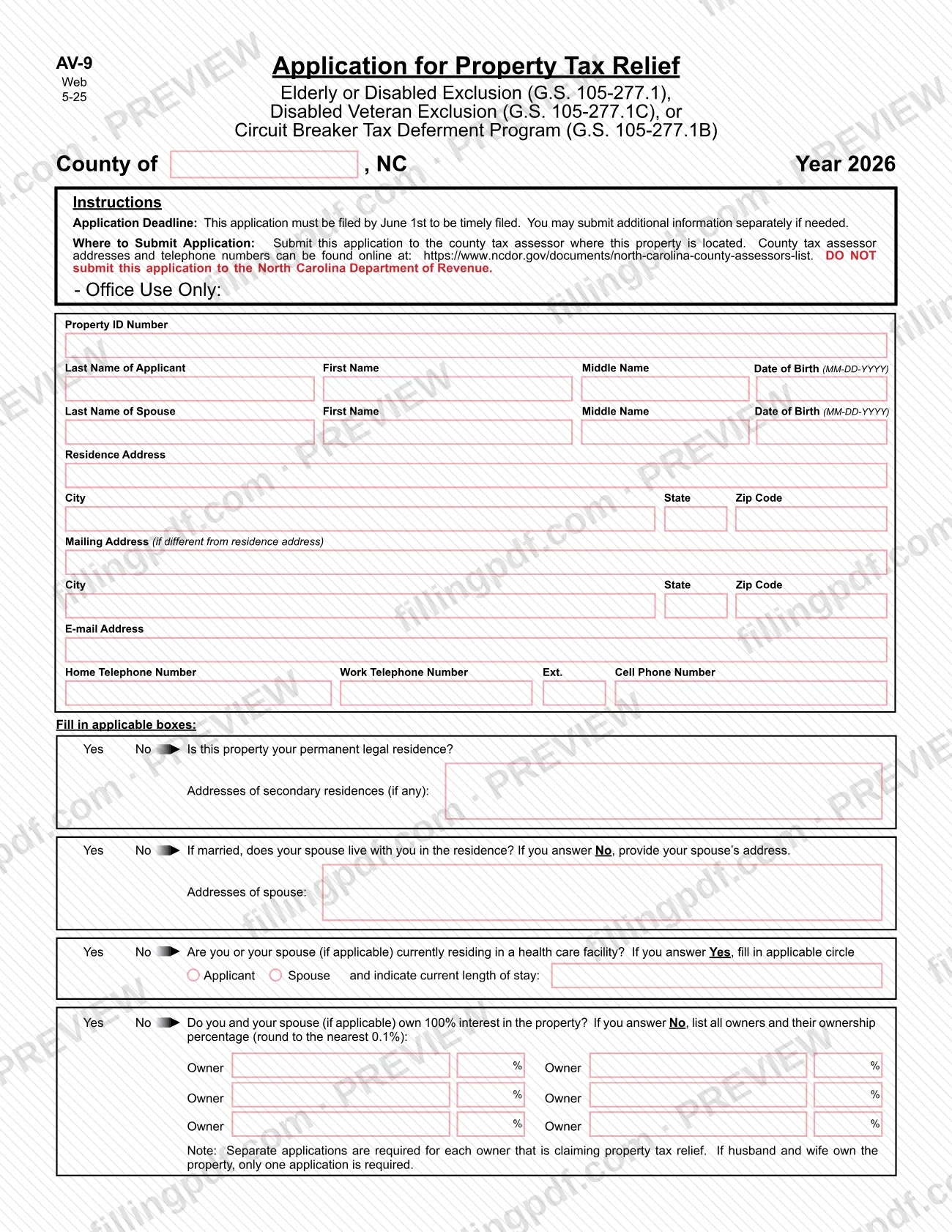
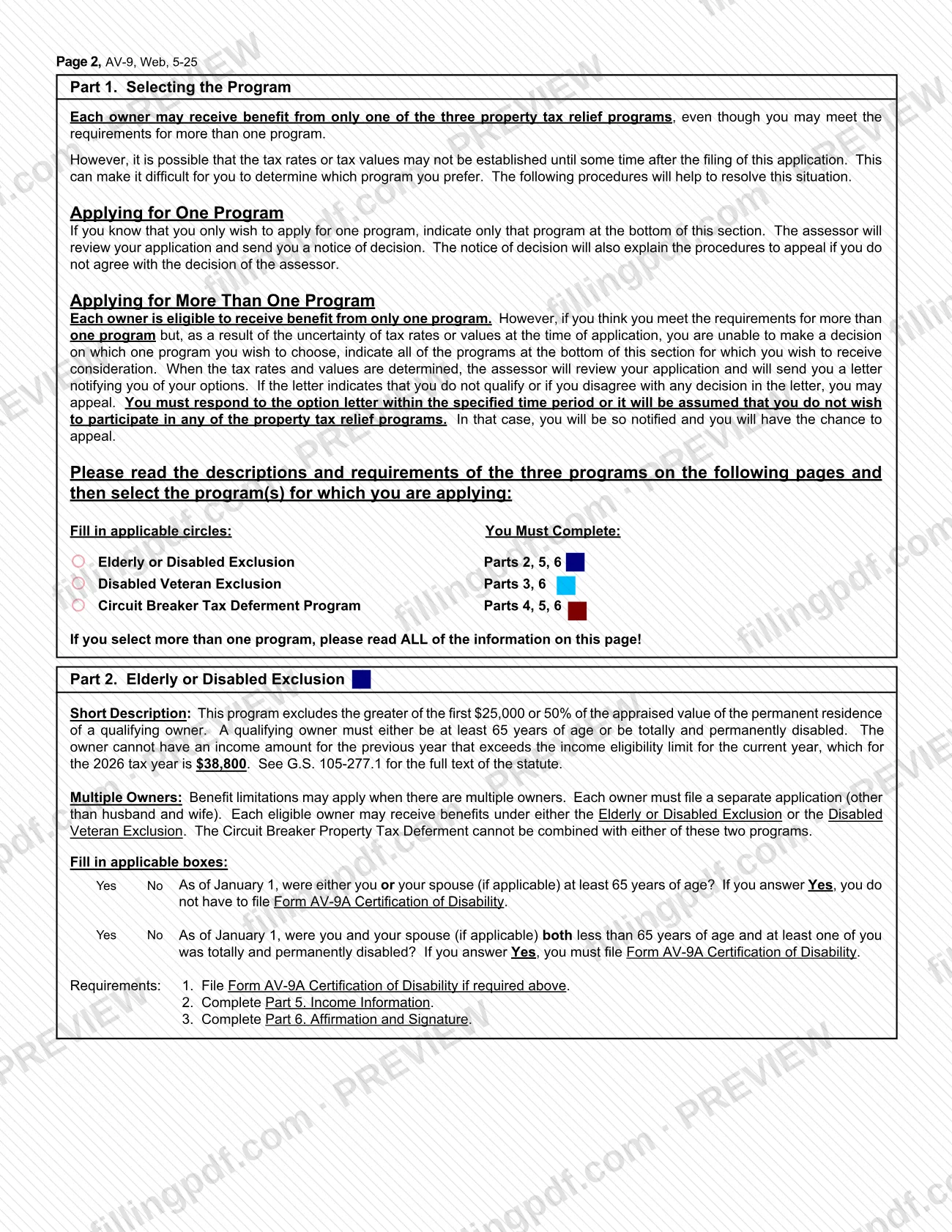
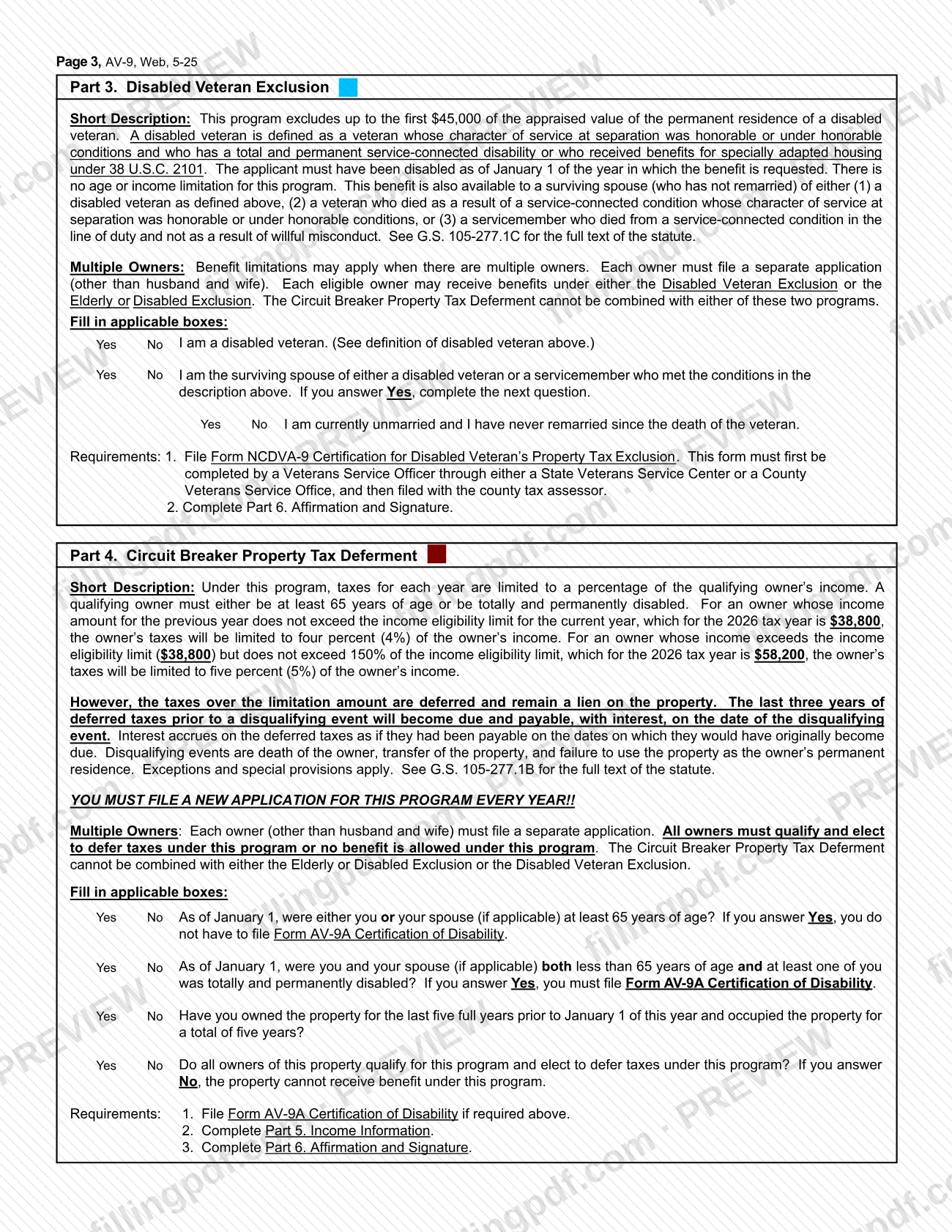
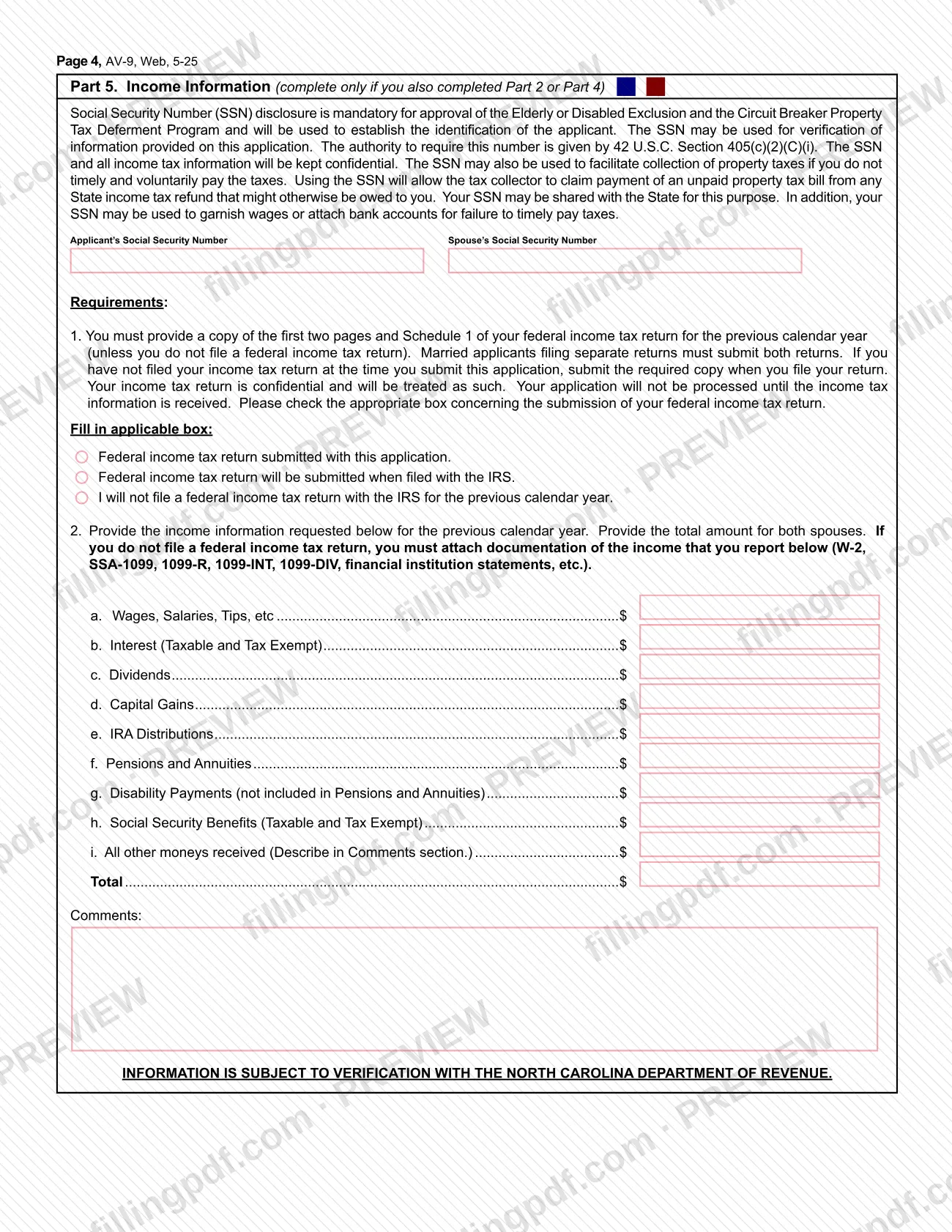
Form AV-9, Application for Property Tax Relief, is the North Carolina application for the Elderly or Disabled Exclusion, the Disabled Veteran Exclusion and the Circuit Breaker Tax Deferment Program, and Durham County Tax Administration publishes this 2026 copy. It is one of the Durham County property tax relief applications that owners of a permanent residence file with the county tax assessor, by June 1 to be timely. On this page you can fill out the form online on FillingPDF and download or print the completed PDF; the official PDF and its filing rules stay with the agency.
Last updated
What is AV-9?
Form AV-9, Application for Property Tax Relief, is the North Carolina application owners file with their county tax assessor to request the Elderly or Disabled Exclusion, the Disabled Veteran Exclusion or the Circuit Breaker Tax Deferment Program on a permanent residence.
The three programs rest on different statutes, and Part 1 of the form is where you choose among them:
- Elderly or Disabled Exclusion (G.S. 105-277.1): excludes part of the appraised value of the permanent residence of an owner who is at least 65 or totally and permanently disabled, within an income limit.
- Disabled Veteran Exclusion (G.S. 105-277.1C): excludes part of the appraised value for a disabled veteran or an unmarried surviving spouse, with no age or income limit.
- Circuit Breaker Tax Deferment Program (G.S. 105-277.1B): limits each year's taxes to a percentage of the owner's income and defers the rest as a lien on the property.
Each owner may receive benefit from only one program. Companion forms are Form AV-9A, Certification of Disability, and Form NCDVA-9, Certification for Disabled Veteran's Property Tax Exclusion. The form is not an application for a charitable, educational or religious exemption, or for the motor vehicle exemption (Form AV-10V), which the Durham County Tax Administration handles separately. This copy is the 2026 version, revision marked Web, 5-25.
Who needs to file AV-9?
Owners of a permanent residence in North Carolina who want property tax relief use Form AV-9. Which parts apply depends on the program:
- Elderly or Disabled Exclusion: an owner who, as of January 1, was at least 65, or was totally and permanently disabled and under 65, with income for the previous year within the limit stated on the form.
- Disabled Veteran Exclusion: a veteran with a total and permanent service-connected disability, or an unmarried surviving spouse of a qualifying veteran or servicemember. No age or income limit applies.
- Circuit Breaker Tax Deferment: an owner who is at least 65 or totally and permanently disabled, has owned the property for the last five full years before January 1 and occupied it for a total of five years. All owners must qualify and elect to defer taxes.
Separate applications are required for each owner claiming relief; if husband and wife own the property, one application is enough. The Circuit Breaker program cannot be combined with either exclusion. Do not send the form to the North Carolina Department of Revenue: it goes to the county tax assessor where the property is located.
When to file AV-9
The application must be filed by June 1 to be timely. Durham County Tax Administration adds that Elderly/Disabled and Disabled Veteran applications should be filed during the January 1 to 31 listing period, but are treated as timely if filed by June 1.
Late applications may be considered for good cause through the last day of the calendar year in which the tax is levied; one received after the calendar year ends cannot be considered. The form notes that a late application approved for good cause applies only to taxes levied in the year it is filed.
After the first approval, the Elderly or Disabled Exclusion and the Disabled Veteran Exclusion need no new application unless the property physically changes, its use changes, or your eligibility changes. The Circuit Breaker program requires a new application every year. The form states no processing time.
Documents you need
- Form AV-9A, Certification of Disability: required for the Elderly or Disabled Exclusion or the Circuit Breaker program if you and your spouse (if applicable) were both under 65 on January 1 and at least one of you is totally and permanently disabled.
- Form NCDVA-9, Certification for Disabled Veteran's Property Tax Exclusion: required for the Disabled Veteran Exclusion; a Veterans Service Officer completes it first, through a State Veterans Service Center or County Veterans Service Office.
- A copy of the first two pages and Schedule 1 of your federal income tax return for the previous calendar year: for the Elderly or Disabled Exclusion and Circuit Breaker, unless you do not file a federal return.
- Both federal returns, if you and your spouse are married and file separate returns (Elderly or Disabled Exclusion and Circuit Breaker).
- Income documentation such as W-2, SSA-1099, 1099-R, 1099-INT, 1099-DIV or financial institution statements: required if you do not file a federal income tax return, to support the income you report in Part 5.
- The federal return copy later, when you file it with the IRS, if you have not yet filed it at the time you submit the application.
How to fill out AV-9
Enter county, year and applicant details
At the top, enter the county and confirm the year (2026). Give the applicant's and, if applicable, the spouse's last, first and middle names and dates of birth in MM-DD-YYYY format. Leave the Office Use Only Property ID Number blank.
Add addresses and contact numbers
Enter the residence address, the mailing address only if it differs, your e-mail address, and your home, work (with extension) and cell phone numbers.
Answer the residence and ownership questions
Mark Yes or No for permanent legal residence, whether your spouse lives with you, whether either of you lives in a health care facility, and whether you own 100% interest. List secondary residences or the spouse's address where the form asks.
List all owners and percentages
If you do not own 100% of the property, list every owner and each ownership percentage, rounded to the nearest 0.1%. Remember that each owner claiming relief, other than husband and wife, files a separate application.
Select your program in Part 1
Fill in the circle for each program you want considered. Choose more than one only if you cannot yet decide because tax rates or values are not set; you can benefit from only one.
Complete Part 2 for the Elderly or Disabled Exclusion
Answer whether you or your spouse were at least 65 as of January 1, and whether you were both under 65 with at least one totally and permanently disabled. If the second answer is Yes, attach Form AV-9A.
Complete Part 3 for the Disabled Veteran Exclusion
Mark whether you are a disabled veteran, whether you are the surviving spouse of a qualifying veteran or servicemember, and, if so, whether you have never remarried. Have Form NCDVA-9 completed by a Veterans Service Officer.
Complete Part 4 for the Circuit Breaker
Answer the age and disability questions, whether you owned and occupied the property for the five full years before January 1, and whether all owners qualify and elect to defer taxes. A No to the last question means no benefit under this program.
Fill in Part 5 income information
Only for Part 2 or Part 4: enter the applicant's and spouse's Social Security numbers, mark the box about your federal return, and enter lines a through i and the Total for the previous calendar year, for both spouses combined. Describe line i amounts under Comments.
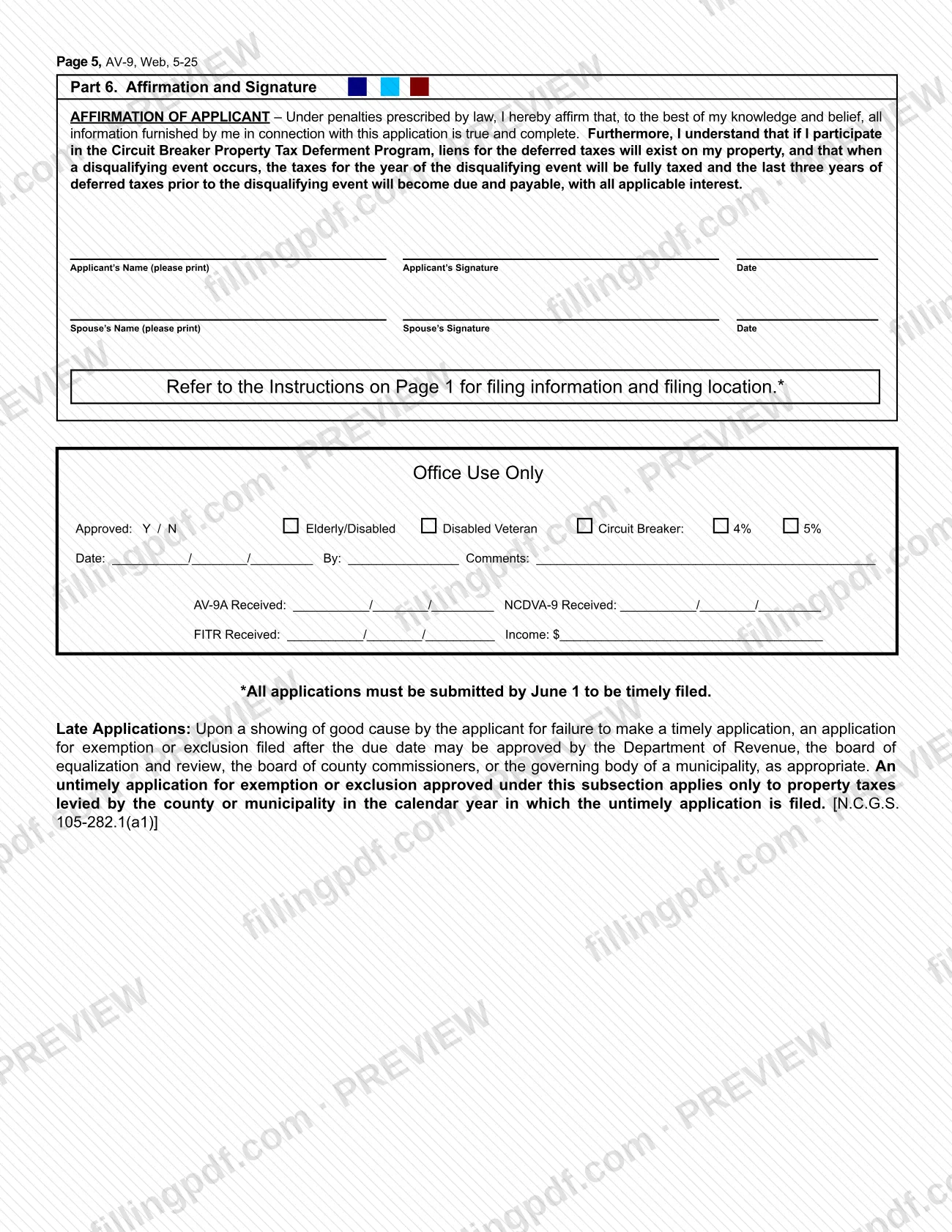
Sign and date in Part 6
Print the applicant's name, sign and date; if applicable, the spouse does the same. The signature affirms the information is true and complete and, for the Circuit Breaker, acknowledges liens for deferred taxes.
Review and download the completed PDF
Check that required parts are complete and attachments are ready, then download or print the completed PDF from FillingPDF and send it to the county tax assessor as described under How to submit.
How to submit AV-9
Submit Form AV-9 to the county tax assessor of the county where the property is located; the form does not name an online portal or a mailing address. Do not send it to the North Carolina Department of Revenue.
- Properties in Durham County: Durham County Tax Administration, 201 East Main Street, 3rd Floor, Durham, NC 27701. The agency lists 919-560-0300 for questions about applications, and the Land Records/GIS main office, which handles exemption applications, lists 919-328-6180, 8:30 AM to 5:00 PM.
- Properties in other counties: find the assessor's address and telephone number in the North Carolina county assessors list at https://www.ncdor.gov/documents/north-carolina-county-assessors-list.
Include any required attachments (see required documents). You may send additional information separately if needed, but the application is not processed until the income tax information is received. The assessor then sends a notice of decision, or, if you chose several programs, a letter listing your options that you must answer within the stated time. FillingPDF lets you fill out and download the PDF; submission follows the channels above.
Common mistakes to avoid
- Sending Form AV-9 to the North Carolina Department of Revenue instead of the county tax assessor where the property is located.
- Filing after June 1 without a showing of good cause; a late application received after the calendar year ends cannot be considered.
- Selecting a program but skipping its required parts: Elderly or Disabled needs Parts 2, 5 and 6; Disabled Veteran needs Parts 3 and 6; Circuit Breaker needs Parts 4, 5 and 6.
- Leaving out Form AV-9A when both spouses were under 65 on January 1 and at least one is totally and permanently disabled.
- Submitting the NCDVA-9 before a Veterans Service Officer has completed it.
- Omitting the federal tax return copy, or the income documents when no return is filed; the application will not be processed until the income tax information is received.
- Reporting only one spouse's income in Part 5; the form asks for the total amount for both spouses.
- Leaving the Social Security number blank in Part 5; its disclosure is mandatory for approval of the Elderly or Disabled Exclusion and the Circuit Breaker program.
- Filing one application for co-owners who are not husband and wife; each such owner must file separately.
- Assuming a Circuit Breaker deferment renews itself; a new application is required every year.
Frequently asked questions
What is Form AV-9 used for?
Form AV-9 is the North Carolina Application for Property Tax Relief. You use it to request one of three programs on your permanent residence: the Elderly or Disabled Exclusion, the Disabled Veteran Exclusion or the Circuit Breaker Tax Deferment Program. You may receive benefit from only one program.
Where do I file Form AV-9 for Durham County property tax relief?
File it with the county tax assessor where the property is located, not the North Carolina Department of Revenue. For Durham County property, the Tax Administration office is at 201 East Main Street, 3rd Floor, Durham, NC 27701, telephone 919-560-0300.
What is the deadline for the AV-9?
June 1 for the application to be timely. Durham County Tax Administration says the January 1 to 31 listing period is when Elderly/Disabled and Disabled Veteran applications should be filed, but they are timely if filed by June 1.
Can I apply for more than one program on one AV-9?
Yes, if tax rates or values are not yet set and you cannot choose. Mark every program you want considered in Part 1; the assessor will send a letter with your options, and you must answer within the stated time or you are assumed not to want any program.
What do I attach to Form AV-9?
It depends on the program. Elderly or Disabled and Circuit Breaker applicants attach the first two pages and Schedule 1 of the prior-year federal return, or income documents if they do not file one. Form AV-9A or Form NCDVA-9 may also be required.
Do I have to reapply for relief every year?
Only for the Circuit Breaker program, which needs a new application every year. After approval, the Elderly or Disabled and Disabled Veteran exclusions need no new application unless the property, its use or your eligibility changes, though the assessor reviews a share of parcels each year.
Is my Social Security number required on the AV-9?
In Part 5, yes for the Elderly or Disabled Exclusion and the Circuit Breaker program: disclosure is mandatory for approval. The form says the number and income tax information are kept confidential. Part 5 does not apply to the Disabled Veteran Exclusion alone.
Can I still apply if I missed the June 1 deadline?
Possibly, if you show good cause. Durham County Tax Administration says late applications may be considered through the last day of the calendar year in which the tax is levied; after the year ends they cannot be considered. The agency lists a separate good-cause request form.
Can I fill out Form AV-9 online on FillingPDF?
Yes. You can fill out the PDF online on FillingPDF and download or print it. FillingPDF is independent of Durham County and the State, and it does not file the application; you submit it to the county tax assessor yourself.
Ready to fill out AV-9?
Fill out AV-9 now