
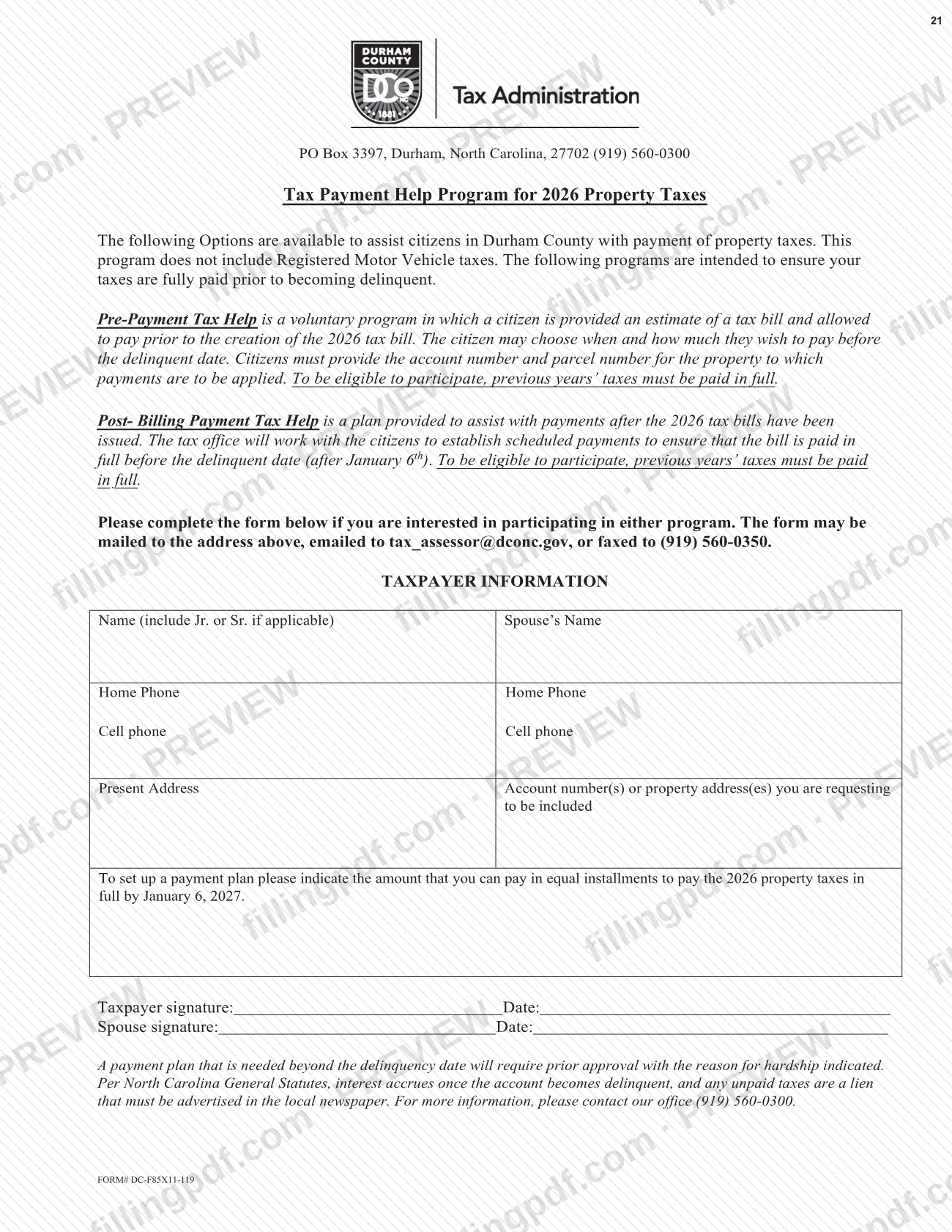
The Tax Payment Help Program application (Form DC-F85X11-119) is the form Durham County Tax Administration uses to enroll property owners in Pre-Payment Tax Help or Post-Billing Payment Tax Help, two programs for paying 2026 property taxes in installments before they become delinquent. It is one of the resources for Durham County property tax payments, and it does not cover Registered Motor Vehicle taxes. On this page you can fill out the form online on FillingPDF and download or print the completed PDF; the county publishes the original at the link below, and you return the form to the tax office yourself.
Last updated
What is DC-F85X11-119?
The Tax Payment Help Program application is the Durham County Tax Administration form that property owners complete to take part in a county plan for paying 2026 property taxes in installments, so the taxes are fully paid before they become delinquent.
One form serves two programs:
- Pre-Payment Tax Help is voluntary. The taxpayer is given an estimate of the tax bill and may pay before the 2026 tax bill is created, choosing when and how much to pay before the delinquent date. The taxpayer must give the account number and parcel number of the property to which the payments are applied.
- Post-Billing Payment Tax Help applies after the 2026 tax bills have been issued. The tax office works with the taxpayer to set scheduled payments so the bill is paid in full before the delinquent date, which falls after January 6.
The form itself asks for taxpayer and spouse details, the accounts or properties to include, the installment amount the taxpayer can pay, and signatures. It states that the programs do not include Registered Motor Vehicle taxes.
The application is not a homestead tax relief application. The county's Tax Payment Help Programs page describes the homestead programs separately and lists a June 1 application deadline for them. That page also points low-income, longtime homeowners to the Department of Social Services (DSS) Low Income Homeowner Relief (LIHR) Program.
Who needs to file DC-F85X11-119?
Durham County property owners who want to pay their 2026 property taxes in scheduled installments, rather than in one payment, use this application. It covers two situations: paying ahead of the tax bill (Pre-Payment Tax Help) and setting up a schedule after the bill is issued (Post-Billing Payment Tax Help).
Conditions that apply:
- Previous years' taxes must be paid in full to take part in either program.
- Registered Motor Vehicle taxes are not part of the program.
- For Pre-Payment Tax Help, you must be able to give the account number and parcel number of the property that will receive the payments.
- A spouse can be listed on the form, with their own phone numbers and signature line.
If you need a payment plan that runs beyond the delinquency date, this application alone is not enough: the form says such a plan needs prior approval, with the reason for hardship indicated, and the county's page says a hardship form is completed and the plan is at the Tax Collector's discretion. Homestead tax relief uses a different application, and the Department of Social Services (DSS) handles the Low Income Homeowner Relief (LIHR) Program.
When to file DC-F85X11-119
Submit the application when you want to start a payment plan: before the 2026 tax bill is created for Pre-Payment Tax Help, or after the 2026 bills have been issued for Post-Billing Payment Tax Help. The form prints no separate deadline for returning it. What it sets is the payment target: the installments you propose should pay the 2026 property taxes in full by January 6, 2027, and the delinquent date falls after January 6.
A plan needed beyond the delinquency date requires prior approval with the reason for hardship indicated. Once an account is delinquent, North Carolina General Statutes apply: interest accrues, and unpaid taxes are a lien that must be advertised in the local newspaper. On the county's page, a delinquent account on a hardship plan must keep making monthly payments; missed payments remove the property from the plan and expose it to enforcement actions. Call (919) 560-0300 with questions about timing.
How to fill out DC-F85X11-119
Enter the taxpayer's name
In the Taxpayer Information section, write your name under Name, adding Jr. or Sr. if it applies.
Add the spouse's name
Enter your spouse's name under Spouse's Name if a spouse is to be included in the plan.
Provide phone numbers
Fill in the Home Phone and Cell phone lines for the taxpayer and, separately, for the spouse.
Enter your present address
Write your current mailing address in the Present Address field.
List the accounts or properties
Under Account number(s) or property address(es) you are requesting to be included, list each account or property. For Pre-Payment Tax Help, give the account number and the parcel number of the property that will receive the payments.
State the installment amount
In the payment plan line, indicate the amount you can pay in equal installments so the 2026 property taxes are paid in full by January 6, 2027.
Sign and date the application
Sign and date the Taxpayer signature line. If a spouse is listed, the spouse signs and dates the Spouse signature line.
Review and download the completed PDF
Check names, phone numbers, account or parcel numbers and the installment amount. Download or print the completed PDF from FillingPDF, then return it to the tax office through one of the channels described under How to submit.
How to submit DC-F85X11-119
You can return the completed application to Durham County Tax Administration by mail, email or fax.
- Mail: PO Box 3397, Durham, North Carolina, 27702.
- Email: [email protected].
- Fax: (919) 560-0350.
The form lists (919) 560-0300 as the office phone number for more information. It names no other channel and prints no payment instructions; installments are arranged with the tax office once the application is in. The signed form should carry the taxpayer's signature and, if a spouse is listed, the spouse's signature. FillingPDF lets you fill out and download the PDF; submission follows the county's channels above.
Common mistakes to avoid
- Applying while previous years' taxes are unpaid; both Pre-Payment Tax Help and Post-Billing Payment Tax Help require previous years' taxes to be paid in full.
- Using the application for Registered Motor Vehicle taxes, which the program does not include.
- Leaving out the account number or parcel number for Pre-Payment Tax Help, when the property to receive payments must be identified by both.
- Proposing an installment amount that will not pay the 2026 property taxes in full by January 6, 2027.
- Assuming a plan that runs past the delinquency date is automatic; it needs prior approval with the reason for hardship indicated.
- Missing monthly payments on a hardship plan; the county's page says the property is then removed from the plan and is subject to enforcement actions.
- Expecting interest or the lien advertisement to stop because a plan exists; the form and county page say interest accrues once the account is delinquent and the lien must be advertised.
- Returning the form unsigned, or without the spouse's signature when a spouse is listed on the application.
Frequently asked questions
What is the Durham County Tax Payment Help Program application?
It is a Durham County Tax Administration form for enrolling in Pre-Payment Tax Help or Post-Billing Payment Tax Help, two programs that spread payment of 2026 property taxes into installments so the bill is fully paid before it becomes delinquent.
Who is eligible for the Tax Payment Help Program?
Durham County property owners whose previous years' taxes are paid in full. The form states that requirement for both programs. Registered Motor Vehicle taxes are not included in the program.
What is the difference between Pre-Payment and Post-Billing Tax Help?
Pre-Payment Tax Help lets you pay against an estimate before the 2026 tax bill is created, choosing when and how much to pay. Post-Billing Payment Tax Help sets scheduled payments with the tax office after the 2026 bills are issued.
By what date must the 2026 taxes be paid under the plan?
The form asks for installments that pay the 2026 property taxes in full by January 6, 2027. Taxes become delinquent after January 6, and interest accrues once the account is delinquent under North Carolina General Statutes.
Where do I send the Tax Payment Help Program application?
Mail it to PO Box 3397, Durham, North Carolina, 27702, email it to [email protected], or fax it to (919) 560-0350. For questions, the form lists the tax office phone number, (919) 560-0300.
Can I get a payment plan after my taxes become delinquent?
Only with prior approval. The form says a plan beyond the delinquency date requires the reason for hardship to be indicated. The county's page adds that these plans are at the Tax Collector's discretion and require monthly payments.
Can I fill out the Tax Payment Help Program application online?
You can fill out the PDF online on FillingPDF and download or print it. FillingPDF is an independent service and does not send the form to Durham County; you return it to the tax office by mail, email or fax.
Does the program cover vehicle taxes?
No. The form says the program does not include Registered Motor Vehicle taxes. It applies to the property taxes on the accounts or property addresses you list on the application.
Ready to fill out DC-F85X11-119?
Fill out DC-F85X11-119 now