
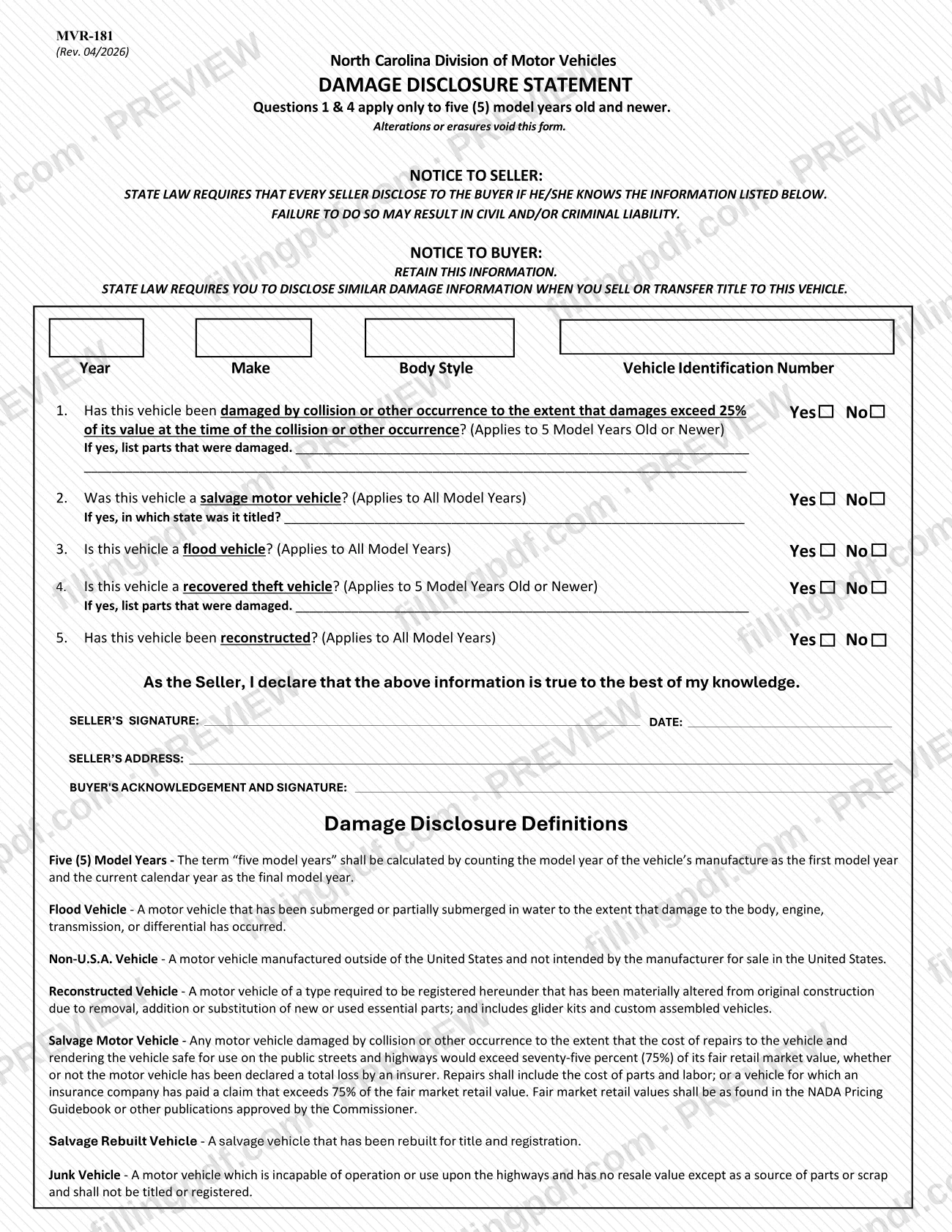
MVR-181, the Damage Disclosure Statement, is the North Carolina Division of Motor Vehicles (NCDMV) form on which a vehicle seller discloses to the buyer whether the vehicle has been damaged, salvaged, flooded, stolen and recovered, or reconstructed. The seller answers five yes/no questions and signs; the buyer acknowledges and signs. On this page you can fill out the form online on FillingPDF and download or print the completed PDF; the original form is published by the NCDMV at ncdot.gov.
Last updated
What is MVR-181?
Form MVR-181, Damage Disclosure Statement, is the North Carolina Division of Motor Vehicles (NCDMV) form on which a seller states, to the best of the seller's knowledge, whether a vehicle has a damage history that the buyer must be told about.
The form opens with the vehicle's year, make, body style and Vehicle Identification Number, then asks five questions:
- Question 1: damage by collision or other occurrence exceeding 25% of the vehicle's value at the time (five model years old or newer).
- Question 2: whether the vehicle was a salvage motor vehicle, and in which state it was titled (all model years).
- Question 3: whether it is a flood vehicle (all model years).
- Question 4: whether it is a recovered theft vehicle (five model years old or newer).
- Question 5: whether it has been reconstructed (all model years).
The seller declares the answers true and signs with a date and address, and the buyer signs an acknowledgement. The form warns that state law requires every seller to disclose this information if known, and that failure to do so may result in civil and/or criminal liability. Alterations or erasures void the form.
A definitions section on the form explains five model years, flood vehicle, non-U.S.A. vehicle, reconstructed vehicle, salvage motor vehicle, salvage rebuilt vehicle and junk vehicle.
Who needs to file MVR-181?
Sellers of a motor vehicle complete MVR-181. The form's notice to seller says state law requires every seller to disclose to the buyer the information listed on it, if the seller knows it, and that failing to do so may result in civil and/or criminal liability.
Buyers sign the Buyer's Acknowledgement and Signature line and should keep the form. The notice to buyer says to retain the information and that state law requires you to disclose similar damage information when you later sell or transfer title to the vehicle.
Which questions apply depends on the vehicle's age:
- Questions 1 and 4 apply only to vehicles five model years old or newer. The form counts the vehicle's model year of manufacture as the first model year and the current calendar year as the final one.
- Questions 2, 3 and 5 apply to all model years.
The form does not describe a representative signing for the seller or the buyer.
When to file MVR-181
The triggering event is the sale or transfer of title of a vehicle: the seller's notice says state law requires disclosure to the buyer, and the buyer's notice refers to disclosing similar information when you sell or transfer title. No separate due date, renewal cycle or validity period is printed on the form.
Because the model-year count uses the current calendar year as the final year, whether Questions 1 and 4 apply to a vehicle can depend on the year in which the sale takes place.
How to fill out MVR-181
Enter the vehicle information
At the top, enter the vehicle's Year, Make, Body Style and Vehicle Identification Number.
Answer Question 1 on collision damage
Check Yes or No for whether damage by collision or other occurrence exceeded 25% of the vehicle's value at the time. This question applies to vehicles five model years old or newer; if Yes, list the damaged parts.
Answer Question 2 on salvage
Check Yes or No for whether the vehicle was a salvage motor vehicle (all model years). If Yes, write the state in which it was titled.
Answer Question 3 on flooding
Check Yes or No for whether the vehicle is a flood vehicle, as defined at the bottom of the form (all model years).
Answer Question 4 on recovered theft
Check Yes or No for whether the vehicle is a recovered theft vehicle (five model years old or newer). If Yes, list the damaged parts.
Answer Question 5 on reconstruction
Check Yes or No for whether the vehicle has been reconstructed (all model years), using the form's definition of a reconstructed vehicle.
Sign as the seller
The seller signs and dates the declaration that the information is true to the best of the seller's knowledge, and enters the Seller's Address.
Obtain the buyer's acknowledgement
The buyer signs the Buyer's Acknowledgement and Signature line and keeps the information, as the notice to buyer directs.
Review and download the completed PDF
Check that every question is answered, that nothing is altered or erased, and that both signature blocks are done. Download or print the completed PDF from FillingPDF.
How to submit MVR-181
MVR-181 is a statement between the seller and the buyer. The form prints no mailing address, portal, fee or office to send it to, and it does not name any channel for returning it to the NCDMV.
- Seller: complete the form without alterations or erasures, which void it, then sign, date and enter your address.
- Buyer: read the disclosures, sign the Buyer's Acknowledgement and Signature line and keep the form, as the buyer's notice instructs.
If you need to know whether the NCDMV wants a copy with a title or registration transaction, check with the NCDMV, which publishes the form at https://www.ncdot.gov/dmv/downloads/Documents/MVR-181.pdf. FillingPDF lets you fill out and download the PDF; handing it over or submitting it follows the channels above.
Common mistakes to avoid
- Altering or erasing an entry: the form states that alterations or erasures void it.
- Leaving out damage the seller knows about; the notice to seller says failing to disclose may result in civil and/or criminal liability.
- Overlooking that Questions 1 and 4 apply only to vehicles five model years old or newer, while Questions 2, 3 and 5 apply to all model years.
- Counting five model years from the wrong year: the model year of manufacture counts as the first and the current calendar year as the last.
- Answering Yes to Question 1 or Question 4 without listing the damaged parts on the line that follows.
- Answering Yes to Question 2 without writing the state in which the vehicle was titled.
- Confusing the 25% damage threshold in Question 1 with the salvage definition, which uses 75% of fair retail market value.
- Handing over the form unsigned, or without the seller's date and address.
Frequently asked questions
What is MVR-181 used for?
MVR-181 is the NCDMV Damage Disclosure Statement. The seller uses it to tell the buyer, in writing, whether the vehicle had major collision damage, was a salvage vehicle, is a flood vehicle, is a recovered theft vehicle or has been reconstructed.
Who has to complete the MVR-181 form?
The seller completes and signs it. The form says state law requires every seller to disclose this information to the buyer if the seller knows it. The buyer signs an acknowledgement and keeps the information.
Which MVR-181 questions apply to older vehicles?
Questions 2 (salvage), 3 (flood) and 5 (reconstructed) apply to all model years. Questions 1 (damage over 25% of value) and 4 (recovered theft) apply only to vehicles five model years old or newer.
How are five model years counted on the damage disclosure statement?
The vehicle's model year of manufacture counts as the first model year and the current calendar year as the final one. The form gives this definition in its Damage Disclosure Definitions section.
What counts as a salvage motor vehicle on MVR-181?
A motor vehicle damaged by collision or other occurrence so that repair costs, including making it safe for public roads, would exceed 75% of its fair retail market value, whether or not an insurer declared a total loss. The form gives the full definition.
What happens if a seller does not disclose damage on MVR-181?
The form warns that failing to disclose known information may result in civil and/or criminal liability. It also states that alterations or erasures void the form, so corrections should not be made by erasing.
Where do I send MVR-181?
The form prints no address or portal. It is a disclosure from seller to buyer, and the buyer keeps it. For any NCDMV requirement to submit a copy with a title or registration transaction, check with the NCDMV.
Can I fill out MVR-181 online?
Yes. You can fill out the PDF online on FillingPDF and download or print it. FillingPDF is an independent service and does not file the form or deliver it to the buyer or the NCDMV.
Ready to fill out MVR-181?
Fill out MVR-181 now