
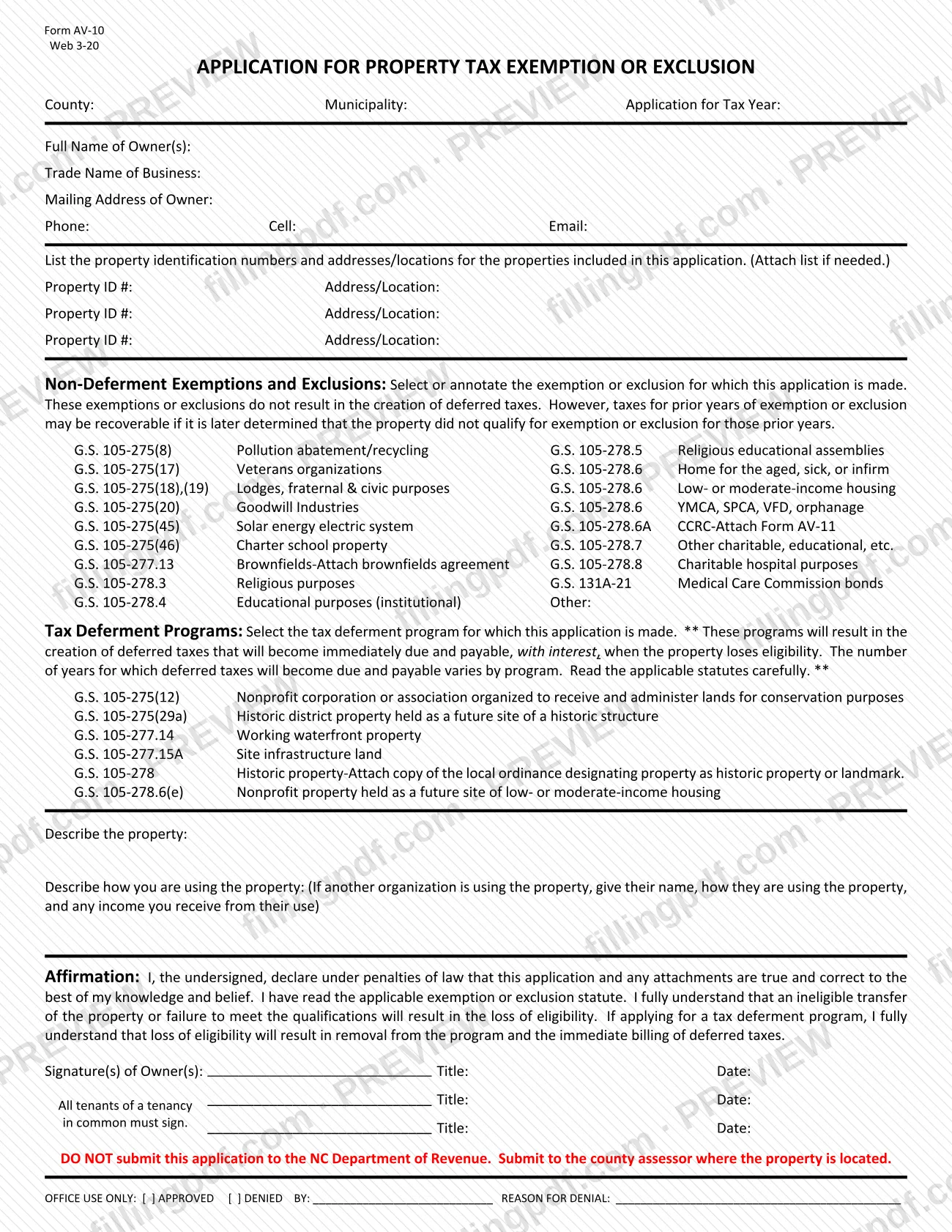
Form AV-10, titled Application for Property Tax Exemption or Exclusion, is the form an owner uses to ask the county for an exemption, an exclusion or a tax deferment program; the Gaston County Tax Office publishes it as Business Personal Property Exemption Application Form AV-10. It is one of the Gaston County property tax forms for business owners, and the county sets a January 31 deadline for timely applications. On this page you can fill out the form online on FillingPDF and download or print the completed PDF; the official PDF is published by the county at gastongov.com.
Last updated
What is AV-10?
Form AV-10, Application for Property Tax Exemption or Exclusion, is the North Carolina form on which a property owner asks the county assessor to exempt or exclude property from property tax, or to place it in a tax deferment program. The Gaston County Tax Office posts it as Business Personal Property Exemption Application Form AV-10.
The form is built around the statute that supports the request. Its first list, Non-Deferment Exemptions and Exclusions, covers grounds such as G.S. 105-275(8) pollution abatement/recycling, G.S. 105-278.3 religious purposes, G.S. 105-278.4 educational purposes (institutional), G.S. 105-278.8 charitable hospital purposes and an Other: line. These do not create deferred taxes, but taxes for prior years may be recoverable if the property is later found not to have qualified.
Its second list, Tax Deferment Programs, covers grounds such as G.S. 105-277.14 working waterfront property and G.S. 105-278 historic property. These programs create deferred taxes that become immediately due and payable, with interest, when the property loses eligibility.
The form also asks you to describe the property and how you use it, and it ends with an affirmation signed under penalties of law. The Gaston County page lists two companion forms next to it: Form AV-11, the Continuing Care Retirement Center addendum, and Business Personal Property Exemption Application Form AV-12. The form is not filed with the NC Department of Revenue.
Who needs to file AV-10?
Owners who claim that their property is exempt or excluded from property tax, or who want it in a tax deferment program, complete Form AV-10. The Gaston County Tax Office page applies it to business personal property, and the form itself lets you list several properties by property ID number and address.
Conditions from the county page and the form:
- Business owners exempt in prior years do not have to file again for assets that were already exempt, but must file a new application each year for newly acquired assets.
- Having 501(c)(3) status from the North Carolina Department of Revenue, or non-profit status from the North Carolina Secretary of State, does not automatically exempt a business from property tax; an AV-10 is still required.
- A completed copy of your application to the Department of Environmental Quality (DEQ) may be submitted instead of Form AV-10. Exempt status is not given until DEQ certification has been granted.
- Owners of a continuing care retirement community (G.S. 105-278.6A) attach Form AV-11.
- When property is held as a tenancy in common, all tenants must sign.
Any owner who claims an exemption or exclusion must establish that the property qualifies.
When to file AV-10
Timely exemption applications for business personal property must be filed by January 31. Business owners who were granted an extension until April 15 to list their business personal property also have until April 15 to file a timely exemption application.
Late applications are accepted until December 31, but every late application must go before the Board of Equalization and Review, which accepts or denies it for "good cause."
Because an application is needed every year for newly acquired assets, plan to file each year in which you acquire property you want exempted. Property that has already received exempt status may be audited periodically to confirm the requirements are still met. The form sets no processing time.
Documents you need
- A list of additional properties, with property ID numbers and addresses/locations, only if the three lines on the form are not enough.
- Form AV-11, only if you apply under G.S. 105-278.6A for a continuing care retirement community (CCRC).
- The brownfields agreement, only if you apply under G.S. 105-277.13 Brownfields.
- A copy of the local ordinance designating the property as historic property or a landmark, only if you apply under G.S. 105-278 Historic property.
How to fill out AV-10
Enter county, municipality and tax year
At the top, fill in County, Municipality and Application for Tax Year.
Enter owner and business details
Write the Full Name of Owner(s), the Trade Name of Business and the Mailing Address of Owner. Add Phone, Cell and Email.
List the properties
Enter the Property ID # and Address/Location for each property in the application. Attach a list if the three lines are not enough.
Select a non-deferment exemption
If your request does not create deferred taxes, select or annotate the exemption or exclusion by its G.S. citation, or write it on the Other: line. Attach the brownfields agreement for G.S. 105-277.13 or Form AV-11 for G.S. 105-278.6A.
Or select a tax deferment program
If you apply to a deferment program, select it instead. For G.S. 105-278 Historic property, attach the local ordinance designating the property as historic property or a landmark.
Describe the property
Under Describe the property, state what the property is.
Describe how you use it
Explain how you are using the property. If another organization uses it, give its name, how it uses the property and any income you receive from that use.
Read the affirmation and sign
Sign under Signature(s) of Owner(s), and enter your Title and Date. All tenants of a tenancy in common must sign.
Leave the office use box blank
Do not fill in the Office Use Only section; the county marks it approved or denied.
Review and download the completed PDF
Check that every entry matches your records and that you have the needed attachments. Download or print the completed PDF from FillingPDF and submit it as described under How to submit.
How to submit AV-10
Form AV-10 goes to the county assessor where the property is located; the form states that it must not be sent to the NC Department of Revenue.
- County assessor: submit the signed application to the assessor of the county where the property is located. For property in Gaston County, the form is published by the Gaston County Tax Office. Neither the form nor the county page prints a street address, portal or appointment rule for it, so confirm the delivery details with the Gaston County Tax Office.
- DEQ application instead: a completed copy of your application to the Department of Environmental Quality (DEQ) may be submitted in place of Form AV-10. It must still arrive by January 31, and exempt status is not granted until DEQ certification is granted.
Include any attachments that your selected exemption or program requires: a property list if the form's lines are not enough, Form AV-11 for G.S. 105-278.6A, the brownfields agreement for G.S. 105-277.13, or the local ordinance for G.S. 105-278. The "Office Use Only" box (approved or denied, with a reason for denial) is completed by the county. FillingPDF lets you fill out and download the PDF; submission follows the channels above.
Common mistakes to avoid
- Sending Form AV-10 to the NC Department of Revenue; the form says to submit it to the county assessor where the property is located.
- Assuming 501(c)(3) or Secretary of State non-profit status exempts the property automatically; the county still requires an AV-10 filed by January 31.
- Skipping a new application for newly acquired assets because earlier assets were already exempt.
- Missing the January 31 deadline; applications after that date can be accepted only until December 31, and only through the Board of Equalization and Review for good cause.
- Picking a tax deferment program without reading the statute; deferred taxes become due immediately, with interest, when eligibility is lost.
- Attaching nothing for G.S. 105-277.13, G.S. 105-278 or G.S. 105-278.6A when the form calls for the brownfields agreement, local ordinance or Form AV-11.
- Signing for a tenancy in common with fewer than all tenants; all tenants must sign.
- Leaving the use description blank when another organization uses the property; the form asks for its name, its use and any income you receive.
Frequently asked questions
What is Form AV-10 used for?
Form AV-10, Application for Property Tax Exemption or Exclusion, is used to ask the county assessor to exempt or exclude property from property tax, or to place it in a tax deferment program. Gaston County posts it as the Business Personal Property Exemption Application Form AV-10.
How do I claim an exemption from Gaston County property tax?
Complete Form AV-10, select the exemption, exclusion or deferment program under which you apply, sign it and submit it to the county assessor, not the NC Department of Revenue. Timely business personal property applications are due by January 31.
What is the deadline for Form AV-10 in Gaston County?
January 31 for timely business personal property exemption applications. Owners granted an extension until April 15 to list their property also have until April 15. Late applications are accepted until December 31 only with good cause, decided by the Board of Equalization and Review.
Do I have to file Form AV-10 every year?
Not for assets that were already exempt in prior years, but you must file a new application each year for newly acquired assets. Property with exempt status may be audited periodically to confirm it still qualifies.
Are 501(c)(3) organizations automatically exempt from Gaston County property tax?
No. The county says 501(c)(3) status from the NC Department of Revenue, or non-profit status from the NC Secretary of State, does not automatically exempt a business. An AV-10 must still be completed and submitted by January 31.
Can I send a DEQ application instead of Form AV-10?
Yes, for the pollution-related exemption the county describes: a completed copy of your Department of Environmental Quality application may be submitted instead of Form AV-10. It must still be filed by January 31, and exempt status waits for DEQ certification.
What is the difference between an exemption and a tax deferment program on this form?
Non-deferment exemptions and exclusions create no deferred taxes, though prior years may be recovered if the property did not qualify. Deferment programs create deferred taxes that become immediately due, with interest, when the property loses eligibility.
Can I fill out Form AV-10 online on FillingPDF?
Yes. You can fill out the PDF online on FillingPDF and download or print it. FillingPDF is independent of Gaston County and does not file the form; you submit it to the county assessor yourself.
Ready to fill out AV-10?
Fill out AV-10 now