
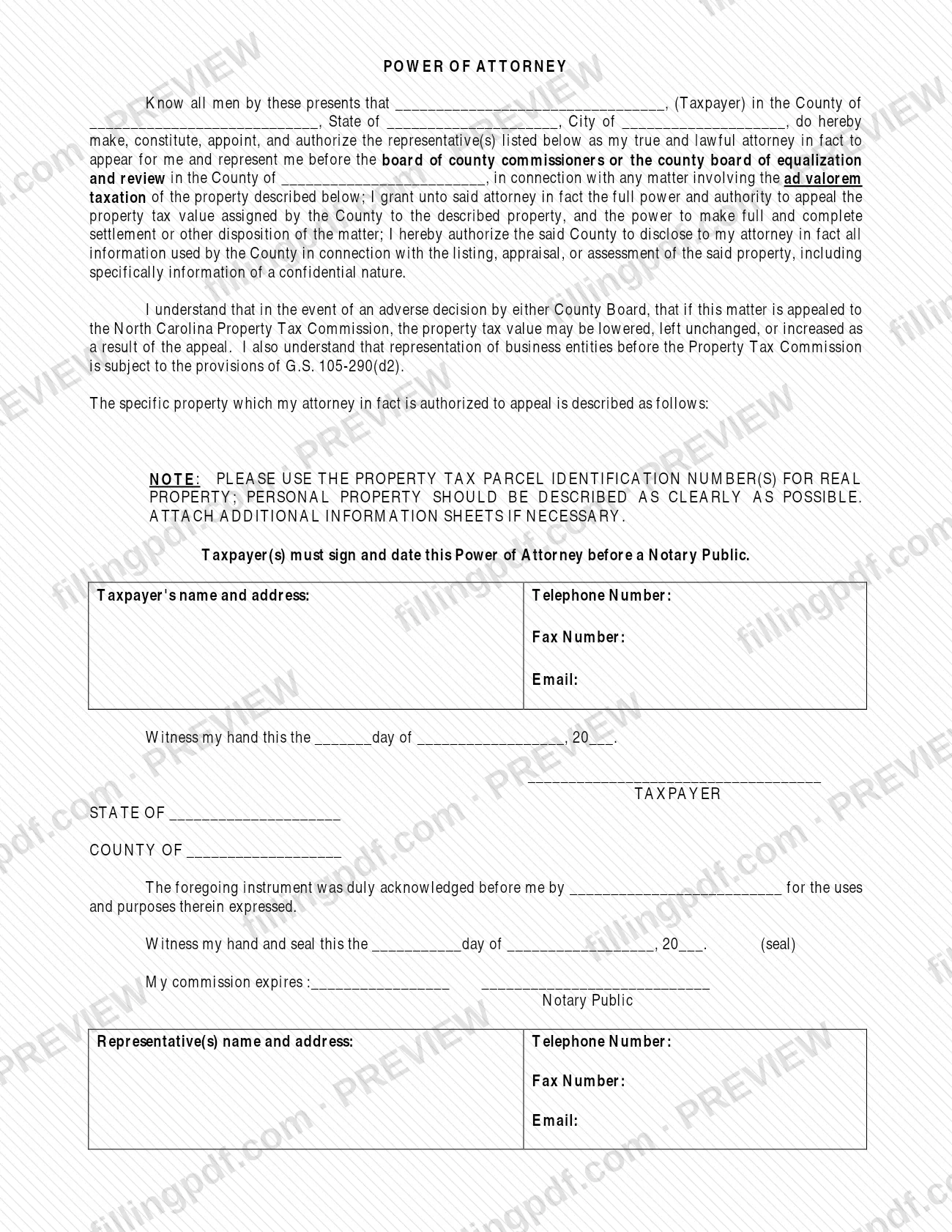
The Power of Attorney Form is the North Carolina Department of Revenue (NCDOR) document that lets a taxpayer appoint a representative to appear for them in a county property tax matter. It covers appearances before the board of county commissioners or the county board of equalization and review, and the taxpayer must sign it before a Notary Public. On this page you can fill out the form online on FillingPDF and download or print the completed PDF; the original PDF is published by the NCDOR.
Last updated
What is Power of Attorney Form – North Carolina?
The Power of Attorney Form is the North Carolina Department of Revenue (NCDOR) document by which a taxpayer authorizes a representative to appear before the board of county commissioners or the county board of equalization and review on property tax matters.
In the form, the taxpayer makes, constitutes, appoints and authorizes the listed representative(s) as attorney in fact for any matter involving the ad valorem taxation of the property described on the form. The attorney in fact receives full power and authority to appeal the property tax value the county assigned to that property and to make full and complete settlement or other disposition of the matter.
The taxpayer also authorizes the county to disclose to the attorney in fact all information it used to list, appraise or assess the property, including information of a confidential nature.
The form carries two statements the taxpayer acknowledges. If an adverse decision by either county board is appealed to the North Carolina Property Tax Commission, the property tax value may be lowered, left unchanged or increased. Representation of business entities before the Property Tax Commission is subject to G.S. 105-290(d2).
The authority is limited to the county named on the form and the property described on it. The form has a notary acknowledgment block and contact blocks for the taxpayer and for the representative(s).
Who needs to file Power of Attorney Form – North Carolina?
A taxpayer who wants someone else to appeal the county's property tax value for them uses this form. It is signed by the taxpayer(s), who must sign and date it before a Notary Public.
- Taxpayers with real property: identify each parcel by its property tax parcel identification number.
- Taxpayers with personal property: describe the property as clearly as possible.
- Taxpayers appointing more than one representative: the form refers to the representative(s) listed in its representative block.
- Representatives: the person named as attorney in fact acts before the board of county commissioners or the county board of equalization and review in the county named on the form.
The form is limited in scope. It authorizes action on the ad valorem taxation of the property described on it, before the county boards, so it is not a general power of attorney for other matters. Anyone who represents a business entity before the North Carolina Property Tax Commission should read G.S. 105-290(d2), which the form cites.
When to file Power of Attorney Form – North Carolina
Complete the form when you decide to have a representative appear for you in a county property tax matter, such as an appeal of the value the county assigned to your property. The taxpayer must sign and date it before a Notary Public, so the notary appointment comes before the form is used.
No due date is printed on the form. It is tied to the county matter it covers: it authorizes appearances before the board of county commissioners or the county board of equalization and review in the county named on it, and the power to appeal and settle the matter described.
If the matter is later appealed to the North Carolina Property Tax Commission, the form notes that the property tax value may be lowered, left unchanged or increased.
Documents you need
- Additional information sheets describing the property, only if the space on the form is not enough; the form says to attach them if necessary.
How to fill out Power of Attorney Form – North Carolina
Enter the taxpayer and location
In the opening clause, write the taxpayer's name, then the county, state and city where the taxpayer is located.
Name the county for the appeal
Write the county whose board of county commissioners or county board of equalization and review the representative will appear before. The authority applies to that county.
Describe the property
Under the property description, use the property tax parcel identification number(s) for real property. Describe personal property as clearly as possible and attach additional information sheets if necessary.
Add the taxpayer's contact details
Enter the taxpayer's name and address, telephone number, fax number and email in the taxpayer block.
Date the instrument
Complete the line "Witness my hand this the ___ day of , 20" with the day, month and year of signing.
Sign before a Notary Public
Each taxpayer signs on the line marked TAXPAYER in front of the notary. Do not sign ahead of time: the form requires signing and dating before a Notary Public.
Have the notary complete the acknowledgment
The notary fills in the state, county, the name of the person acknowledging, the date, the commission expiration date, the signature and the seal.
List the representative(s)
In the representative block, enter the name and address, telephone number, fax number and email of each representative appointed.
Review and download the completed PDF
Check the county, the property description, the dates and the contact blocks. Download or print the completed PDF from FillingPDF and take it to the notary for signing.
How to submit Power of Attorney Form – North Carolina
The form names no mailing address, portal or appointment rule of its own. It is an authorization addressed to the board of county commissioners or the county board of equalization and review in the county you write on it.
- Before using it: the taxpayer signs and dates it in front of a Notary Public, who completes the acknowledgment block and seal.
- Where it goes: it concerns the county named in the form, so it follows the process of that county's board for the property tax matter.
- Where to get it: the NCDOR publishes the form at https://www.ncdor.gov/documents/files/power-attorney-form/open.
Attach additional information sheets if the property description does not fit in the space on the form. FillingPDF lets you fill out and download the PDF; submission follows the county's channels.
Common mistakes to avoid
- Signing without a Notary Public. The form says the taxpayer(s) must sign and date it before a Notary Public.
- Describing real property in words instead of using the property tax parcel identification number(s), which the form's note asks for.
- Describing personal property vaguely; the form says it should be described as clearly as possible.
- Leaving out additional information sheets when the property description does not fit in the space provided.
- Leaving the county blank in the clause naming the county boards, so the authority has no county to apply to.
- Assuming an appeal can only lower the value; the form states the value may be lowered, left unchanged or increased if appealed to the Property Tax Commission.
- Using the form as a general power of attorney; it covers only ad valorem property taxation matters before the county boards.
- Leaving the representative's name, address and contact lines empty.
Frequently asked questions
What is the North Carolina Power of Attorney Form for?
This power of attorney form, published by the NCDOR, appoints a representative to appear before the board of county commissioners or the county board of equalization and review on the ad valorem taxation of described property, including appealing its assigned value.
Does the Power of Attorney Form have to be notarized?
Yes. The form states that the taxpayer(s) must sign and date it before a Notary Public. It includes an acknowledgment block for the notary's name, commission expiration date and seal.
What can my representative do under this form?
The attorney in fact may appear for you before the county boards, appeal the property tax value assigned to the described property, and make full and complete settlement or other disposition of the matter. You also authorize the county to disclose its confidential property information to them.
Can an appeal raise my property tax value?
Yes, it can. The form says that if an adverse decision by either county board is appealed to the North Carolina Property Tax Commission, the property tax value may be lowered, left unchanged or increased.
How do I describe the property on the form?
For real property, use the property tax parcel identification number(s). Describe personal property as clearly as possible. If the space is not enough, attach additional information sheets, as the form's note instructs.
Is this a general power of attorney?
No. It is limited to matters involving the ad valorem taxation of the property described on it, before the board of county commissioners or the county board of equalization and review in the named county.
Can I fill out the Power of Attorney Form online?
Yes. You can fill out the form online on FillingPDF and download or print the PDF. FillingPDF is an independent service, not affiliated with the NCDOR, and it does not file or notarize the form; you still sign it before a notary.
Ready to fill out Power of Attorney Form – North Carolina?
Fill out Power of Attorney Form – North Carolina now