
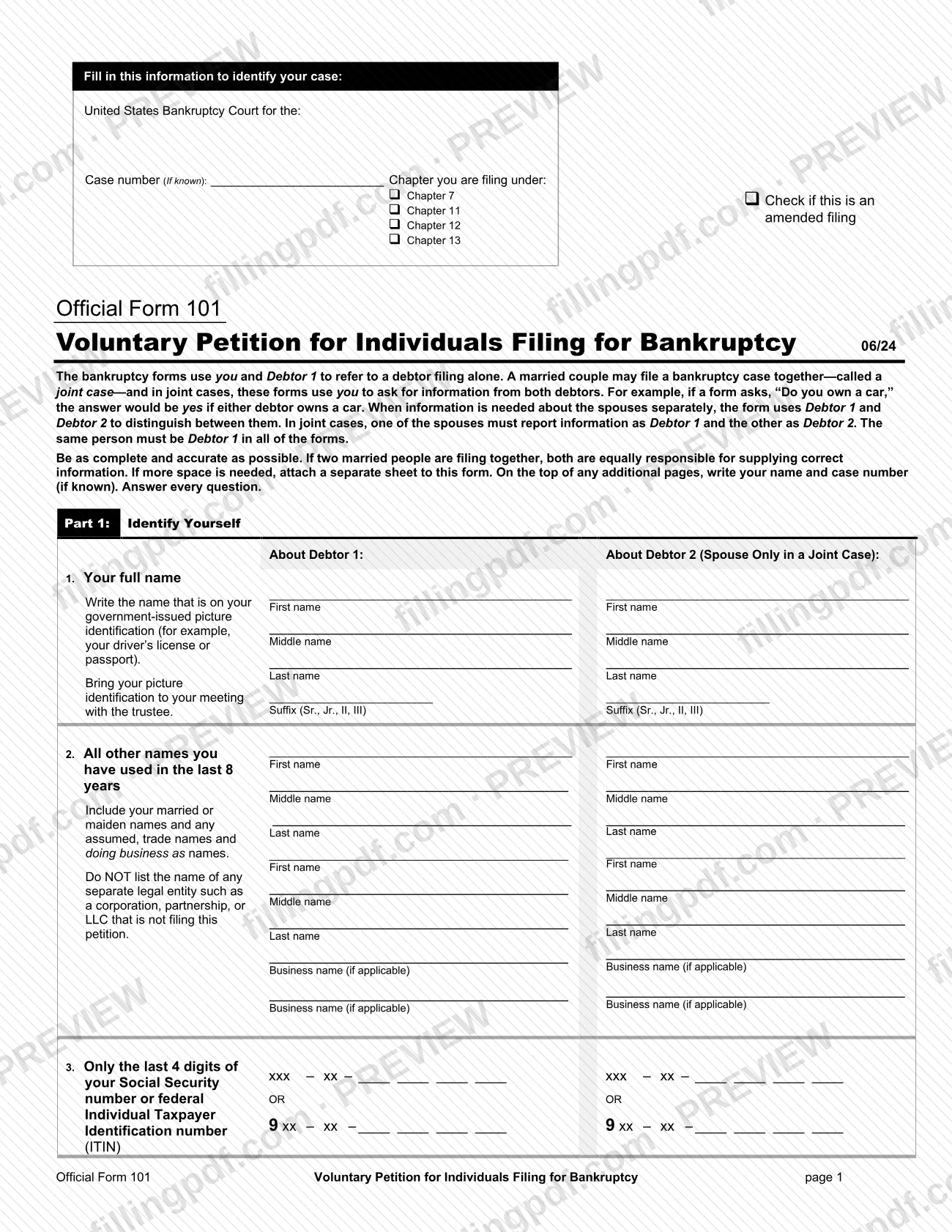
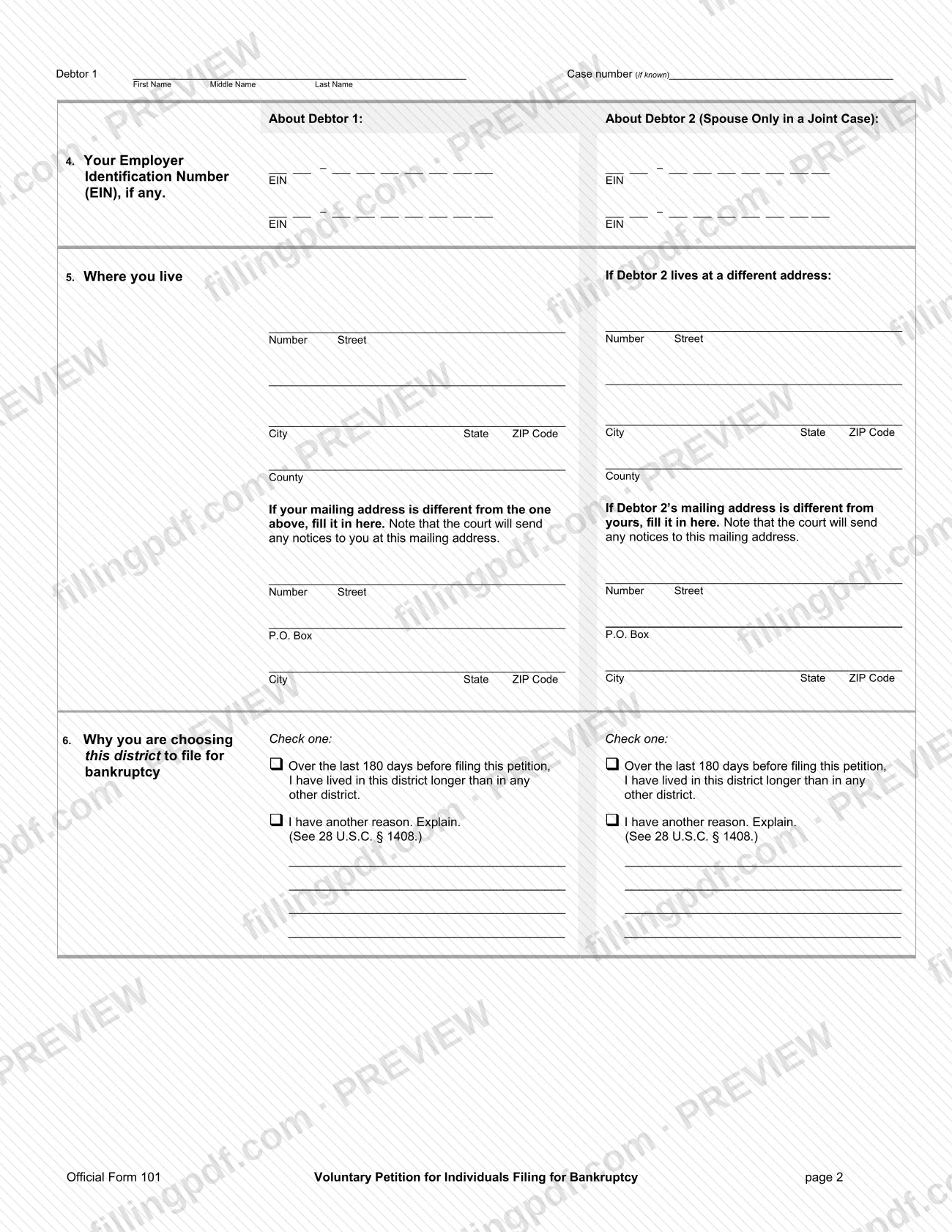
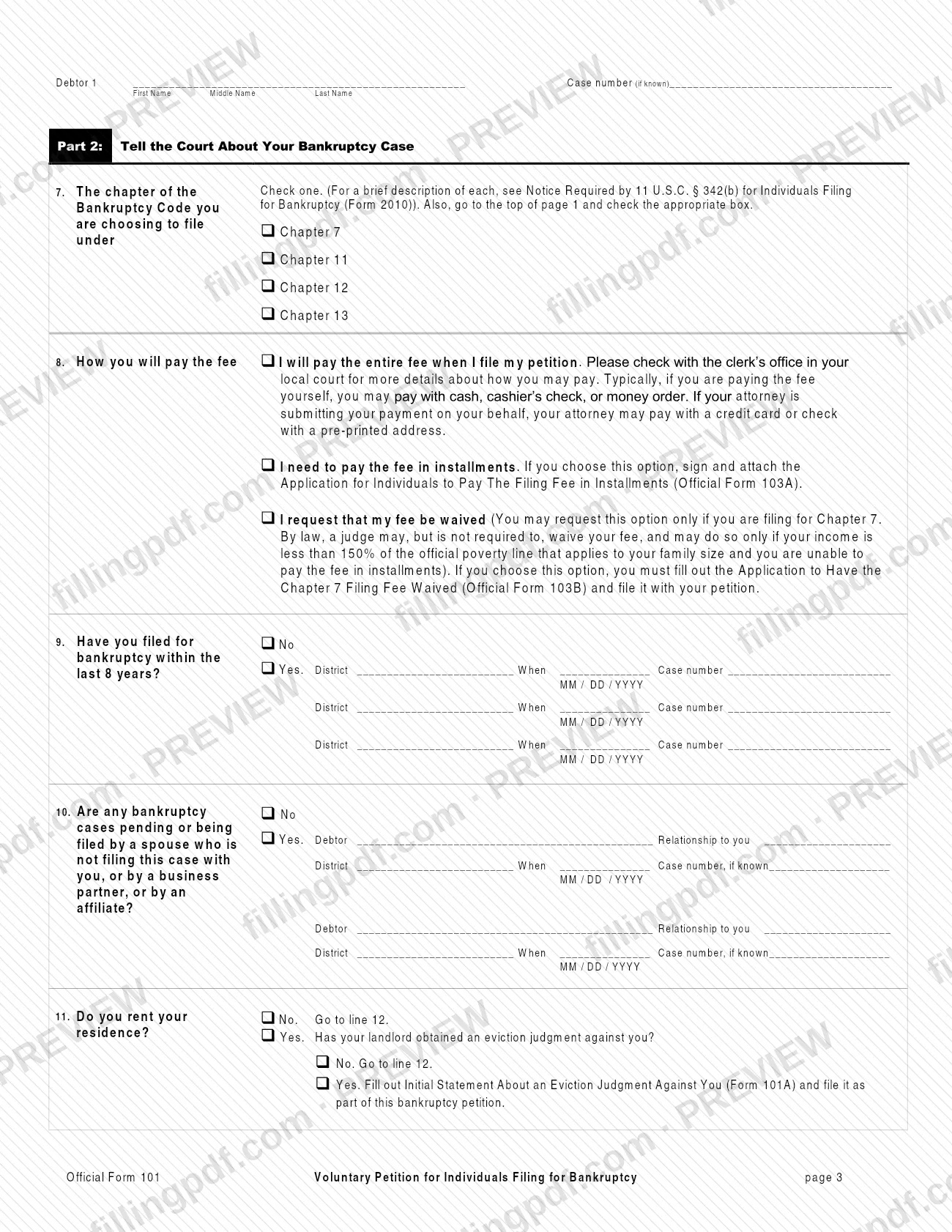
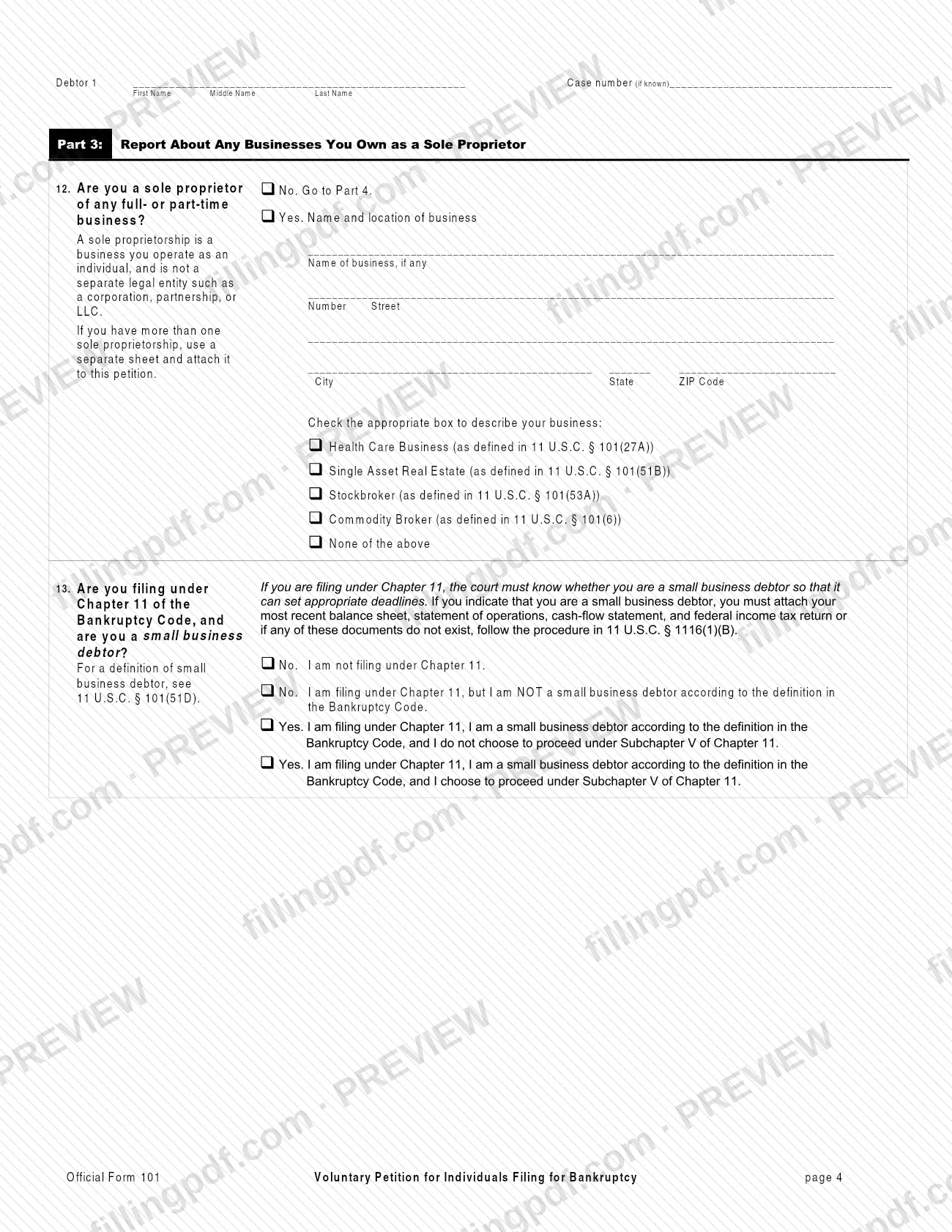
B101, printed as Official Form 101, Voluntary Petition for Individuals Filing for Bankruptcy, is the form that opens a bankruptcy case for an individual or a married couple in a U.S. Bankruptcy Court. The Administrative Office of the U.S. Courts publishes it with the other bankruptcy forms for individuals. On this page you can fill out the form online on FillingPDF and download or print the completed PDF; the court receives the petition only through the channels described below, and the official form and instructions are published at uscourts.gov.
Last updated
What is Official Form 101?
Official Form 101, Voluntary Petition for Individuals Filing for Bankruptcy, often searched as B101, is the form an individual or married couple files to open a bankruptcy case in a U.S. Bankruptcy Court and to state the chapter of the Bankruptcy Code chosen.
The instructions booklet for individuals says this form opens the case, and that directions for completing it are printed on the form itself. It is the first of the forms an individual gives the court; schedules, statements and other documents follow with it or within 14 days.
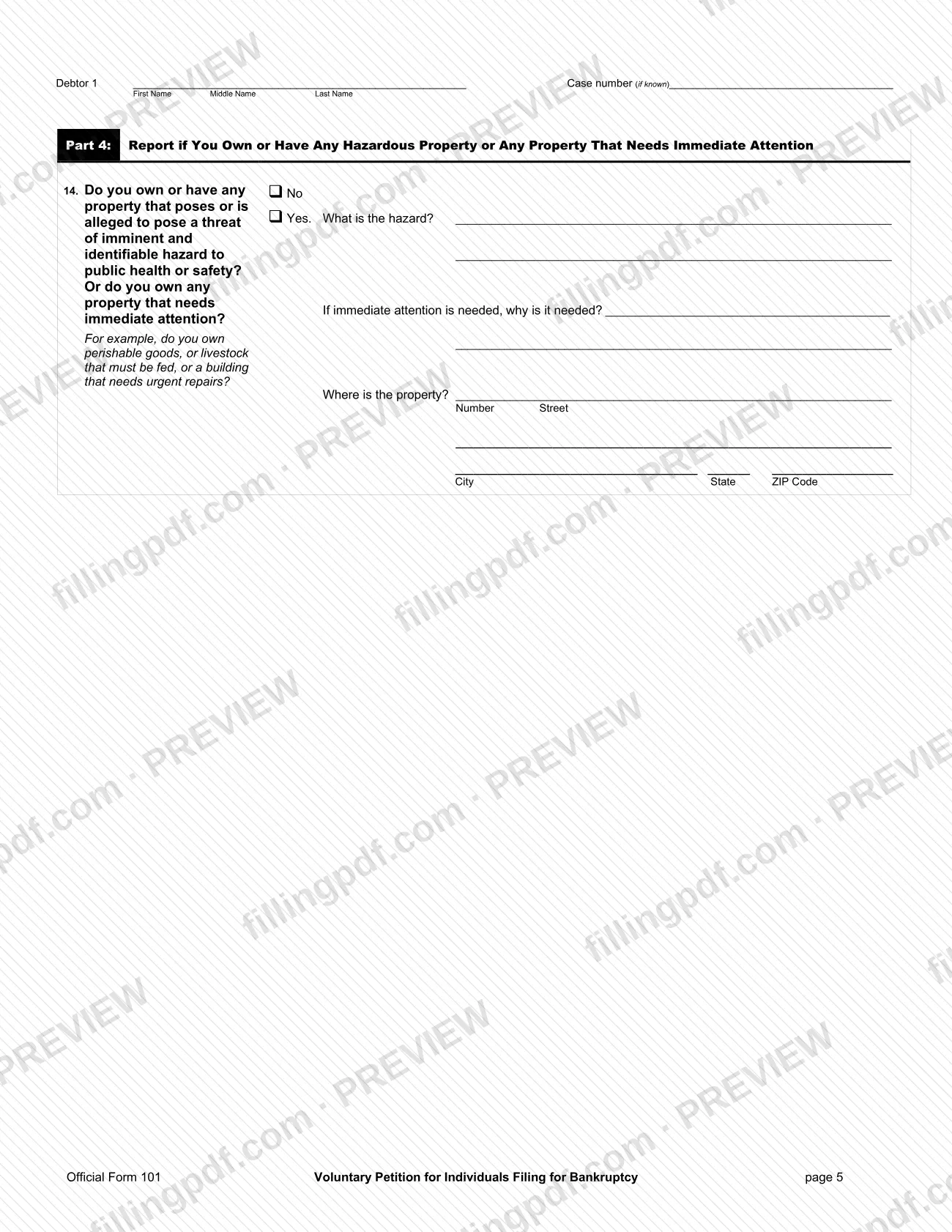
The petition has seven parts: identifying yourself (lines 1 to 6), your bankruptcy case (lines 7 to 11), businesses you own as a sole proprietor (lines 12 and 13), hazardous property (line 14), credit counseling (line 15), reporting questions about debts, creditors, assets and liabilities (lines 16 to 20), and signatures (Part 7, plus a page for the attorney and a page for filers without an attorney).
Official Form 101 is one of the forms numbered in the 100 series, which are for individuals and married couples, including sole proprietors. The instructions say the 200 series is used when preparing a bankruptcy for a nonindividual such as a corporation, partnership or limited liability company (LLC). Form 101 is not the schedules of assets and liabilities, which are separate forms.
Who needs to file Official Form 101?
Individuals who are filing for bankruptcy under Chapter 7, Chapter 11, Chapter 12 or Chapter 13 of the Bankruptcy Code use Official Form 101 to open their case. A married couple may file together in a joint case; one spouse reports as Debtor 1 and the other as Debtor 2, and the same person must be Debtor 1 on every form.
- Sole proprietors use the 100-series forms, including this one, and report their business on lines 12 and 13.
- Filers with an attorney still sign Part 7; the attorney completes the separate attorney page. If an attorney represents you, you must make sure the forms are accurate and complete.
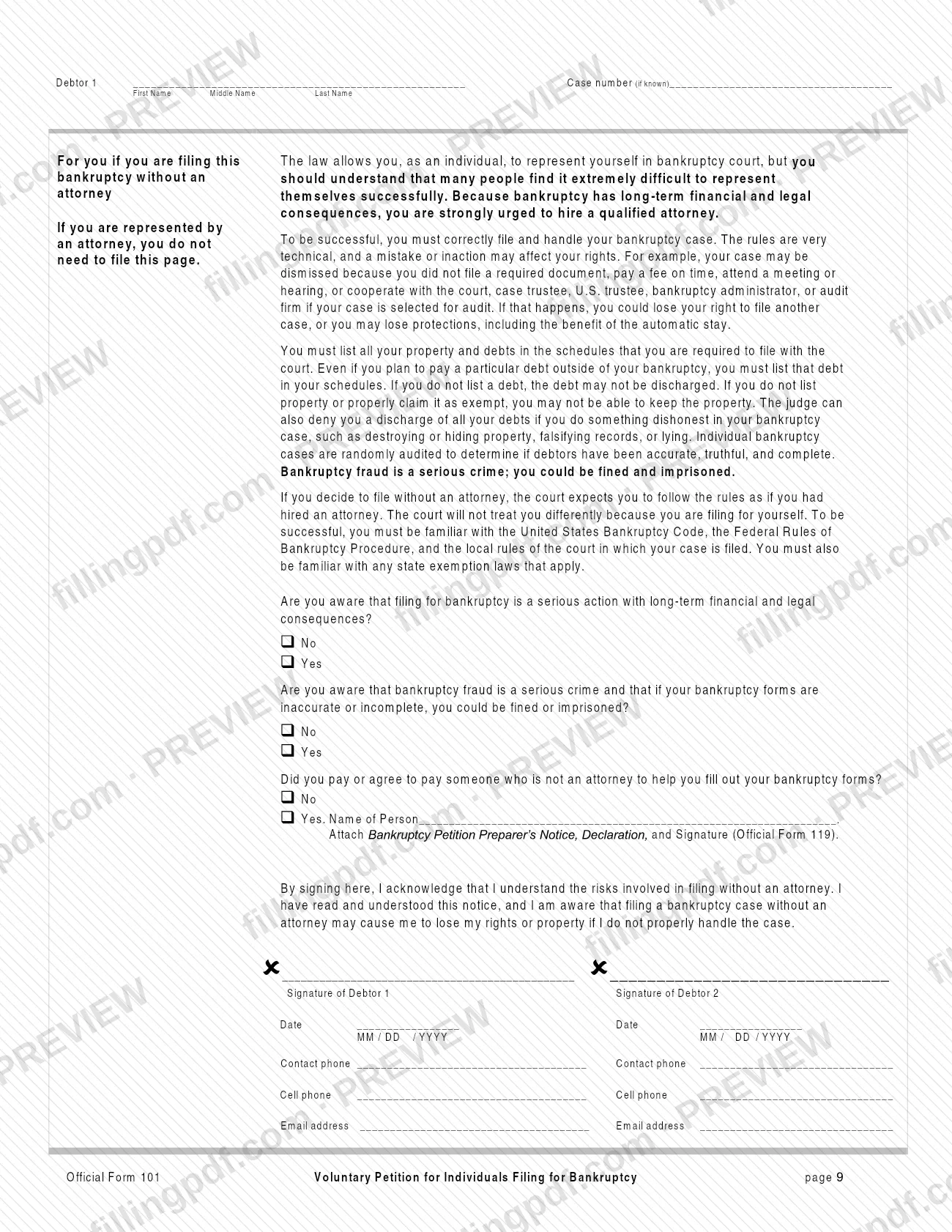
- Filers without an attorney also complete the last page, which asks whether you paid someone who is not an attorney to help you; if you did, Form 119 must be attached.
Do not use this form for a corporation, partnership or LLC; the instructions point those filers to the 200-series forms. The instructions also warn that you should not file if you are not eligible to file or do not intend to file the necessary documents. Credit counseling is generally required before filing, and in a joint case both spouses must receive the briefing.
When to file Official Form 101
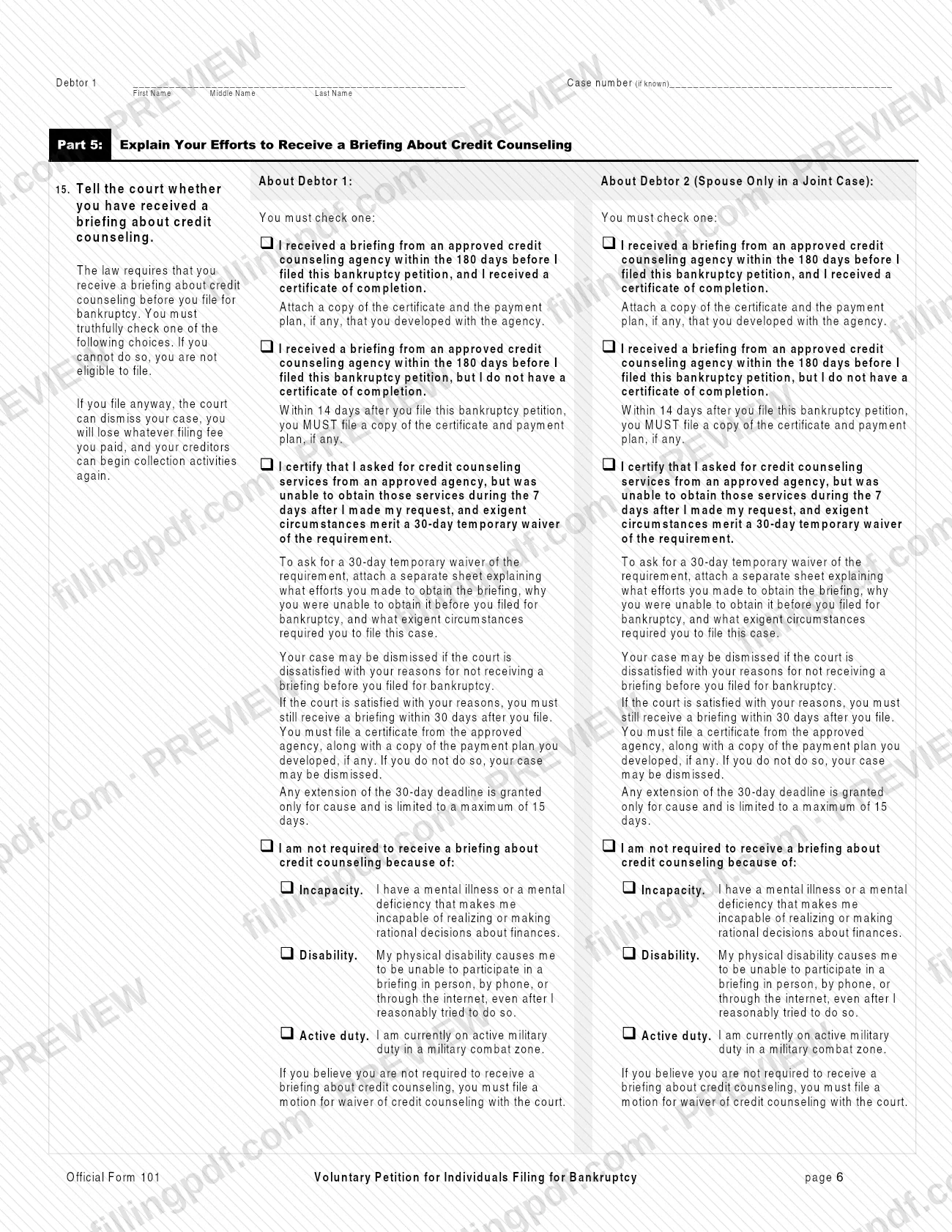
Form 101 is filed on the day you open your bankruptcy case; it is the form that opens it. Before that, you must generally receive a credit counseling briefing from an approved agency within the 180 days before you file, and line 15 asks you to report it. In a joint case each spouse must receive a briefing.
The instructions list other documents that go in with the petition, such as the creditor mailing list, Form 121 and the filing fee documents. Further forms, including the schedules and the statement of financial affairs, may be filed at the same time or no later than 14 days after the petition; the instructions warn that the case may be dismissed if they are not filed on time. If you have the briefing but not the certificate, line 15 requires you to file it within 14 days after filing the petition.
Documents you need
- Application for Individuals to Pay The Filing Fee in Installments (Official Form 103A), signed and attached, only if you check the installment option on line 8.
- Application to Have the Chapter 7 Filing Fee Waived (Official Form 103B), filed with the petition, only if you check the fee waiver option on line 8; this option is for Chapter 7 filers only.
- Initial Statement About an Eviction Judgment Against You (Form 101A), filed as part of the petition, only if you rent your residence and your landlord has obtained an eviction judgment (line 11).
- Certificate of completion from an approved credit counseling agency and any payment plan developed with it, attached if you received the briefing within the 180 days before filing (line 15).
- A separate sheet explaining your efforts, why you could not get the briefing and the exigent circumstances, only if you ask for the 30-day temporary waiver on line 15.
- Most recent balance sheet, statement of operations, cash-flow statement and federal income tax return, only if you are filing under Chapter 11 as a small business debtor (line 13); the form gives a procedure under 11 U.S.C. § 1116(1)(B) if they do not exist.
- Bankruptcy Petition Preparer's Notice, Declaration, and Signature (Official Form 119), only if you paid or agreed to pay someone who is not an attorney to help fill out your forms.
- A separate sheet for any answer that needs more space, with your name and case number at the top and the form and line number identified; also for a second sole proprietorship under line 12.
How to fill out Official Form 101
Enter court, case number and chapter
At the top of page 1, write the district of the United States Bankruptcy Court, the case number if known, and check the chapter you are filing under. Check the amended filing box only if you are amending a petition.
Enter your full name on line 1
Write the name on your government-issued picture ID, such as a driver's license or passport, for Debtor 1 and, in a joint case, for Debtor 2. Bring that ID to your meeting with the trustee.
List other names and ID numbers
Line 2: enter all other names used in the last 8 years, including married, maiden, assumed and trade names. Line 3: enter only the last 4 digits of your Social Security number or ITIN. Line 4: enter any EIN.
Give your residence and mailing address
Line 5: enter where you live and your county; if Debtor 2 lives elsewhere, use the right-hand column. Enter a different mailing address if you want court notices sent there.
Explain why you chose this district
Line 6: check whether you lived in this district longer than in any other during the last 180 days before filing, or check the other-reason box and explain (see 28 U.S.C. § 1408).
Choose your chapter and fee option
Line 7: check Chapter 7, 11, 12 or 13. Line 8: check pay in full, pay in installments (attach Form 103A) or request a waiver (Chapter 7 only, with Form 103B).
Report earlier and related cases
Line 9: answer whether you filed for bankruptcy in the last 8 years, giving district, date as MM / DD / YYYY and case number. Line 10: list any case pending or being filed by a spouse not filing with you, a business partner or an affiliate.
Answer the rental and eviction question
Line 11: if you rent your residence, say whether your landlord has an eviction judgment against you. If yes, fill out Form 101A and file it with the petition.
Describe any sole proprietorship
Line 12: if you operate a business as a sole proprietor, give its name and address and check the business type that applies, or None of the above. Line 13: if you are filing under Chapter 11, choose the small business debtor option that fits.
Report hazardous or urgent property
Line 14: answer Yes or No. If Yes, describe the hazard or why the property needs immediate attention, and give its location.
Complete the credit counseling section
Line 15: check one choice for each debtor: briefing with a certificate, briefing without a certificate yet, a request for a 30-day temporary waiver, or not required because of incapacity, disability or active duty in a combat zone.
Answer the reporting questions
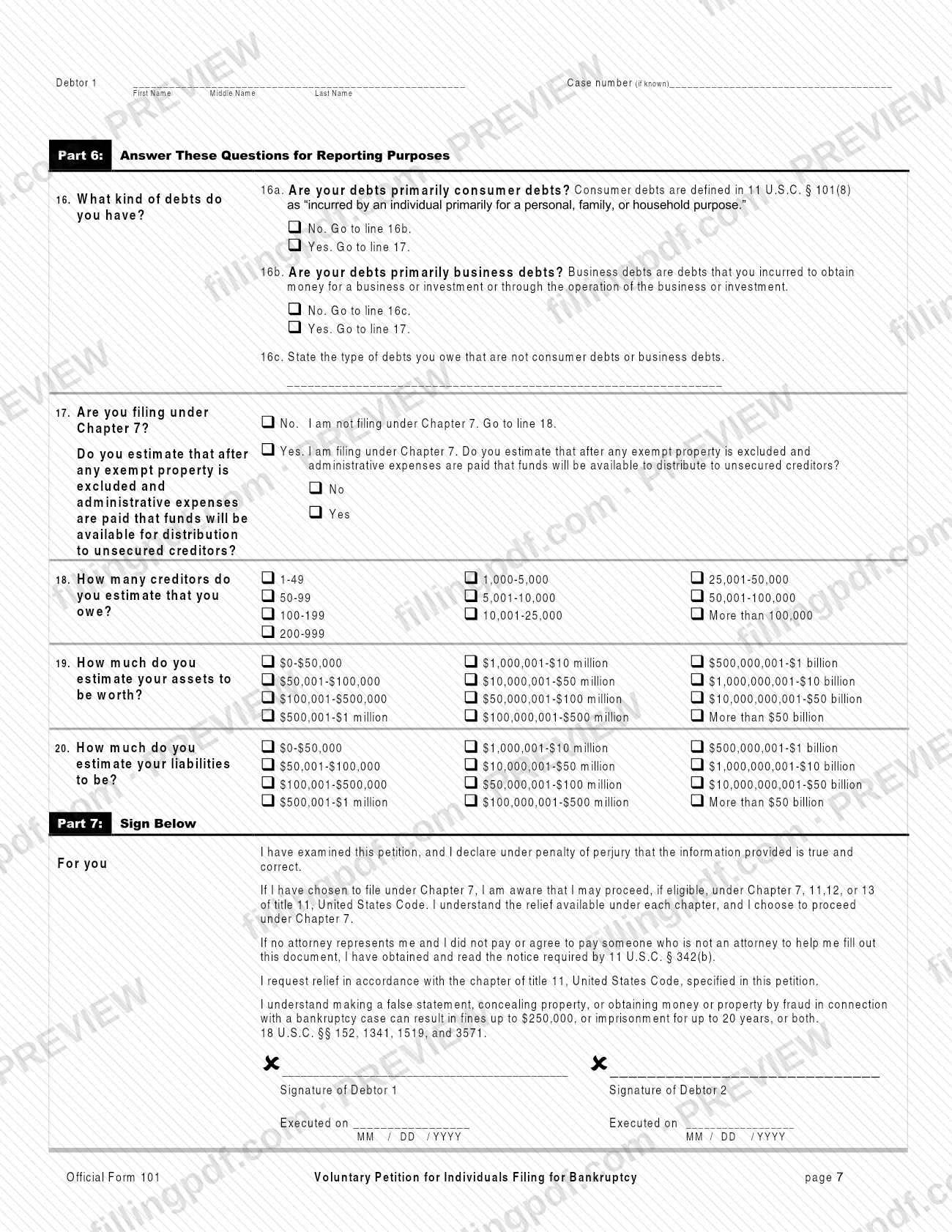
Line 16: say whether your debts are primarily consumer debts, business debts or another type. Line 17: if filing under Chapter 7, estimate whether funds will be available to unsecured creditors. Lines 18 to 20: check the ranges for creditors, assets and liabilities.
Sign the petition and attorney pages
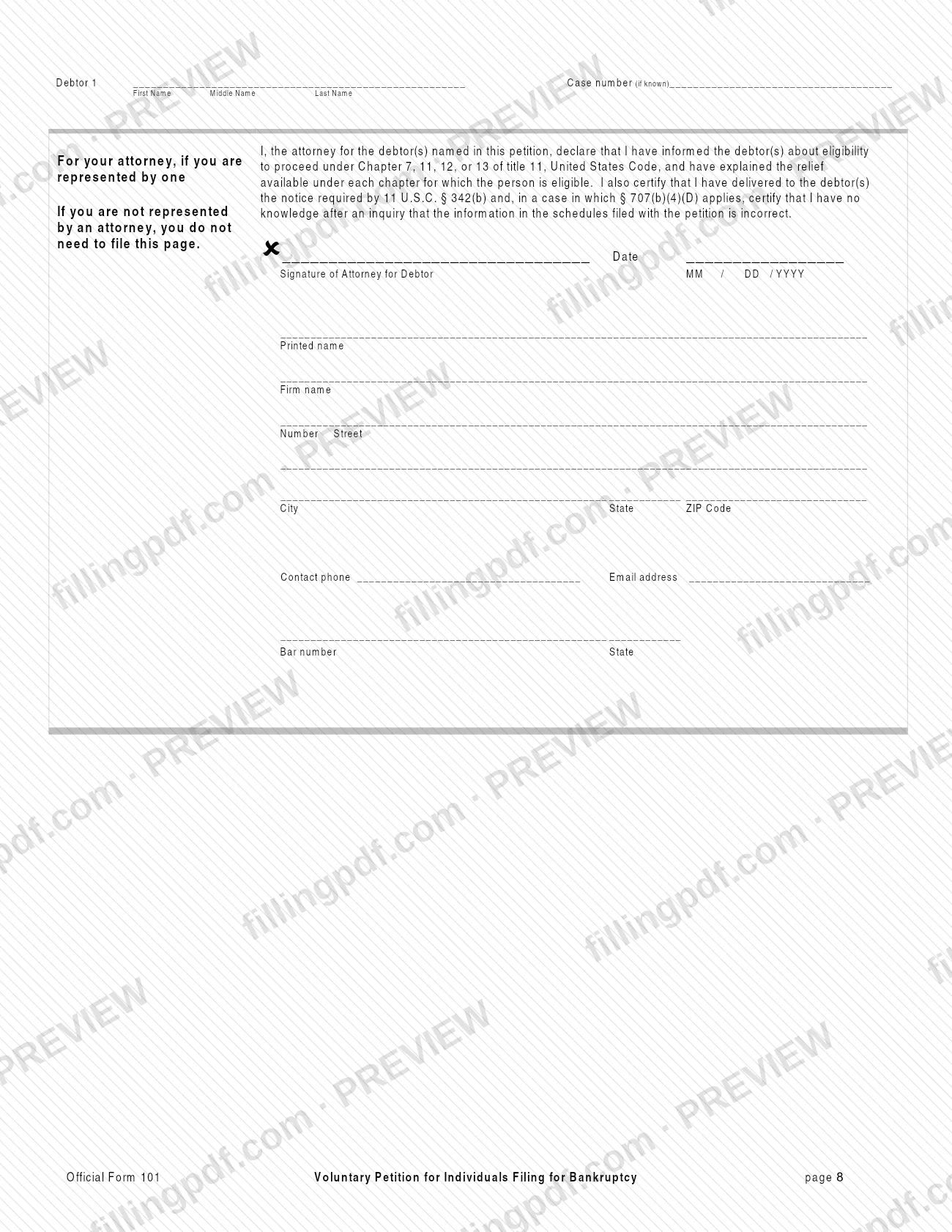
In Part 7, each debtor signs and dates in MM / DD / YYYY format under penalty of perjury. An attorney signs the attorney page; if you have no attorney, complete the final page, including whether a non-attorney helped you.
Review and download the completed PDF
Check that every question is answered, names match your ID and any needed attachments are ready. Download or print the completed PDF from FillingPDF and submit it as described under How to submit.
How to submit Official Form 101
The instructions say to file Official Form 101 with the U.S. Bankruptcy Court for the district where you must file; the form itself names no mailing address or portal.
- Find your court: use the federal court finder at https://www.uscourts.gov/federal-court-finder/find to learn which district you are in, then check that court's website for local requirements.
- Filing fee: a fee applies and line 8 asks how you will pay it. The form says to check with the clerk's office in your local court for details. If you pay yourself, it typically accepts cash, cashier's check or money order; an attorney paying for you may use a credit card or a check with a pre-printed address. Ask the clerk's office for the current amount.
- Installments or waiver: attach Form 103A to pay in installments, or file Form 103B with the petition to request a Chapter 7 fee waiver.
- After filing: the court sends notices to the mailing address on line 5, and Bankruptcy Rule 4002 requires you to notify the court of any address change. Keep a copy of everything you file.
Do not file the instructions booklet with the forms. FillingPDF lets you fill out and download the PDF; submission follows the channels above.
Common mistakes to avoid
- Leaving questions unanswered; the form says to answer every question and to be as complete and accurate as possible.
- Listing the name of a separate legal entity, such as a corporation, partnership or LLC that is not filing, among other names on line 2.
- Writing a full Social Security number or ITIN on line 3 instead of only the last 4 digits; the full number goes on Form 121.
- Filing without the required credit counseling briefing, or without checking one of the line 15 choices; the court can dismiss the case, you lose the filing fee paid, and creditors can resume collection.
- Requesting a fee waiver on line 8 when you are not filing under Chapter 7, or without filing Form 103B with the petition.
- Choosing the installment option on line 8 without signing and attaching Form 103A.
- Answering Yes on line 11 to an eviction judgment without filing Form 101A as part of the petition.
- Entering a mailing address on line 5 that is wrong or outdated; the court sends notices to that address, and address changes must be reported.
- Using different people as Debtor 1 across forms in a joint case; the same person must be Debtor 1 on every form.
Frequently asked questions
What is the B101 form?
B101 is the common name for Official Form 101, Voluntary Petition for Individuals Filing for Bankruptcy. An individual or married couple files it with a U.S. Bankruptcy Court to open a bankruptcy case and to state the chapter, 7, 11, 12 or 13, under which they are filing.
Can I fill out Form B101 online?
Yes. You can fill out the PDF online on FillingPDF and download or print it. FillingPDF is an independent service and does not file the petition; you file it with your U.S. Bankruptcy Court through that court's channels.
Can a married couple file one Official Form 101 together?
Yes. A married couple may file a joint case on one petition. One spouse is Debtor 1 and the other is Debtor 2, and the same person must be Debtor 1 on every form. Both spouses are equally responsible for correct information, and each signs.
Do I need credit counseling before filing Form 101?
Generally yes. You must receive a briefing from an approved credit counseling agency within the 180 days before you file, and in a joint case both spouses must. Line 15 covers exceptions, such as a 30-day temporary waiver request or incapacity, disability or combat-zone active duty.
How do I pay the filing fee with Form 101?
Line 8 offers three options: pay the whole fee at filing, pay in installments with Form 103A, or, in Chapter 7 only, request a waiver with Form 103B. Ask your local clerk's office for the current fee and accepted payment methods.
What if I file Form 101 without a lawyer?
You may represent yourself, but the form warns that many people find it extremely difficult, and you are urged to hire a qualified attorney. If you file without one, you complete the last page and, if a non-attorney helped you, attach Form 119.
Where do I file Official Form 101?
File it with the U.S. Bankruptcy Court for the district where you must file. Use the federal court finder at https://www.uscourts.gov/federal-court-finder/find to identify your district and check that court's website for local requirements.
What happens if I give false information on Form 101?
You sign Part 7 under penalty of perjury. The form says a false statement, concealing property, or obtaining money or property by fraud in a bankruptcy case can result in fines, imprisonment for up to 20 years, or both.
Ready to fill out Official Form 101?
Fill out Official Form 101 now