
The Real Property Conveyance Fee Statement of Value and Receipt (DTE 100) is the form that accompanies a transfer of real property in Cuyahoga County, Ohio. It is one of the Cuyahoga County property tax forms handled by the Cuyahoga County Fiscal Officer, whose Real Estate Services Department requires either this form or the DTE 100-EX exemption form with every transfer. The grantee or a representative completes it. On FillingPDF you can fill out the form online and download or print the completed PDF; the form itself is published by the Fiscal Officer.
Last updated
What is DTE 100?
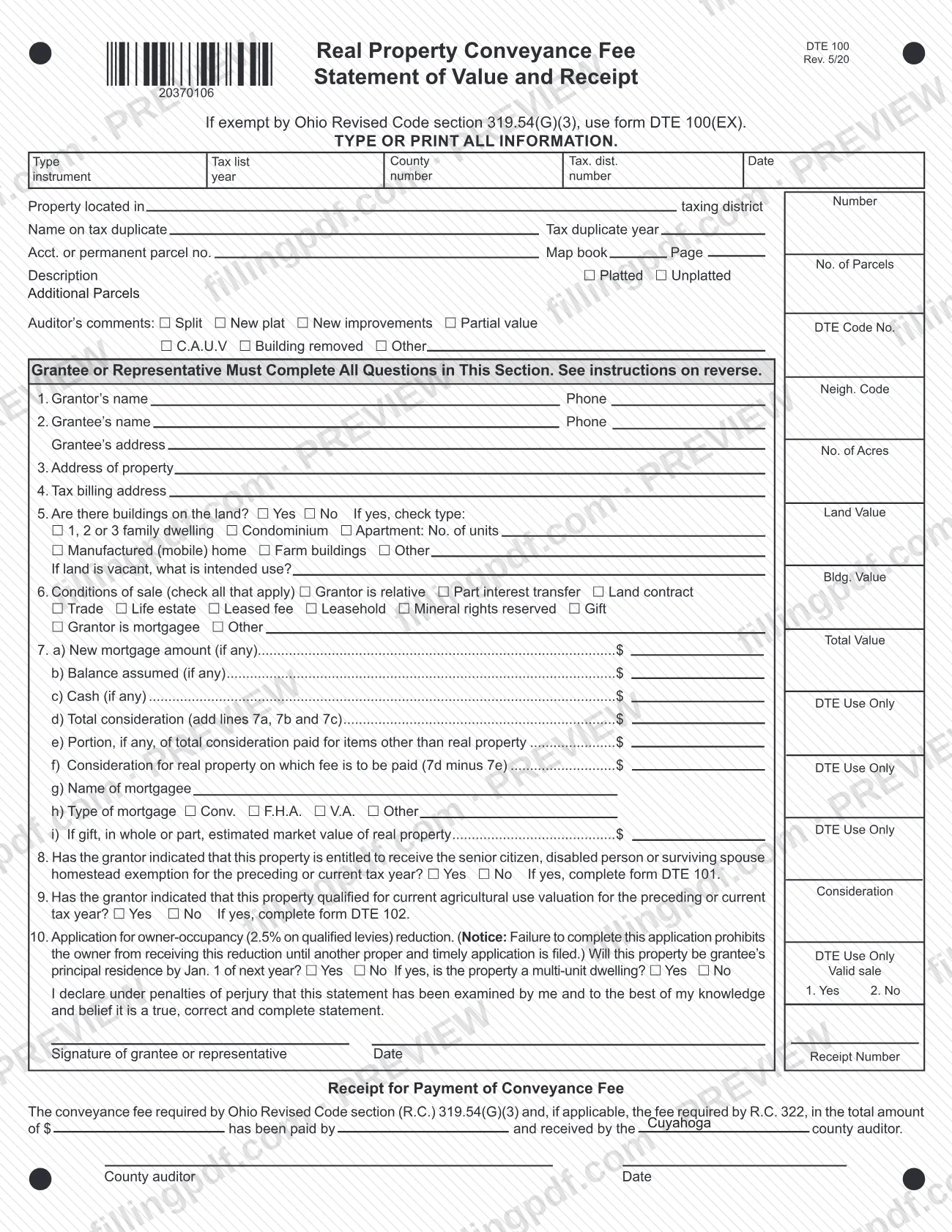
The Real Property Conveyance Fee Statement of Value and Receipt (DTE 100) is the form on which the grantee reports the consideration and conditions of a real property transfer, and which also serves as the receipt for the conveyance fee paid to the county auditor.
The front of the form collects the grantor and grantee, the property and tax billing addresses, the buildings on the land, the conditions of sale, the mortgage and cash consideration (line 7), and two homestead-related questions (lines 8 and 9). Line 10 is an application for the owner-occupancy reduction on qualified levies. A signed declaration under penalties of perjury follows, and then the Receipt for Payment of Conveyance Fee, which cites the fee required by Ohio Revised Code (R.C.) section 319.54(G)(3) and, if applicable, the fee required by R.C. 322.
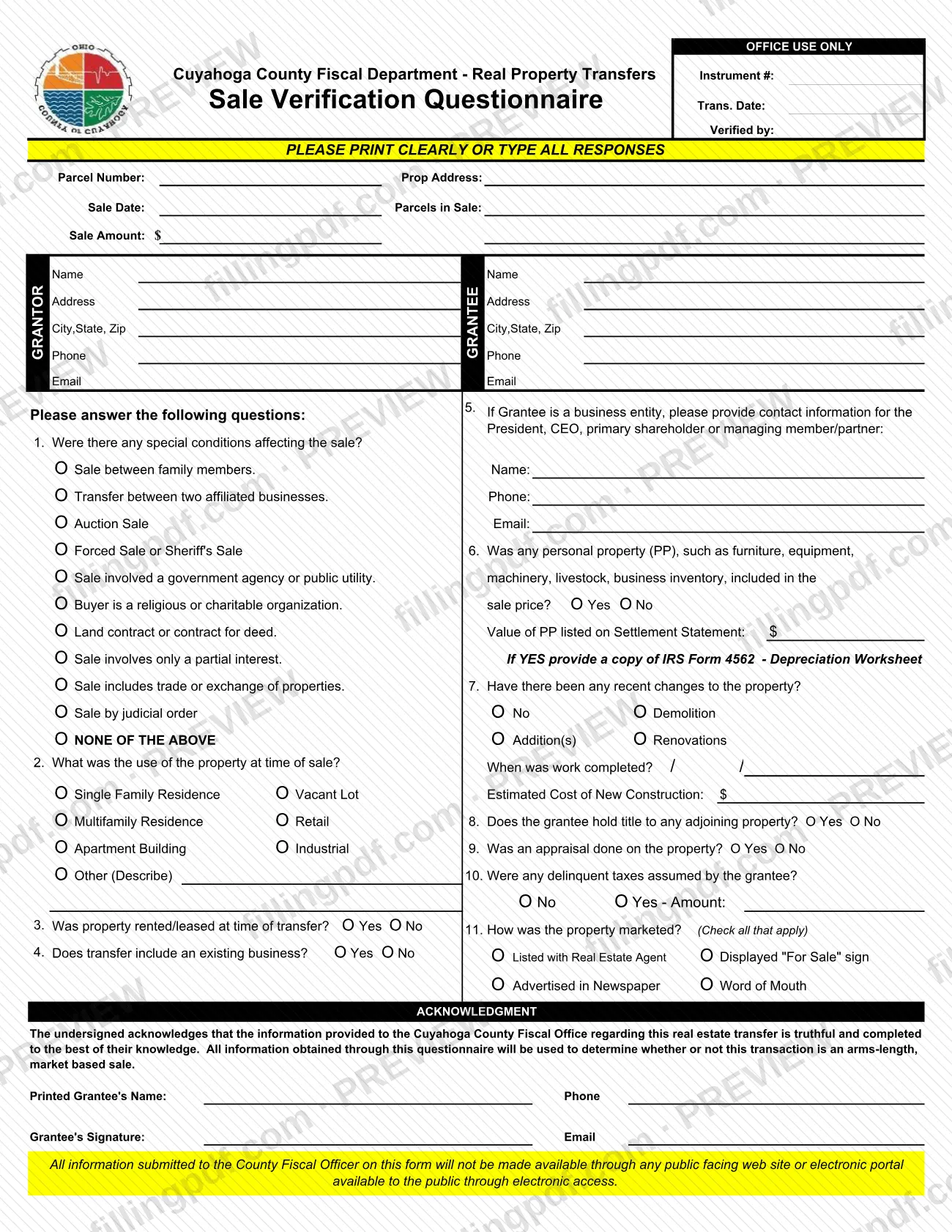
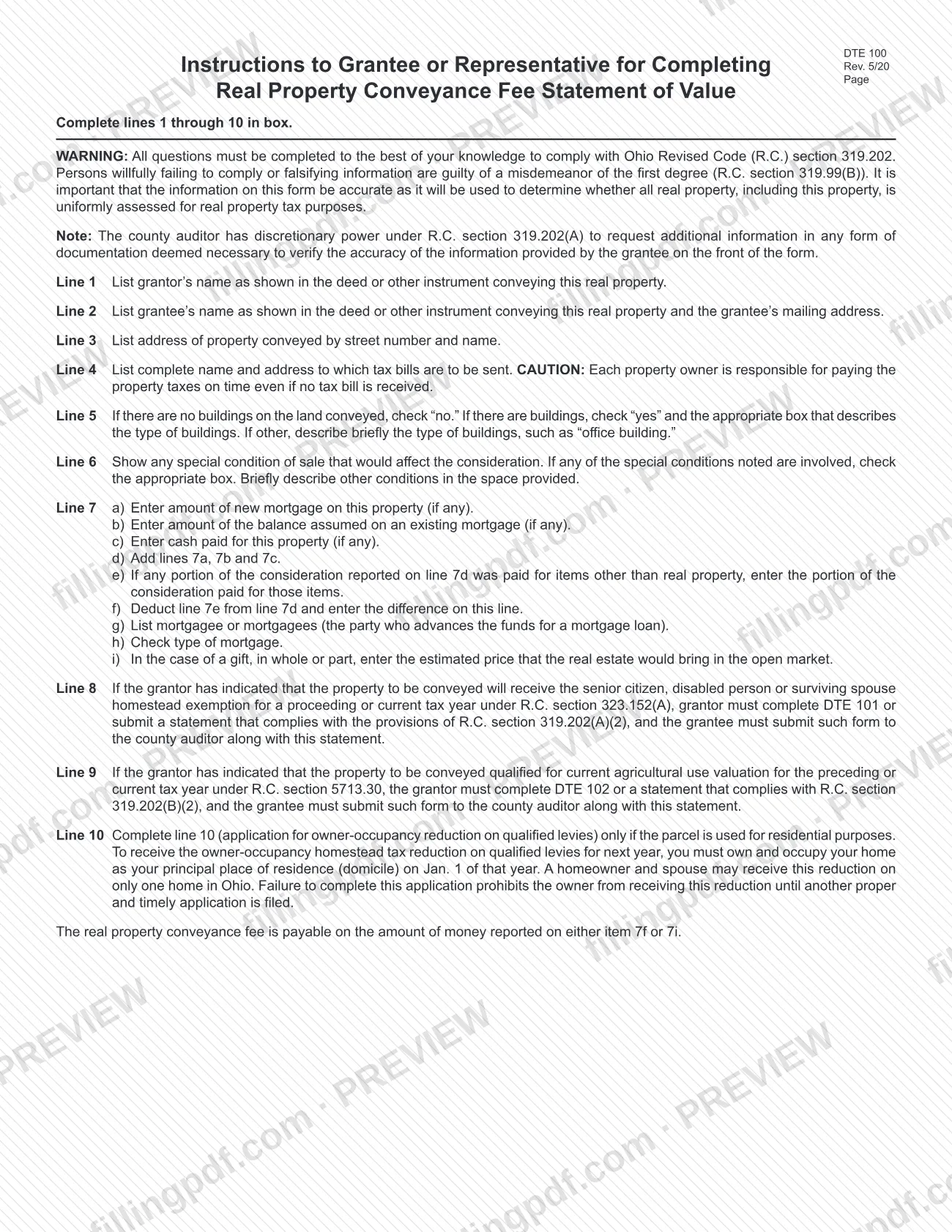
The instructions on the reverse explain that the information is used to decide whether all real property, including this property, is uniformly assessed for real property tax purposes. The PDF also contains the Cuyahoga County Fiscal Department Sale Verification Questionnaire, which the county uses to judge whether a transaction is an arms-length, market-based sale.
This form is not used for transfers exempt under R.C. 319.54(G)(3); those use DTE 100(EX), the Statement of Reason for Exemption from Real Property Conveyance Fee. Lines 8 and 9 can also require DTE 101 or DTE 102.
Who needs to file DTE 100?
The grantee, or a representative of the grantee, completes DTE 100. The form says the grantee or representative must answer all questions in the boxed section, lines 1 through 10, and sign the declaration.
- Grantees in a real property transfer in Cuyahoga County. The Real Estate Services Department requires either this form or the DTE 100-EX form to accompany every transfer.
- Grantees whose transfer is exempt by R.C. 319.54(G)(3) should not use this form. The form tells them to use DTE 100(EX).
- Grantees of residential property complete line 10 only if the parcel is used for residential purposes. To receive the owner-occupancy reduction for next year, the owner must own and occupy the home as a principal residence on Jan. 1 of that year. A homeowner and spouse may receive the reduction on only one home in Ohio.
If the grantor has said the property gets the senior citizen, disabled person or surviving spouse homestead exemption, or qualified for current agricultural use valuation, the grantor must complete DTE 101 or DTE 102 (or a statement meeting the cited R.C. provisions), and the grantee submits it to the county auditor with this statement.
When to file DTE 100
DTE 100 is completed when real property is transferred, because the Cuyahoga County Fiscal Officer's Real Estate Services Department requires either this form or DTE 100-EX to accompany every transfer. Neither the form nor the agency page prints a separate due date, so it travels with the transfer documents.
Two dates matter on the form itself. Lines 8 and 9 ask about the exemption or valuation for the preceding or current tax year. Line 10 asks whether the property will be the grantee's principal residence by Jan. 1 of next year. Failing to complete line 10 prohibits the owner from receiving the owner-occupancy reduction until another proper and timely application is filed.
Documents you need
- Form DTE 101, if the grantor indicated on line 8 that the property gets the senior citizen, disabled person or surviving spouse homestead exemption; the grantor completes it and the grantee submits it with DTE 100.
- A statement complying with R.C. 319.202(A)(2), as an alternative to DTE 101 for line 8.
- Form DTE 102, if the grantor indicated on line 9 that the property qualified for current agricultural use valuation; the grantor completes it and the grantee submits it.
- A statement complying with R.C. 319.202(B)(2), as an alternative to DTE 102 for line 9.
- A copy of IRS Form 4562 - Depreciation Worksheet, if the Sale Verification Questionnaire says personal property was included in the sale price.
- Any additional documentation the county auditor requests under R.C. 319.202(A) to verify the information on the front of the form.
How to fill out DTE 100
Confirm DTE 100 applies
If the transfer is exempt by Ohio Revised Code section 319.54(G)(3), use form DTE 100(EX) instead. Type or print all information.
Enter grantor and grantee (lines 1-2)
Line 1: the grantor's name as shown in the deed or other instrument. Line 2: the grantee's name as shown there, plus the grantee's mailing address.
Enter property and tax billing addresses
Line 3: the address of the property by street number and name. Line 4: the complete name and address where tax bills are to be sent.
Describe buildings on the land
Line 5: check No if there are no buildings. If Yes, check the building type; if Other, describe it briefly, such as "office building". If the land is vacant, state the intended use.
Check the conditions of sale
Line 6: check every special condition that would affect the consideration, such as Grantor is relative, Gift, Land contract or Life estate. Describe any other condition briefly.
Report the consideration (lines 7a-7d)
Enter the new mortgage on 7a, the balance assumed on 7b and cash on 7c, then add them on 7d.
Figure line 7e and 7f
Line 7e: any portion of 7d paid for items other than real property. Line 7f: subtract 7e from 7d; the conveyance fee is payable on the amount on 7f or 7i.
Complete mortgage and gift details
Line 7g: the mortgagee, the party who advances the mortgage funds. Line 7h: the mortgage type. Line 7i: for a gift in whole or part, the estimated open-market price.
Answer the exemption questions (lines 8-9)
Check Yes or No for the homestead exemption and for current agricultural use valuation. If Yes, DTE 101 or DTE 102 must be completed and submitted with the form.
Complete the owner-occupancy application
Line 10: complete only if the parcel is used for residential purposes. Say whether it will be the grantee's principal residence by Jan. 1 of next year and whether it is a multi-unit dwelling.
Sign the declaration
The grantee or representative signs and dates the statement made under penalties of perjury. The receipt section is completed by the county auditor.
Complete the Sale Verification Questionnaire
Answer questions 1 through 11 and print the grantee's name and phone; the grantee signs the acknowledgment. Where it applies, add the personal property value and the other details it asks for.
Review and download the PDF
Check names against the deed and recheck the arithmetic on lines 7d to 7f. Download or print the completed PDF from FillingPDF and attach any DTE 101 or DTE 102.
How to submit DTE 100
The form is submitted with the transfer to the Cuyahoga County Fiscal Officer, Transfer and Recording division (Real Estate Services Department), which says one of the two forms, DTE 100 or DTE 100-EX, must accompany every transfer.
- Office: 2079 E. Ninth Street, 4th floor, Cleveland, OH 44115. Office hours are Monday-Friday 8:30am - 4:30pm; recording hours are 8:30am – 4:00pm.
- Phone: 216-443-2060.
- Electronic recording: the division's page invites title companies and attorneys to register for Electronic Recording.
The completed form must be signed by the grantee or representative. Include DTE 101 or DTE 102 where lines 8 or 9 require it. The conveyance fee is payable on the amount reported on line 7f or 7i; the form gives no amount, so ask the Fiscal Officer for the current fee and accepted payment methods. The division says its staff cannot give legal advice. FillingPDF lets you fill out and download the PDF; submission follows the channels above.
Common mistakes to avoid
- Leaving questions blank: the instructions say all questions on lines 1 through 10 must be completed to the best of your knowledge.
- Using DTE 100 for a transfer exempt by R.C. 319.54(G)(3), when the form says to use DTE 100(EX).
- Not completing line 10 for a residential parcel, which keeps the owner from the owner-occupancy reduction until a proper and timely application is filed.
- Answering Yes on line 8 or 9 without submitting DTE 101 or DTE 102 (or the statement the instructions allow).
- Listing the grantor or grantee name differently from the deed or other conveying instrument, contrary to the instructions for lines 1 and 2.
- Entering a wrong amount on line 7f; it is line 7d minus line 7e, and the fee is payable on the amount on line 7f or 7i.
- Falsifying information or willfully failing to comply, which the instructions say is a first-degree misdemeanor under R.C. 319.99(B).
- Assuming a tax bill will arrive: the line 4 caution says each owner must pay property taxes on time even if no bill is received.
Frequently asked questions
What is the DTE 100 form in Cuyahoga County?
DTE 100 is the Real Property Conveyance Fee Statement of Value and Receipt. The grantee completes it to report the consideration and conditions of a real property transfer, and it serves as the receipt for the conveyance fee paid to the county auditor.
Who fills out the DTE 100?
The grantee or a representative of the grantee completes lines 1 through 10 and signs the declaration. The grantor does not complete this form, except for DTE 101 or DTE 102 when lines 8 or 9 require them.
What is the difference between DTE 100 and DTE 100-EX?
DTE 100 is used when the conveyance fee applies. DTE 100(EX) is the Statement of Reason for Exemption from Real Property Conveyance Fee, used for transfers exempt under R.C. 319.54(G)(3). One of the two must accompany every transfer.
Do I have to complete line 10 on DTE 100?
Complete line 10 only if the parcel is used for residential purposes. It is the application for the owner-occupancy reduction on qualified levies. Skipping it prevents the owner from receiving that reduction until another proper and timely application is filed.
How is the conveyance fee amount determined on DTE 100?
The fee is payable on the amount of money reported on line 7f or 7i. Line 7f is total consideration (7d) minus the portion paid for items other than real property (7e). The form prints no fee amount; ask the Cuyahoga County Fiscal Officer for it.
Where do I take the DTE 100 in Cuyahoga County?
It goes with the transfer to the Cuyahoga County Fiscal Officer's Transfer and Recording division, 2079 E. Ninth Street, 4th floor, Cleveland, OH 44115. Office hours are Monday-Friday 8:30am - 4:30pm, and the phone is 216-443-2060.
Can I fill out DTE 100 online on FillingPDF?
Yes. You can fill out the fillable PDF online on FillingPDF and download or print it. FillingPDF is an independent service and does not file or record anything; you submit the form through the Cuyahoga County Fiscal Officer's channels.
Ready to fill out DTE 100?
Fill out DTE 100 now