
Form DTE 24 is the application that property owners, or the political subdivision granting an incentive, use to ask that real property be placed on Ohio's tax-exempt list under a tax incentive program. It is issued by the Ohio Department of Taxation (DTE) and filed first with the county auditor where the property is located. On this page you can fill out the form online on FillingPDF and download or print the completed PDF; the official PDF is published by the Ohio Department of Taxation.
Last updated
What is DTE 24?
Form DTE 24, Tax Incentive Program -- Application for Real Property Tax Exemption and Remission, is the Ohio Department of Taxation form for asking that real property be placed on the tax-exempt list under an incentive agreement, ordinance or resolution.
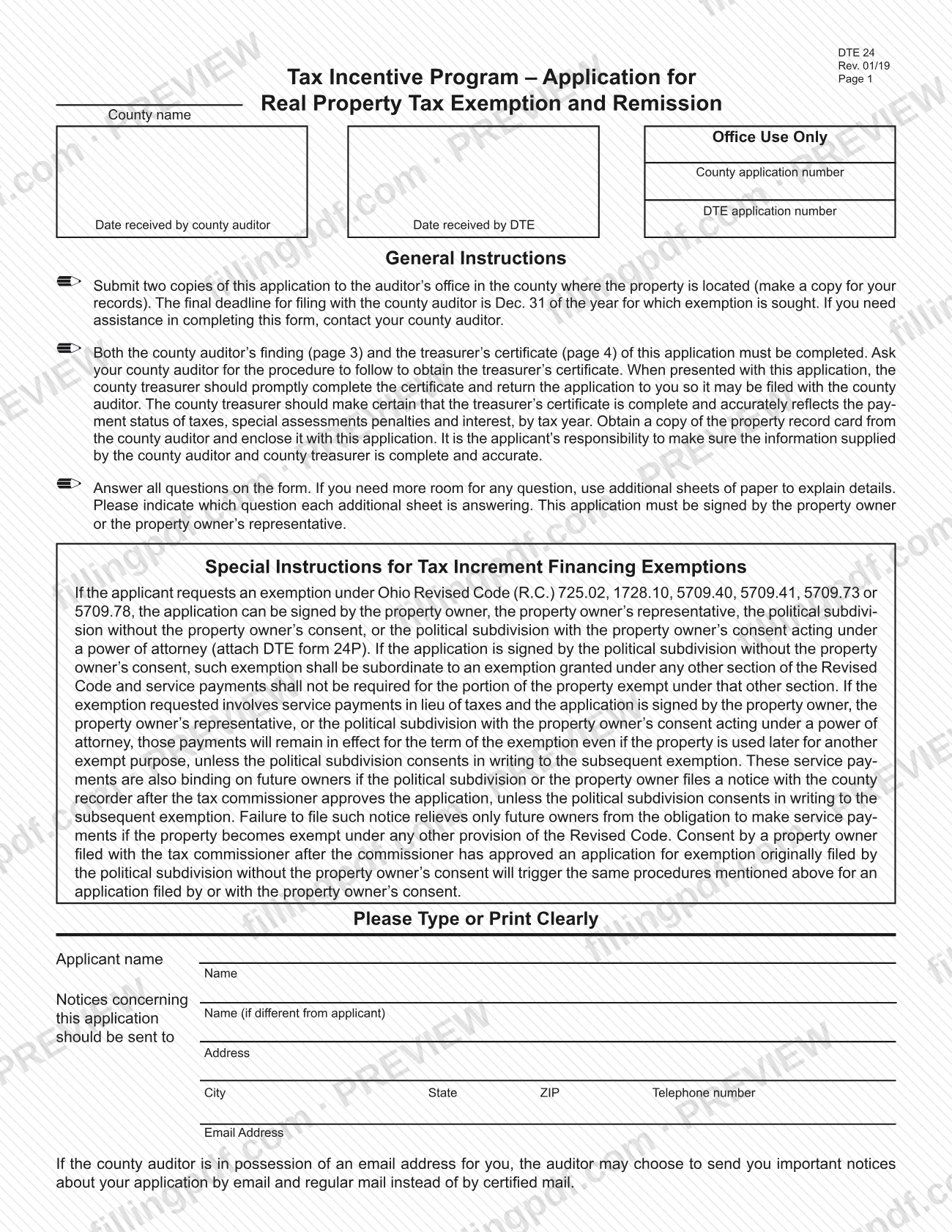
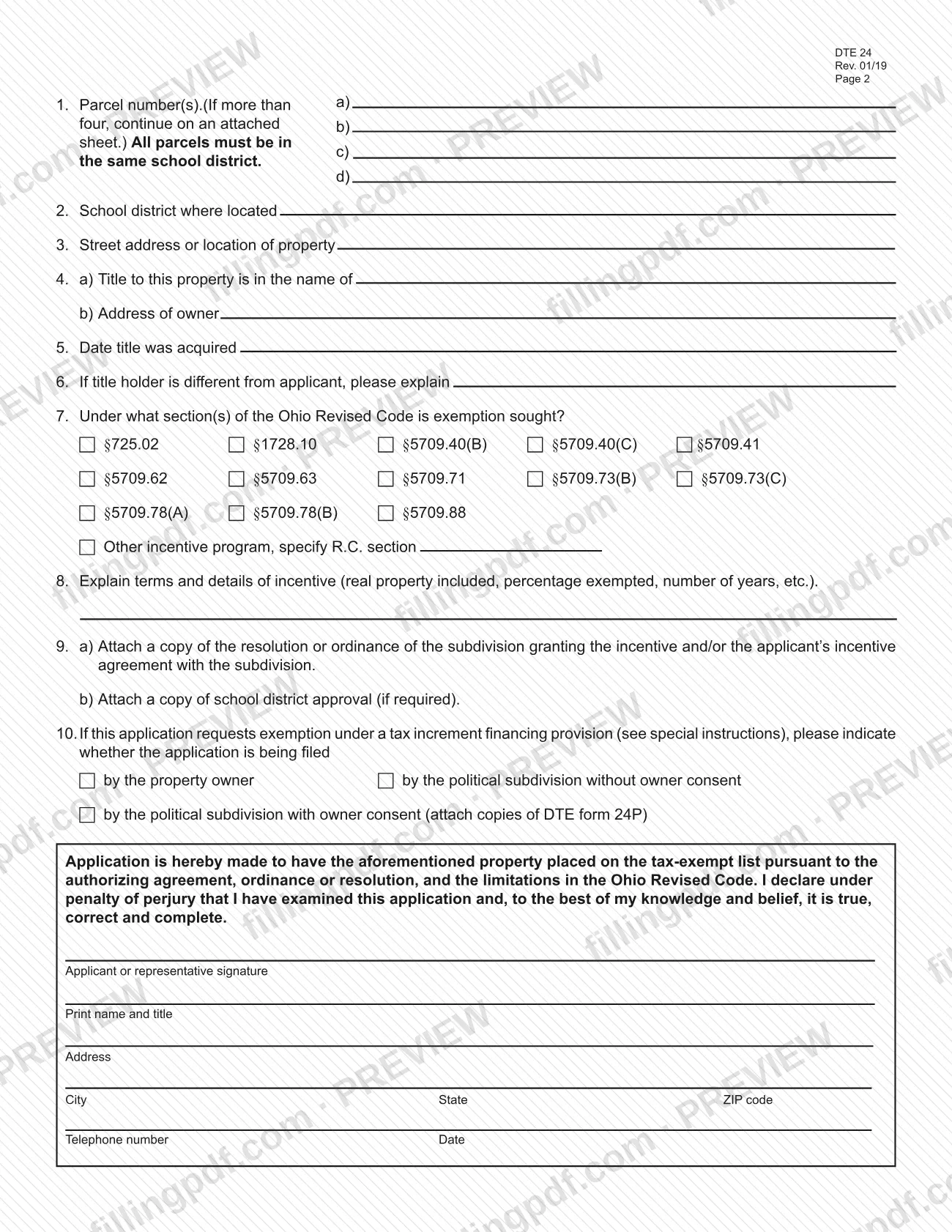
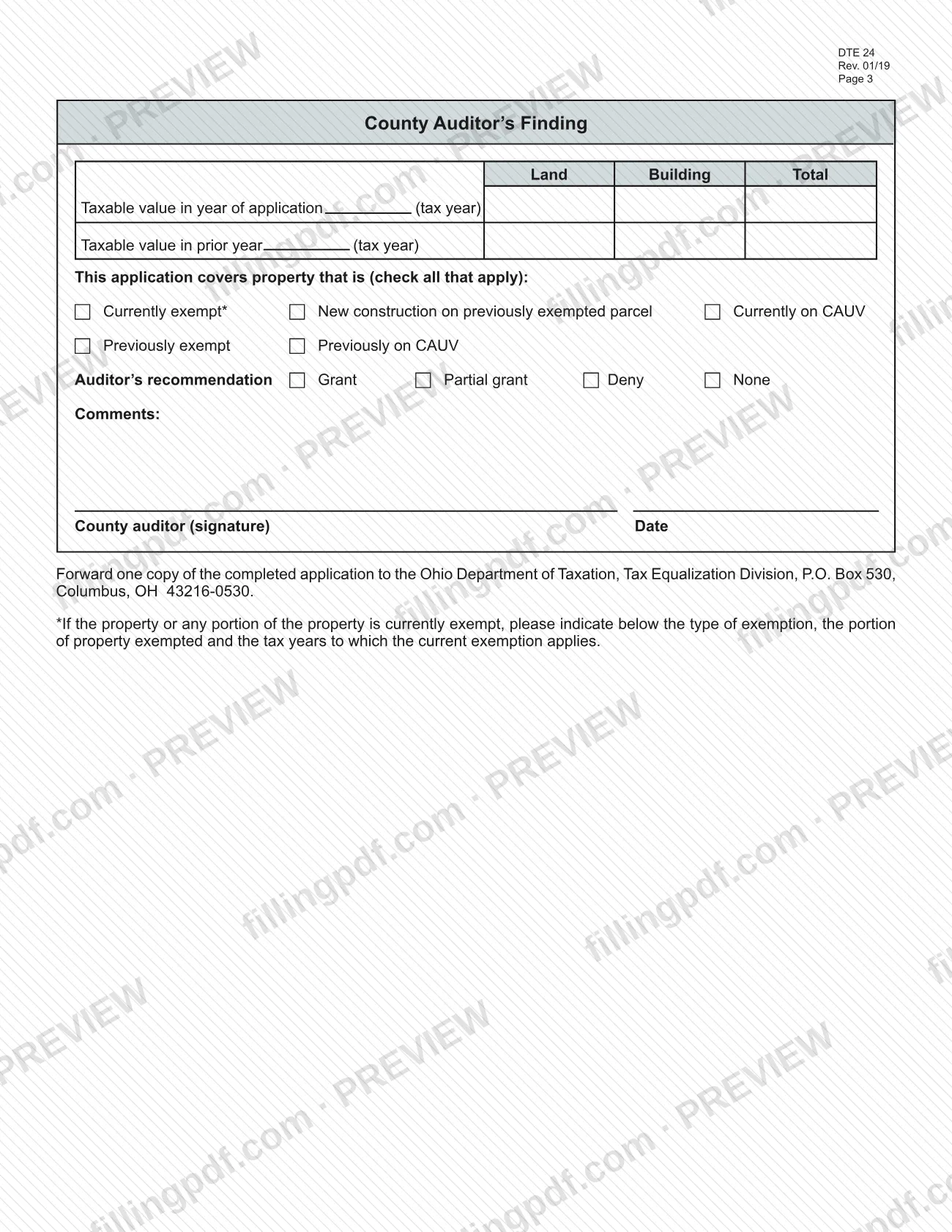
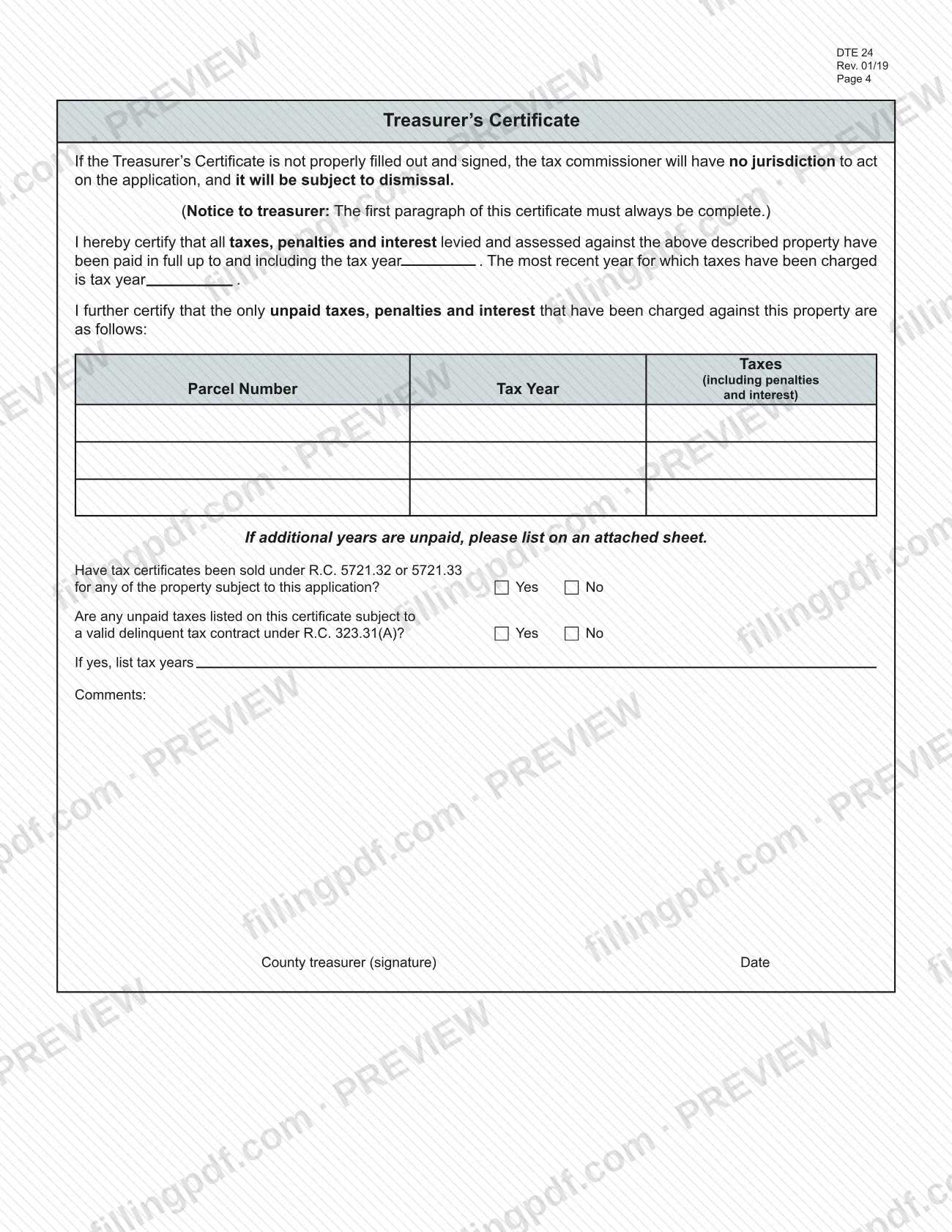
The form is a four-page package. Page 1 holds the instructions and the applicant and notice contact details. Page 2 is the applicant's part: parcel numbers, school district, property address, title holder, the Ohio Revised Code (R.C.) section under which exemption is sought, the terms of the incentive and the signed declaration. Page 3 is the County Auditor's Finding, which records taxable values, the property's exemption or CAUV status and the auditor's recommendation (grant, partial grant, deny or none). Page 4 is the Treasurer's Certificate, which states the payment status of taxes, penalties and interest by tax year.
Question 7 lists the R.C. sections the form covers, including §725.02, §1728.10, §5709.40(B) and (C), §5709.41, §5709.62, §5709.63, §5709.71, §5709.73(B) and (C), §5709.78(A) and (B) and §5709.88, with a line for another incentive program. Special instructions apply to tax increment financing exemptions, where the form is filed by the owner or by the political subdivision and may involve service payments in lieu of taxes. The form's companion is DTE form 24P, the power of attorney used when a political subdivision files with the owner's consent.
Who needs to file DTE 24?
The property owner, or the owner's representative, files Form DTE 24 when seeking a real property tax exemption under one of the incentive provisions of the Ohio Revised Code listed in question 7, or under another incentive program identified by its R.C. section. The application must be signed by the owner or the owner's representative.
Tax increment financing exemptions have more possible filers. If the exemption is requested under R.C. 725.02, 1728.10, 5709.40, 5709.41, 5709.73 or 5709.78, the application can be signed by:
- the property owner;
- the property owner's representative;
- the political subdivision without the owner's consent; or
- the political subdivision with the owner's consent, acting under a power of attorney (attach DTE form 24P).
If the political subdivision signs without the owner's consent, the exemption is subordinate to an exemption granted under any other section of the Revised Code, and service payments are not required for the portion exempt under that other section. If you need help completing the form, the instructions say to contact your county auditor.
When to file DTE 24
The final deadline for filing Form DTE 24 with the county auditor is December 31 of the year for which exemption is sought. Plan the timing around the treasurer's certificate: the application cannot be filed with the auditor until the county treasurer has completed the certificate on page 4 and returned the application to you. Ask the county auditor for the procedure to obtain it.
The form prints no processing time. For questions about timing or status, contact your county auditor, as the instructions advise for help with the form.
Documents you need
- Two copies of the completed application, filed with the county auditor in the county where the property is located; keep a copy for your records.
- Treasurer's certificate (page 4), completed and signed by the county treasurer; the first paragraph must always be complete.
- A copy of the property record card, obtained from the county auditor, enclosed with the application.
- A copy of the resolution or ordinance of the subdivision granting the incentive and/or the applicant's incentive agreement with the subdivision (question 9a).
- A copy of school district approval, if required (question 9b).
- DTE form 24P (power of attorney), attached only when a political subdivision files a tax increment financing application with the owner's consent (question 10).
- Additional sheets of paper if you need more room for any answer, marked with the question each one answers; a continuation sheet for parcels if you list more than four.
How to fill out DTE 24
Gather the county items first
Ask your county auditor how to obtain the treasurer's certificate and request a copy of the property record card. Have the incentive resolution, ordinance or agreement and any school district approval on hand.
Enter applicant and notice details
Under Please Type or Print Clearly, enter the applicant name and the name, address, city, state, ZIP, telephone and email for notices, if different from the applicant. Leave the Office Use Only boxes on page 1 blank.
List parcels and school district
Question 1: enter up to four parcel numbers (a through d) and continue on an attached sheet if there are more; all must be in the same school district. Question 2: the school district. Question 3: the street address or location of the property.
Give title information
Question 4a: the name in which title is held; 4b: the owner's address. Question 5: the date title was acquired. Question 6: explain if the title holder is different from the applicant.
Check the R.C. sections requested
Question 7: check each section of the Ohio Revised Code under which exemption is sought, from §725.02 through §5709.88. For another program, check Other incentive program and specify the R.C. section.
Explain the incentive terms
Question 8: describe the incentive, including the real property included, the percentage exempted and the number of years. Use an additional sheet if needed, marked with the question number.
Confirm the required attachments
Question 9a: attach the resolution or ordinance granting the incentive and/or the incentive agreement. Question 9b: attach school district approval, if required.
Identify the filer for TIF requests
Question 10 applies only to tax increment financing exemptions. Check whether the application is filed by the property owner, by the political subdivision without owner consent, or by the political subdivision with owner consent (attach DTE form 24P).
Sign and date the declaration
The applicant or representative signs, prints name and title, and enters address, telephone number and date. The signature is made under penalty of perjury that the application is true, correct and complete.
Obtain the auditor and treasurer pages
The county auditor completes the Auditor's Finding on page 3 and the county treasurer completes the Treasurer's Certificate on page 4. These parts are not completed by the applicant; the applicant is responsible for making sure they are complete and accurate.
Review and download the completed PDF
Check that every question is answered and that your parcel numbers and R.C. sections match your incentive documents. Download or print the completed PDF from FillingPDF, make two copies and assemble the package described under How to submit.
How to submit DTE 24
Form DTE 24 is filed with the county auditor's office in the county where the property is located, and the county then forwards a copy to the Ohio Department of Taxation.
- County auditor: Submit two copies of the application, and keep a copy for your records. Before filing, take the application to the county treasurer for the certificate on page 4, then enclose a copy of the property record card, which you obtain from the county auditor.
- Ohio Department of Taxation: The auditor's page of the form directs that one copy of the completed application be forwarded to the Ohio Department of Taxation, Tax Equalization Division, P.O. Box 530, Columbus, OH 43216-0530.
The form names no online portal. If the county auditor has your email address, the auditor may send important notices about the application by email and regular mail instead of certified mail. FillingPDF lets you fill out and download the PDF; submission follows the channels above.
Common mistakes to avoid
- Filing after December 31 of the year for which the exemption is sought, which is the final deadline with the county auditor.
- Submitting one copy instead of the two copies the instructions require for the county auditor's office.
- Filing without a complete treasurer's certificate; if it is not properly filled out and signed, the tax commissioner has no jurisdiction to act and the application is subject to dismissal.
- Leaving the first paragraph of the treasurer's certificate incomplete; the notice to the treasurer says it must always be complete.
- Omitting the property record card, the incentive resolution, ordinance or agreement, or the school district approval where required.
- Listing parcels from more than one school district; all parcels on the application must be in the same school district.
- Skipping questions or adding extra sheets without noting which question each one answers.
- Leaving the application unsigned, or having someone other than the owner, the owner's representative or an allowed political subdivision sign.
- Not attaching DTE form 24P when the political subdivision files a tax increment financing application with the owner's consent.
Frequently asked questions
What is Form DTE 24 used for?
Form DTE 24 is the Ohio Department of Taxation application to have real property placed on the tax-exempt list under an incentive agreement, ordinance or resolution and the limits of the Ohio Revised Code. It is filed through the county auditor in the county where the property is located.
What is the deadline to file DTE 24?
The final deadline for filing with the county auditor is December 31 of the year for which exemption is sought. Build in time to get the county treasurer's certificate first, because the application must include it when you file.
Where do I send Form DTE 24?
Submit two copies to the auditor's office in the county where the property is located. The auditor's page directs that one copy of the completed application be forwarded to the Ohio Department of Taxation, Tax Equalization Division, P.O. Box 530, Columbus, OH 43216-0530.
What do I attach to the DTE 24 application?
Enclose a copy of the property record card from the county auditor and the treasurer's certificate. Attach the incentive resolution, ordinance or agreement, and school district approval if required. Add DTE form 24P if a political subdivision files a TIF application with the owner's consent.
Who can sign Form DTE 24?
The property owner or the owner's representative signs. For tax increment financing exemptions under certain R.C. sections, the political subdivision may also sign, with or without the owner's consent; with consent it acts under a power of attorney, using DTE form 24P.
What happens if the treasurer's certificate is incomplete?
The tax commissioner will have no jurisdiction to act on the application, and it will be subject to dismissal. The first paragraph of the certificate must always be complete, and the applicant is responsible for making sure it is accurate.
Can I fill out DTE 24 online?
You can fill out the DTE 24 PDF online on FillingPDF and download or print it. FillingPDF is independent of the Ohio Department of Taxation and does not file the application; you submit it to the county auditor yourself.
Ready to fill out DTE 24?
Fill out DTE 24 now