
The Current Home Information Sheet is a PDF from the Summit County Fiscal Office that summarizes the homestead exemption and carries Form DTE 105A, Homestead Exemption Application for Senior Citizens, Disabled Persons and Surviving Spouses. It is one of the Summit County property tax forms, used by homeowners who want a property tax reduction on their primary residence. On this page you can fill out the form online on FillingPDF and download or print the completed PDF; the original is published by the Fiscal Office at fiscaloffice.summitoh.net.
Last updated
What is DTE 105A?
The Current Home Information Sheet is the Summit County Fiscal Office PDF that explains who may be eligible for the homestead exemption and includes the Form DTE 105A application used to request that property tax reduction.
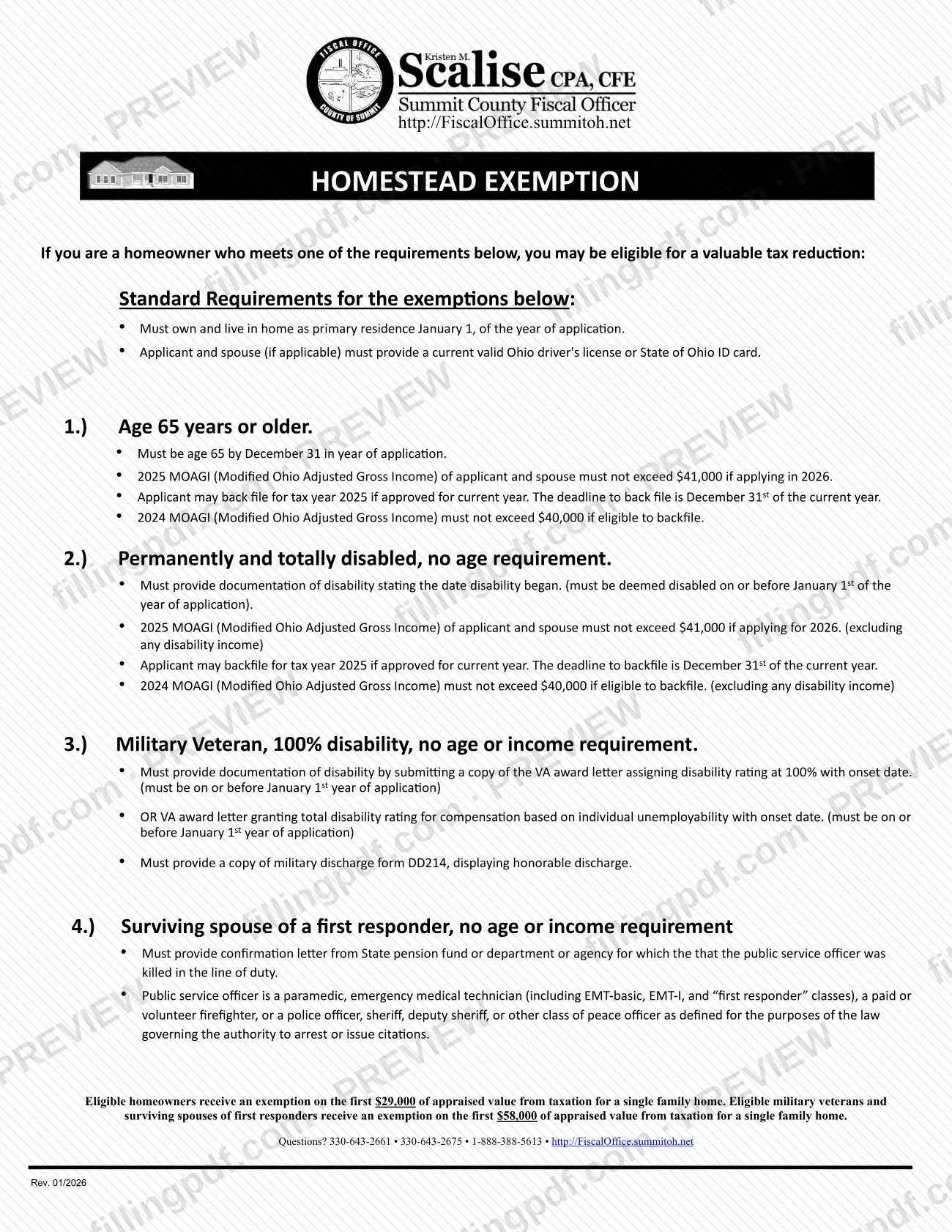
The PDF has two parts. The first page, marked Rev. 01/2026, lists the standard requirements and four categories of homeowners who may be eligible: age 65 or older, permanently and totally disabled, military veterans with a 100% disability rating, and surviving spouses of first responders. It also says that eligible veterans and surviving spouses of first responders receive an exemption on a larger share of appraised value than other eligible homeowners. The Fiscal Office phone numbers and website are printed at the bottom.
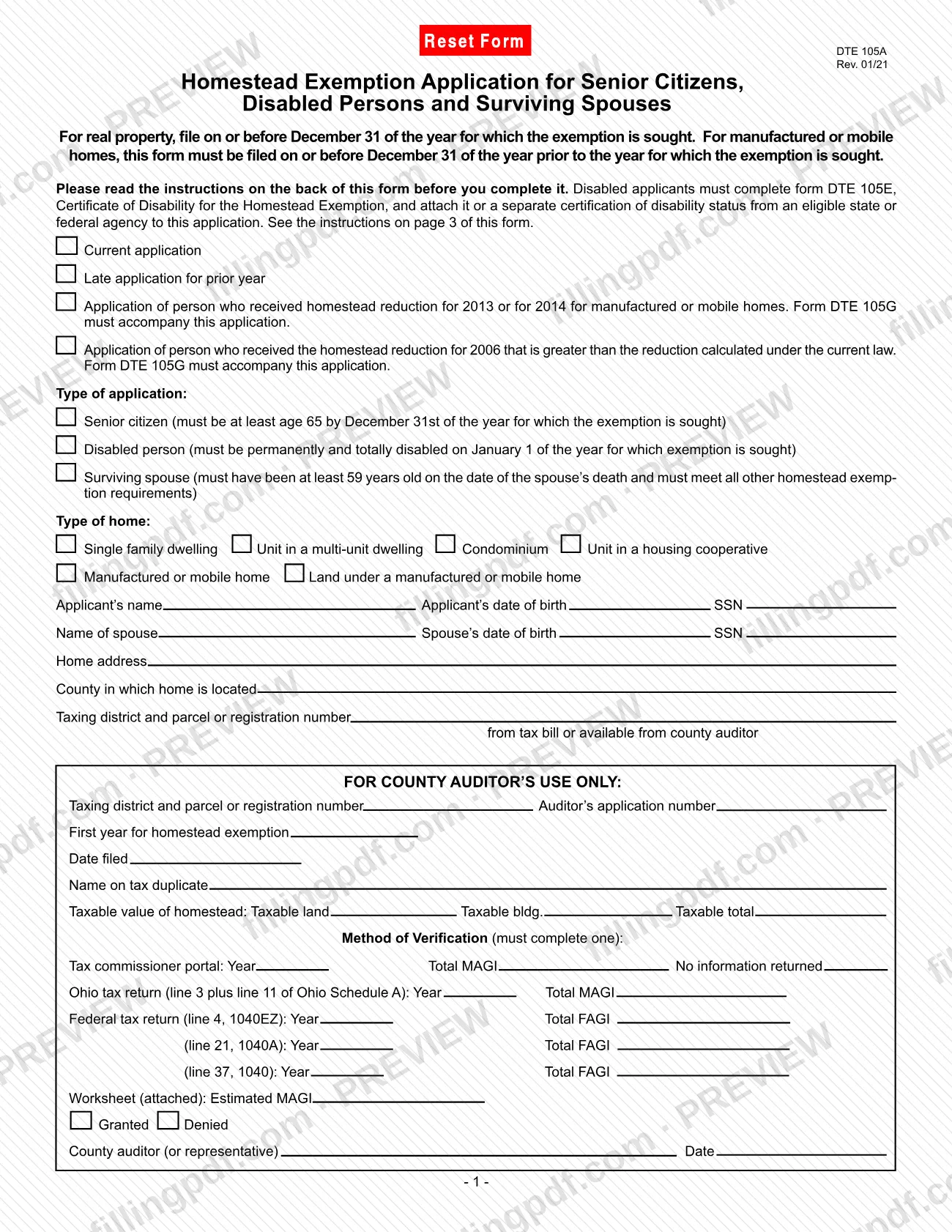
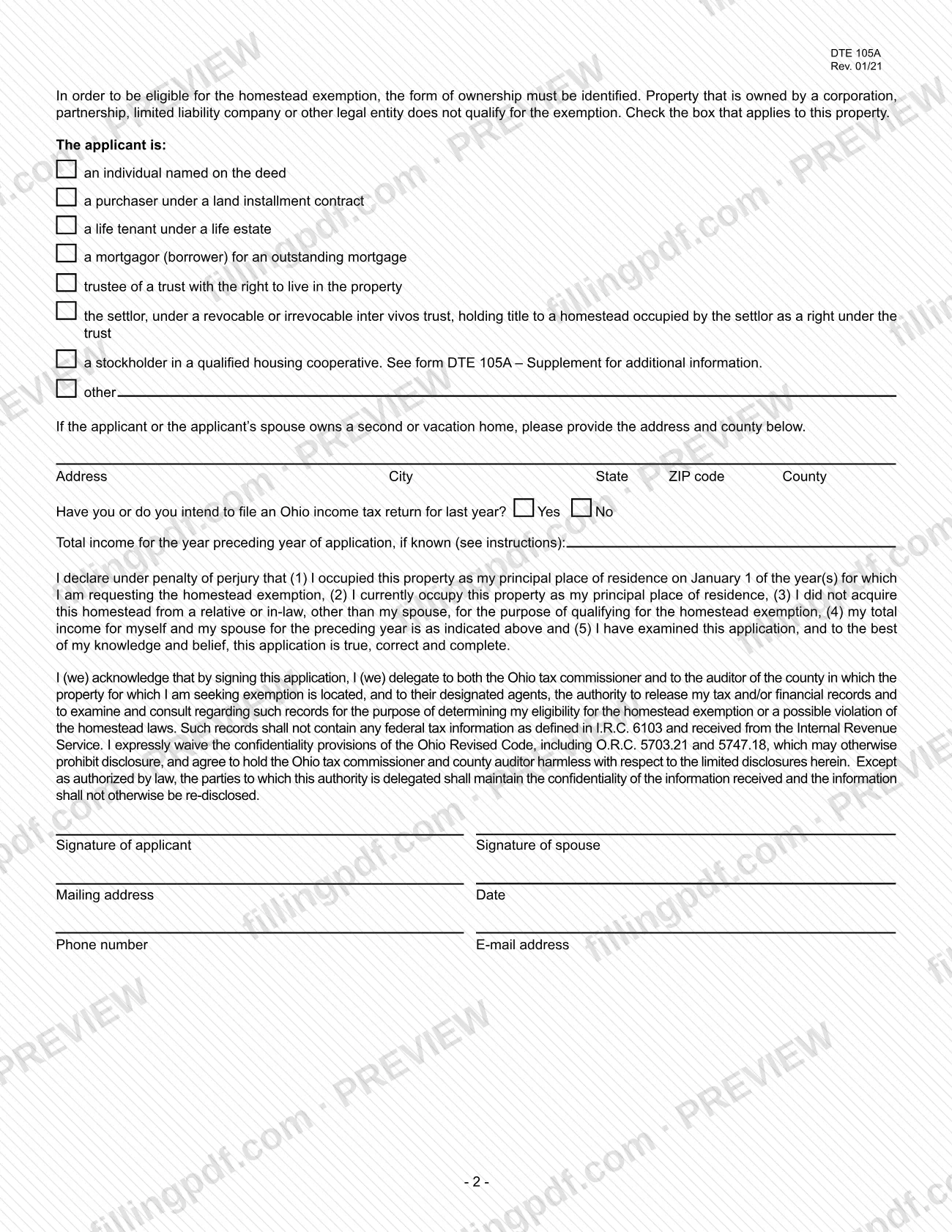
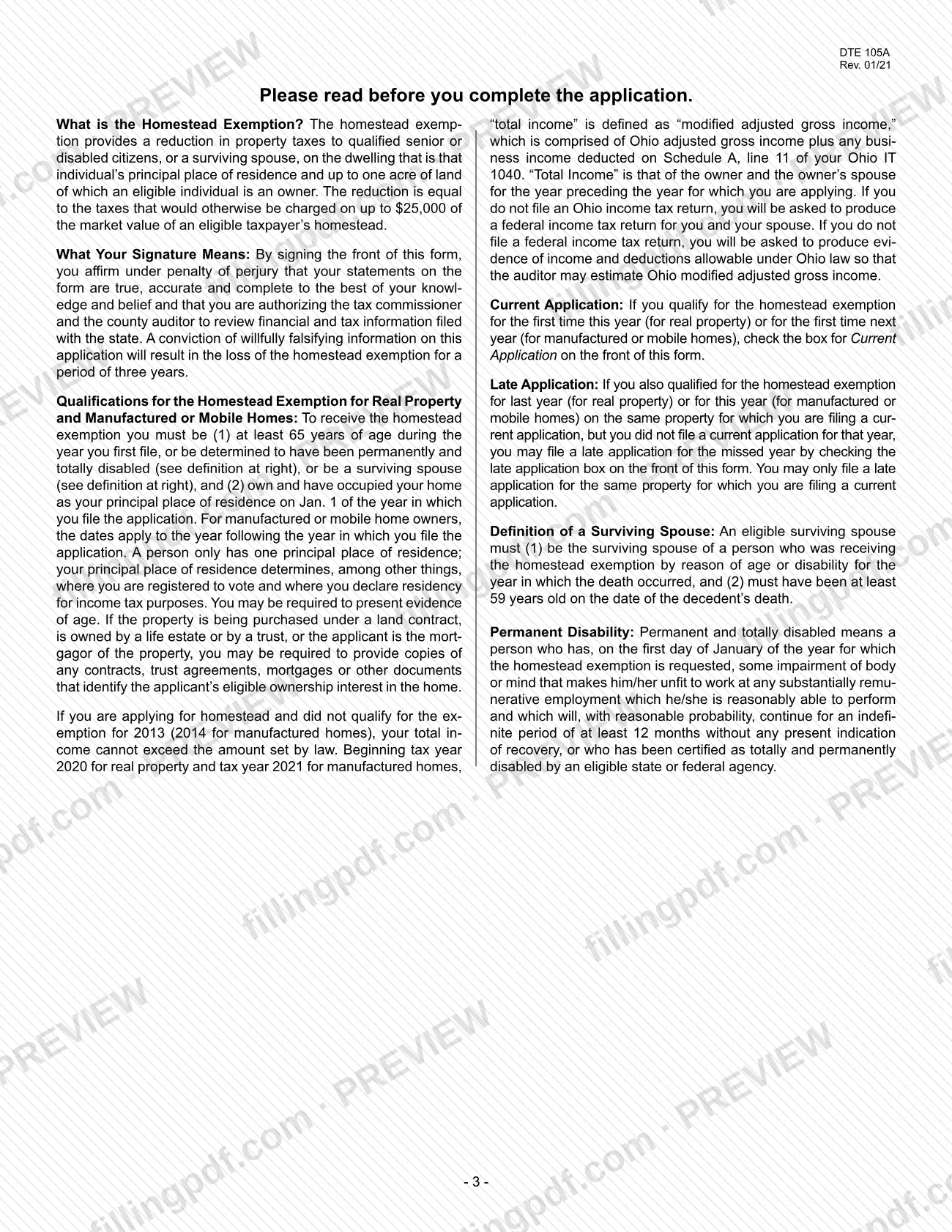
The remaining pages are Form DTE 105A, Homestead Exemption Application for Senior Citizens, Disabled Persons and Surviving Spouses (Rev. 01/21). It asks for the type of application, the type of home, the owner and spouse, the parcel, the form of ownership and income, and ends with a declaration under penalty of perjury. A block for the county auditor's use records the verification and the decision. The back of the form explains the exemption, the qualifications and the definitions of surviving spouse and permanent disability.
The Fiscal Office forms page lists separate applications for other situations, including DTE 105I for veterans evaluated at 100% disability, DTE 105K for surviving spouses of public service officers killed in the line of duty, DTE 105G for homeowners who changed residences, and DTE 105C for the owner-occupancy credit.
Who needs to file DTE 105A?
Homeowners who own and live in the home as their primary residence on January 1 of the year of application, and who fall into one of the categories below, may use this packet. Applicants and spouses (if applicable) must provide a current valid Ohio driver's license or State of Ohio ID card.
- Age 65 or older: you must be age 65 by December 31 of the year of application, and the income of you and your spouse must stay within the limit printed on the information sheet.
- Permanently and totally disabled: no age requirement. You must be deemed disabled on or before January 1 of the year of application and provide documentation of disability stating when it began; the same income limit applies, excluding disability income.
- Military veteran with a 100% disability rating: no age or income requirement; the information sheet lists the documents to submit.
- Surviving spouse of a first responder killed in the line of duty: no age or income requirement.
- Surviving spouse (Form DTE 105A): the spouse must have been at least 59 years old on the date of the death of a person who was receiving the exemption by reason of age or disability in the year of death.
Property owned by a corporation, partnership, limited liability company or other legal entity does not qualify. The Fiscal Office forms page lists DTE 105I and DTE 105K as separate applications for veterans and for surviving spouses of public service officers.
When to file DTE 105A
For real property, file Form DTE 105A on or before December 31 of the year for which the exemption is sought. For manufactured or mobile homes, the form says to file on or before December 31 of the year before the year for which the exemption is sought; the Fiscal Office forms page gives the first Monday in June of that preceding year, so confirm the date with the office.
Eligibility is measured on set dates: you must own and have occupied the home as your principal residence on January 1 of the year you file, and a senior applicant must be 65 by December 31 of that year. A disabled applicant must be permanently and totally disabled on January 1.
If you also qualified for the prior year on the same property but did not file, check Late application for prior year. The information sheet states that a 65-or-older or disabled applicant approved for the current year may back file for the prior tax year, with a deadline of December 31 of the current year.
Documents you need
- Current valid Ohio driver's license or State of Ohio ID card for the applicant and for the spouse, if applicable; the information sheet lists it as a standard requirement.
- Disabled applicants: Form DTE 105E, Certificate of Disability for the Homestead Exemption, or a separate certification of disability status from an eligible state or federal agency, attached to the application.
- Disabled applicants: documentation of disability stating the date the disability began, which must be on or before January 1 of the year of application.
- Veterans with a 100% disability rating: a copy of the VA award letter assigning the 100% rating with an onset date on or before January 1 of the year of application.
- Veterans, as an alternative to the 100% letter: a VA award letter granting total disability based on individual unemployability, with an onset date on or before January 1 of the year of application.
- Veterans: a copy of military discharge form DD214 displaying an honorable discharge.
- Surviving spouses of first responders: a confirmation letter from the State pension fund or the department or agency showing the public service officer was killed in the line of duty.
- Form DTE 105G, when you check one of the two boxes for a person who received a homestead reduction for 2013 or 2014 (manufactured or mobile homes) or for 2006.
- Copies of contracts, trust agreements, mortgages or other documents showing your ownership interest, which you may be asked to provide if the home is under a land contract, a life estate or a trust, or you are the mortgagor.
- A federal income tax return for you and your spouse if you do not file an Ohio return; if you file neither, evidence of income and allowable deductions so the auditor can estimate Ohio modified adjusted gross income.
- Evidence of age, which you may be required to present.
How to fill out DTE 105A
Read the requirements first
Review the information sheet to see which category fits you and which documents it asks for. Then read the instructions on the back of Form DTE 105A before you start entering information.
Choose the type of application
Under the application options, check Current application if you qualify for the first time, or Late application for prior year for a missed year on the same property. Check one of the two DTE 105G options only if they describe you, and enclose Form DTE 105G.
Select the applicant type
Under Type of application, check Senior citizen, Disabled person or Surviving spouse, matching the age, disability or surviving-spouse conditions printed beside each box.
Select the type of home
Check one under Type of home: single family dwelling, unit in a multi-unit dwelling, condominium, unit in a housing cooperative, manufactured or mobile home, or land under a manufactured or mobile home.
Enter applicant and spouse details
Enter the applicant's name, date of birth and SSN. If applicable, enter the spouse's name, date of birth and SSN on the next line.
Enter the home and parcel details
Enter the home address, the county in which the home is located, and the taxing district and parcel or registration number from the tax bill (also available from the county auditor). Leave the block marked for the county auditor's use blank.
Identify the form of ownership
On the second page, check the box that describes the applicant: individual named on the deed, land installment contract purchaser, life tenant, mortgagor, trustee, settlor, cooperative stockholder or other.
List any second or vacation home
If you or your spouse own a second or vacation home, enter its address, city, state, ZIP code and county in the spaces provided.
Answer the income questions
Check Yes or No for whether you have filed or intend to file an Ohio income tax return for last year. Enter the total income for the year before the year of application, if known; it is income of the owner and spouse as defined in the instructions.
Sign and add contact details
Read the declaration under penalty of perjury and the records-release acknowledgment, then sign. The spouse signs in the spouse's space; enter your mailing address, date, phone number and email.
Gather the supporting documents
Attach the identification and category documents the information sheet lists for your situation, such as Form DTE 105E for disability, VA letters and DD214 for veterans, or a first-responder confirmation letter.
Review and download the PDF
Check names, parcel number, checked boxes and signatures. Download or print the completed PDF from FillingPDF and deliver it with your documents as described under How to submit.
How to submit DTE 105A
The PDF does not print a mailing address, portal or drop-off location for the completed application, so confirm the delivery method with the Summit County Fiscal Office before sending it.
- Phone: 330-643-2661, 330-643-2675 or 1-888-388-5613, as printed on the information sheet.
- Website: http://FiscalOffice.summitoh.net; the office's forms page is at https://fiscaloffice.summitoh.net/forms.
Sign the application and include the supporting documents that apply to your situation (see the document list). The county auditor, or a representative, records the method of verification and marks the application granted or denied in the block reserved for the county auditor's use; do not fill in that block. By signing, you authorize the Ohio tax commissioner and the county auditor to review your tax and financial records to determine eligibility. FillingPDF lets you fill out and download the PDF; submission follows the Fiscal Office's channels.
Common mistakes to avoid
- Applying for a home owned by a corporation, partnership, limited liability company or other legal entity; the form says such property does not qualify.
- Filing after December 31 of the year for which the exemption is sought (real property), or after the earlier date that applies to a manufactured or mobile home.
- Disabled applicants sending the application without Form DTE 105E or a certification of disability status from an eligible state or federal agency.
- Providing an Ohio driver's license or State of Ohio ID for the applicant only, when a spouse must also provide one.
- Checking the DTE 105G boxes under the type of application without enclosing Form DTE 105G.
- Filing a late application for a property other than the one named on the current application; late applications are allowed only for the same property.
- Leaving the form of ownership unmarked, or skipping the second or vacation home address when you or your spouse own one.
- Using this application as a veteran with a 100% disability rating or as the surviving spouse of a public service officer, when the Fiscal Office lists DTE 105I and DTE 105K for those cases.
- Entering false residency or income information; a conviction of willfully falsifying the application means losing the exemption for three years.
Frequently asked questions
What is the Current Home Information Sheet?
It is a Summit County Fiscal Office PDF that summarizes who may be eligible for the homestead exemption and includes Form DTE 105A, the application for senior citizens, disabled persons and surviving spouses. It covers requirements, documents to submit and the application itself.
Which Summit County property tax form is this?
It is a Summit County property tax form for the homestead exemption, a reduction on the owner's primary residence. The Fiscal Office lists other property tax forms separately, such as DTE 1 for valuation complaints and DTE 105C for the owner-occupancy credit.
Who qualifies for the homestead exemption in Summit County?
Homeowners who own and live in the home as their primary residence on January 1 of the year of application and are 65 or older, permanently and totally disabled, a veteran with a 100% disability rating, or the surviving spouse of a first responder killed in the line of duty. Age and disability categories have an income limit.
What is the deadline to file Form DTE 105A?
For real property, December 31 of the year for which the exemption is sought. For manufactured or mobile homes the form says December 31 of the prior year, while the Fiscal Office forms page gives the first Monday in June, so confirm with the office.
Can I file for a year I missed?
Possibly. If you qualified for the prior year on the same property but did not file, check Late application for prior year. The information sheet says 65-or-older and disabled applicants approved for the current year can back file the prior tax year by December 31 of the current year.
What documents do I need with the application?
Applicants and spouses need a current valid Ohio driver's license or State of Ohio ID card. Disabled applicants add Form DTE 105E or an agency certification; veterans add a VA award letter and DD214; first-responder spouses add a confirmation letter. Other documents may be requested.
Do veterans use this same application?
Veterans with a 100% disability rating are listed on the information sheet, but the Fiscal Office forms page lists DTE 105I as the application for veterans evaluated at 100% disability. Ask the Fiscal Office which application applies to you before filing.
Can I fill out the Current Home Information Sheet online?
Yes. You can fill out the PDF online on FillingPDF and download or print it. FillingPDF is an independent service and does not file the application with the Summit County Fiscal Office; you deliver it through the office's channels.
What does my signature on the application mean?
You declare under penalty of perjury that the statements are true and complete, and you authorize the Ohio tax commissioner and county auditor to review your tax and financial records to determine eligibility. A conviction of willful falsification means losing the exemption for three years.
Ready to fill out DTE 105A?
Fill out DTE 105A now