
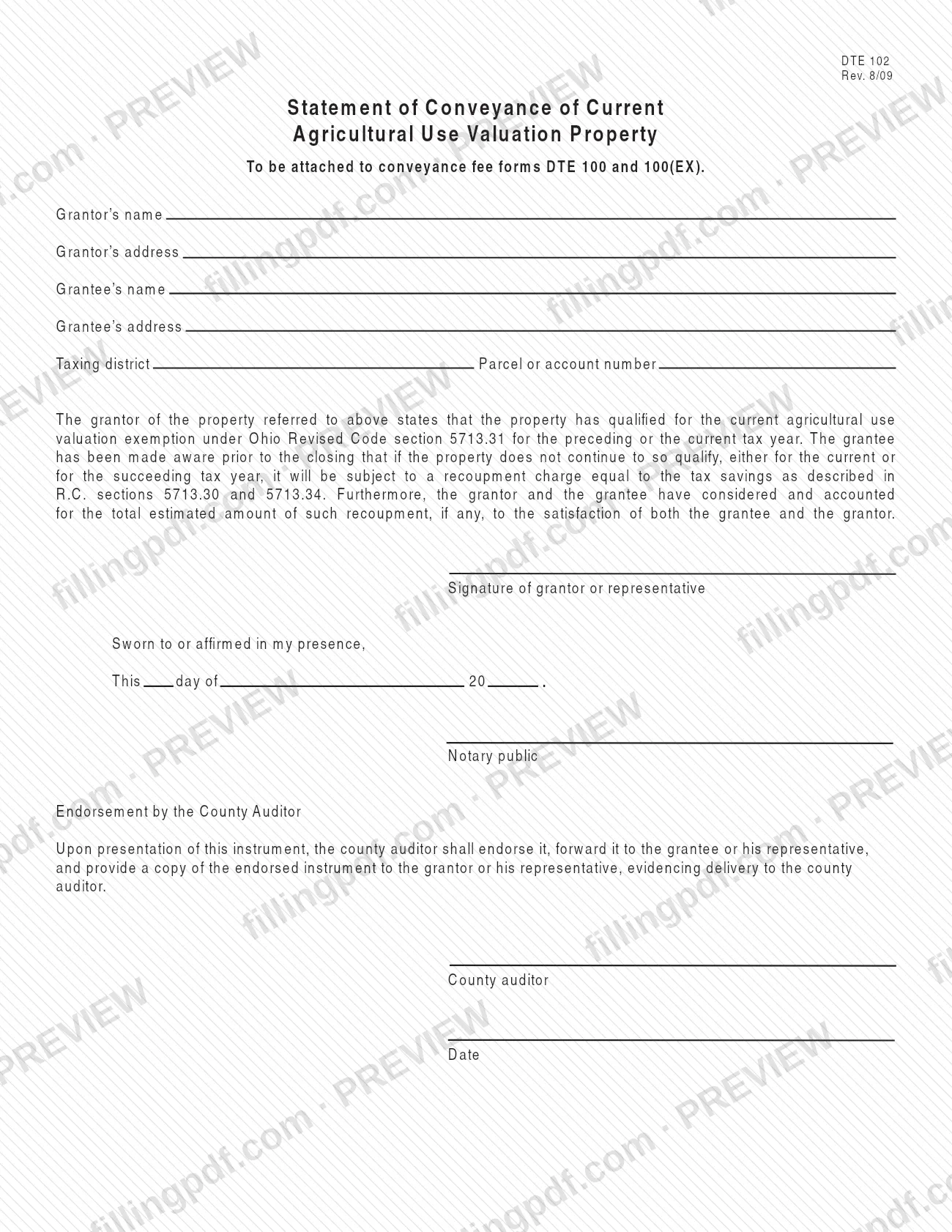
Form DTE 102, Statement of Conveyance of Current Agricultural Use Valuation Property, is the statement a grantor signs when land valued under the Current Agricultural Use Valuation (CAUV) program is conveyed. It is one of the Summit County property tax forms published by the Summit County Fiscal Office, and it is attached to conveyance fee forms DTE 100 and 100(EX). On this page you can fill out the form online on FillingPDF and download or print the completed PDF; the original is published by the Fiscal Office at the official link.
Last updated
What is DTE 102?
Form DTE 102, Statement of Conveyance of Current Agricultural Use Valuation Property, is the one-page statement, printed "Rev. 8/09", that accompanies a conveyance of property that has qualified for the Current Agricultural Use Valuation (CAUV) exemption. It is attached to conveyance fee forms DTE 100 and 100(EX).
In the statement, the grantor says the property has qualified for the current agricultural use valuation exemption under Ohio Revised Code section 5713.31 for the preceding or the current tax year. The grantee confirms having been made aware, before the closing, that if the property does not continue to qualify, either for the current or for the succeeding tax year, it will be subject to a recoupment charge equal to the tax savings, as described in R.C. sections 5713.30 and 5713.34. The grantor and the grantee also state that they have considered and accounted for the total estimated recoupment, if any, to the satisfaction of both.
The form has three parts: the identification block (grantor, grantee, taxing district, parcel or account number), the grantor's signature sworn to or affirmed before a notary public, and an endorsement by the county auditor.
The Summit County Fiscal Office lists a companion statement, DTE 101, for conveyed property that is receiving a homestead exemption reduction for the current year. DTE 102 is the one for CAUV property.
Who needs to file DTE 102?
The grantor of property that is qualified for the CAUV exemption completes and signs Form DTE 102 when that property is conveyed. The Summit County Fiscal Office says it is to be filed with a conveyance form when the property being transferred is qualified for CAUV.
- Grantor: states that the property qualified for the exemption under R.C. 5713.31 for the preceding or the current tax year, signs the form (or a representative signs for the grantor) and swears or affirms the signature before a notary public.
- Grantee: is named on the form and, under its text, has been made aware before the closing of the possible recoupment charge. The form has a line for the grantee's name and address but no grantee signature line.
- County auditor: endorses the form after it is presented.
Do not use DTE 102 for property receiving a homestead exemption reduction; the Fiscal Office lists Statement of Conveyance of Homestead property, DTE 101, for that case.
When to file DTE 102
Form DTE 102 is filed when property qualified for the CAUV exemption is being transferred, together with the conveyance fee form (DTE 100 or 100(EX)) that the transfer requires. The form prints no separate due date, so it travels with the conveyance form.
The grantor's statement covers qualification for the preceding or the current tax year. The grantee must have been made aware, prior to the closing, that the property will be subject to a recoupment charge if it does not continue to qualify for the current or the succeeding tax year, so the statement is prepared before or at the closing.
The signature must be sworn to or affirmed in the presence of a notary public, so plan the signing where a notary is present.
Documents you need
- Conveyance fee form DTE 100 or DTE 100(EX): Form DTE 102 is attached to it. Use the State of Ohio DTE 100 (Rev. 5/20) and DTE 100EX (Rev. 1/14) editions the Summit County Fiscal Office requires.
How to fill out DTE 102
Enter the grantor's details
Fill in Grantor's name and Grantor's address for the person or entity conveying the property.
Enter the grantee's details
Fill in Grantee's name and Grantee's address for the person or entity receiving the property.
Identify the property
Enter the Taxing district and the Parcel or account number of the CAUV property being conveyed.
Read the printed statement
The text states that the property qualified for CAUV under R.C. 5713.31 for the preceding or current tax year and that the grantee knows about the possible recoupment charge (R.C. 5713.30 and 5713.34). Confirm both parties agree with it before signing.
Sign as grantor or representative
The grantor, or a representative, signs on Signature of grantor or representative. Do this in front of a notary public.
Have the notary complete the jurat
The notary completes the "Sworn to or affirmed in my presence" lines: the day and month, the year (20__) and the notary public's signature.
Leave the auditor block blank
The County auditor and Date lines under Endorsement by the County Auditor are for the county auditor to complete when the instrument is presented.
Review, download and attach
Check names, addresses and parcel number, then download or print the completed PDF from FillingPDF and attach it to conveyance fee form DTE 100 or 100(EX) as described under How to submit.
How to submit DTE 102
Form DTE 102 is not filed alone: it is attached to conveyance fee form DTE 100 or 100(EX) and presented with the conveyance to the Summit County Fiscal Office, which publishes the form.
- Attach it to the conveyance form: the form states it is to be attached to conveyance fee forms DTE 100 and 100(EX). The Fiscal Office says it is filed with a conveyance form when the property is qualified for CAUV.
- County auditor endorsement: upon presentation of the instrument, the county auditor endorses it, forwards it to the grantee or the grantee's representative, and provides a copy of the endorsed instrument to the grantor or the grantor's representative, evidencing delivery to the county auditor.
- Current conveyance forms: the Fiscal Office's forms page says it requires the State of Ohio DTE 100 (Rev. 5/20) and DTE 100EX (Rev. 1/14) and no longer accepts the outdated DTE forms.
The form prints no mailing address, portal or appointment rule. Ask the Summit County Fiscal Office how it takes conveyance filings. FillingPDF lets you fill out and download the PDF; submission follows the channels above.
Common mistakes to avoid
- Filing Form DTE 102 on its own instead of attaching it to conveyance fee form DTE 100 or 100(EX).
- Signing the grantor's statement without a notary public present; the signature must be sworn to or affirmed in the notary's presence.
- Using DTE 102 for property that receives a homestead exemption reduction, which the Fiscal Office lists under DTE 101 instead.
- Attaching DTE 102 to an outdated DTE 100 or DTE 100EX; the Fiscal Office no longer accepts the outdated editions.
- Leaving the taxing district or the parcel or account number blank, so the statement cannot be matched to the property conveyed.
- Closing without telling the grantee about the possible recoupment charge; the form states the grantee was made aware prior to the closing.
- Skipping the county auditor endorsement block: the auditor, not the signer, completes it on presentation of the instrument.
Frequently asked questions
What is Form DTE 102?
Form DTE 102 is the Statement of Conveyance of Current Agricultural Use Valuation Property. It is attached to conveyance fee forms DTE 100 and 100(EX) when property that qualified for the CAUV exemption is conveyed, and it records the grantor's statement and the grantee's awareness of possible recoupment.
Do I need DTE 102 to transfer CAUV farmland in Summit County?
Yes, if the property being transferred is qualified for the CAUV exemption. The Summit County Fiscal Office says DTE 102 is to be filed with a conveyance form in that case; the form itself is attached to DTE 100 or 100(EX).
What is the recoupment charge on DTE 102?
It is a charge equal to the tax savings, described in R.C. sections 5713.30 and 5713.34. The form says the property is subject to it if it does not continue to qualify for CAUV for the current or the succeeding tax year.
Does DTE 102 have to be notarized?
Yes. The grantor's signature is sworn to or affirmed in the presence of a notary public, who completes the lines under the signature. The grantor or a representative may sign.
Who completes the county auditor endorsement on DTE 102?
The county auditor does. On presentation of the instrument, the auditor endorses it, forwards it to the grantee or the grantee's representative, and gives the grantor or the grantor's representative a copy evidencing delivery to the auditor.
What is the difference between DTE 101 and DTE 102?
The Summit County Fiscal Office lists DTE 101 for conveyed property receiving a homestead exemption reduction for the current year, and DTE 102 for property qualified for the CAUV exemption. Each is filed with a conveyance form.
Can I fill out DTE 102 online?
You can fill out the PDF online on FillingPDF and download or print it. FillingPDF is an independent service: it does not file the form or notarize it. Filing follows the Summit County Fiscal Office's process for conveyance forms.
Ready to fill out DTE 102?
Fill out DTE 102 now