
Form DTE 23, Application for Real Property Tax Exemption and Remission, is the application used to ask that real property be removed from the tax list and placed on the tax-exempt list. In Summit County, Ohio, it is filed with the Summit County Fiscal Office and is one of the Summit County property tax forms that the Fiscal Office publishes. Exemption itself is granted through the Ohio Department of Taxation. On this page you can fill out the form online on FillingPDF and download or print the completed PDF; the form and its instructions are published by the Fiscal Office.
Last updated
What is DTE 23?
Form DTE 23, Application for Real Property Tax Exemption and Remission, is the application in which an owner or its representative asks to have property removed from the tax list and duplicate and placed on the tax-exempt list for the current tax year, and to have taxes and penalties for preceding tax years remitted.
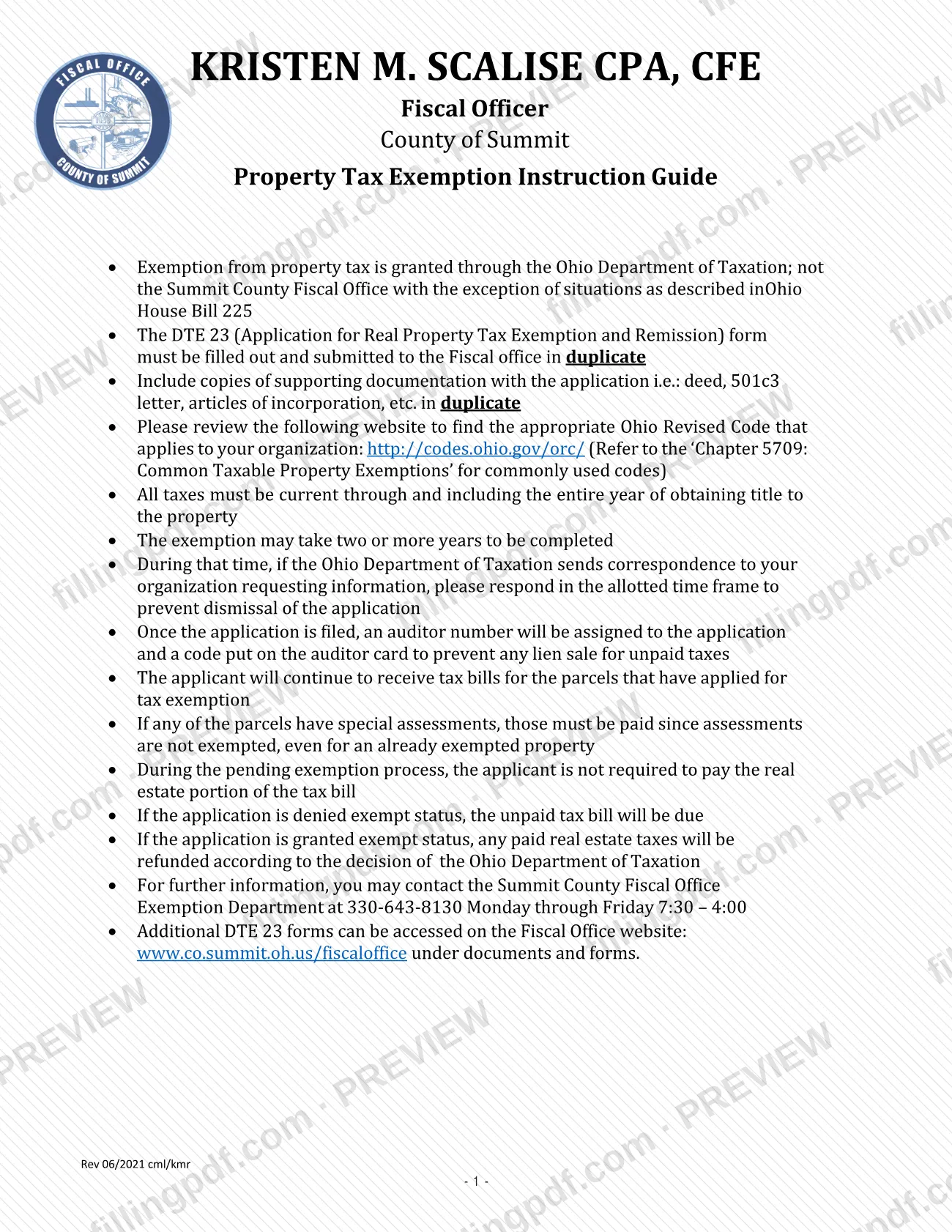
The Summit County Fiscal Office distributes the form together with a Property Tax Exemption Instruction Guide. The guide explains that exemption from property tax is granted through the Ohio Department of Taxation, not the Fiscal Office, except in situations described in Ohio House Bill 225. The Department may set a hearing on the application.
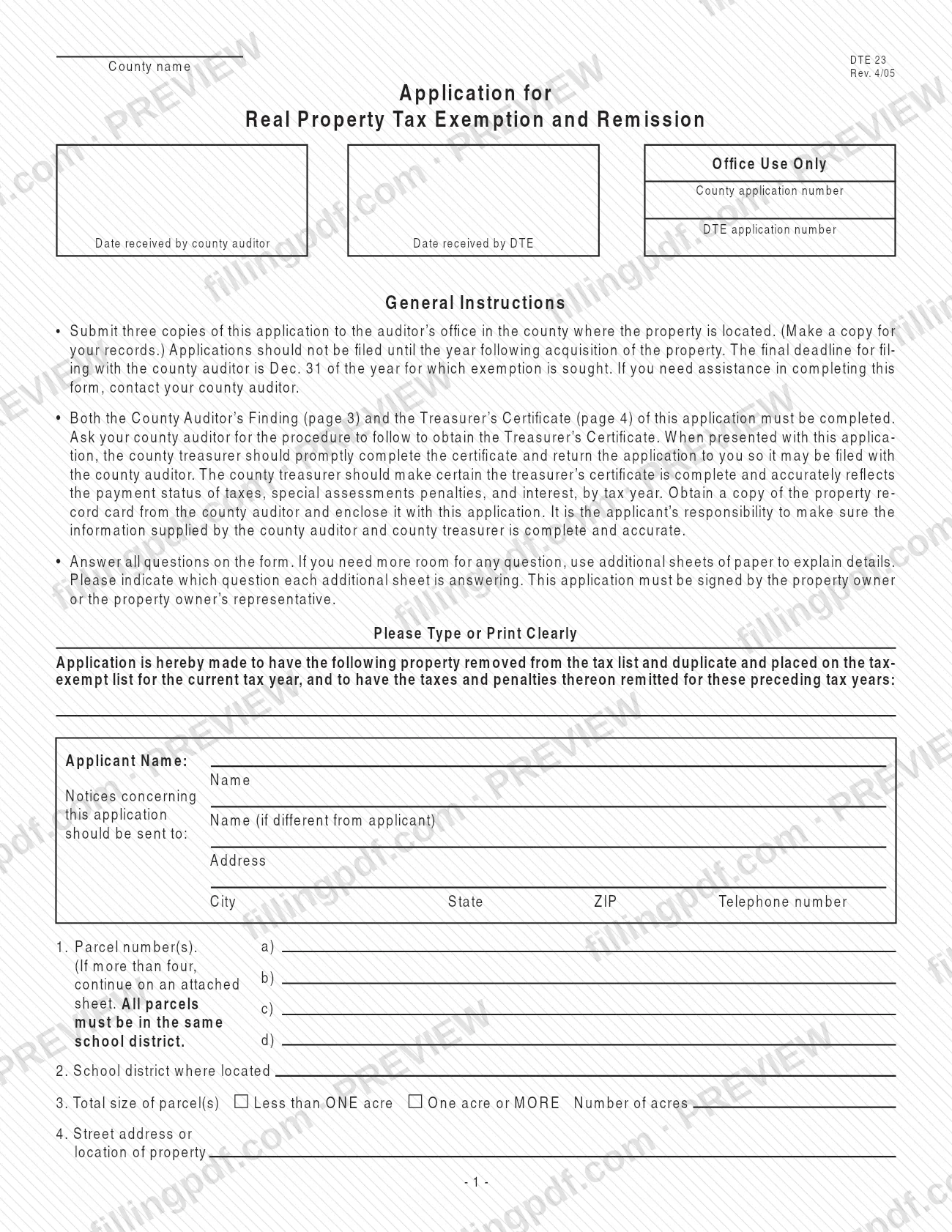
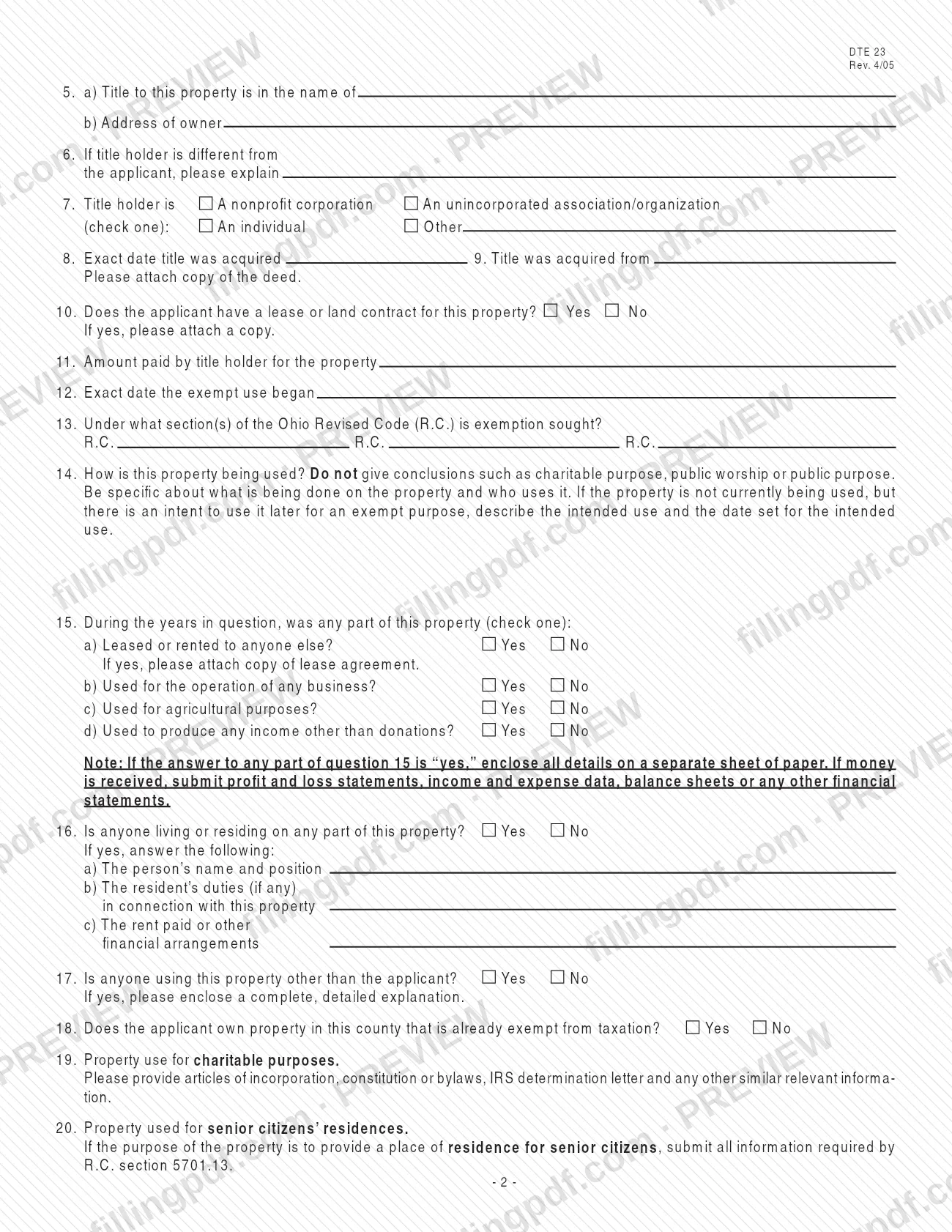
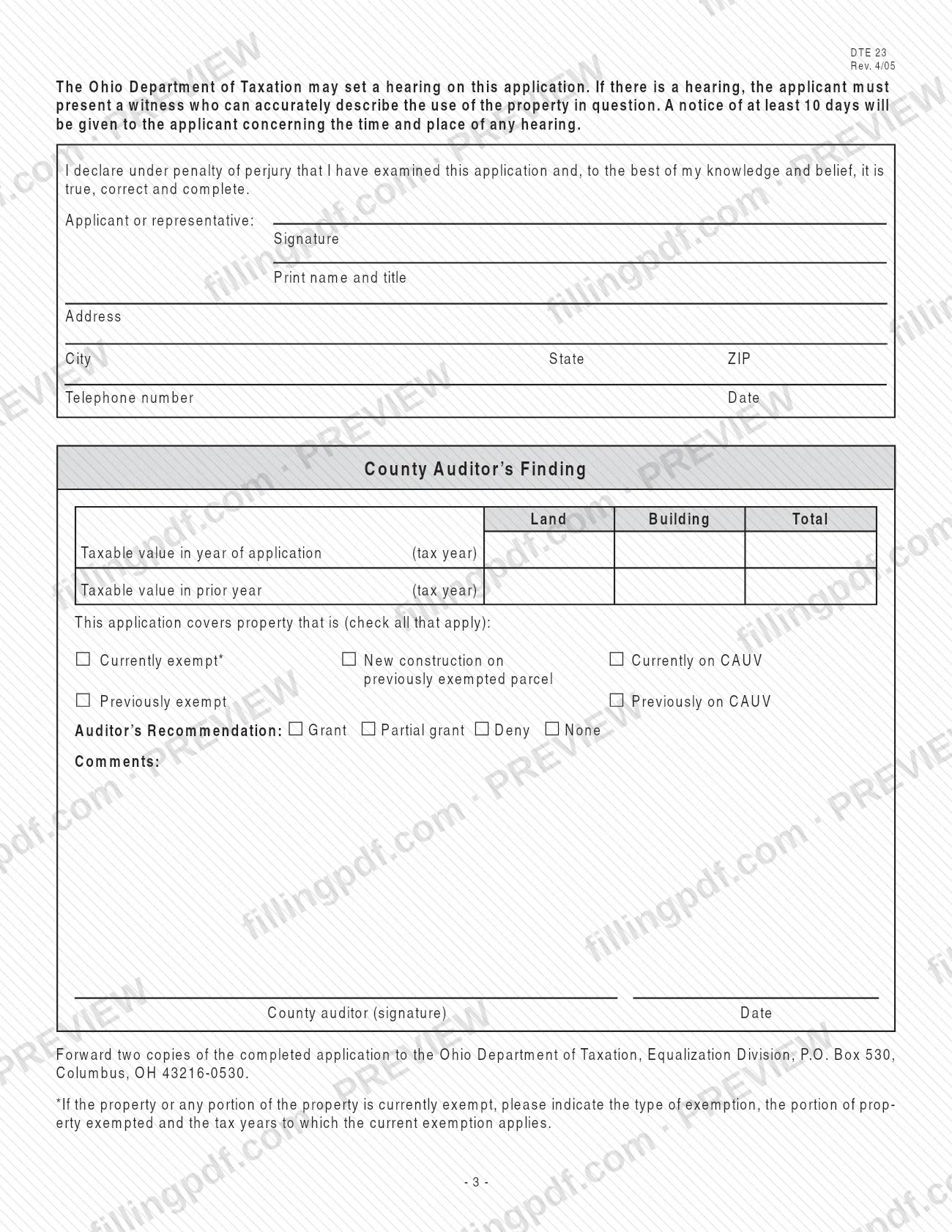
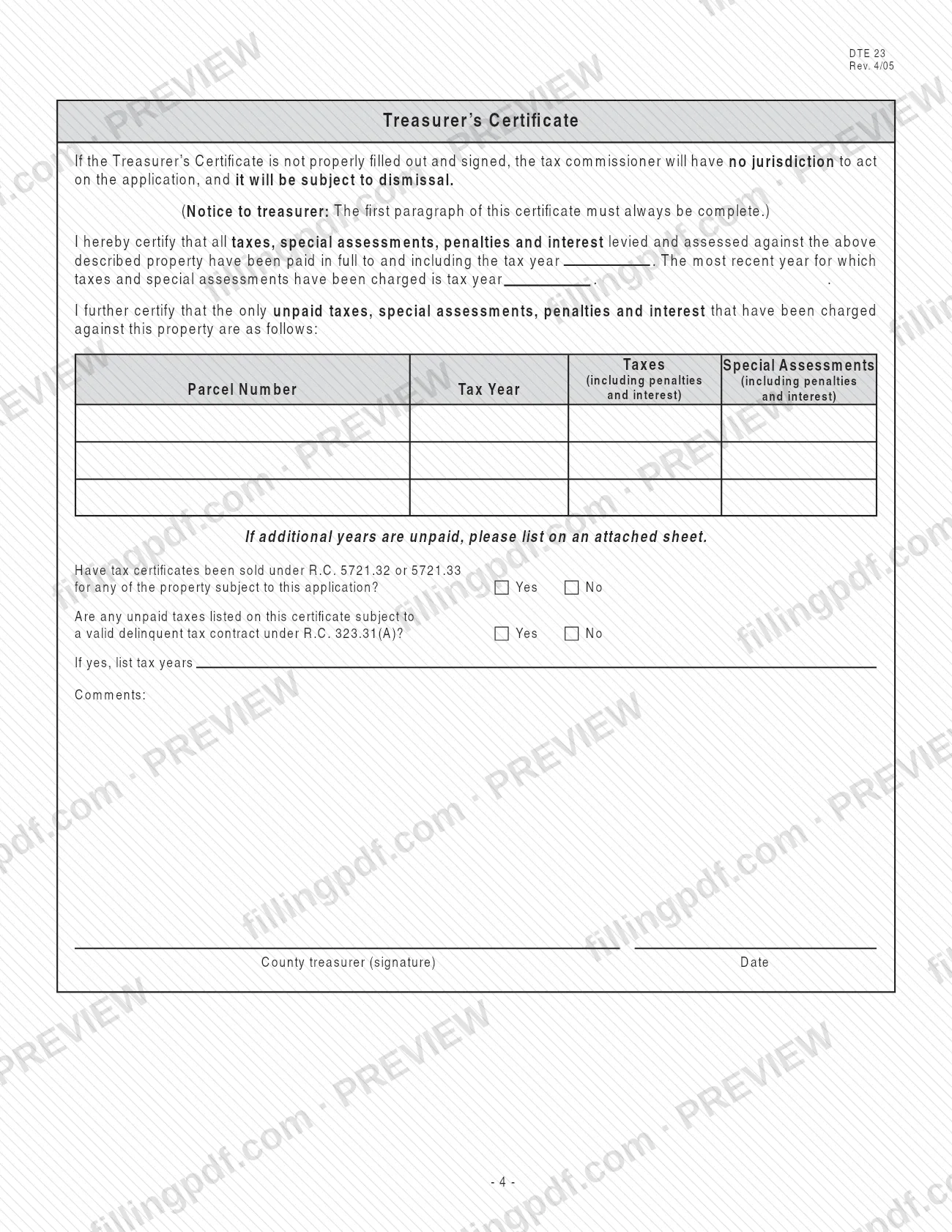
The form has four pages. Pages 1 and 2 hold the applicant's information and questions 1 to 20 about the parcels, the title, the use of the property and its occupants. Page 3 ends with the applicant's signature under penalty of perjury and holds the County Auditor's Finding. Page 4 is the Treasurer's Certificate, which states the payment status of taxes, special assessments, penalties and interest.
DTE 23 is not the only exemption-related form the Fiscal Office lists. DTE 24 is the version for tax incentive program applications, and DTE 23A is the application for remission of late-payment penalties on real property, personal property and manufactured homes. Homestead reductions use the DTE 105 series.
Who needs to file DTE 23?
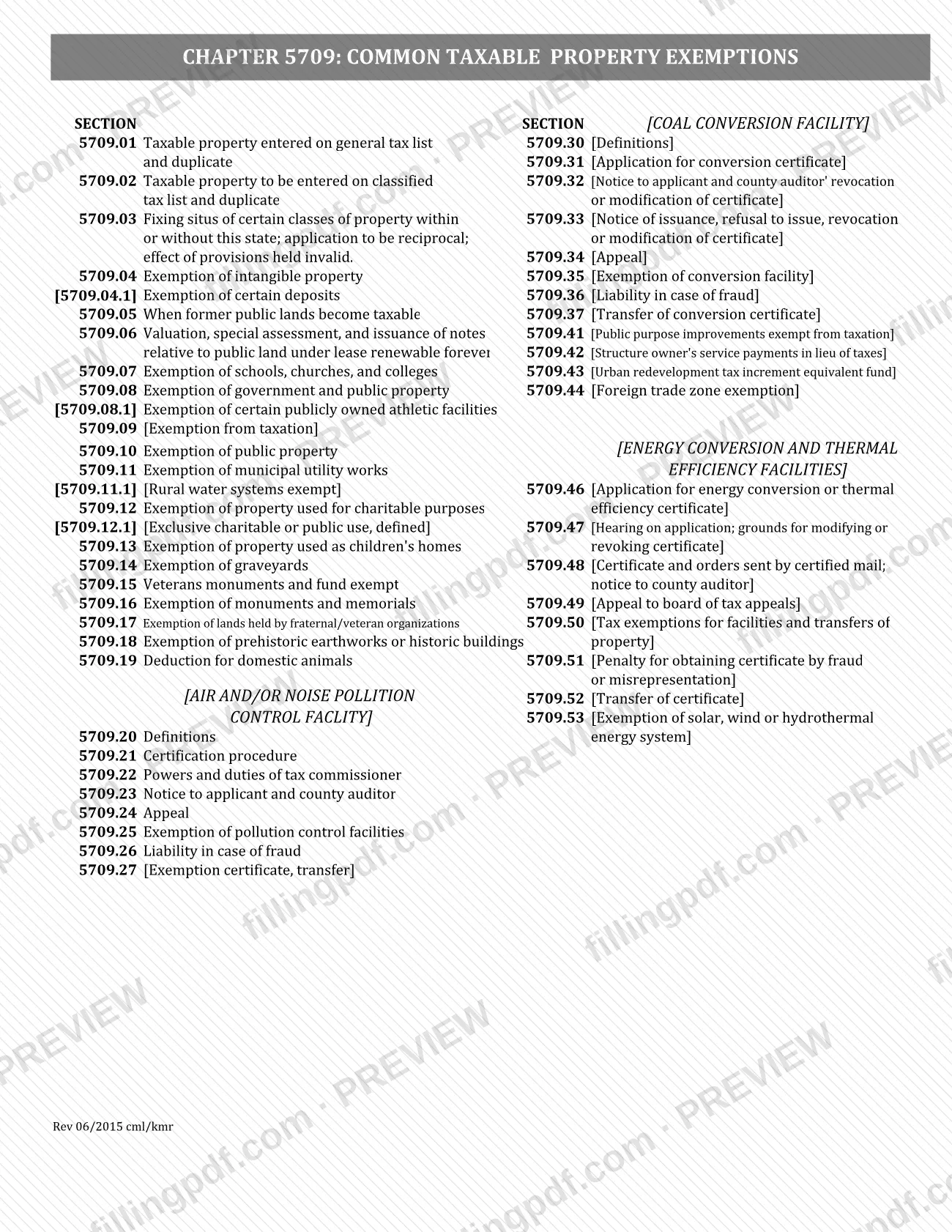
Property owners, or their representatives, who want real property removed from the tax list and placed on the tax-exempt list use Form DTE 23. The form asks you to identify the title holder as a nonprofit corporation, an unincorporated association or organization, an individual, or other. It includes sections for property used for charitable purposes and for senior citizens' residences. The guide gives examples of supporting papers such as a deed, a 501c3 letter and articles of incorporation, and points to Chapter 5709 of the Ohio Revised Code to find the section that fits your organization.
The form must be signed by the property owner or the owner's representative. If the title holder is not the applicant, question 6 asks you to explain.
Use a different form in these cases, according to the Fiscal Office's forms page:
- Tax incentive program applications use DTE 24.
- Requests to remit late-payment penalties use DTE 23A.
- Homestead exemptions for seniors, disabled persons, surviving spouses or veterans use the DTE 105 series.
The Fiscal Office does not grant the exemption: the Ohio Department of Taxation decides, apart from situations described in Ohio House Bill 225.
When to file DTE 23
Do not file DTE 23 until the year following acquisition of the property. The final deadline for filing with the county auditor is December 31 of the year for which exemption is sought. The Summit County Fiscal Office forms page repeats both rules.
The guide adds that all taxes must be current through and including the entire year of obtaining title to the property. Once the application is filed, an auditor number is assigned and a code is placed on the auditor card to prevent a lien sale for unpaid taxes.
The exemption may take two or more years to be completed. If the Ohio Department of Taxation writes to your organization asking for information, respond within the allotted time to prevent dismissal of the application. If the Department sets a hearing, it gives the applicant notice of at least 10 days of the time and place, and the applicant must present a witness who can accurately describe the use of the property.
Documents you need
- Copy of the deed, attached for question 9 (the date title was acquired and from whom).
- Copy of the lease or land contract, only if you answer Yes to question 10.
- Copy of the lease agreement, only if any part of the property was leased or rented to anyone else (question 15a).
- Details on a separate sheet, only if you answer Yes to any part of question 15; if money is received, add profit and loss statements, income and expense data, balance sheets or other financial statements.
- A complete, detailed explanation, only if someone other than the applicant uses the property (question 17).
- For charitable use (question 19): articles of incorporation, constitution or bylaws, the IRS determination letter and other similar relevant information.
- For senior citizens' residences (question 20): all information required by R.C. section 5701.13.
- Supporting documentation named in the Summit County guide, such as a deed, 501c3 letter or articles of incorporation, in duplicate.
- Copy of the property record card, obtained from the county auditor and enclosed with the application.
- Completed Treasurer's Certificate (page 4), obtained through the procedure the county auditor gives you.
- Additional sheets if you need more room for any answer, marked with the question each one answers.
How to fill out DTE 23
Enter applicant and notice contact
Under the heading, type or print the applicant name. In the notices block, enter the name (if different from the applicant), address, city, state, ZIP and telephone number where correspondence should be sent.
List parcels and school district
Question 1: enter up to four parcel numbers, a) to d), and continue on an attached sheet if there are more; all must be in the same school district. Question 2: enter that school district.
Give size and location
Question 3: check Less than ONE acre or One acre or MORE and enter the number of acres. Question 4: enter the street address or location of the property.
Identify the title holder
Question 5: the name and address of the owner. Question 6: explain if the title holder differs from the applicant. Question 7: check one of nonprofit corporation, unincorporated association/organization, individual or other.
Enter acquisition and lease details
Question 8: the exact date title was acquired. Question 9: from whom, and attach the deed. Question 10: check Yes or No for a lease or land contract and attach a copy if Yes. Question 11: the amount paid by the title holder.
State exempt-use date and legal basis
Question 12: the exact date the exempt use began. Question 13: enter the Ohio Revised Code section or sections under which exemption is sought, in the R.C. spaces.
Describe how the property is used
Question 14: be specific about what is done on the property and who uses it, without conclusions. If it is not yet used, describe the intended use and the date set for it.
Answer lease, business and income questions
Question 15 a) to d): check Yes or No for lease or rental, business operation, agricultural use and income other than donations. Enclose details, copies and financial statements for any Yes.
Report residents and other users
Question 16: if anyone lives on the property, give the person's name and position, duties and rent or financial arrangements. Question 17: explain any use by someone other than the applicant. Question 18: say whether you own other exempt property in the county.
Complete use-specific questions
Question 19: for charitable use, provide the articles, constitution or bylaws, IRS determination letter and similar information. Question 20: for senior citizens' residences, submit the information required by R.C. section 5701.13.
Sign the declaration
On page 3, the applicant or representative signs, prints name and title, and enters address, city, state, ZIP, telephone number and date, declaring under penalty of perjury that the application is true, correct and complete.
Obtain auditor and treasurer sections
The County Auditor's Finding (page 3) and the Treasurer's Certificate (page 4) are completed by county officials. Ask the county auditor for the procedure; do not fill these sections yourself.
Review and download the completed PDF
Check every question, attachment and signature, then download or print the completed PDF from FillingPDF. Assemble the copies and documents described under How to submit.
How to submit DTE 23
Submit Form DTE 23 to the auditor's office in the county where the property is located; for Summit County that is the Summit County Fiscal Office. The form prints no street address or portal for that office, so call the Exemption Department at 330-643-8130, Monday through Friday, 7:30 – 4:00, to confirm how to deliver the package.
- Copies: the printed form says to submit three copies and to keep a copy for your records. The Summit County guide says to submit the application and its supporting documents in duplicate. Confirm the number with the Exemption Department before you file.
- Treasurer's Certificate: page 4 must be completed before filing. Ask the county auditor for the procedure; the county treasurer completes the certificate and returns the application to you so it can be filed with the auditor.
- Property record card: obtain a copy from the county auditor and enclose it.
- After filing: the County Auditor's Finding on page 3 is completed by the auditor. The form prints the Ohio Department of Taxation, Equalization Division, P.O. Box 530, Columbus, OH 43216-0530 as the place the completed application is forwarded.
Additional DTE 23 forms are on the Fiscal Office website under documents and forms. FillingPDF lets you fill out and download the PDF; submission follows the channels above.
Common mistakes to avoid
- Filing in the year the property was acquired; the form says applications should not be filed until the following year.
- Filing after December 31 of the year for which exemption is sought, which is the final deadline with the county auditor.
- Leaving the Treasurer's Certificate incomplete or unsigned; without it the tax commissioner has no jurisdiction and the application is subject to dismissal.
- Answering questions 14 with conclusions such as charitable purpose or public worship instead of specifically what is done on the property and who uses it.
- Not responding in time to Ohio Department of Taxation correspondence, which can lead to dismissal of the application.
- Skipping questions: the form says to answer all of them, using additional sheets marked with the question number if needed.
- Answering Yes to question 15 without enclosing the details and financial statements the note requires.
- Not paying special assessments while the exemption is pending; the guide says assessments are not exempted.
- Submitting the application without the signature of the owner or the owner's representative.
- Omitting the copy of the deed or the property record card.
Frequently asked questions
What is Form DTE 23 used for?
Form DTE 23 is the Application for Real Property Tax Exemption and Remission. It asks that property be removed from the tax list and placed on the tax-exempt list for the current tax year, and that taxes and penalties for preceding tax years be remitted.
Who grants the property tax exemption in Summit County?
The Ohio Department of Taxation grants it, not the Summit County Fiscal Office, except in situations described in Ohio House Bill 225. The Fiscal Office receives the application, completes the County Auditor's Finding and forwards it.
What is the deadline to file Form DTE 23?
The final deadline for filing with the county auditor is December 31 of the year for which exemption is sought. The form also says not to file until the year following acquisition of the property.
Do I have to pay property taxes while my exemption is pending?
You are not required to pay the real estate portion of the tax bill while the application is pending, but you still receive bills and must pay special assessments. If the application is denied, the unpaid tax bill becomes due; if granted, paid real estate taxes are refunded as the Department of Taxation decides.
How many copies of DTE 23 do I submit?
The printed form says to submit three copies and keep one for yourself, while the Summit County guide says to file the application and documents in duplicate. Call the Exemption Department at 330-643-8130 to confirm before filing.
What is the Treasurer's Certificate on DTE 23?
It is page 4, completed by the county treasurer, certifying the payment status of taxes, special assessments, penalties and interest. If it is not properly filled out and signed, the tax commissioner has no jurisdiction and the application can be dismissed. Ask the county auditor how to obtain it.
How long does a property tax exemption take?
The Summit County guide says the exemption may take two or more years to be completed. During that time, answer any Ohio Department of Taxation requests for information within the time given, or the application can be dismissed.
Can I fill out Form DTE 23 online?
You can fill out the PDF online on FillingPDF and download or print it. FillingPDF does not file anything with the county or the state; you submit the completed application to the Summit County Fiscal Office through its own channels.
Is DTE 23 the same as DTE 24 or DTE 23A?
No. DTE 24 is the Fiscal Office's version for tax incentive program applications, and DTE 23A is the application for remission of late-payment penalties. DTE 23 is the general application for real property tax exemption and remission.
Ready to fill out DTE 23?
Fill out DTE 23 now