
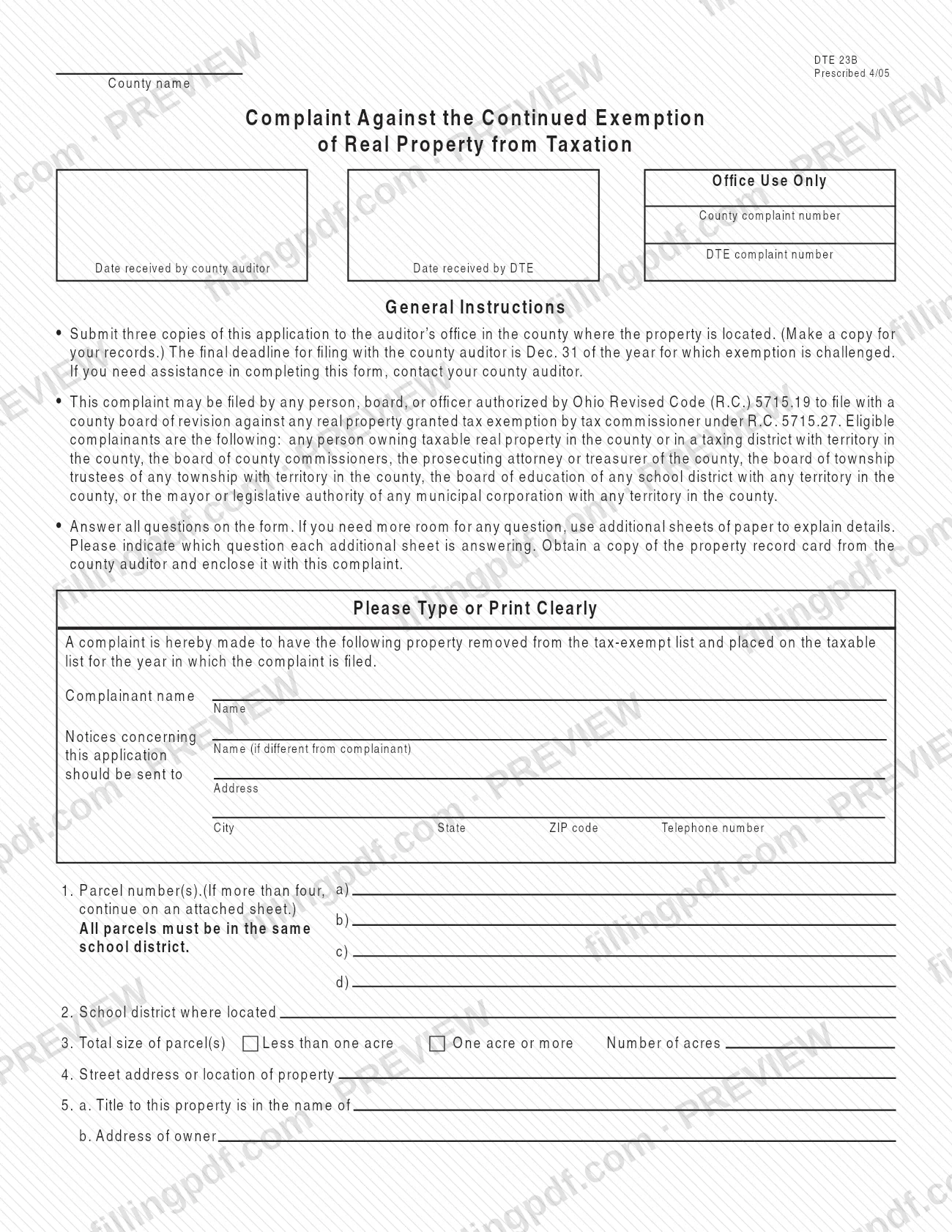
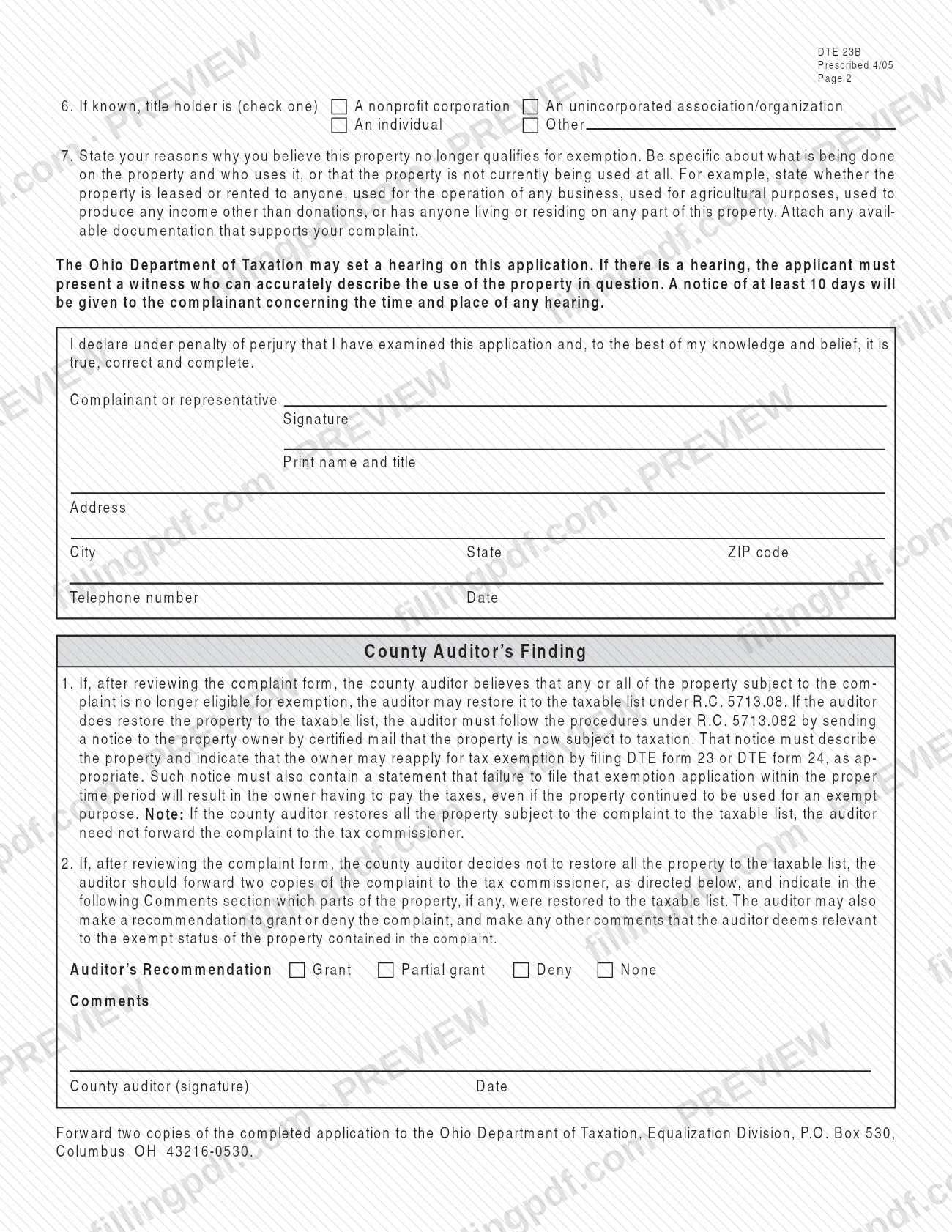
Form DTE 23B, Complaint Against the Continued Exemption of Real Property from Taxation, is the Ohio form on which an authorized complainant asks that a tax-exempt property be moved to the taxable list. It is one of the Summit County property tax forms published on the Summit County Fiscal Office website. It is filed with the county auditor's office, which may restore the property itself or forward the complaint to the Ohio Department of Taxation. On this page you can fill out the form online on FillingPDF and download or print the completed PDF; the form is published by the agency at the official source link.
Last updated
What is DTE 23B?
Form DTE 23B, Complaint Against the Continued Exemption of Real Property from Taxation, is the Ohio form used to complain that a property no longer qualifies for tax exemption and to have it removed from the tax-exempt list and placed on the taxable list for the year in which the complaint is filed.
The form applies to real property that the tax commissioner granted an exemption under Ohio Revised Code (R.C.) 5715.27. Its general instructions tie the right to complain to R.C. 5715.19. The complainant describes the parcels, the title holder and, on question 7, the reasons the property no longer qualifies, including what is done on the property and who uses it.
The county auditor reviews the complaint. If the auditor believes some or all of the property is no longer eligible, the auditor may restore it to the taxable list under R.C. 5713.08 and must then send the owner a certified-mail notice under R.C. 5713.082. That notice says the owner may reapply by filing DTE form 23 or DTE form 24. If the auditor restores all of the property, the complaint need not go to the tax commissioner. Otherwise the auditor forwards two copies to the Ohio Department of Taxation, Equalization Division, with a recommendation to grant, partially grant or deny.
Form DTE 23B is not a valuation complaint. The Summit County Fiscal Office lists DTE 1 separately for complaints against the valuation of real property, which go to the Board of Revision.
Who needs to file DTE 23B?
The form may be filed by any person, board or officer authorized by R.C. 5715.19 to file with a county board of revision, against real property that the tax commissioner exempted under R.C. 5715.27. The eligible complainants listed on the form are:
- any person owning taxable real property in the county or in a taxing district with territory in the county;
- the board of county commissioners;
- the prosecuting attorney or treasurer of the county;
- the board of township trustees of any township with territory in the county;
- the board of education of any school district with any territory in the county;
- the mayor or legislative authority of any municipal corporation with any territory in the county.
The signature block reads "Complainant or representative," so a representative may sign for the complainant and prints a name and title. The property must be the one whose exemption you are challenging, and all parcels listed on one complaint must be in the same school district. The form does not treat a property owner who wants an exemption as a complainant: owners reapply with DTE form 23 or 24 after a property is restored to the taxable list.
When to file DTE 23B
File Form DTE 23B whenever you believe a property exempted by the tax commissioner no longer qualifies, but no later than December 31 of the year for which the exemption is challenged. That is the final deadline for filing with the county auditor.
The form asks that the property be placed on the taxable list for the year in which the complaint is filed.
If the Ohio Department of Taxation sets a hearing, it gives the complainant notice of at least 10 days of the time and place. The complainant must then present a witness who can accurately describe how the property is used.
Documents you need
- A copy of the property record card for the parcel, obtained from the county auditor and enclosed with the complaint.
- Any available documentation that supports your reasons on question 7, such as records showing how the property is used.
- Additional sheets of paper if you need more room for any question, each marked with the question it answers.
- A continuation sheet listing parcel numbers when more than four parcels are involved (all in the same school district).
How to fill out DTE 23B
Enter the county name
At the top, write the county name. Leave the Office Use Only boxes (county complaint number, DTE complaint number and the dates received) blank.
Enter the complainant name
Under Complainant name, type or print your name. Print clearly, as the form requires.
Set where notices should go
In the Notices concerning this application should be sent to block, enter the name if different from the complainant, then the address, city, state, ZIP code and telephone number.
List the parcel numbers
Question 1: enter up to four parcel numbers (a through d) and continue on an attached sheet if there are more. All parcels must be in the same school district.
Give school district and size
Question 2: enter the school district where the property is located. Question 3: check Less than one acre or One acre or more and enter the number of acres.
Enter the property address
Question 4: write the street address or location of the property.
Identify the title holder
Question 5a: enter the name in which title to the property is held. Question 5b: enter the owner's address.
Check the title holder type
Question 6, if known: check one of A nonprofit corporation, An unincorporated association/organization, An individual or Other.
State your reasons
Question 7: explain why the property no longer qualifies for exemption, including what is done on the property, who uses it, or that it is not used at all. Mention any leasing, business use, agricultural use, income other than donations or residents, and attach supporting documentation.
Sign the declaration
The complainant or representative signs, prints name and title, and enters address, city, state, ZIP code, telephone number and date, under the declaration made under penalty of perjury.
Review, download and assemble copies
Leave the County Auditor's Finding section for the auditor. Check every entry, then download or print the completed PDF from FillingPDF, make three copies and add the property record card and any supporting documents, as described under How to submit.
How to submit DTE 23B
Form DTE 23B is submitted on paper to the county auditor's office in the county where the property is located; the form names no online channel.
- To the county auditor: submit three copies of the complaint, and keep a copy for your records. The Summit County Fiscal Office publishes the form on its forms page, and the form says to contact your county auditor if you need help completing it.
- Enclosures: include a copy of the property record card, which you obtain from the county auditor, and any documentation that supports your reasons.
- After filing: the auditor completes the County Auditor's Finding section. If the auditor does not restore all of the property to the taxable list, two copies go to the Ohio Department of Taxation, Equalization Division, P.O. Box 530, Columbus OH 43216-0530. You do not send them there yourself.
FillingPDF lets you fill out and download the PDF; submission follows the channels above.
Common mistakes to avoid
- Filing after December 31 of the year for which the exemption is challenged, which is the final deadline with the county auditor.
- Submitting one copy instead of the three copies the instructions ask for, or not keeping a copy for your records.
- Leaving out the property record card from the county auditor.
- Listing parcels from different school districts on one complaint; all parcels must be in the same school district.
- Writing a general reason on question 7 instead of stating what is done on the property and who uses it, such as leasing, business use, agricultural use, income other than donations or residents.
- Using additional sheets without indicating which question each one answers.
- Filing the complaint when you are not one of the complainants the form lists.
- Filling in the County Auditor's Finding section, which is for the auditor.
Frequently asked questions
What is Form DTE 23B used for?
Form DTE 23B is a complaint asking that real property exempted by the tax commissioner be removed from the tax-exempt list and placed on the taxable list for the year the complaint is filed. It is filed with the county auditor under the authority of R.C. 5715.19.
Who can file a DTE 23B complaint?
Any person owning taxable real property in the county or in a taxing district with territory in the county can file. So can the county commissioners, the county prosecuting attorney or treasurer, township trustees, a school district board of education, or a mayor or legislative authority of a municipal corporation with territory in the county.
What is the deadline to file Form DTE 23B?
The final deadline for filing with the county auditor is December 31 of the year for which the exemption is challenged. The form asks that the property be placed on the taxable list for the year in which the complaint is filed.
How many copies of Form DTE 23B do I submit?
Submit three copies to the auditor's office in the county where the property is located, and keep a copy for your records. Enclose the property record card, which you get from the county auditor, with the complaint.
What happens after I file the complaint?
The county auditor reviews it and may restore the property to the taxable list under R.C. 5713.08. If not all of it is restored, the auditor forwards two copies to the Ohio Department of Taxation, which may set a hearing with at least 10 days' notice.
Do I need a witness at the hearing?
Yes, if the Ohio Department of Taxation sets a hearing. The form says the complainant must present a witness who can accurately describe the use of the property. The complainant receives notice of at least 10 days of the time and place.
Is DTE 23B the same as DTE 1?
No. DTE 23B challenges a property's continued tax exemption. The Summit County Fiscal Office lists DTE 1 as the complaint against the valuation of real property, which the Board of Revision reviews.
Can I fill out Form DTE 23B online?
You can fill out the PDF online on FillingPDF and download or print it. FillingPDF is an independent service and does not file the complaint; you submit the copies to the county auditor's office yourself.
Ready to fill out DTE 23B?
Fill out DTE 23B now