
Form 10-207, the Title Clearance Unit intake form, is the four-page questionnaire the City of Philadelphia Register of Wills uses to start a title review for residents who live in a home but are not on its deed. It is not a tax form, although it asks whether the real estate tax on the property is delinquent, which is why people searching for Philadelphia property tax help sometimes land on it. On this page you can fill out the form online on FillingPDF and download or print the completed PDF; the form and the agency's alternative digital intake form are published by the Register of Wills.
Last updated
What is 10-207?
Form 10-207, the Title Clearance Unit (TCU) Constituent Intake Form, is the City of Philadelphia Register of Wills questionnaire that collects information about a home, its owner or deceased owner, and the household so the TCU can research problems with the property's title.
The Register of Wills describes the Title Clearance Unit as a unit that helps qualified residents work through the probate process and transfer the titles of their properties. The agency says it uses the information you provide to do research and identify the issues that affect your home's title. The form therefore does not transfer a title or open an estate by itself; it is the intake step.
The four pages are organized in four parts:
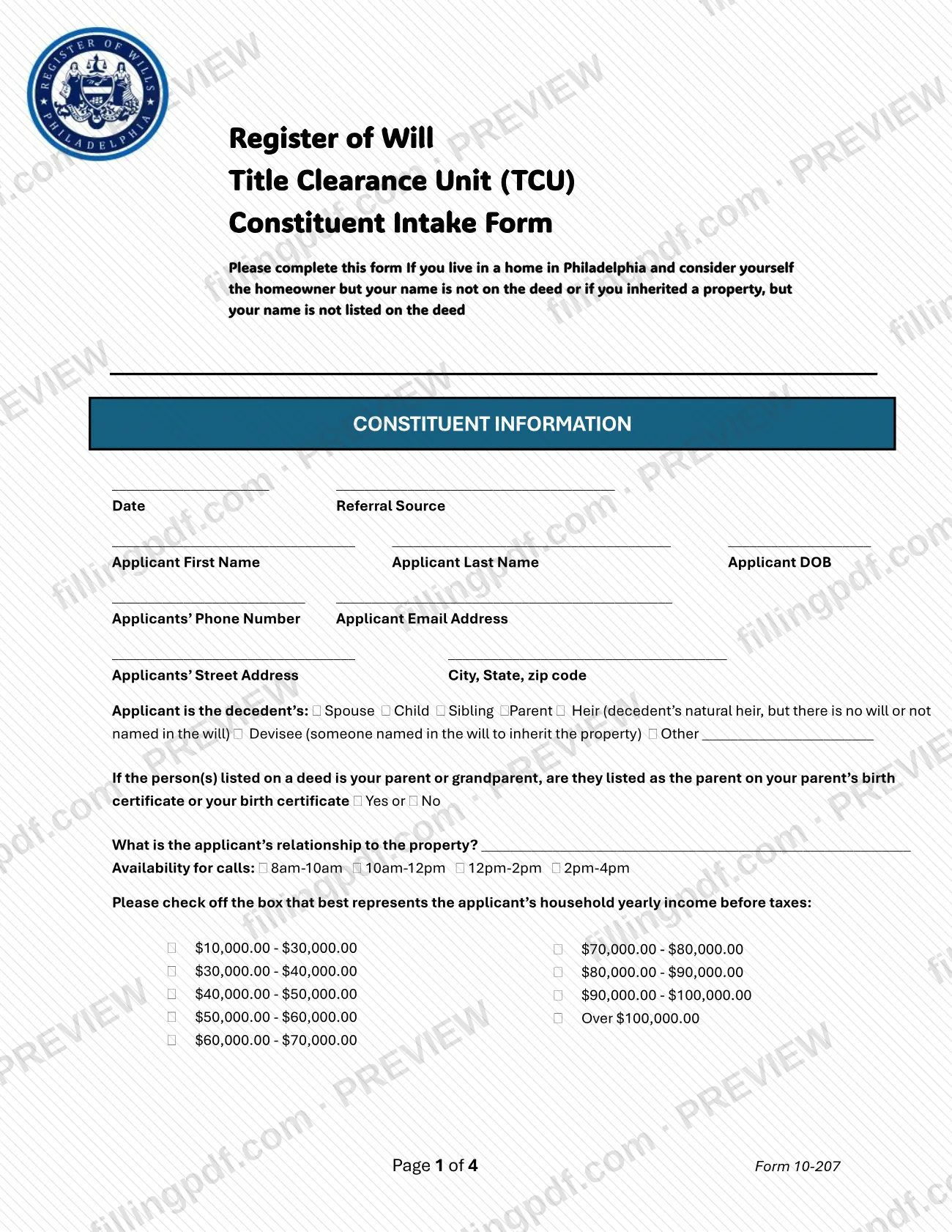
- Constituent Information: the applicant, the applicant's relationship to the decedent and to the property, availability for calls and household income range.
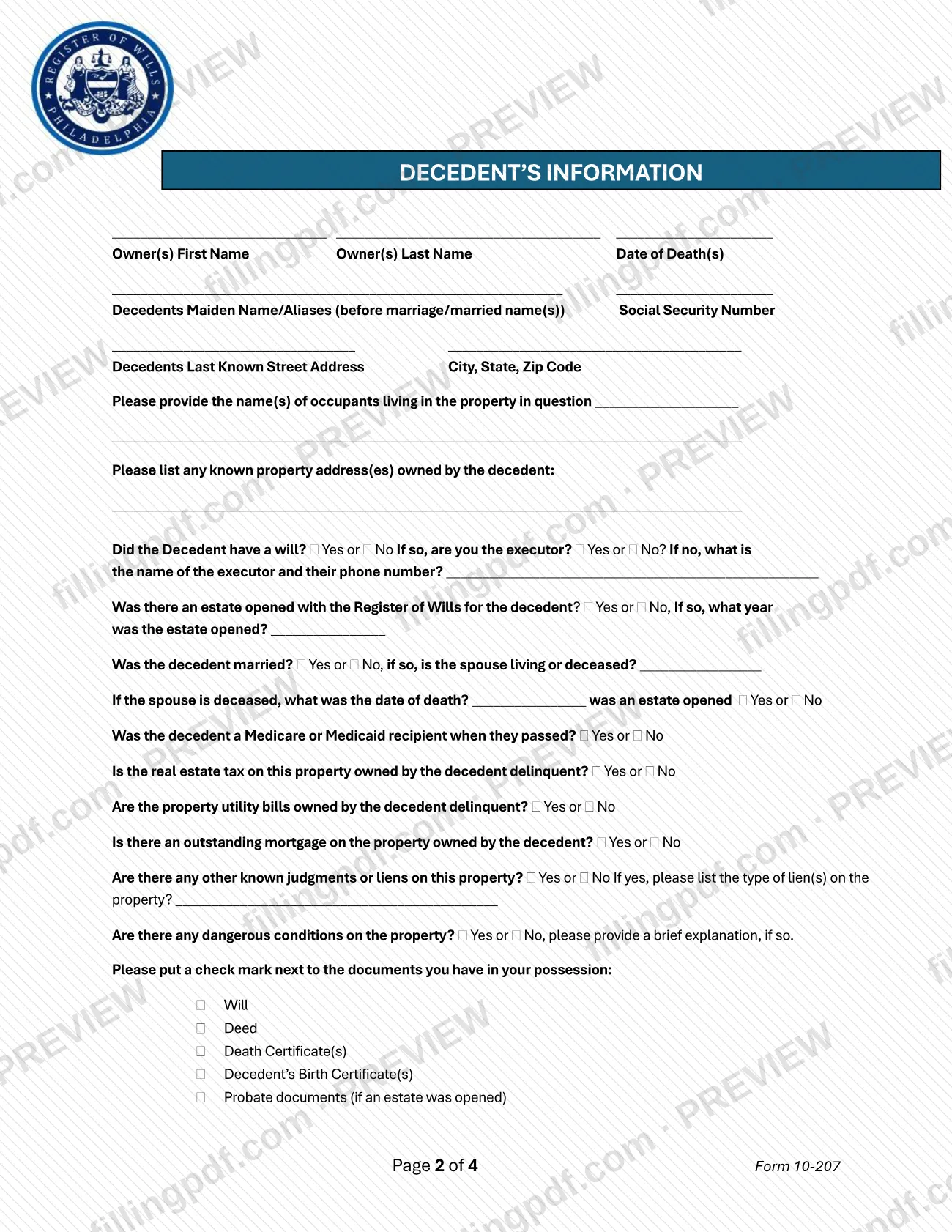
- Decedent's Information: the owner's name, date of death, estate, will, debts, liens and property conditions, plus the documents you hold.
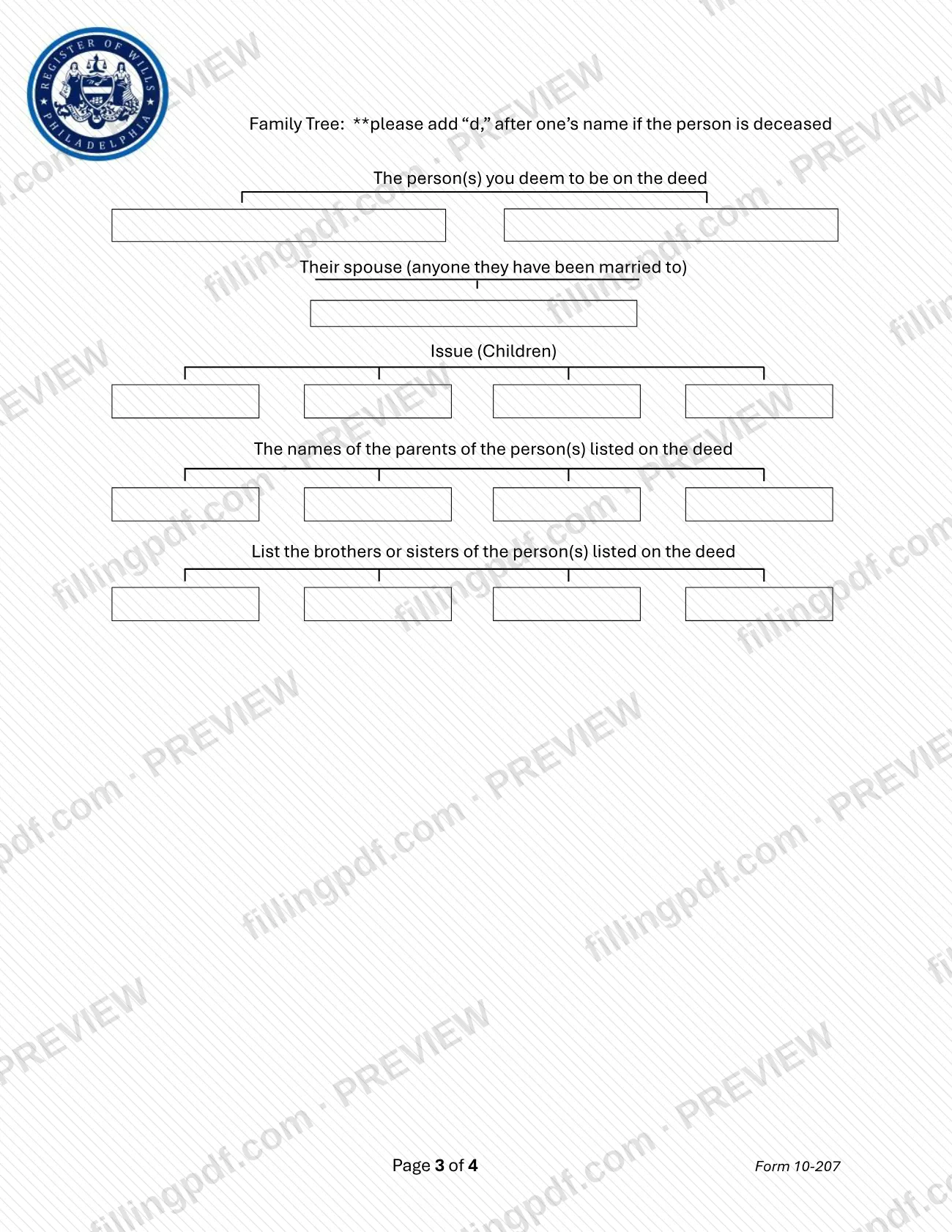
- Family Tree: the person(s) on the deed, their spouses, children, parents and siblings.
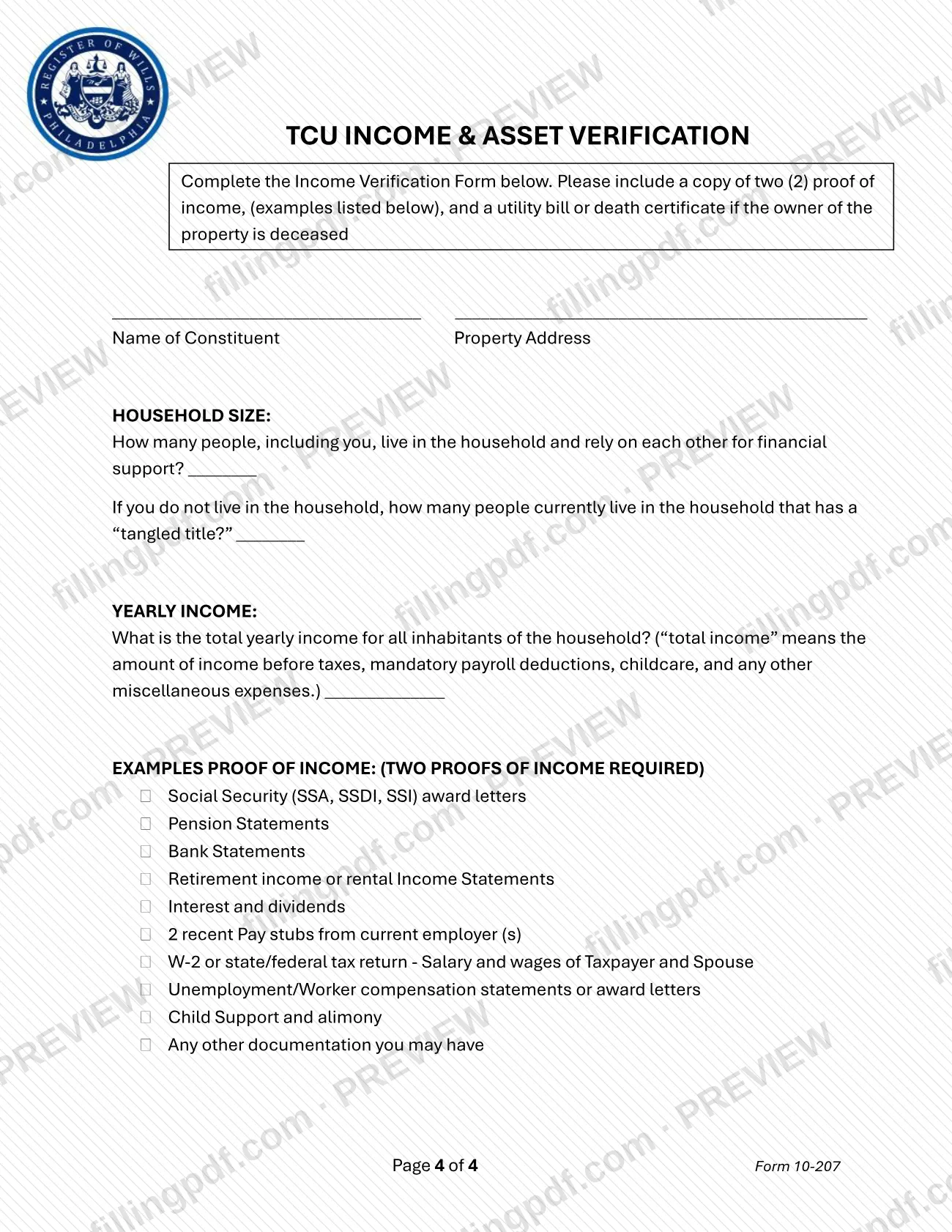
- TCU Income & Asset Verification: household size, yearly income and proof of income.
The agency also offers a digital intake form as an alternative to this PDF. Form 10-207 is not a property tax return or bill, even though one question asks whether the real estate tax on the property is delinquent.
Who needs to file 10-207?
The form is for people who live in a home in Philadelphia and consider themselves the homeowner but whose name is not on the deed, and for people who inherited a property but whose name is not listed on the deed. The Register of Wills page describes the Title Clearance Unit as serving qualified residents.
The applicant states how they relate to the decedent by checking one of these options:
- Spouse
- Child
- Sibling
- Parent
- Heir (the decedent's natural heir, when there is no will or the person is not named in the will)
- Devisee (someone named in the will to inherit the property)
- Other, with a space to write the relationship
The form also asks the applicant to describe their relationship to the property. If the person on the deed is your parent or grandparent, it asks whether they are listed as the parent on your parent's birth certificate or your own.
A person who does not live in the household can still complete the income page: the form asks how many people currently live in the household that has the "tangled title." The form does not describe a representative signing for the applicant.
When to file 10-207
Complete the form when you want the Title Clearance Unit's help clearing the title of a home you live in or inherited and your name is not on the deed. The form prints no deadline and no filing window, and it does not say how long the TCU takes to respond.
Have the supporting papers ready when you fill it out, because page 4 asks you to include two proofs of income, and a utility bill or a death certificate if the owner of the property is deceased. Page 2 also asks which documents you already hold (will, deed, death certificates, decedent's birth certificate(s) and probate documents if an estate was opened), so gather those first.
The form includes a field for the dates of death of the owner(s), and a question asking whether an estate was opened with the Register of Wills and in what year, so look those up before you start.
Documents you need
- Two proofs of income for the household, as page 4 requires. Accepted examples include Social Security (SSA, SSDI, SSI) award letters, pension statements and bank statements.
- Other accepted proofs of income: retirement or rental income statements, interest and dividends, and child support and alimony records.
- Two recent pay stubs from current employer(s), or a W-2 or state/federal tax return showing salary and wages of the taxpayer and spouse, as proof of income.
- Unemployment or worker compensation statements or award letters, or any other documentation you have, as proof of income.
- A utility bill or a death certificate, if the owner of the property is deceased, to accompany the income verification.
- Documents you hold, to check off on page 2: will, deed, death certificate(s), decedent's birth certificate(s) and, if an estate was opened, probate documents.
How to fill out 10-207
Enter the date and referral source
Under Constituent Information, write the date and the referral source in the first two lines.
Enter the applicant's details
Enter the applicant's first name, last name and date of birth, phone number, email address, street address, and city, state and ZIP code.
Describe your relationship to the decedent
Check Spouse, Child, Sibling, Parent, Heir, Devisee or Other (and write it in). Answer the birth certificate question if the person on the deed is your parent or grandparent, then describe your relationship to the property.
Choose call availability and income range
Check the time windows when you can take calls, then check the one box that best matches your household's yearly income before taxes.
Complete the decedent's information
Enter the owner's first and last name, date(s) of death, maiden name or aliases, Social Security number, and last known address. List occupants of the property and any other known property addresses owned by the decedent.
Answer the will, estate and marriage questions
Check Yes or No on whether there was a will, whether you are the executor (and, if not, the executor's name and phone number), whether an estate was opened (and the year), and whether the decedent was married. If the spouse is deceased, add the date of death and whether an estate was opened.
Answer the property condition questions
Check Yes or No on Medicare or Medicaid status, delinquent real estate tax, delinquent utility bills, an outstanding mortgage, other judgments or liens (listing the type if yes), and dangerous conditions (with a brief explanation).
Check the documents you have
Put a check mark next to each document in your possession: will, deed, death certificate(s), decedent's birth certificate(s), and probate documents if an estate was opened.
Build the family tree
On page 3, list the person(s) you deem to be on the deed, their spouses, their children, their parents and their brothers or sisters. Add "d," after the name of anyone who is deceased.
Complete the income and asset verification
On page 4, enter your name and the property address, the household size, and the total yearly income of everyone in the household before taxes and deductions. Check the types of proof of income you are including.
Review and download the completed PDF
Check every page, then download or print the completed PDF from FillingPDF and assemble the two proofs of income and the utility bill or death certificate to go with it.
How to submit 10-207
The form itself prints no mailing address, email address or drop-off location, so check the Register of Wills page for the Title Clearance Unit intake form at https://www.phila.gov/documents/title-clearance-unit-intake-form/ before sending it. The page tells residents to fill out the form to get help with clearing their home's title.
- This PDF: complete all four pages, including the TCU Income & Asset Verification on page 4, and include copies of two proofs of income and a utility bill or death certificate if the owner of the property is deceased.
- Digital intake form: the agency's page says you can use its digital intake form as an alternative to the PDF.
The form asks for your phone number, email address and the time windows when you are available for calls, so enter contact details the TCU can use to reach you. The form mentions no fee. FillingPDF lets you fill out and download the PDF; submission follows the Register of Wills channels described above.
Common mistakes to avoid
- Including only one proof of income; the form states that two proofs of income are required.
- Leaving out the utility bill or death certificate when the owner of the property is deceased.
- Reporting household income after taxes; the form asks for the amount before taxes, mandatory payroll deductions, childcare and other miscellaneous expenses.
- Forgetting to add "d," after the name of a deceased person in the Family Tree section.
- Leaving the income verification page blank because the income range was already checked on page 1.
- Counting people who do not rely on each other for financial support in the household size, or skipping the separate count of people living in the "tangled title" household when you do not live there.
- Checking Yes or No on the estate and spouse questions without writing the requested year, name or date of death.
- Using the form when your name is already on the deed, since it is addressed to residents who are not listed on it.
Frequently asked questions
What is Form 10-207 from the Philadelphia Register of Wills?
Form 10-207 is the Title Clearance Unit (TCU) Constituent Intake Form. Residents of Philadelphia use it to ask the Register of Wills for help when they live in a home or inherited one but their name is not on the deed. The TCU uses the answers to research title issues.
Is Form 10-207 a Philadelphia property tax form?
No. It is a title intake form, not a tax return or bill. It does ask whether the real estate tax on the property owned by the decedent is delinquent, and that answer is one of several facts the Title Clearance Unit collects about the property.
Who should fill out the Title Clearance Unit intake form?
Residents of Philadelphia who live in a home and consider themselves the owner but are not on the deed, or who inherited a property but are not listed on the deed. The form asks whether you are a spouse, child, sibling, parent, heir, devisee or another relation.
What proof of income do I need with the TCU intake form?
Two proofs of income are required, for example Social Security award letters, pension or bank statements, two recent pay stubs, a W-2 or tax return, or unemployment statements. If the owner of the property is deceased, add a utility bill or a death certificate.
Can I fill out the Title Clearance Unit intake form online?
Yes, you can fill out the PDF online on FillingPDF and download or print it. FillingPDF is an independent service and does not send the form to the Register of Wills. The agency also offers its own digital intake form as an alternative.
Where do I send Form 10-207?
The form prints no address or email. The Register of Wills page for the Title Clearance Unit intake form tells residents to fill out the form to get help and offers a digital intake form as an alternative, so use that page for current instructions.
What does the "d," mean in the family tree section?
The form instructs you to add "d," after a person's name if that person is deceased. Use it for every person you list as on the deed, spouses, children, parents and siblings who has died.
Is there a deadline to submit the TCU intake form?
The form prints no deadline. It is an intake form for residents seeking help clearing a home's title, so you complete it when you want that help and have the documents the form asks for.
Ready to fill out 10-207?
Fill out 10-207 now